
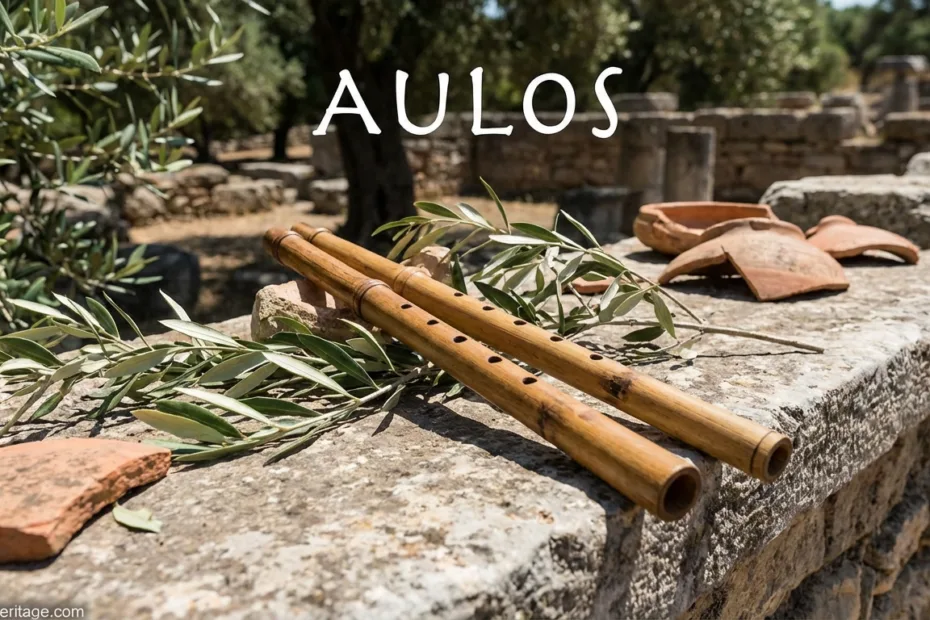
The Aulos was one of the most prominent reed instruments of the ancient Greek and wider Mediterranean world. Usually played as a pair of pipes, it accompanied theater, religious ceremonies, athletic events, military movement, banquets, and professional musical contests. Older translations often call it a “flute,” but its sound was produced by reeds rather than by blowing across an edge. That places its basic sound mechanism closer to reed instruments such as the oboe than to a transverse flute.
Archaeological finds also show that aulos technology travelled far beyond mainland Greece. Instruments, performers, musical theory, and construction knowledge circulated through the Hellenistic and Greco-Roman worlds, reaching places well outside the Aegean. Research published in 2026 on a large group of auloi from the tomb of the Kushite queen Amanishakheto at Meroë provides unusually detailed physical evidence for this movement of musical technology.
| Feature | Details |
|---|---|
| Instrument Family | Reed woodwind |
| Classification | Aerophone, commonly played as a pair of pipes |
| Primary Materials | Cane, bone, wood, ivory and, on later mechanically complex instruments, bronze or other metal fittings |
| Sound Production | Reed vibration, generally associated with double-reed construction in Greek and Roman auloi |
| Mythic Associations | Dionysus, Athena and Marsyas; Apollo appears in the Marsyas contest tradition |
| Key Accessory | Phorbeia, a strap shown on some professional players |
| Historical Range | Ancient Greek, Hellenistic and Roman periods, with many regional and chronological forms |
Not a Flute: How the Aulos Produced Sound
The common translation “double flute” can be misleading. A flute produces sound when an airstream meets a sharp edge. The aulos used reeds, and most familiar Greek forms were played with two pipes at the same time. The Metropolitan Museum of Art describes the aulos as one of the principal instruments of Greek musical life and identifies it as a double-reed instrument. Reference-1✅
That reed mechanism gave the instrument a direct and strongly projecting tone. The exact sound varied with pipe length, bore, reed design, register, tuning, and the skill of the player. Ancient auloi were not one standardized model. Surviving pipes range from relatively simple bone instruments to long Hellenistic and Roman examples equipped with elaborate metal mechanisms.
Key term: a player was called an aulētēs (plural aulētai). Professional players could compete at major festivals, accompany dramatic performances, work at banquets, or perform in religious and civic settings.
Anatomy of the Ancient Pipes
An aulos could look simple from a distance, yet surviving instruments show careful control of bore diameter, finger-hole placement, joints, reed fittings, and, in later examples, mechanical devices. Different periods produced different designs, so terminology and construction details should not be applied identically to every surviving pipe.
1. The Pipe Body
Ancient auloi were made from materials including bone, wood, cane, ivory, and metal-covered composite structures. Bone was well suited to sectional construction because pieces could be drilled and connected with sockets and tenons. Later professional instruments could combine an internal resonator of bone or wood with very thin metal tubing and movable sleeves.
Finger holes determined the basic available pitches, but mechanically developed instruments added ways of opening, closing, or redirecting holes. This allowed professional players to handle more than a simple fixed row of notes.
2. Bulbs, Sockets and Reed Holders
Some surviving auloi preserve shaped components between the main pipe and the reed. Archaeological literature uses terms such as holmos and related names for parts of this upper assembly, although their exact form varies between instruments.
On mechanically complex examples, these sections could include bone components, sockets, metal coverings, and dedicated reed holders. Their function was structural as well as acoustic: they joined the reed assembly securely to the resonating pipe while maintaining an airtight path for the player’s air.
3. The Reeds
The reed was responsible for initiating vibration. Cane such as Arundo donax has long been associated with reed making around the Mediterranean and remains important for modern double reeds. Ancient written sources and experimental reconstruction provide clues about reed preparation, but reed dimensions cannot simply be inferred from a modern oboe reed because surviving auloi vary substantially in bore and register.
Organic reed blades rarely preserve as completely as bone and metal pipe components. Modern players therefore combine measurements from surviving instruments with experimental reed making to determine what designs can produce stable and historically plausible responses.
Why Two Pipes?
The paired pipes allowed an aulētēs to control two lines at once. Surviving instruments and reconstructions indicate that their relationship could be more flexible than a simple “melody plus drone” formula.
- Sustained pitch relationships: one pipe could maintain repeated or stable tones while the other changed.
- Simultaneous melodic movement: both hands could create changing pitches, producing intervals and overlapping lines.
- Different pipe designs: some paired instruments were closely related, while others offered different lower or upper pitch resources.
The exact technique depended on the instrument and repertoire rather than one universal playing system.
The Phorbeia and Breath Control
Ancient images sometimes show aulos players wearing a leather band around the cheeks and head. This is commonly called the phorbeia (Latin capistrum). It appears especially in representations of professional or strenuous performance, although it should not be assumed that every player always used one.
Reed instruments work against resistance, and playing two reeds simultaneously can require controlled pressure. The strap may have helped stabilize the cheeks and embouchure during long or demanding performances. It also provided physical support around the mouth while leaving the hands free to control the two pipes.
Circular breathing is particularly useful for sustaining uninterrupted sound: the player briefly pushes stored air from the mouth while inhaling through the nose, then resumes airflow from the lungs. Related techniques remain common among players of several traditional reed instruments.
Sound, Register and Playing Technique
No single modern reconstruction represents every ancient aulos. Short bone pipes, long mechanically equipped Hellenistic instruments, and Roman-period examples can differ greatly in pitch and response. The shared feature is a reed-driven tone rich in upper partials, capable of carrying clearly in outdoor and theatrical spaces.
- Attack: direct and clearly articulated because the reed begins vibrating as pressure is applied.
- Timbre: can range from bright and penetrating to lower and fuller, depending on pipe dimensions and reed setup.
- Intervals: paired pipes allow simultaneous pitches and changing relationships between the hands.
- Continuous phrasing: circular breathing can extend musical lines without a conventional breathing break.
Ancient descriptions frequently connect aulos playing with movement, emotional intensity, theater, procession, and dance. These associations do not mean that every instrument sounded harsh or extremely loud. Archaeological examples span several sizes and registers, suggesting a broader tonal range than one fixed “piercing” stereotype.
Athena, Marsyas and Apollo
The aulos appears prominently in Greek mythology. One group of stories credits Athena with making or playing the instrument before rejecting it. The satyr Marsyas then acquires the pipes and later competes musically with Apollo.
- Athena
- In several versions, Athena abandons the aulos after seeing how playing changes the appearance of her face. Details differ among ancient authors and later retellings.
- Marsyas
- The satyr becomes closely associated with aulos playing and challenges Apollo to a musical contest.
- Apollo
- Apollo defeats Marsyas in the contest tradition. Some versions involve singing or manipulating the lyre in a way that Marsyas cannot duplicate while blowing his pipes.
- The Punishment
- Marsyas is punished by being flayed. The episode became a frequent subject in ancient and later art. Reference-2✅
The myth has often been interpreted as a contrast between different musical ideals, but ancient Greek attitudes toward the aulos were not uniformly negative. The instrument was deeply embedded in public worship, theater, competition, military movement, and private entertainment.
The Aulos in Greek Social and Public Life
1. Military Movement
The best-known military account comes from Thucydides. During the Battle of Mantinea in 418 BCE, he describes the Lacedaemonians advancing to the music of numerous pipe players. The purpose, in his account, was not to inflame the soldiers but to help the formation move evenly and maintain its order. Reference-3✅
2. The Symposium
Aulos players also worked at the symposium, the Greek drinking gathering. Vase paintings show musicians accompanying entertainment, songs, poetry, games, and dancing. Female professional players, often called aulētrides, appear regularly in visual and literary evidence.
3. Religious Ritual
The aulos accompanied processions, sacrifice, dance, and other acts of worship. Its continuous sound could coordinate movement and establish an audible structure around ritual activity. Its repeated association with Dionysian imagery reflects one part of that religious role, but aulos performance was not limited to Dionysus.
4. Theater and Competition
Aulos accompaniment was closely associated with Greek dramatic performance and choral movement. Professional aulētai also competed at major festivals, including the Pythian Games, where instrumental expertise could bring public recognition.
Pronomos of Thebes
Pronomos, active around the late fifth and early fourth centuries BCE, became one of antiquity’s best-known aulos players. Ancient tradition credited him with an instrument capable of handling several musical harmoniai without requiring the performer to change to a different pair of pipes. Later archaeological instruments with rotating sleeves and mechanical hole-control systems show that ancient makers did develop sophisticated methods for expanding the pitch resources of an aulos.
2026 Meroë Auloi: Greek Instrument Technology at the Kushite Court
A major reassessment published in 2026 broadened the archaeological picture of the aulos far beyond the Greek mainland. The material comes from the tomb of Queen Amanishakheto at ancient Meroë, capital of the Kingdom of Kush in present-day Sudan. The instruments were excavated in 1921 by the Harvard University–Museum of Fine Arts expedition.
The collection was extraordinarily difficult to interpret. The pipes had deteriorated into numerous fragments, and researchers eventually documented more than 200 larger pieces, together with many smaller fragments. A twelve-year research and conservation project led by specialists including Susanne Gänsicke and Stefan Hagel reconstructed the material as twelve individual pipes forming six paired auloi.
🏺 The Meroë Instrument Group
- 12 pipes: interpreted as six paired instruments rather than unrelated fragments.
- More than 200 larger fragments: bone, bronze, wood, and related components had to be recorded and reassembled.
- Several instrument types: the group was not a set of six identical pairs.
- Mechanical systems: rotating sleeves, sliders, controlled tone holes, sockets, and other fittings show highly developed instrument technology.
- Exceptional size: some reconstructed pipes exceed 1.15 metres in length.
The physical construction is particularly informative. Conservation work identified thin bronze tubes around internal resonators made from bone or wood, together with bone bulbs, reed holders, sockets, and mechanical components. Some tubes were so precisely made that moving metal sleeves could open or close selected holes.
One reconstructed mechanism included a rotating ring that changed the relationship between several tone holes. When researchers established its working position, the resulting scale corresponded with pitch relationships described in Hellenistic Greek musical theory. Other holes on the long pipes extended down to notes that correspond with the lowest range described in the Greek theoretical system.
Why Meroë matters: these instruments were found at a Kushite royal site hundreds of kilometres south of the Mediterranean. Their mechanics and pitch organization can nevertheless be explained through Greek musical theory. The evidence points to the movement of performers, instrument technology, theoretical knowledge, or a combination of these between the Mediterranean sphere and the Kushite court.
This does not mean that Kushite musical culture was simply a copy of Greek practice. The archaeological context places imported or transferred technology inside the court culture of Meroë, where it became part of a different political and cultural environment. Researchers have suggested that musicians or instruments may have reached the court from the north, possibly through centres such as Alexandria, while the exact path remains uncertain.
The instruments also demonstrate how advanced late Hellenistic aulos construction had become. A pipe longer than one metre had to be supported by one hand while the thumb remained involved in fingering, placing unusual demands on balance and control. Its length was not decorative: it extended the available pitch range downward and connected directly with the tonal organization reconstructed from ancient theory.
The twelve-year project was presented in the 2026 volume Music from Ancient Meroë: Reconstructing Queen Amanishakheto’s Auloi, edited by Susanne Gänsicke and Stefan Hagel. On 7 October 2026, the Austrian Academy of Sciences summarized the results and their implications for ancient music technology and cultural exchange. Reference-4✅
Reconstructing Ancient Auloi
Surviving pipes provide dimensions, bore profiles, hole positions, joints, and traces of mechanisms, but a playable reconstruction still requires decisions about reed design and setup. Researchers therefore combine archaeological measurement, ancient textual evidence, acoustical modelling, conservation data, and practical playing tests.
The Meroë project shows how much can be learned when conservation and acoustics are studied together. Fragments that appear difficult to position visually can sometimes be tested against bore continuity, mechanical function, hole placement, and possible pitch relationships. A proposed assembly has to make sense as an object and as a playable instrument.
Modern replicas are especially useful for testing physical possibilities. They can show whether a fingering works, whether two pipes balance correctly, what pressure a reed requires, and what pitch range a reconstructed mechanism permits. They cannot recover one exact ancient performance style, because the original reeds, embouchures, repertories, and individual playing habits are not preserved in full.
Frequently Asked Questions
Was the aulos a flute?
No. Although older translations frequently call it a flute, the aulos produced sound through reeds. Greek forms were commonly played as a pair of pipes, making their sound-production system fundamentally different from an edge-blown flute.
Did every aulos use two pipes?
Paired pipes are the best-known form in Greek art and archaeological study, but ancient terminology and instrument types varied. The two pipes could produce simultaneous pitches, repeated tones, or changing lines rather than following one fixed melody-and-drone pattern.
What was the phorbeia used for?
The phorbeia was a strap worn around the cheeks and head by some aulos players. It probably helped stabilize the cheeks and embouchure when maintaining pressure during demanding performances. Ancient imagery does not indicate that every player used one in every setting.
What was found in Queen Amanishakheto’s tomb at Meroë?
Researchers reconstructed more than 200 larger surviving fragments as twelve pipes forming six paired auloi. The instruments combined materials such as bronze, bone, and wood and included advanced mechanical elements for controlling tone holes. Some reconstructed pipes exceed 1.15 metres in length.
Why are the Meroë auloi important for Greek music history?
The reconstructed instruments contain mechanical and acoustic features that correspond closely with Greek musical theory. Their presence at the Kushite royal court also provides physical evidence for the movement of musical technology and knowledge between the Greco-Roman Mediterranean and the Kingdom of Kush.
Do any ancient auloi survive?
Yes. Archaeologists have recovered many sections of ancient pipes made from bone, wood, bronze, and other materials. Preservation varies greatly. The Meroë group is unusually informative because long-term conservation and reconstruction allowed twelve individual pipes to be identified from a large fragmented assemblage.
Could the aulos play more than a simple five- or seven-note scale?
Yes. Some instruments had additional holes or mechanical sleeves that changed which openings were active. Combined with different fingerings and paired-pipe technique, these systems gave skilled players access to a much wider range of pitch relationships than a simple fixed scale suggests.
