
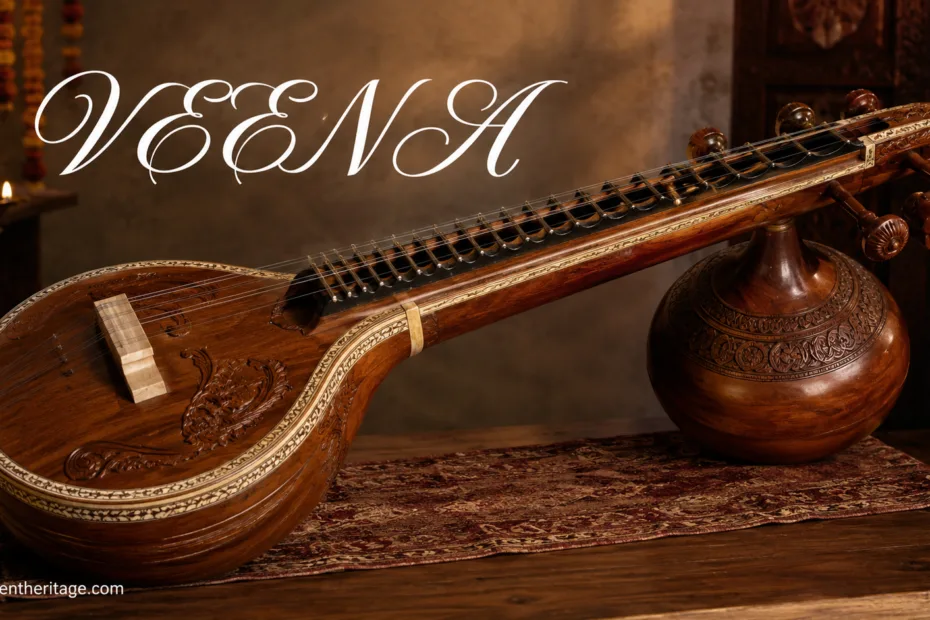
The veena is one of those instruments that feels older than the room it is played in. A single pluck can bloom slowly, bend like a human voice, and leave a soft shimmer behind it. In Indian classical music, the word veena can point to a whole family of string instruments, yet most listeners today think first of the Saraswati veena, the long-necked, fretted lute heard in Carnatic music. It is not just a concert instrument. It is wood, metal, wax, craft memory, sacred image, and musical discipline living in one body.
| Feature | Details |
|---|---|
| Instrument Family | Chordophone; in common use, the Saraswati veena is a plucked fretted lute, while the wider veena family also includes stick zithers and fretless slide forms. |
| Main Tradition | Most strongly linked with Carnatic classical music in South India; related forms also appear in Hindustani and devotional settings. |
| Common String Layout | Usually four main playing strings and three side drone or tala strings, though layouts vary by type and regional school. |
| Frets | Often 24 fixed metal frets on the Saraswati veena, set into a wax-and-resin bed that can be adjusted by skilled makers. |
| Primary Materials | Seasoned jackwood, metal strings, brass or bell-metal frets, wax mixture, bone or synthetic decorative pieces, and a carved resonating body. |
| Sound Character | Warm, rounded, vocal, and gently buzzing; famous for long bends, gamaka ornamentation, and a tone that can feel both earthy and meditative. |
| Sacred Association | Closely associated with Saraswati, the goddess of learning, music, speech, and the arts, which gives the instrument a special cultural place. |
| Related Forms | Rudra veena, chitravina, vichitra veena, Bobbili veena, Thanjavur veena, and other regional or technique-based variants. |
🎼 What Is a Veena?
The safest way to understand the veena is this: veena is both a name and a family name. In everyday conversation, many people use it for the Saraswati veena of South Indian Carnatic music. In older music writing, museum records, and Indian cultural history, vīṇā or vina can describe several Indian string instruments, including older harp-like instruments, stick zithers, long-necked lutes, and later concert instruments.
That is why two veenas may look very different and still belong to the same broad musical family. A Saraswati veena sits across the player’s lap with a large wooden resonator. A rudra veena often has two large gourds and is held at an angle. A vichitra veena is fretless and played with a slide. A chitravina, also called gottuvadyam in older usage, has its own flowing voice and slide technique.
Britannica describes the veena as several stringed instruments of India, including arched harps, stick zithers, and lutes; it also notes the North Indian bin and the South Indian Carnatic veena as distinct forms within that larger family.Reference-1✅
Simple way to hear the difference: the Saraswati veena often feels like a singing wooden lute, while the rudra veena has a slower, deeper, almost meditative gravity. Both are veenas, but they breathe differently.
The Saraswati Veena in Plain Words
The Saraswati veena is the form most closely tied to Carnatic music. It has a long hollow neck, a large resonating body, a smaller support gourd or resonator, raised frets, and metal strings. The player sits on the floor, places the instrument across the lap, plucks with the right hand, and shapes pitch with the left hand.
Its best-known magic is gamaka, the curved movement between notes. On the veena, a note rarely has to stand still. It can lean, stretch, return, tremble, or glide. That is why listeners often compare the instrument to the human voice.
Why the Name Can Confuse New Listeners
A beginner may search for “veena” and see different shapes: one with a dragon-like head, one with two gourds, one that looks almost like a slide instrument, and even modern adaptations. None of this is a mistake. The word has lived for a long time, and it has carried many instruments along the way.
- Saraswati veena: fretted, plucked, central to Carnatic music.
- Rudra veena: North Indian, linked with dhrupad, usually with two large gourds.
- Vichitra veena: fretless, played with a slide in Hindustani music.
- Chitravina: fretless South Indian slide instrument with a smooth, singing tone.
- Bobbili and Thanjavur veenas: regional craft traditions known for local making styles.
🪷 Why the Veena Is Called Sacred
The veena’s sacred place is not only about ceremony. It comes from long habit, visual memory, and sound. In Indian art, the instrument is closely linked with Saraswati, the goddess of learning, music, speech, and the arts. She is often shown holding a veena, which makes the instrument feel like a symbol of knowledge made audible.
For many families, teachers, and performers, the veena is treated with care that goes beyond ordinary maintenance. It may be placed respectfully, touched before practice, or associated with study, discipline, and devotion. This does not mean every veena performance is religious. A concert can be fully musical, technical, and artistic. Still, the instrument carries a cultural glow around it.
Britannica notes that Saraswati is widely revered as a patron of education, music, speech, and the arts, and is typically pictured with her signature veena.Reference-2✅
A Sacred Instrument with a Practical Body
One beautiful thing about the veena is that its sacred image never removes it from the workshop. It is still shaped by chisels. It still needs a good bridge. It still reacts to air, temperature, and string tension. A sacred instrument can also be very physical. The veena proves that easily.
The carved wooden body matters as much as the symbolism. If the resonator is too heavy, the voice can feel dull. If the bridge is not shaped well, the buzz may become harsh. If the frets are badly placed, the raga loses its center. Respect for the veena is also respect for exact craft.
What the Veena Symbolizes
Music: not just melody, but disciplined listening.
Speech: the shaped note, like a shaped word, carries meaning.
Learning: the instrument rewards slow attention.
Craft: every carved curve affects tone, balance, and touch.
🪵 Anatomy of the Saraswati Veena
A Saraswati veena is easy to recognize once you know its main parts. It has a large rounded resonator, a long neck, a row of raised metal frets, a carved head, tuning pegs, a bridge, four main strings, and three side strings. The body often looks grand, but the design is not decoration first. It is a sound machine. A gentle one, but still a machine.
The Met describes a South Indian veena, sometimes called a Saraswati veena, as one of the widely used stringed instruments in the Carnatic classical music tradition and notes that the form is thought to have developed into its current shape roughly 400 years ago.Reference-3✅
The Resonator: Where the Note Opens Up
The large body, often called the kudam, acts like the veena’s chest. When a string is plucked, the vibration passes through the bridge into the wooden body. The cavity gives the sound room to bloom. Good veena tone is not just loud. It has roundness, a steady center, and a soft afterglow.
Jackwood is commonly used because it is workable, resonant, and familiar to regional makers. It can be carved, hollowed, and seasoned into a body that is strong without feeling lifeless. In the hands of a fine maker, the wood is not forced. It is listened to.
The Neck and Frets
The long neck holds the frets and carries the main strings. The frets are usually metal, often brass or bell metal, and they are raised high enough to let the player pull the string sideways. This is vital. Without that pulling space, the veena would lose much of its singing style.
Many Saraswati veenas have 24 frets, which allows the player to move across a wide melodic range. These frets may be set in a dark wax mixture. That bed is not random filler; it lets skilled hands place and adjust frets with care. A tiny shift can change intonation. Small details matter here.
Main Strings and Side Strings
The four main strings run over the frets. They carry the melody and are plucked by the right hand. The three side strings are usually used for rhythmic and drone support. They are often struck with the little finger, adding a bright pulse around the main line.
| Part | Common Name or Role | What It Does |
|---|---|---|
| Large Resonator | Kudam | Gives body, warmth, and depth to the plucked string. |
| Long Neck | Dandi | Holds the frets and supports the main string path. |
| Frets | Metal fret row | Allows fixed pitch points while still permitting wide bends and gamakas. |
| Bridge | Kudirai in many South Indian contexts | Transfers vibration into the body and shapes the veena’s buzzing color. |
| Carved Head | Often a yali form | Adds visual identity and balances tradition with craft style. |
| Side Strings | Tala or drone strings | Add rhythmic sparkle and tonal reference during performance. |
🎶 How the Veena Sounds
The veena has a tone that sits between string, wood, and voice. It can be soft, but not weak. It can be bright, but not sharp. A good note opens with a clear pluck, spreads into the wood, then hangs for a moment like a lamp after the match has gone out.
One reason the instrument feels vocal is the way players bend the string. In many Western fretted instruments, the fret stops the note in a firm place. On the veena, the fret is more like a starting stone in a river. The player can press and pull the string across it, making the pitch curve upward or return slowly.
Gamaka: The Veena’s Singing Gesture
Gamaka is not just ornament. In Carnatic music, it can define the life of a raga. A plain note may be correct on paper, but without the right movement it can sound unfinished. The veena is built for this. Its high frets, string tension, and playing position allow deep bends and subtle pitch shades.
Some gamakas are small and quick. Others are broad, almost elastic. The left hand may pull a string so far that the note seems to rise from one pitch into another without stepping. This is why a veena phrase can sound like a singer shaping a vowel.
The Bridge and the Gentle Buzz
The veena’s bridge gives it a special edge. It is not a clean, glassy string sound. There is often a mild buzz or textured ring, sometimes discussed through the idea of javari. This texture helps the note carry and gives the sound a living surface. Not rough. Alive.
A flat or broad bridge can change how the string vibrates after being plucked. The result is a tone with body and a fine shimmer. Too little contact, and the note may feel plain. Too much, and the sound can become noisy. Makers and repairers work in that narrow middle space.
Rhythm Inside the Tone
The three side strings bring a crisp rhythmic accent. In a Carnatic setting, where tala cycles shape the music, these strings help the player mark pulse and return points. They also add brightness around the main melody, like tiny bells beside a warm voice.
Listen for this: when a veena player moves from one note to another, the beauty is often in the travel, not only the landing. The bend is part of the note’s meaning.
📜 A Short History Without Flattening the Story
The veena’s history is not a straight line from one old object to one present-day object. The name moved through time with different instruments. Older Indian texts and sculpture refer to veena-like instruments, but shapes changed: harps, stick zithers, lutes, and regional forms all appear in the larger story.
By the time we talk about the Saraswati veena now heard in Carnatic music, we are dealing with a developed South Indian concert instrument. Its form is often associated with the Thanjavur region, courtly music culture, temple arts, and hereditary craft communities. The instrument matured through use, not theory alone. Musicians needed pitch range. Makers answered. Musicians needed sustain. Makers adjusted. Musicians needed ornaments that could speak. The body evolved.
The Carnatic Home of the Veena
In Carnatic music, the veena has long been treated as a serious solo instrument. It is also close to vocal music. Many compositions played on the veena come from the same repertoire sung by vocalists: varnams, kritis, ragam-tanam-pallavi forms, devotional songs, and raga explorations.
The instrument suits Carnatic thought because it can hold melody and rhythm together. A player can outline a raga, mark tala, create drone color, and bring out the shape of a composition with one body of wood and strings. That is no small thing.
Rudra Veena and the North Indian Branch
The rudra veena, also called bin in many contexts, belongs more strongly to North Indian classical music, especially dhrupad. It is longer, deeper in sound, and visually different, with large resonating gourds. The musical pace is often spacious. Notes are given room to settle.
Comparing the Saraswati veena and rudra veena is like comparing two old speaking voices. One may move with the carved curves of Carnatic gamaka; the other may unfold with the meditative weight of dhrupad. They are relatives, not copies.
🛠️ Materials, Making, and Regional Craft
A veena begins before the first string is tied. It begins with wood selection, seasoning, carving, hollowing, joining, measuring, fret placement, bridge shaping, polishing, and decoration. The maker has to think like a carpenter, sculptor, acoustician, and musician at once.
In South Indian veena making, jackwood is especially valued. It is not used only because it is traditional. It has a workable grain, a useful strength-to-weight balance, and a tone that can support a warm plucked sound. The wood must be seasoned properly. Fresh wood can move, crack, or lose stability as it dries.
Thanjavur Veena and the Value of Place
Thanjavur is one of the best-known centers of veena craft. The Thanjavur veena, also written Thanjavur Veenai, is registered as a geographical indication in India; the official GI record lists it as registered, with the applicant named as The Thanjavur Musical Instruments Workers Co-operative Cottage Industrial Society Limited.Reference-4✅
This matters because a handmade instrument is not only a product. It is a local knowledge system. Measurements are remembered by hands. Carving choices are passed through families and workshops. The curve of the resonator, the thickness of the top, the placement of the bridge, and the wax bed under the frets all carry the memory of place.
Bobbili Veena and One-Piece Carving
The Bobbili veena, associated with Andhra Pradesh, is another respected craft lineage. WIPO describes the Bobbili veena as traditionally carved from a single piece of jackwood and notes that making one can take up to 25 days. That gives a good sense of the patience behind the instrument, even before the player begins years of practice.Reference-5✅
One-piece construction is often admired because the body and neck come from the same log. This can give structural unity and a special feeling of continuity. It also demands more from the maker. A mistake in carving cannot be hidden easily.
Why Decoration Is Not Just Decoration
The veena often carries carved forms, painted details, inlay work, and a head shaped like a yali, a mythical creature in South Indian art. These details give the instrument its visual dignity. They also remind us that the veena lives between sound and sculpture.
Still, a good maker never lets decoration fight the tone. Too much weight in the wrong place can affect balance. A beautiful veena must still sit correctly, tune cleanly, and speak well under the fingers. Beauty has a job.
What Makers Watch Closely
- Wood age and dryness
- Resonator thickness
- Bridge height and contact
- Fret spacing and wax stability
- Neck balance
- String angle and tension
What Players Feel First
- Comfort across the lap
- Ease of bending notes
- Evenness across frets
- Warmth of the lower strings
- Clarity of side strings
- Steadiness of tuning
🎵 How the Veena Is Played in Indian Classical Music
The veena player sits cross-legged, with the large resonator resting near the right side and the neck extending left. The posture looks calm, but a lot is happening. The right hand plucks. The left hand presses, pulls, slides, and releases. The ear keeps watch over every shade of pitch.
In Carnatic performance, the veena can play composed pieces and improvised passages. A raga may begin slowly, with phrases that reveal its identity one curve at a time. Then the rhythm may grow clearer. The side strings enter with small bright strokes. The composition arrives, and the instrument starts to speak in full sentences.
The Right Hand
The right hand usually plucks the main strings with the index and middle fingers. The little finger may strike the side strings. This creates a built-in conversation between melody and pulse. It is one reason the veena can sound complete on its own.
Good right-hand technique does not simply pluck louder. It shapes attack. A harsh pluck can flatten the beauty of the note. A careful pluck lets the string open naturally. Tone begins at the fingertip.
The Left Hand
The left hand is where the veena becomes vocal. A player presses the string behind or near the fret, then pulls it sideways to raise the pitch. The movement must be controlled, not guessed. Too far and the note overshoots. Too little and the phrase loses its flavor.
This is why the veena can take years to sound relaxed. The instrument is honest. It reveals tension in the hand, weak intonation, and hurried listening. That honesty is part of its charm.
Raga, Tala, and the Veena’s Musical Space
A raga is not just a scale. It is a melodic personality with preferred movements, phrases, and emotional color. The veena is excellent at showing those curves because it can bend and sustain. A tala is the rhythmic cycle. The veena’s side strings help mark that cycle while the main melody moves freely above it.
When both are balanced, the instrument feels steady and alive. The rhythm is the floor. The raga is the body moving across it.
🪕 Veena Compared with Similar Instruments
The veena is often confused with the sitar, tanpura, and other Indian string instruments. The confusion is understandable. They share cultural space, use drone concepts, and may appear in Indian classical settings. Yet their jobs are different.
| Instrument | Main Tradition | Structure | Sound and Role |
|---|---|---|---|
| Saraswati Veena | Carnatic music | Fretted lute with large wooden resonator, 24 frets, main and side strings | Warm, vocal, curved; used for solo performance and classical repertoire. |
| Rudra Veena | Hindustani dhrupad | Long tube or stick zither form with two large gourds | Deep, slow, meditative tone suited to spacious raga development. |
| Sitar | Hindustani music | Long-necked lute with movable frets and sympathetic strings | Bright, ringing, and highly resonant; widely known in global concert settings. |
| Tanpura | Indian classical music | Long-necked drone lute, usually without frets for melody playing | Creates a continuous drone; supports singers and instrumentalists. |
| Chitravina | Carnatic music | Fretless slide instrument | Smooth glides and vocal-like lines, often with a glassy, flowing tone. |
| Sarod | Hindustani music | Fretless lute with metal fingerboard | Deep, clear, sliding tone with strong plucked attack. |
Veena vs Sitar
The sitar has a brighter, more ringing sound, helped by sympathetic strings and a very different bridge setup. The Saraswati veena sounds thicker and more wooden. Its bends feel wide and grounded. If the sitar sparkles like light on water, the veena glows more like polished wood.
Veena vs Tanpura
The tanpura is not mainly a melody instrument. It creates the drone that supports the music. The veena can provide drone touches, but it also carries melody, ornament, rhythm, and composition. A tanpura is the atmosphere. A veena is a speaking voice inside that atmosphere.
Veena vs Chitravina
The chitravina has no frets and is played with a slide. This lets it move between notes with great smoothness. The veena, with frets, has a different kind of articulation. Its notes can be struck, held, bent, and released with a tactile clarity that is very satisfying to hear.
🌿 Why the Veena Still Feels Personal
The veena asks for closeness. It is usually held against the body, not hung from a strap or placed far away. The player feels the vibration through the lap and hand. That physical contact changes the musical experience. You do not only hear the note. You feel a small part of it returning through the wood.
This closeness also shapes the audience experience. Veena music often rewards patient listening. The first few notes may not shout for attention. They invite it. Once the ear settles, the details appear: a bend that rises slowly, a side string that marks the pulse, a low note that opens like a door.
A Craft Instrument in a Digital Age
The veena now appears in concerts, recordings, film music, teaching studios, online lessons, and experimental collaborations. Yet it keeps its handmade identity. Even when amplified, its best sound still depends on wood, bridge, string, hand, and ear.
That is a rare balance. The instrument can travel through speakers and screens, but it still belongs to the bench of the maker and the floor of the practice room.
Why Students Are Drawn to It
Many learners come to the veena because of its sound. Then they discover the discipline behind that sound. It teaches posture, patience, pitch control, rhythmic awareness, and deep listening. It is not an instrument that gives all its beauty away in the first week.
But even early practice has a charm. A single clean note on the veena can feel rewarding. The body answers. The string speaks. The room changes a little.
FAQ About the Veena
Common Questions About the Veena
Is the veena the same as the Saraswati veena?
Not exactly. Veena is a broad family name for several Indian string instruments. The Saraswati veena is the best-known South Indian fretted form used in Carnatic music.
Why is the veena associated with Saraswati?
Saraswati is widely linked with learning, music, speech, and the arts. In many images, she holds a veena, so the instrument became a strong cultural symbol of refined knowledge, disciplined sound, and artistic study.
How many strings does a Saraswati veena have?
A common Saraswati veena layout has seven strings: four main playing strings and three side strings used for drone or rhythmic support. Some related veena types may use different string arrangements.
What is the veena made from?
Many traditional veenas are made from seasoned jackwood, with metal strings, brass or bell-metal frets, a wax mixture for fret setting, and carved decorative parts. The exact materials can vary by region and maker.
Is the veena used in Carnatic or Hindustani music?
The Saraswati veena is strongly tied to Carnatic music in South India. The rudra veena is linked more with Hindustani dhrupad. So the answer depends on which veena type is being discussed.
How is the veena different from the sitar?
The sitar usually has a brighter, more ringing sound and often uses sympathetic strings. The Saraswati veena has a warmer wooden tone, a large resonating body, side drone strings, and a playing style shaped deeply by Carnatic gamakas.
Why does the veena sound close to the human voice?
The raised frets and string tension allow the player to pull notes into curved movements. These bends, called gamakas, let the veena move between pitches in a way that resembles sung ornamentation.
Is the veena hard to learn?
It takes patience, mostly because tone and pitch control are very exposed. A learner must develop steady posture, clean plucking, careful bending, and strong listening. The first clean notes, though, can be deeply satisfying.
What is a Thanjavur veena?
The Thanjavur veena, or Thanjavur Veenai, is a respected South Indian veena craft tradition from Tamil Nadu. It is known for skilled handwork, regional identity, and its registered geographical indication status in India.
Can the veena be used outside classical music?
Yes. While its deepest roots are in Indian classical music, the veena can appear in devotional music, fusion projects, film music, teaching, and solo recordings. Its voice remains most recognizable when the player preserves its curved, vocal character.
