| Feature | What it means | Why it matters to the sound |
|---|---|---|
| Instrument family | Fretless box zither, often grouped with American chord zithers and parlor instruments. | The strings run over a flat soundbox, so the tone is bright, direct, and lightly metallic. |
| Main mechanism | Spring steel hammers strike paired melody strings when pressed by the player. | One touch can make a single note; holding the strip down creates a fast mandolin-like tremolo. |
| Typical melody range | Two diatonic octaves, usually laid out in C major. | Easy for simple tunes, but less flexible for chromatic melodies unless retuned or modified. |
| Chord side | Common sets include C, G, F, and D7 chord groups. | The left hand strums accompaniment while the right hand works the hammer keys. |
| Body and materials | Wooden resonator box, metal strings, metal bridges or pins, spring strips, felt stops, and hammer heads. | The body gives warmth, while the hammer action adds sparkle and a pulsing attack. |
| Best-known maker link | Henry C. Marx designed the hammer attachment; the patent was assigned to the Phonoharp Company. | This places the Marxophone inside the early 20th-century American zither trade, not inside the later bowed-zither line alone. |
| Playing feel | Part zither, part dulcimer, part tiny keyboard. | It rewards a light touch. Heavy hands make the mechanism chatter instead of sing. |
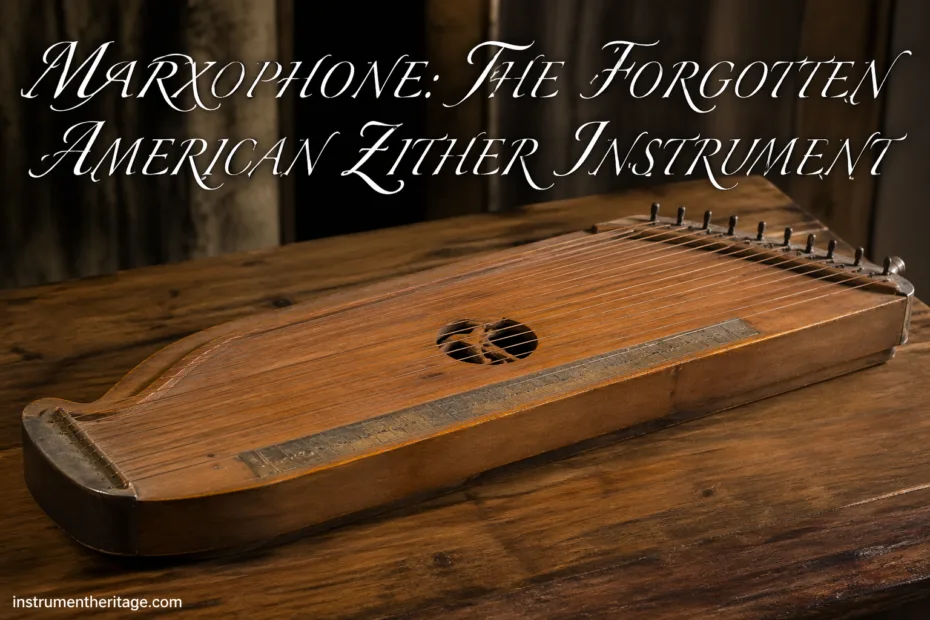
The Marxophone looks like a small wooden box that learned a strange trick. At first glance, it belongs with the old American zithers that once sat in parlors, catalogs, music schools, and family rooms. Then you notice the row of thin metal strips stretched over the melody strings. Press one, and a little hammer jumps. Hold it down, and the note trembles like a mandolin played by a clockwork finger. That is the charm of the Marxophone: a simple-looking American zither instrument with a sound that feels familiar and odd at the same time.
What Is a Marxophone?
The Marxophone is a fretless zither fitted with a row of spring-mounted hammers. The player usually strums chord strings with the left hand and presses metal hammer strips with the right hand. It is not a piano, not a dulcimer, not an autoharp, and not a mandolin. It borrows a little behavior from each of them, then becomes its own peculiar little machine.
Its body is a shallow wooden soundbox. Across that body sit groups of strings: chord strings on one side and melody strings on the other. The melody strings are commonly arranged in pairs, so one hammer can strike two strings tuned together. That paired-string setup is a big part of the Marxophone’s shimmer. A single note does not feel lonely; it arrives with a small silver halo.
🎵 The simplest way to picture it
Imagine a zither soundboard, a mandolin tremolo, and a tiny hammer action sitting in the same wooden case. The Marxophone is where those ideas meet.
The instrument is often described as “forgotten,” but that word needs care. It was never a vanished mystery. Collectors, restoration people, experimental musicians, and recording engineers have kept it alive in small circles. What it lost was everyday recognition. Most listeners have heard similar bright tremolo colors without knowing the name behind the sound.
- Fretless zither
- Spring hammer action
- Paired melody strings
- Chord accompaniment
- American parlor instrument
- Early 1900s design
The American Story Behind the Marxophone
The Marxophone belongs to a period when American instrument makers loved clever hybrids. Catalogs offered guitar-zithers, mandolin harps, autoharps, ukelins, bowed zithers, and other home-music inventions made for people who wanted music without years of formal study. Some were elegant. Some were fussy. Many were both.
Henry C. Marx’s hammer attachment was filed in January 1912 and published in November 1912. The patent names Marx as inventor and lists the Phonoharp Company as assignee, placing the idea in the commercial world of East Boston zither manufacture.Reference-1✅ That detail matters because the Marxophone is often loosely mixed up with later Marx-branded bowed zithers. They share family resemblance and inventor history, yet the hammer-operated Marxophone has its own mechanical identity.
National Music Museum collection records also place Marxophone examples under the Phonoharp Company and related early 20th-century production windows.Reference-2✅ In plain terms: this was not just a homemade curiosity. It was part of a real manufacturing and sales culture around American chord zithers.
Why instruments like this existed
Before recorded music became a constant household presence, home music had a different value. Families wanted playable instruments. Teachers wanted beginner-friendly systems. Sales catalogs wanted objects that looked impressive and promised fast musical results. The Marxophone fit that mood neatly. It gave the player melody, chord backing, and a built-in tremolo effect without frets, bowing, or a piano keyboard.
Oscar Schmidt’s own company history describes an early 1900s trade in guitars, banjos, mandolins, ukuleles, zithers, and Autoharps, with instruments distributed widely in rural areas and small-town shops.Reference-3✅ The Marxophone sits comfortably in that same landscape: practical, portable, a little theatrical, and aimed at music making outside formal concert halls.
Small but telling detail: the Marxophone’s numbered melody system made sense for players who did not read staff notation fluently. It treated music almost like a pattern map. Press this number, strum that chord, follow the line.
How the Hammer System Works
The Marxophone’s heart is the spring hammer mechanism. Each melody note has a strip of spring steel with a small striker at the end. When you press the strip, the hammer head moves toward the string pair. Release it quickly, and you get a single bright note. Keep pressure on it, and the spring vibrates, making the hammer bounce repeatedly.
That bounce is the instrument’s voice. It is not the smooth sustain of a violin or the long bloom of a piano string. It is a rapid, grainy flutter. The sound has little teeth. In a good way.
Single note versus tremolo
A Marxophone can speak in two ways:
- Short tap: the hammer hits once, giving a clear, dry note with a quick decay.
- Held press: the hammer keeps rebounding, creating a tremolo pulse over the paired strings.
- Light pressure change: pressing at a slightly different point on the strip can affect the feel of the bounce.
- Chord strum: the left hand adds harmonic support from the chord groups.
The original patent text describes spring hammers, fingerpieces, a rest, and a stop bar. That stop bar is not decorative. It helps control the spring motion, cushions release, and makes the mechanism more manageable when the instrument is stored. The design is clever because it gives the player a repeat-striking action without keys, levers, or a full piano mechanism.
🔨 Hammer side
The right hand plays the melody. Each strip is like a tiny spring-loaded performer waiting above the string pair.
🎶 Chord side
The left hand strums or plucks grouped strings. This gives the music its simple harmonic bed.
The Sound: Mandolin Sparkle, Dulcimer Ring, Zither Body
The Marxophone’s tone is hard to describe in one clean label. It has the ring of a zither, the quick attack of a hammered dulcimer, and the tremolo shimmer of a mandolin. Yet it is softer than a true hammered dulcimer and stranger than a mandolin because the hammers bounce with a mechanical rhythm.
When the strings are fresh and the instrument is in tune, the sound can feel glassy and tender. When the tuning drifts, it turns ghostly. Not broken, exactly. More like an old music box remembering the tune from another room.
Why paired melody strings matter
Many Marxophones use double melody strings tuned in unison. This is important. Two strings struck together produce a thicker note than one string alone. If the pair is tuned perfectly, the note sounds clean and bright. If the pair is slightly apart, you hear a gentle beating effect: a wave inside the tone. Some players like that soft wobble. Others tune the pairs tightly for a more focused studio sound.
The body adds its own color. A Marxophone does not have the deep air chamber of a guitar or the large soundboard of a piano. Its soundbox is shallow, so it favors clear attack, upper harmonics, and fast decay. That makes it useful in recordings where a small sparkling line needs to sit above guitars, vocals, or soft percussion without taking too much space.
Natural limits of the tuning
The usual melody layout is diatonic, often in C major. That makes many folk melodies and simple songs easy to map. It also means the Marxophone is not naturally built for every key or every chromatic line. A player can retune, adapt the melody, or use the instrument for color rather than full harmonic freedom.
- C major melodies sit naturally under the hammer strips.
- A minor moods can work because they share the same basic notes.
- Chromatic passages require workarounds, retuning, or another instrument.
- Fast repeated notes can sound wonderful because the hammer already wants to tremble.
Materials, Craft, and Ageing
A Marxophone is a simple object only until you look closely. The body is usually a wooden box with a soundboard, bridges, tuning pins, and groups of metal strings. The hammer assembly brings in spring steel, small striker heads, felt or cushioning material, screws, plates, and printed note guides. Every part has a job.
The wood does not merely hold the strings. It shapes the attack. A dry, lightly built soundboard gives the note a quick snap. A heavier body can make the tone feel more muted. Old glue joints, loose braces, tired strings, and worn hammer parts all change the voice. Vintage Marxophones often arrive with one foot in the instrument world and one foot in the conservation world.
Hammer heads and careful handling
Some early hammer designs used lead for the striker material. That was not unusual for its time, but modern owners should treat old hammer heads with care. Avoid sanding, scraping, or creating dust. Wash hands after handling old hardware. If restoration is needed, a qualified repairer or conservator is safer than guesswork.
Practical note: an antique Marxophone should be approached gently. The goal is not to make it look new. The goal is to let the mechanism, strings, and soundboard work without harming the original character.
Common restoration concerns
- Missing strings: old zither strings may be broken, mismatched, or badly corroded.
- Loose tuning pins: the pinblock can lose grip after decades of tension changes.
- Weak hammer bounce: spring strips may be bent, tired, or rubbing against stops.
- Buzzing: loose hardware, dry wood, or uneven string height can create rattles.
- Printed guides: note labels and number charts may be faded but historically useful.
A playable restoration should keep the instrument’s design logic intact. Replace only what must be replaced. Label removed parts. Measure string gauges before changing them. Tune slowly. These little boxes are tougher than they look, but they do not like being rushed.
Numbered Music and the Player’s Experience
The Marxophone was built for approachability. Its numbered note system helped players follow prepared music without reading standard notation in the usual way. The player could match printed numbers to the labeled hammer strips, then combine melody taps with chord strums. It is close to tablature in spirit: less theory first, more action first.
That does not mean the instrument is effortless. The sales language around early home instruments often made playing sound easier than it really was. A Marxophone asks for timing, touch, and patience. Press too hard and the hammers lose grace. Press too weakly and notes may not speak. Strum too loudly and the melody disappears.
What feels natural on a Marxophone
- Simple diatonic tunes
- Slow airs and lullaby-like melodies
- Repeated-note patterns
- Soft tremolo drones
- Chord-and-melody sketches
- Studio textures
- Old parlor repertoire
- Experimental acoustic layers
The best Marxophone playing often leaves space around the notes. Because the instrument has a glittering attack, it does not need crowded arrangements. A few well-placed tremolo tones can say more than a stream of busy notes.
Marxophone and Similar Instruments
The Marxophone makes more sense when placed beside its relatives. It is part of a broad zither family, but its hammer system separates it from the autoharp, concert zither, and bowed-zither hybrids. The differences are not just names. They change how the hands move and how the sound begins.
| Instrument | How it is played | Closest link to the Marxophone | Main difference |
|---|---|---|---|
| Autoharp | Chord bars mute unwanted strings while the player strums. | Both are box zithers made for home music. | The autoharp uses damping bars, not bouncing melody hammers. |
| Hammered dulcimer | Handheld beaters strike open strings. | Both create bright struck-string tones. | The dulcimer uses free hand hammers; the Marxophone uses fixed spring hammers. |
| Mandolin harp | Usually plucked or strummed, often with chord and melody string areas. | The Marxophone patent describes a cithern or mandolin-harp type body. | The Marxophone adds a mechanical tremolo hammer action. |
| Ukelin | Typically bowed on melody strings and plucked or strummed for chords. | Both come from the same home-music invention culture. | The ukelin centers on bowing; the Marxophone centers on hammered tremolo. |
| Concert zither | Plucked with more advanced left-hand and right-hand technique. | Both belong to the zither family. | The concert zither has fretted melody strings and a deeper classical tradition. |
Why the Marxophone still feels different
Many zithers ask the player to pluck. The Marxophone asks the player to press and release. That tiny change creates a different relationship with sound. The note is not pulled from the string; it is set into motion by a bouncing strip of metal. You feel the spring under your finger. The instrument pushes back.
This is why musicians who enjoy unusual acoustic textures still find it useful. The Marxophone can sit between folk instrument, sound effect, and melody machine. It can be sweet. It can be slightly eerie. It can be plain and homely. That range is part of its appeal.
Collecting and Identifying a Marxophone
If you find a Marxophone in a case, attic, shop, or collection, start by looking for the mechanical clues. The row of spring hammers is the giveaway. A label or metal plate may show the Marxophone name, patent number, maker, note letters, or numbers. Some related instruments look similar at a glance, so the hammer system matters more than the outline of the body.
Identification details worth checking
- Name plate or printed panel: look for the Marxophone name, patent number, or maker text.
- Hammer count: melody hammers should align with paired melody strings.
- Chord labels: chord groups may be marked with common home-music chord names.
- Case fit: many were designed as portable instruments, often with shallow cases.
- Instruction sheets: old number-coded music can add context and value for study.
Condition matters, but not only in the usual “shiny versus worn” sense. A Marxophone with faded graphics but an intact hammer rail may be more interesting than a cleaner one with missing mechanical parts. The mechanism is the story. Without it, the instrument becomes just another silent zither box.
- Best first check
- Press each hammer gently and see whether it moves freely without scraping nearby parts.
- Best tuning habit
- Bring strings up slowly, especially on an old body with unknown pinblock condition.
- Best preservation choice
- Keep original labels, note guides, and hardware whenever possible.
- Best playing mindset
- Use touch, not force. The spring does most of the work.
Why Modern Musicians Still Use It
The Marxophone is not common on stage, but it has a useful studio personality. It gives a track a bright moving line without sounding like a standard guitar, piano, or mandolin. Because the tremolo is mechanical, it has a pulse that feels handmade but oddly steady. That makes it good for intros, bridges, background shimmer, and small melodic hooks.
Microphones tend to hear details that the ear may miss in a room: the click of the hammer, the paired-string shimmer, the short wooden resonance after each strike. Some engineers like that. Others tame it with distance, soft room sound, or gentle equalization. The Marxophone does not need much volume. It needs placement.
Where it works well
- Acoustic folk textures: it can add a delicate top layer above guitar or banjo.
- Film and game scoring: its tone suggests memory, motion, and old machinery without needing heavy processing.
- Experimental music: the hammer rail invites prepared techniques, drones, and close-mic detail.
- Songwriting demos: simple chord-and-melody patterns can spark ideas quickly.
It is also a reminder that “obsolete” instruments are not useless. Some simply wait for a new ear. The Marxophone’s old design can still solve a modern musical problem: how to make a small line sound alive, textured, and slightly outside the ordinary.
Marxophone FAQ
Common questions about the Marxophone
Is the Marxophone a zither?
Yes. The Marxophone is a fretless box zither with chord strings and paired melody strings. Its special feature is the spring-mounted hammer system used to play the melody notes.
Who invented the Marxophone?
The hammer attachment associated with the Marxophone was invented by Henry C. Marx. The 1912 patent record lists the Phonoharp Company as assignee.
How does a Marxophone make sound?
The right hand presses spring steel strips that carry small hammer heads. These hammers strike paired melody strings. A short press makes a single note, while holding the strip down creates a repeated tremolo effect.
Is a Marxophone the same as an autoharp?
No. Both are related to the zither family, but an autoharp uses chord bars with dampers, while a Marxophone uses spring hammers for melody notes and separate chord strings for accompaniment.
Can a Marxophone play in every key?
Not easily. Most Marxophones are arranged around a diatonic melody scale, often C major. They can handle related modes and simple tunes well, but chromatic music usually needs retuning, adaptation, or another instrument.
Are old Marxophones safe to restore?
They can be restored, but old hammer materials and fragile parts deserve care. Avoid sanding or scraping antique hammer heads, tune slowly, and seek help from a repairer familiar with vintage zithers when the mechanism is damaged.
