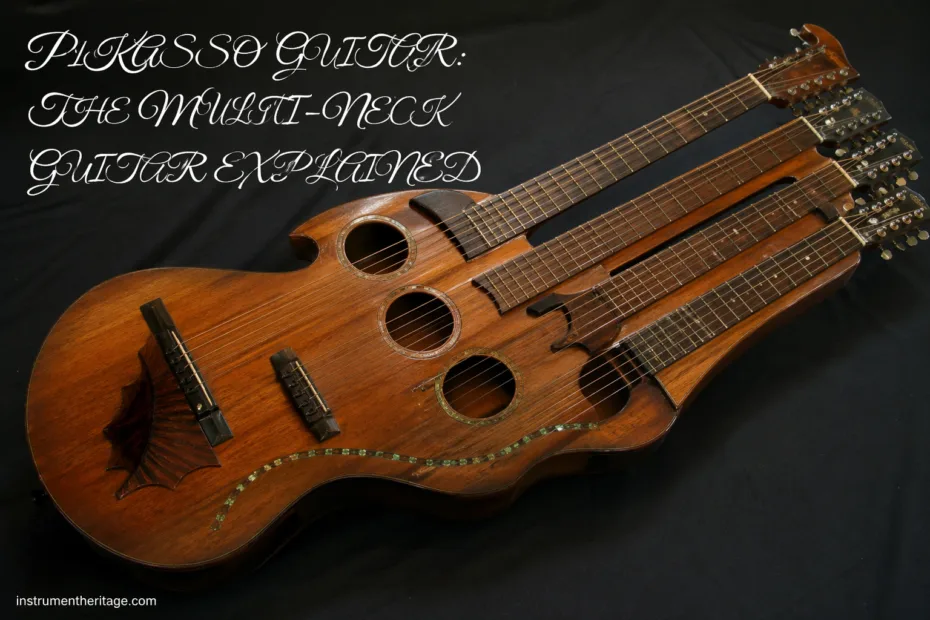
The Pikasso Guitar looks as if a luthier took several acoustic guitars, a harp guitar, and a small studio full of ideas, then asked them all to share one body. It is a 42-string custom acoustic guitar built by Canadian luthier Linda Manzer for guitarist Pat Metheny in 1984. Strange shape? Yes. Random object? Not at all. Every neck, sound hole, string bank, pickup, access door, and body angle has a job.
| Feature | Detail |
|---|---|
| Instrument type | Custom multi-neck acoustic guitar with harp-guitar and extended-string ideas built into one body |
| Builder | Linda Manzer, Canadian luthier known for archtop, flattop, harp, and custom acoustic guitars |
| Player associated with it | Pat Metheny, who asked for a guitar with “as many strings as possible” |
| Year | 1984 |
| String count | 42 strings, arranged across several playable string sections |
| Neck layout | The maker lists four necks; some short summaries describe it differently because the string banks are not laid out like normal guitar necks |
| Body features | Two sound holes, two access doors, stand-mounting brass insets, and the early form of Manzer’s Wedge body shape |
| Main woods and parts | Indian rosewood back and sides, German spruce top, mahogany necks, ebony fingerboards and bridges, abalone trim, boxwood, rosewood, and brass mounting parts |
| Electronics | Piezo pickup system plus a hexaphonic pickup on the six-string section for synth control |
| Weight and load | About 6.7 kg; the tuned strings place roughly 1000 lb of pressure on the instrument |
| Best-known sound use | Layered acoustic resonance, ringing sympathetic strings, harp-like bass, melodic guitar lines, and percussive attacks |
What Is the Pikasso Guitar?
The Pikasso Guitar is a multi-neck acoustic guitar, but that phrase barely covers it. A double-neck guitar usually gives a player two familiar instruments in one frame, such as a six-string and a twelve-string. The Pikasso goes much further. It combines a standard fretted guitar section, extra string banks, harp-like bass strings, and shimmering sympathetic possibilities into a single wooden body.
It was not built to be a stage prop. That matters. Its unusual shape came from a practical musical request: Pat Metheny wanted more strings, more register, more color, and more ways to make one acoustic instrument behave like a small ensemble. Linda Manzer’s answer was not “make it bigger and hope.” She had to solve tension, balance, access, projection, comfort, tuning, and amplification at once.
On a normal steel-string acoustic guitar, the player thinks in six courses of strings. On the Pikasso, the player has to think in zones. One area behaves like a familiar guitar. Another works more like a harp guitar. Another adds high ringing colors. The instrument invites both fretted playing and open-string orchestration. Touch one note and the body answers with a cloud of nearby resonance.
🎸 A useful way to picture it: the Pikasso is not “four guitars glued together.” It is closer to a small acoustic soundboard orchestra arranged around one performer’s hands.
The 1984 Commission: Pat Metheny and Linda Manzer
Linda Manzer built the original Pikasso for Pat Metheny in 1984. According to Manzer’s own account, Metheny asked for a guitar with “as many strings as possible,” and the final instrument became a 42-string custom guitar with four necks, two sound holes, special access doors, piezo electronics, a hexaphonic pickup, and brass mounting insets for a stand.Reference-1✅
That request sounds playful, but for a builder it is a serious puzzle. More strings mean more pull. More necks mean more wood, more glue joints, more angles, more places where the structure can fight itself. The top still has to vibrate. The guitar still has to stay in tune. The player still needs to reach the notes without feeling as if he is wrestling furniture.
Manzer was not coming from factory guitar design. She was working as a hand-builder, the kind of luthier who listens to a player’s body and musical habits before committing to a shape. That relationship matters here. The Pikasso did not come from a catalogue. It came from a musician asking for a sound that did not yet have a standard form.
Linda Manzer’s background also helps explain why the instrument works as more than a curiosity. She is widely associated with custom acoustic guitars, archtops, flattops, harp guitars, and unusual multi-string builds; her career is tied closely to player-specific instruments rather than mass production.Reference-2✅
Why the name “Pikasso”?
The name points toward the visual language of Picasso, especially the fractured guitar forms found in his early twentieth-century constructions and paintings. MoMA’s exhibition record for Picasso: Guitars 1912–1914 notes Picasso’s use of cardboard, paper, string, wire, and sheet metal in guitar-related works from that period.Reference-3✅
The spelling “Pikasso” belongs to the instrument. It is not a museum replica, and it is not an art object pretending to be a guitar. The name fits because the body looks rearranged from familiar parts: necks jutting at unexpected angles, string paths crossing the eye, curves and planes stacked like a wooden collage. Then you hear it, and the joke disappears. It plays.
How the Pikasso Guitar Is Built 🪵
The material list reads like a careful acoustic recipe rather than a decoration plan: Indian rosewood for the back and sides, German spruce for the top, mahogany for the necks, ebony for fingerboards and bridges, plus abalone, boxwood, rosewood, and brass parts. These materials are familiar to luthiers, but the job they perform here is not ordinary.
Spruce is used for the top because a good acoustic soundboard needs a rare mix of stiffness and lightness. It must resist string tension, yet move easily enough to turn vibration into sound. Rosewood back and sides tend to support a broad overtone field, which suits an instrument full of open strings. Ebony gives hard, stable contact surfaces under fingers and strings. Mahogany necks bring strength without unnecessary bulk.
Now add the problem: 42 tuned strings. A normal acoustic guitar already lives under heavy tension. The Pikasso, when tuned to pitch, carries roughly 1000 pounds of pressure. That is not just a number. It changes everything: bracing, bridge design, neck reinforcement, glue surface, body depth, and even where the player can safely rest the instrument.
The body is a sound chamber, not just a container
With many multi-neck instruments, the body risks becoming a heavy plank. The Pikasso avoids that feeling by staying rooted in acoustic guitar logic. The top must breathe. The back and sides must hold shape. The air cavity must support low-end response without turning the instrument muddy.
The two sound holes help the large body release sound from different parts of the top. They also make visual sense on a body where string banks occupy unusual space. A single central sound hole would not serve the layout as naturally. On the Pikasso, everything is spread wider, like a table set for several courses of sound.
Small construction details with big jobs
- Two access doors allow the builder and technician to reach inside areas that would be difficult to service on a body this complex.
- Brass insets help mount the instrument on a stand, so the player does not have to support the whole weight by hand.
- Ebony bridges and fingerboards provide hard, stable contact points across several string areas.
- Multiple neck joints and string paths require very careful angle planning, because small errors would become large playing problems.
The Wedge: A Comfort Idea Born from a 42-String Problem
One of the most useful ideas to come out of the Pikasso project is Manzer’s Wedge body design. The body tapers so the side under the player’s arm is thinner, while the side toward the knee is deeper. This tilts the top slightly back toward the player, giving better visual access to the strings while keeping body volume for sound.Reference-4✅
That may sound modest until you imagine sitting behind the Pikasso. With a flat, deep body, the player would look down and see a maze. Some strings would hide behind other strings. The right arm would sit too high. The body would feel like a box fighting the musician.
The Wedge changes the viewing angle. It gives the hands a map. It also makes the instrument less punishing to hold, which matters when the guitar weighs around 6.7 kg. Comfort is not a luxury here; it is part of the instrument’s musical function.
🧰 The clever part is that the Wedge was not created as a visual trick. It came from a plain luthier’s question: How can the player see and reach this many strings without losing acoustic body volume?
The Neck and String Layout
The Pikasso is often described with different neck counts. The safest figure is the builder’s own: four necks. The confusion is understandable because the instrument does not behave like four ordinary guitars placed side by side. Some sections are fretted, some act more like open harp strings, and some are arranged for color rather than familiar chord shapes.
For a player, the layout is less about counting necks and more about learning territory. The standard guitar area gives familiar fretted control. Other strings add open bass notes, drones, bright upper colors, and ringing sympathetic textures. The whole instrument becomes a map of register and resonance.
Why so many strings?
Extra strings do three main things. First, they extend range. A player can reach low notes and high colors without constantly shifting position. Second, they add resonance. Open strings vibrate with played notes, giving the sound a glow around the edge. Third, they create arrangement options. A guitarist can set up bass, harmony, melody, and texture without needing another player to cover each role.
The tradeoff is obvious: more strings mean more tuning work, more physical distance, and more mental load. The Pikasso asks the player to think like a guitarist, harpist, arranger, and percussionist at the same time. Not easy. But the reward is a sound that does not fit inside a normal six-string vocabulary.
| String area | Closest familiar idea | Musical role |
|---|---|---|
| Fretted guitar section | Steel-string acoustic guitar | Melody, chord shapes, bends, slides, and familiar left-hand phrasing |
| Lower open strings | Harp guitar bass strings | Bass pedals, drones, low anchors, and open resonance |
| Higher auxiliary strings | Zither or sympathetic-string color | Bright ringing textures, shimmer, and harmonic air |
| Cross-body string zones | Custom extended-range lutherie | Layered sounds that let one player imply several parts at once |
What Does the Pikasso Guitar Sound Like? 🔊
The sound is not simply “big guitar.” It has a wide acoustic field, with low strings that can bloom under the melody and upper strings that sparkle around it. A normal acoustic guitar gives you a focused voice. The Pikasso gives you a roomful of related voices, all coming from one wooden body.
There is also a lovely looseness to its resonance. When open strings answer a fretted note, the sound feels alive in a way that is hard to fake with studio layering. Some notes arrive clearly. Others hover. The ear hears attack, then halo.
The piezo pickup system helps capture the many string areas for performance, while the hexaphonic pickup on the six-string section gives access to synth control. That means the Pikasso can live in two worlds: physical acoustic wood and expanded electronic color. For Pat Metheny, that pairing makes sense. His playing has long moved between natural guitar tone, processed textures, and orchestral thinking.
The acoustic character
- Low end: broad, harp-like, and useful for bass pedals.
- Middle range: warm enough for guitar voicings, but surrounded by extra resonance.
- High strings: clear, glassy, and often used for shimmer or bell-like response.
- Attack: can be gentle and rounded, or sharp and percussive depending on the touch.
- Sustain: shaped by open strings, body size, and sympathetic vibration.
The word sympathetic is useful here. It means a string can vibrate because another note nearby excites it. You play one note; another string quietly agrees. On the Pikasso, that agreement can happen all over the body.
Playing the Pikasso: More Like Navigation Than Normal Guitar Practice
A guitarist approaching the Pikasso for the first time would not simply run normal scale patterns across it. The instrument asks for a different kind of hand planning. Where is the bass? Which open strings are tuned to useful notes? Which strings should ring, and which should be muted? How does the right hand move from a plucked melody to a brushed chord to a harp-like bass note?
That last question matters. On a six-string guitar, muting is already part of tone. On the Pikasso, muting becomes even more important because a forest of open strings can turn beautiful resonance into blur. The player has to choose what gets to ring. Silence becomes a tool.
Left-hand demands
- Finding fretted notes without being distracted by nearby string banks
- Using familiar guitar shapes only where they make sense
- Letting open strings carry part of the harmony
- Moving slowly enough for the instrument’s sustain to speak
Right-hand demands
- Plucking across different string planes
- Controlling bass, melody, and color strings separately
- Muting extra resonance when the harmony changes
- Using touch to keep the sound clear instead of crowded
In the hands of the right player, the Pikasso can make one musician sound surrounded by reflections. Not louder. Wider.
Why the Pikasso Is Not Just a Novelty Instrument
Unusual instruments often get reduced to their strangest number: 42 strings, four necks, two sound holes, 1000 pounds of tension. Those numbers are useful, but they can also hide the musical point. The Pikasso works because it gives a player access to range, resonance, and orchestration in a way a normal guitar cannot.
It also belongs to a real family of instrument-making ideas. Harp guitars have existed in many forms, usually adding unstopped bass strings beside a standard guitar neck. Multi-neck guitars have served practical stage needs for players who want different tunings or string sets. Sympathetic-string instruments, from the sitar to the viola d’amore, use extra strings to create a glowing response around the main notes.
The Pikasso gathers those ideas, then bends them into a single custom voice. That is why it has stayed interesting. A novelty wears off after the first photograph. A playable instrument keeps giving musicians questions to answer.
Materials and Tone: Why These Woods Make Sense
A guitar with this many strings cannot rely on exotic shape alone. The wood choices have to serve the sound. German spruce is a natural choice for the top because it can be light, stiff, and responsive. On an instrument with many string inputs, the top needs to handle energy without becoming sluggish.
Indian rosewood back and sides help give depth and overtone color. Rosewood often supports a broad, ringing voice, which suits an instrument where open strings and sustained tones are part of the design. Mahogany necks bring dependable strength and workability. Ebony fingerboards and bridges offer hardness at the contact points, where wear and pressure are constant.
The decorative materials also sit inside a craft tradition. Abalone, boxwood, and rosewood trim do not make the instrument play better by themselves, but they show the hand-built nature of the piece. On a guitar this unusual, ornament can easily become noise. Here it works best when it frames the structure rather than competing with it.
Electronics: Acoustic Body, Expanded Control
The Pikasso is an acoustic instrument, but it was made for a player who knows how to use electronics musically. The piezo system helps translate string vibration for performance settings. A normal microphone alone would struggle with this much body area, this many string sources, and the practical needs of live sound.
The hexaphonic pickup on the six-string section is especially interesting. A hexaphonic system senses individual strings separately instead of treating the guitar as one blended signal. That allows more detailed tracking for synthesis and processing. In plain words: the fretted guitar area can speak to electronic sound systems while the rest of the instrument keeps its acoustic personality.
This is one reason the Pikasso feels connected to Pat Metheny’s broader musical language. It can be intimate and wooden, then suddenly become part of a larger texture. It is not trapped in one color.
Similar Instruments and How the Pikasso Compares
The Pikasso makes more sense when placed beside related instruments. It is unusual, but it did not appear from nowhere. It sits near the harp guitar, the multi-neck guitar, the extended-range acoustic guitar, and instruments that use extra ringing strings for color.
| Instrument | Shared idea | How it differs from the Pikasso |
|---|---|---|
| Harp guitar | Extra open bass or treble strings beside a guitar neck | Usually simpler, with fewer string zones and a less sculptural body layout |
| Double-neck guitar | Multiple necks on one body | Often combines two familiar guitars, while the Pikasso creates a wider acoustic system |
| 12-string guitar | Added strings for shimmer and fullness | Uses paired courses; the Pikasso spreads strings into separate musical areas |
| Sitar guitar | Bright string color and drone-like textures | The Pikasso is broader in range and built around several guitar-family functions |
| Zither or autoharp | Open strings over a resonant body | The Pikasso keeps fretted guitar technique at the center while borrowing some open-string logic |
The closest relative is probably the harp guitar, because both instruments use extra strings to widen the guitar’s range. Still, the Pikasso is more complex than most harp guitars. It is less like adding a porch to a house and more like designing the whole house around several entrances.
Tuning, Tension, and Care
A 42-string guitar is not casual to tune. Each string is a small mechanical promise: pitch, tension, contact point, and speaking length must all cooperate. When there are 42 of them, tiny problems multiply. The necks, bridges, top, and internal bracing must carry the pull without choking the sound.
Humidity control also becomes more than a nice habit. Wood moves. Spruce and rosewood react to dry air and moisture. On a normal acoustic guitar, poor humidity can cause sharp fret ends, top sinking, cracks, bridge lift, or tuning instability. On the Pikasso, the same risks are spread across a far more complex structure.
What a technician would watch closely
- Top movement under the combined load of many strings
- Bridge stability and clean string break angles
- Neck alignment across the different playing sections
- Pickup balance between string zones
- Tuning drift caused by temperature, humidity, or string changes
- Stand-mount hardware and brass inset security
This is not the kind of instrument most players would leave on a couch. It belongs on a proper stand, in a stable room, with careful tuning and patient handling. It asks for respect in the same way a rare cello or concert harp does.
Why the Pikasso Still Holds Attention
The Pikasso keeps attracting guitar lovers because it touches several kinds of curiosity at once. Builders see a structural challenge. Players see a new map for the hands. Listeners hear a guitar that can bloom into harp, drone, chord, melody, and texture. Instrument historians see a modern custom build that belongs to a longer story of expanded strings and player-led invention.
Its shape is easy to remember, but the deeper fascination is practical. It solved problems that only appear when a musician asks for something outside the normal menu. How many strings can an acoustic guitar carry before it stops being playable? How can a player see them? How can a soundboard respond under that much tension? How do electronics help without replacing the wooden voice?
The Pikasso answers with wood, string, brass, angle, and touch. No single part explains it. The magic is in the negotiation between them.
Common Misunderstandings About the Pikasso Guitar
- “Is it just a weird-looking guitar?”
- No. The shape follows musical and ergonomic needs: string access, body volume, playing angle, tuning layout, and live sound control.
- “Is it a normal guitar with extra necks?”
- Not really. It includes familiar guitar technique, but the open string banks and resonance areas change how the player thinks.
- “Is it only acoustic?”
- It has a real acoustic body and voice, but it also uses pickups for performance and expanded tone control.
- “Why do some sources say three necks and others say four?”
- The layout is unusual enough that short descriptions vary. The maker’s own specification lists four necks.
- “Can it be mass-produced?”
- In theory, a company could make a multi-neck guitar inspired by it. In practice, the Pikasso is a custom luthier-built instrument shaped around one player’s request.
What the Pikasso Teaches About Instrument Making
The Pikasso Guitar teaches a simple lesson: new instruments usually begin with a player’s need, not with a drawing board fantasy. Pat Metheny wanted more strings and more sound possibilities. Linda Manzer translated that wish into a playable object. The result looks wild because the request was wild, but the craft underneath is calm and exact.
A good luthier does not only ask, “Can this be built?” The better question is, “Can this be played, heard, tuned, repaired, and loved?” The Pikasso clears that harder test. It has traveled through recordings and performances because it gives real music back to the player.
That is the difference between an odd object and an instrument. One is looked at. The other keeps asking to be played.
FAQ
How many strings does the Pikasso Guitar have?
The Pikasso Guitar has 42 strings. They are arranged across several playing areas rather than one normal guitar neck.
Who built the Pikasso Guitar?
It was built by Canadian luthier Linda Manzer for guitarist Pat Metheny in 1984.
Why is it called the Pikasso Guitar?
The name refers to its fractured, sculptural look, which visually recalls Picasso’s guitar-related artworks and Cubist forms. The spelling “Pikasso” is the instrument’s own name.
Is the Pikasso Guitar playable or just decorative?
It is fully playable. Its unusual form supports real musical functions: extended range, open-string resonance, harp-like basses, fretted melody, and electronic pickup control.
What woods are used in the Pikasso Guitar?
The original instrument uses Indian rosewood back and sides, a German spruce top, mahogany necks, ebony fingerboards and bridges, plus decorative and structural materials such as abalone, boxwood, rosewood, and brass.
What is the Wedge body on the Pikasso Guitar?
The Wedge is a tapered body design created by Linda Manzer. It makes the strings easier to see, improves arm comfort, and helps keep useful body volume for acoustic response.
Is the Pikasso Guitar related to a harp guitar?
Yes, it shares ideas with harp guitars, especially the use of extra open strings. The Pikasso is more complex because it combines several string zones, multiple necks, acoustic resonance, and pickup systems in one custom body.
