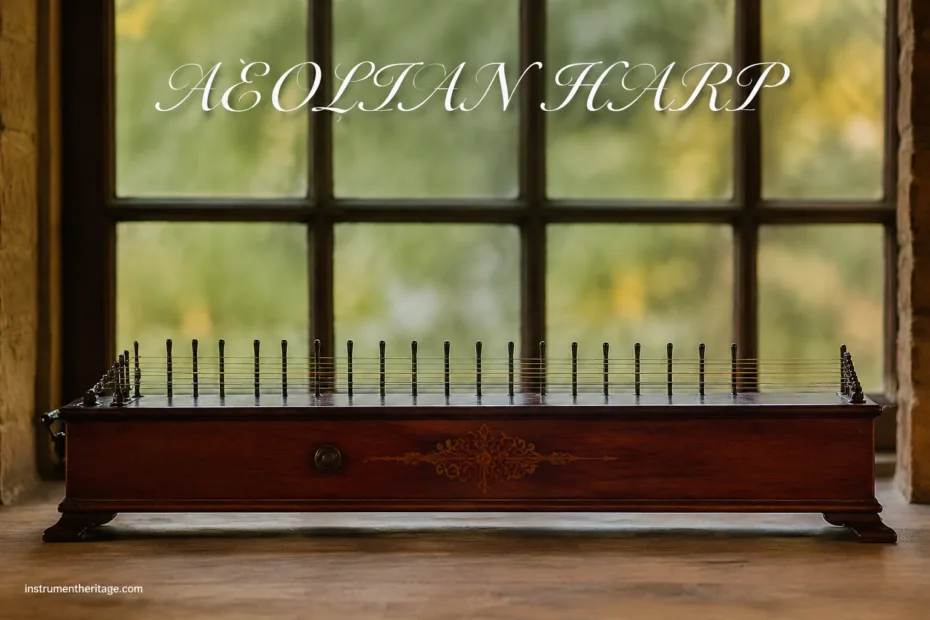
An Aeolian harp produces music without fingers, a bow, hammers, or a mechanical player. Air moving across its stretched strings supplies the energy. Under the right conditions, those strings begin vibrating in particular modes and the resonating body makes the motion audible. The result is a wind-played string instrument whose pitch content, volume, and timing can change with the airflow.
The name suggests a conventional harp, yet its construction tells a different story. Historic examples usually have strings stretched lengthwise over a shallow box, much closer to the layout of a zither than a concert harp. That distinction matters because it explains both how the instrument is built and why museums may classify it as a wind-activated zither.
| Feature | Aeolian harp |
|---|---|
| Instrument type | Wind-activated chordophone; historic museum examples are classified as zither-blown instruments |
| Other names | Wind harp; Eolian harp is an alternate spelling |
| Sound source | Moving air interacting with tensioned strings |
| Typical historic form | Long wooden resonating box, parallel strings, bridges, tuning pins, and sometimes a lid or air-directing top |
| Historic string material | Gut is documented on surviving examples; later and experimental instruments may use metal, synthetic line, or other string materials |
| Common acoustic behavior | Sustained tones with strongly audible upper harmonics rather than ordinary plucked-string attacks |
| Tuning | Many historic household designs used strings tuned alike but with different diameters; this is not a rule for every Aeolian harp ever made |
| Human control | The maker controls string length, tension, material, body design, and placement; the airflow determines when and how strongly individual modes respond |
| Historic placement | Partly opened windows were especially useful because they could direct a current of air across the strings |
| Museum example | A Met example dated 1800–1851 measures 83 × 17 × 12 cm and is made of wood with gut strings. Reference-1✅ |
🌬️ How Wind Actually Plays an Aeolian Harp
The wind does not pluck the strings. It does not need to push them continuously in one direction either. The more useful explanation comes from airflow around a narrow cylindrical object.
When air crosses a string, the flow can separate around its surface and form alternating vortices downstream. These small rotating regions are shed from opposite sides of the string. The changing pressure produces a repeating sideways force, and that force can set the string into motion.
Wind → alternating vortices → periodic force on the string → string vibration → soundboard vibration → audible sound.
This process is known as vortex shedding. For a simplified circular-string model, the shedding frequency rises with wind speed and falls as string diameter becomes larger. A commonly used approximation under suitable flow conditions is f ≈ 0.2U/d, where U is air speed and d is string diameter. A real Aeolian harp is more complicated because tension, damping, turbulence, string motion, and the instrument body also affect the response. Reference-2✅
The important part is the match between the aerodynamic forcing and a vibration mode the string can support. When they lie near each other, the string may respond strongly. If they do not, the same string can remain faint even though air is moving across it.
Wind speed changes more than loudness
It is tempting to imagine a simple relationship in which stronger wind merely makes the harp louder. That is not how the instrument behaves. Changes in airflow can move the aerodynamic excitation toward a different string mode, so the audible pitch content may change as well.
- Faster airflow generally raises the characteristic vortex-shedding frequency.
- String diameter changes how the airflow interacts with the string.
- String tension and mass set the natural frequencies available to the string.
- Wind angle affects how effectively the air crosses the strings.
- The resonating body determines how much of the small string motion becomes useful audible sound.
This is why an Aeolian harp can seem quiet for a while and then produce a clear sustained tone when the airflow changes only modestly.
〰️ Why Aeolian Harps Produce Such Strong Harmonics
A stretched string does not have only one possible vibration. Its lowest mode is the fundamental, where the string vibrates as one main segment. It can also divide into two, three, four, or more vibrating sections. Those higher modes form the harmonic series.
| String mode | Approximate frequency relationship | What happens along the string |
|---|---|---|
| Fundamental | 1 × fundamental frequency | The full vibrating length acts as the main segment |
| Second harmonic | 2 × fundamental frequency | Two vibrating sections form |
| Third harmonic | 3 × fundamental frequency | Three sections form |
| Fourth harmonic | 4 × fundamental frequency | Four sections form |
| Higher modes | 5 ×, 6 ×, 7 × and beyond | More nodes and smaller vibrating sections appear |
When a guitar string is plucked, the fundamental is normally very prominent because the initial displacement excites a broad collection of its modes. Aeolian excitation works differently. The airflow can favor one of the string’s higher modes, which is why upper harmonics may dominate what the listener hears.
A useful distinction: saying that an Aeolian harp “plays harmonics” does not mean its strings somehow lose their fundamental frequency. The fundamental still belongs to each string’s natural mode set. Wind simply tends to excite particular modes selectively, and higher modes can become much more audible than they would be after an ordinary pluck.
Why different string thicknesses can matter
Historic Aeolian harps were often made with several strings sharing the same fundamental tuning while differing in diameter. That arrangement is acoustically useful. If the strings differ in thickness, the same airflow does not interact with every string in precisely the same way, so different parts of the harmonic series can respond.
The listener may therefore hear changing combinations of octaves, fifth-related harmonics, thirds, and higher partials even though the underlying strings were tuned in unison. The intervals belong to the natural harmonic series rather than an equal-tempered keyboard grid, so the relationships are not always identical to the pitches of a piano.
🪵 Inside a Traditional Aeolian Harp
A traditional domestic Aeolian harp is mechanically simple. Its effectiveness comes from how a few parts work together. A loose string in the wind makes very little sound by itself; the instrument needs a way to transfer that vibration into a larger radiating surface.
Soundbox and soundboard
The wooden body receives vibration from the strings through the bridges. Its larger surface can move more air than the strings alone, making the instrument easier to hear.
Bridges
The strings pass over bridges near the ends of their vibrating length. These contact points define the sounding length and transmit vibration into the body.
Tuning pins
Tuning hardware adjusts string tension. The wind may be the performer, but the starting pitch relationships are set by people.
Parallel strings
The strings normally run lengthwise across the resonating box. This layout is one reason the instrument is structurally associated with the zither family.
Air-directing cover
Some historic designs used an upper cover or sloping element to channel a narrower current of air across the strings instead of leaving them fully exposed.
Strings
Surviving instruments document gut strings, while later makers have experimented with wire and synthetic materials. Diameter, density, tension, and surface behavior all influence the response.
String material changes more than tone color
On an ordinary plucked instrument, string material is often discussed mainly in terms of feel and timbre. An Aeolian harp adds another issue: the string is directly exposed to moving air. Its diameter, mass per unit length, tension, damping, and surface all take part in determining how easily a vibration mode develops.
Historic gut is also sensitive to environmental conditions. Modern synthetic line can behave differently, while wire permits another set of tension and diameter combinations. This is one reason Aeolian harps built by different makers do not all react to the same breeze in the same way.
🪟 Why Aeolian Harps Were Put in Windows
The familiar image of an Aeolian harp in a partly opened sash window has a practical acoustic basis. A window opening can create a directed current rather than exposing the strings to air arriving from every possible angle. The harp can then sit across or near that opening with airflow crossing its strings.
Some instruments went further. Their upper structure helped concentrate and accelerate the moving air before it reached the strings. The window was therefore part of the operating arrangement, not merely a convenient shelf.
Boston University describes the long wooden box, bridges, tuning pegs, window use, slanted tops on some models, and the popularity of unison-tuned strings of different diameters in historic English instruments. It also records how sensitive such harps could be to temperature, humidity, tuning, and placement. Reference-3✅
Aeolian harps are sensitive instruments. A harp can be physically intact and correctly strung yet produce little sound when the wind angle, speed, string tension, or surrounding airflow is unsuitable.
Why weather affects the instrument
Historic household harps combined wooden bodies with strings that could react to changing environmental conditions. Temperature and humidity may alter string behavior and tuning, while the wooden body itself must be kept in suitable conditions. An open window also exposes the instrument to changing air and moisture.
This helps explain why a domestic wind harp required more attention than its simple appearance suggests. Positioning mattered. Tuning mattered. Weather mattered too.
🎵 Can an Aeolian Harp Be Tuned?
Yes. Aeolian harps are tuned instruments, even though the player cannot choose each sounding event in the normal way.
For any stretched string, the fundamental frequency is governed mainly by its vibrating length, tension, and mass per unit length. Shortening a string, raising its tension, or reducing its linear mass can raise its fundamental pitch. The maker uses these relationships when setting up the instrument.
The unusual part begins after tuning. The airflow may excite a higher string mode rather than making the tuned fundamental the most obvious sound. In practice, tuning defines the available resonances; the wind determines which ones become active.
Are all the strings tuned to one note?
No universal rule requires it. Unison tuning is strongly associated with historic Aeolian harp design, especially when strings of different diameters are used to encourage varied responses to one airflow. Other experimental and contemporary instruments can use different arrangements.
It is therefore better to describe unison tuning as a historic design practice, not as the definition of the instrument.
What determines the pitch that reaches your ear?
| Variable | Role in the sound |
|---|---|
| String length | Helps establish the natural modal frequencies of the string |
| String tension | Higher tension generally raises natural frequencies |
| String mass | Heavier stringing changes the available frequencies and response |
| String diameter | Affects both string properties and the aerodynamic shedding frequency |
| Wind speed | Changes the frequency and strength of aerodynamic excitation |
| Wind direction | Changes how efficiently the airflow crosses the string |
| Resonating body | Shapes projection, sustain, and the audible balance of frequencies |
| Damping | Determines how readily vibration grows and how quickly it fades |
👂 What Does an Aeolian Harp Sound Like?
An Aeolian harp does not usually behave like a sequence of separately plucked notes. Its tones can emerge gradually, hold, change intensity, shift toward another harmonic, and fade as the airflow moves away from a favorable condition.
- Sustained: there may be little sense of a sharp beginning to each tone.
- Harmonic-rich: upper string modes can be much more obvious than the fundamental.
- Variable: pitch content and volume respond to changing airflow.
- Drone-like: several continuing tones may overlap rather than forming a conventional melody.
- Resonant: the character comes from both string vibration and the body that amplifies it.
A smooth breeze can support a relatively stable tone. Gustier air tends to produce more movement in level and harmonic content. Two nearby listeners may even notice different balances if the harp radiates some frequencies more strongly in particular directions.
Why there is often no clear “pluck” at the start
Plucked strings begin with a rapid burst of energy. The Aeolian harp receives energy continuously from airflow instead. A vibration can therefore build over several cycles until it becomes audible, giving the sound a softer onset.
That gradual attack is one of the clearest ways to distinguish a wind harp recording from an ordinary harp note.
Why Is It Called a Harp If It Is Built More Like a Zither?
The word harp in “Aeolian harp” is traditional, but instrument classification depends on construction rather than name alone.
On a concert harp, strings stretch between the soundboard and a neck supported by a tall frame. On a zither, the strings typically extend across or along a resonating body without the harp’s neck-and-pillar arrangement. Traditional Aeolian harps follow the second layout much more closely.
The Metropolitan Museum of Art therefore identifies surviving examples with the classification Chordophone-Zither-blown. “Chordophone” identifies the vibrating string as the sound-producing element; “zither” describes the structural family; “blown” distinguishes the unusual method of excitation.
| Feature | Aeolian harp | Concert harp | Typical zither |
|---|---|---|---|
| Primary excitation | Wind | Finger plucking | Usually plucking, striking, or another direct technique |
| Strings across a box-like body | Usually | No | Usually |
| Tall neck and pillar frame | No | Yes | No |
| Human selects each note while playing | Normally no | Yes | Yes |
| Main structural relationship | Zither-type chordophone | Harp | Zither |
The old name is still useful. It identifies a well-established instrument tradition. Organological classification simply gives a more exact description of how that instrument is constructed.
Aeolian Harp vs Wind Chimes
Both can respond without a human performer, but they obtain sound in different ways.
Aeolian harp
Wind crosses stretched strings. Aerodynamic forces cause the strings to vibrate, and the resonating structure amplifies them.
Wind chimes
Wind moves hanging parts. Tubes, rods, bells, or other bodies normally sound through impact or direct mechanical movement.
A wind chime is commonly an idiophone because the body of the chime itself vibrates to make the sound. An Aeolian harp is a chordophone because its strings are the primary vibrating elements.
📜 How the Aeolian Harp Became a Household and Literary Instrument
The term Aeolian comes from Aeolus, a figure associated with winds in Greek mythology. References to wind interacting with strings are older than the familiar domestic instrument, but the modern European Aeolian harp is closely connected with seventeenth-century acoustic experimentation.
Kircher and the seventeenth-century form
Athanasius Kircher is regularly associated with the development and description of the Aeolian harp in the seventeenth century. His work helped place wind-induced string sound within the study of acoustics rather than leaving it only as an observed curiosity.
English makers and the eighteenth century
By the eighteenth century the instrument had moved into domestic musical culture. Boston University’s historical account records that a maker identified as Oswald was producing Aeolian harps in London around 1750, while William Jones’s published discussion in 1781 helped spread knowledge of the instrument.
The design suited household manufacture: an oblong box, strings, bridges, and tuning hardware could create an instrument whose behavior remained acoustically unusual despite relatively straightforward construction.
The Romantic fascination with a self-sounding string instrument
The Aeolian harp became closely associated with Romantic-period writing because it provided a real musical example in which environmental motion could produce organized tones without ordinary instrumental technique. Samuel Taylor Coleridge used it directly in The Eolian Harp, and Percy Bysshe Shelley also drew on the instrument in his writing.
The literary interest is easier to understand after hearing how the instrument works. Its tones do not arrive in neat, performer-controlled attacks. They emerge according to airflow, resonance, and harmonic response. Writers were responding to an actual acoustic property, not merely to the appearance of a decorative harp.
Why Historic Household Aeolian Harps Needed Regular Attention
An Aeolian harp has few moving parts, but that does not make it maintenance-free. Historic gut strings could drift in pitch, wooden bodies lived close to open windows, and small tuning changes could alter which modes responded well to the available airflow.
Three practical conditions had to cooperate:
- The strings had to be in useful tension. Poorly adjusted strings could respond weakly or at unintended frequencies.
- The airflow had to cross them effectively. Merely placing the instrument somewhere breezy did not guarantee a strong response.
- The resonator had to remain acoustically functional. String energy had to reach the bridges and soundboard efficiently enough to become audible.
Changing temperature, humidity, and wind direction could disturb that balance. The apparent simplicity of the instrument therefore hides a fairly sensitive interaction between materials, tuning, airflow, and resonance.
Related Instruments and Sound-Producing Devices
The Aeolian harp sits in an unusual position because it combines a familiar string principle with an uncommon form of excitation. Comparing it with nearby instrument types makes its identity clearer.
| Instrument or device | What vibrates first | How it is activated | Relationship to the Aeolian harp |
|---|---|---|---|
| Aeolian harp | Stretched string | Airflow across the string | The reference instrument |
| Zither | Stretched string | Usually plucked or struck | Closest structural family for many traditional Aeolian harps |
| Concert harp | Stretched string | Plucked by the player | Shares the harp name but uses a different frame and playing method |
| Monochord | One stretched string | Usually plucked or otherwise set in motion manually | Useful comparison for understanding string length, tension, and harmonics |
| Wind chime | Solid tube, bell, rod, or similar body | Wind causes motion and usually impact | Wind-activated, but normally an idiophone rather than a chordophone |
| Singing wire or cable | Tensioned wire or cable | Airflow | Can display related vortex-induced vibration without being designed as a musical instrument |
Modern Aeolian Harps: From Window Boxes to Sound Sculpture
The domestic window harp is only one form of the idea. Contemporary makers and artists can enlarge the scale, change the string material, expose the instrument permanently outdoors, or treat the wind-driven string as part of an architectural sound work.
Large outdoor designs also solve amplification in different ways. Instead of relying on a small wooden soundbox, they may use larger resonating surfaces, metal structures, dishes, architectural cavities, or amplified contact with other materials.
A recent museum-scale example
In 2025, The Metropolitan Museum of Art presented Jennie C. Jones’s Ensemble on its Roof Garden. The installation included three large forms based on string instruments: a zither, an Aeolian harp, and a one-string. The museum described the Aeolian-harp form as intended for wind activation and noted that its sound required close listening despite its large physical scale. The exhibition ran from April 15 to October 19, 2025. Reference-4✅
That example shows why the Aeolian principle remains useful in sound art. The basic acoustic event has not changed: moving air transfers energy to a stretched string. What can change freely is the scale, material, resonator, setting, and relationship between the sounding object and its surroundings.
Tuned by People, Performed by Airflow
An Aeolian harp is not uncontrolled in every sense. Before the wind ever reaches it, someone has already chosen the vibrating length of each string, its material and diameter, its tension, the resonating body, the bridge positions, and the orientation of the instrument.
Those decisions define what the strings are capable of doing. The air then determines which responses become audible at a particular moment.
- Humans determine
- Construction, stringing, tuning, resonator design, placement, and orientation.
- Airflow determines
- When excitation occurs, how strongly it develops, and which available string modes receive enough energy to stand out.
- The listener hears
- A changing combination of string resonance, harmonic modes, and soundboard radiation rather than a fixed sequence of performed notes.
This division of control is what separates the Aeolian harp from both an ordinary harp and a passive wind ornament. It is a tuned acoustic system whose performer is moving air.
Frequently Asked Questions About Aeolian Harps
Aeolian harp questions
Is an Aeolian harp really a harp?
It is historically called a harp, but traditional examples are structurally closer to zithers. Museums may classify them as zither-type chordophones because their strings run over a box-like resonating body rather than between the neck, soundboard, and pillar of a conventional harp.
Is a wind harp the same as an Aeolian harp?
Usually, yes. Wind harp is the plain descriptive name commonly used for an Aeolian harp. “Eolian harp” is also found as an alternate spelling.
Does an Aeolian harp need to be tuned?
Yes. String tension, length, and mass establish the instrument’s natural frequencies. The wind does not replace tuning; it supplies the energy that excites the already tuned strings.
Are all Aeolian harp strings tuned to the same note?
No rule requires every Aeolian harp to use unison tuning. It was a well-documented historic approach, often paired with strings of different diameters so that one airflow could encourage different harmonic responses. Contemporary designs can use other tuning systems.
Why does an Aeolian harp play harmonics?
Airflow around a string creates periodic aerodynamic forces. When that forcing aligns with one of the string’s vibration modes, the mode can grow strongly. Higher modes are often prominent, so listeners hear upper harmonics more clearly than they would after an ordinary pluck.
Can an Aeolian harp play a normal melody?
Not in the usual performer-controlled sense. A traditional Aeolian harp does not let a musician choose a sequence of individual notes while the wind plays. It more often produces sustained tones and changing harmonic combinations determined by airflow and resonance.
Why were Aeolian harps placed in windows?
A partly opened window can direct a useful stream of air across the strings. Some historic designs also included covers or sloping structures that helped channel the airflow through the instrument.
Can an Aeolian harp work indoors?
Yes, if a suitable smooth airflow crosses the strings. Natural wind through an opening is traditional, but experimental setups can use controlled moving air. The direction and quality of the airflow matter as much as simply having air movement in the room.
What materials are Aeolian harp strings made from?
Historic surviving instruments document gut strings. Modern makers may also use metal wire, synthetic strings, or fishing line depending on the design, scale, tension range, and desired aerodynamic response.
Is an Aeolian harp the same as wind chimes?
No. Wind chimes normally make sound when wind moves solid objects that strike or move against one another. An Aeolian harp uses airflow to excite tensioned strings, making it a chordophone rather than a typical chime-type idiophone.
