
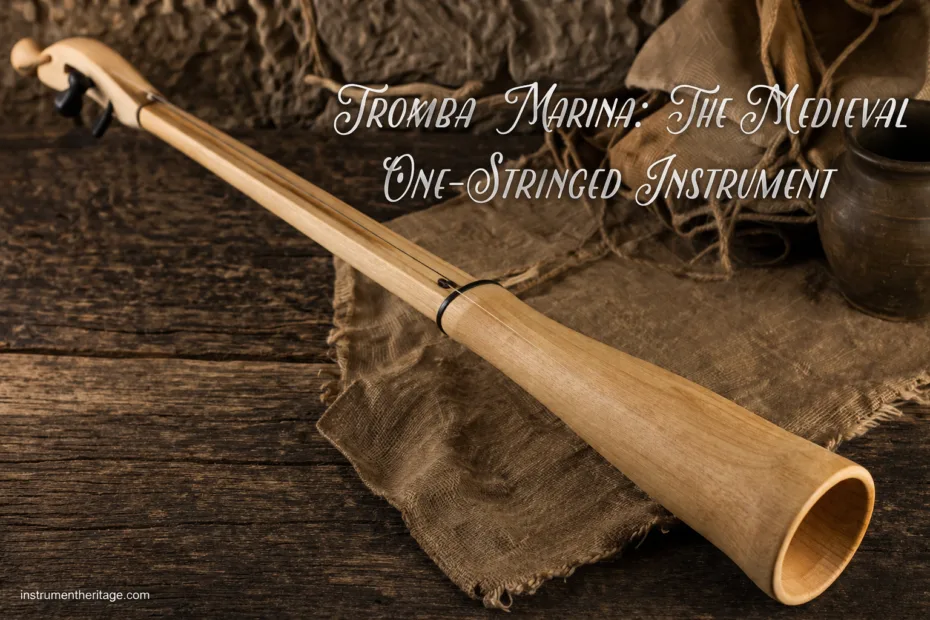
| Feature | What it means | Why it matters |
|---|---|---|
| Instrument family | Bowed chordophone, often described as a bowed monochord or trumpet marine. | It belongs to the string family, even though its tone can fool the ear into hearing something close to a brass instrument. |
| Main string layout | Usually built around one main playing string; later examples may include extra sympathetic strings. | The player does not stop the string like a violinist. The sound comes from light harmonic touching. |
| Body shape | A tall, hollow, narrow body, often triangular, tapered, or slightly boat-like. | The long resonating chamber gives the instrument its carrying tone and unusual visual shape. |
| Historic size range | Many surviving examples stand roughly around adult shoulder height or taller; one Met example is listed at 207.6 cm overall, made of spruce, oak, and iron.Reference-1✅ | Its scale helps explain why it feels closer to a sounding column than to a handheld fiddle. |
| Sound engine | An asymmetrical bridge, sometimes called a shoe bridge, creates a controlled buzzing rattle. | This bridge is the little trick behind the big illusion: a bowed string with a trumpet-like edge. |
| Playing technique | Bowed with one hand while the other lightly touches harmonic nodes along the string. | The technique favors natural harmonics, open resonance, and clean touch rather than finger pressure. |
| Historical setting | Used in parts of medieval, Renaissance, and later European musical life, with surviving museum examples from the 17th to 19th centuries. | It sits between craft, acoustics, ceremony, chamber music, and instrument curiosity. |
| Related names | Tromba marina, marine trumpet, trumpet marine, Trumscheit, Marientrompete, and nuns’ fiddle. | The names tell a story of movement across languages, regions, and musical settings. |
The tromba marina looks like a musical riddle. It is a one-stringed bowed instrument, yet it can bark, buzz, and shine with a tone that feels oddly close to a trumpet. Not a soft violin cousin. Not a brass horn either. More like a tall wooden tower that learned how to sing through a single stretched string and a restless little bridge.
For anyone curious about old instruments, the tromba marina is a rewarding object to study because it refuses the tidy boxes we usually use. It is made with luthier materials, played with a bow, shaped like no common orchestral instrument, and voiced through natural harmonics. The result is a sound with grain in it. A bright buzz. A narrow beam of tone.
Its beauty is not polished in the modern sense. It has a handmade directness: wood, string, air, pressure, and a bridge that lightly taps the soundboard like a tiny wooden heel.
What Is a Tromba Marina?
The tromba marina is a medieval and later European bowed string instrument built around the idea of a stretched string, a resonating body, and harmonic playing. Its Italian name means “marine trumpet,” though the instrument is not a trumpet in the brass-family sense. It has no cup mouthpiece, no blown air column, and no valve system. The player draws a bow across a string.
That is the strange part. A string is bowed, yet the tone can have a brassy bite. This is why old names such as trumpet marine and Marientrompete stayed attached to it. The ear hears a trumpet-like color, while the hands see a bowed chordophone.
The instrument is often described as a monochord. That word simply means “one string.” The tromba marina is not the same as the teaching monochord used for measuring intervals, but it shares the same old acoustic idea: one string can produce many notes when touched at the right places.
🎻 Simple way to picture it: imagine a very tall, narrow wooden body with one main string running along it. The player bows that string and lightly touches harmonic points instead of pressing the string down to a fingerboard.
The instrument is less simple than it looks
A single string sounds basic on paper. In the hands, it is not basic at all. The tromba marina depends on tiny adjustments: bow angle, bow pressure, thumb placement, bridge balance, string tension, and the way the body answers back. A player has to listen closely. Too much pressure and the sound chokes. Too little and the tone thins out. Just right, and the instrument gives that nasal, glowing, trumpet-like voice.
Many modern listeners expect old instruments to sound gentle or distant. The tromba marina breaks that expectation. It can be clear, raw, reedy, bright, and buzzing. It does not behave like a museum whisper.
Body, Shape, and Materials
The body of a tromba marina is usually long, hollow, and tapered. Some examples look triangular when seen from the end. Others have a multi-ribbed back, a flat or slightly shaped soundboard, and an open lower end. The form changes from maker to maker, region to region, and century to century.
Wood matters here. A surviving instrument recorded through MIMO and linked to the Galleria dell’Accademia in Florence is described with a two-part silver fir soundboard, a back made of nine cherry-wood ribs, and an open base framed in black-stained walnut.Reference-2✅ That combination tells us plenty: light resonant top, shaped back, and a structure built to project rather than merely decorate.
The soundboard is the speaking face of the instrument. It takes vibration from the string and bridge, then spreads it into the body. Spruce and fir have long been favored in bowed and plucked instruments because they can be light, stiff, and responsive. Cherry, oak, walnut, and other woods may appear in backs, frames, pegs, or structural parts depending on the instrument.
🪵 Resonating body
The body is not just a shell. It is the chamber that gives the instrument its carrying voice. The long body helps the tone feel column-like rather than small and boxy.
🎼 Soundboard
The top plate receives the vibration directly. Its thickness, arching, grain, age, and repair history all shape the response.
Why the shape feels so unusual
A violin fits under the chin. A cello rests between the knees. The tromba marina rises upward like a wooden signpost. Its long body gives the player a different relationship with the instrument: more vertical, more architectural, and less intimate than a small bowed instrument.
That scale is part of its identity. Some examples are close to two meters high. The Museo della Musica notes that the instrument derived from the medieval monochord, originally had one string, later gained additional strings in some forms, and could reach two meters in height.Reference-3✅ A small instrument can buzz too, of course, but the tromba marina’s size lets the buzz travel through a larger wooden body.
The Bridge: The Small Part That Changes Everything
The tromba marina’s secret sits at the bridge. On many bowed instruments, the bridge transfers vibration cleanly from string to soundboard. On the tromba marina, the bridge is more mischievous. It is often asymmetrical, with one foot more firmly connected and the other allowed to move or tap lightly.
This creates the famous buzzing trumpet effect. The sound is not produced by metal tubing or lip vibration. It is a controlled rattle made by wood and string. Think of it as a tiny, fast, musical tap-dance happening under the string.
Historical descriptions often call this a shoe-shaped bridge. That name makes sense when you see one. It is not a neat, symmetrical violin bridge. It looks more like a fitted tool made for a very specific job.
🔔 The important acoustic idea: the string gives the pitch, the hollow body gives the resonance, and the bridge adds the buzzing color that makes the instrument sound almost horn-like.
Why the buzz is musical, not accidental
A badly repaired instrument can buzz by mistake. The tromba marina buzzes by design. The loose bridge foot must be balanced well enough to speak, but not so loosely that the sound collapses into noise. This is where the maker’s skill shows. A few millimeters can change the whole voice.
The bridge also changes how the player bows. A smooth violin tone asks for one kind of pressure. A tromba marina asks for another. The player has to wake the bridge without bullying it.
How the Tromba Marina Makes Notes
The tromba marina is not played by pressing the string firmly against a fingerboard. Instead, the player touches the string lightly at certain points called nodes. These points divide the string into simple fractions. When touched correctly, the string speaks in natural harmonics.
That means the instrument does not behave like a violin, where each finger can stop the string at many positions. It behaves more like a horn in one useful sense: much of its pitch material comes from the harmonic series.
- The open string gives the fundamental area of the instrument.
- Light thumb touches bring out higher harmonic tones.
- Bow speed and pressure shape whether the sound is clean, buzzy, thin, or bold.
- The bridge adds its quick tapping color to the tone.
Some historical instruments even mark the harmonic positions. The Florence-linked MIMO record describes letters written in white ink on the fingerboard, corresponding to the harmonic series of D from the third to the fourteenth harmonic. That detail is lovely because it shows the instrument as a working tool, not just a strange shape in a case.
What the tone feels like
The sound can be nasal, bright, and carrying. It has a grainy edge, a little like a reed pipe seen through wood. Close up, the rattle may feel almost rough. From a distance, the tone can blend into a more ceremonial color.
It is not “pretty” in the soft modern sense. Better words are clear, strange, focused, and alive. It has corners.
A Short History Without the Dust
The tromba marina grew from the older monochord idea: one stretched string, a resonating surface, and measurable pitch relationships. Over time, that simple acoustic principle became a performance instrument with a body, bridge, bowing method, and stage presence.
Its strongest historical life sits in medieval, Renaissance, and early modern Europe, though surviving instruments often come from later centuries because old wooden instruments are fragile and collections tend to preserve objects that lasted. MIMO’s musical-instrument records list tromba marina and related trumpet marine examples from makers and collections connected with dates such as 1680, 1702, 1728, 1740, and 1763, showing how the instrument continued beyond its medieval roots.Reference-4✅
One reason it stayed interesting is easy to understand: it could imitate the color of a trumpet without being a wind instrument. That made it useful in musical settings where a bright ceremonial color was wanted, but a bowed string instrument was more practical or more suitable for the players available.
The convent and chapel connection
One of its old nicknames, nuns’ fiddle, points toward a known association with convent music. The exact use varied by place and period, so it is better not to flatten the story into one neat rule. Still, the connection makes musical sense. A bowed instrument that can suggest a trumpet color would have been useful in devotional music, procession-like textures, and festive sacred pieces.
The tromba marina could give a bright line without requiring the player to blow into a horn. That single detail helps explain why the instrument gathered such unusual names in different languages.
Vivaldi, Lully, and the taste for color
The instrument did not live only as a curiosity. Composers and performers also used its color as a special effect. The Museo della Musica notes that Antonio Vivaldi wrote two concertos using violins in tromba marina, and that Jean-Baptiste Lully called for the tromba marina color in Serse. This is a useful reminder: historical musicians loved unusual sound colors too.
The phrase violin in tromba marina can confuse readers. It does not always mean a normal tromba marina standing beside the violins. In some settings, it refers to violin-family instruments or playing effects used to imitate the tromba marina’s bright, buzzing tone. Musicians borrowed the color, not only the object.
The Name “Marine Trumpet”: What Does It Really Mean?
The name is one of the instrument’s little puzzles. Tromba means trumpet in Italian. Marina has led to several explanations, and not every old source uses names in a tidy modern way. Some writers connect the English “marine trumpet” with the shape of old speaking trumpets used at sea. Others point toward Marien names linked with devotional use. The safest reading is simple: the name preserves both its trumpet-like tone and its long cultural travels.
Names shift. Instruments travel. A workshop name, a local nickname, and a collector’s label may not tell the same story. That is normal in instrument history.
- Italian
- Tromba marina
- English
- Trumpet marine, marine trumpet
- German
- Trumscheit, Marientrompete, Trompetengeige
- Common descriptive label
- Bowed monochord or one-stringed bowed instrument
Construction Details a Player Would Notice
A player approaching a tromba marina for the first time would notice three things before any music begins: the height, the string, and the bridge. The instrument does not invite the same posture as a violin. It asks the body to stand or sit with a vertical object, to bow in a narrow zone, and to let the left hand touch rather than press.
The string
The main string must be responsive enough to speak under the bow yet stable enough for harmonic playing. Historical strings could vary in material and setup, and modern reconstructions may use gut or other historically informed choices. What matters is not just the string itself, but how it works with tension, length, bridge weight, and body resonance.
The fingerboard area
The left hand does not need a violin-style fingerboard for stopping notes. It needs a reference surface or line where the thumb can find harmonic points. Some instruments mark those points. That makes sense, because harmonic playing can feel like touching invisible frets.
The bow
The bow has to feed the string steadily. Too much bite and the bridge rattles harshly. Too little and the harmonic does not bloom. The tromba marina rewards a player who can be patient with contact. Small changes matter.
Why One String Can Produce Many Notes
A stretched string does not vibrate in only one way. It can vibrate as a whole, in halves, thirds, quarters, fifths, and so on. Each division brings out a different harmonic. The tromba marina uses this natural behavior as its note system.
Here is the neat part: the player’s thumb does not clamp the string. It only touches the node lightly enough to guide the vibration. The string still rings. That is why the tone can feel airy and bright rather than pressed and dense.
| Action | What happens to the string | Resulting sound |
|---|---|---|
| Open bowing | The full string vibrates along its length. | A low reference tone or strong resonant base, depending on tuning and setup. |
| Light touch at halfway point | The string divides into two vibrating halves. | A clear octave harmonic. |
| Light touch at third division | The string vibrates in three sections. | A higher harmonic with a more horn-like brightness. |
| Higher harmonic touches | Smaller string divisions speak. | Brighter, narrower tones that need careful bow control. |
| Bridge rattle active | The asymmetrical bridge adds fast tapping energy. | The familiar tromba marina buzz. |
Why It Sounds Like a Trumpet Without Being One
The trumpet-like effect comes from several parts working together. The harmonic series gives the instrument a pitch behavior that can remind listeners of natural brass. The bridge adds a sharp buzzing edge. The long resonating body helps the sound project. None of these pieces alone explains it. Together, they make the illusion believable.
A normal bowed string tone is often valued for smoothness. The tromba marina is valued for controlled roughness. It has texture in the note. That texture is not a flaw; it is the voice.
- Harmonics give the tone a clear, ringing upper structure.
- The buzzing bridge adds a brass-like rasp.
- The tall wooden body supports projection and resonance.
- The player’s bow pressure decides whether the sound speaks cleanly or becomes too scratchy.
Extra Strings and Sympathetic Resonance
Although the tromba marina is famous as a one-stringed instrument, historical examples are not all identical. Some later instruments added extra strings. These could support resonance, strengthen the color, or vibrate sympathetically inside or along the body.
A sympathetic string is not always played directly. It responds when nearby notes match its vibration. You can think of it as a quiet room lamp that turns on when the right pitch walks past. The sound gains shimmer, even if the player only bows the main string.
This is one of the places where the instrument is often oversimplified. “One-stringed” is a useful label, but real instruments can be more varied. The main idea remains the same: one primary bowed string drives the musical line.
Where the Tromba Marina Fits in Instrument History
The tromba marina sits near several instrument families without fully belonging to any familiar modern group. It is a string instrument, but its tone reaches toward brass color. It relates to the monochord, but it is a performance instrument. It uses a bow, but its left-hand method is closer to harmonic touching than melodic stopping.
That mixed identity is exactly why it matters. It shows that instrument makers were not trapped inside modern categories. They chased sound. If a single string and a clever bridge could bring a trumpet color into a bowed instrument, that was worth trying.
🎺 Close to brass in color
The sound can suggest a natural trumpet because of its harmonic tones and bright buzz.
🎻 Close to strings in method
The player uses a bow, a string, and a resonating wooden body, not blown air.
Similar Instruments and Useful Comparisons
The tromba marina becomes easier to understand when placed beside nearby instruments. None of these are exact twins. Each comparison reveals one part of the puzzle.
| Instrument | Shared idea | Main difference |
|---|---|---|
| Monochord | One string used to explore pitch, intervals, and vibration. | The teaching monochord is mainly a measuring and demonstration tool; the tromba marina is a performance instrument with a resonant body and buzzing bridge. |
| Natural trumpet | Both rely strongly on the harmonic series. | The natural trumpet is a wind instrument; the tromba marina uses a bowed string. |
| Hurdy-gurdy | Both are string instruments with continuous excitation and drone-friendly behavior. | The hurdy-gurdy uses a rosined wheel and keys; the tromba marina uses a bow and harmonic touch. |
| Bowed psaltery | Both can produce clear, ringing bowed tones. | The bowed psaltery has many strings; the tromba marina centers on one main string and a buzzing bridge. |
| Đàn bầu | Both show how one string can create expressive pitch through harmonic behavior. | The đàn bầu is plucked and pitch-bent with a flexible rod; the tromba marina is bowed and historically European. |
| Rebec | Both belong to older bowed-string culture. | The rebec is a melodic stopped-string instrument; the tromba marina is built around harmonics and trumpet-like buzz. |
How to Recognize a Tromba Marina in a Museum
If you see one in a collection, it may not look like the image you had in mind. Some are plain. Some are elegant. Some are tall and narrow, while others have broader bodies. Still, a few clues help.
- Look for a very long body, often tapered or triangular.
- Check whether it has one main string path running along the front.
- Notice the bridge. If it looks asymmetrical or shoe-like, you may be looking at the heart of the instrument.
- Search for harmonic markings along the playing area.
- Read the collection label for names such as tromba marina, trumpet marine, Trumscheit, or Marientrompete.
Because many museum examples are not played regularly, their full voice may be hard to imagine from sight alone. The object can look silent and narrow. Its sound is bigger than its outline suggests.
What a Modern Maker Has to Solve
Building a tromba marina today is not a matter of copying a silhouette. The maker has to solve an acoustic balancing act. The body must be light enough to respond, strong enough to hold tension, and shaped well enough to support the buzzing bridge without swallowing its energy.
The bridge is the hardest little beast. It must be stable, but not too stable. Loose, but not sloppy. The string has to excite it. The soundboard has to answer it. The player has to control it.
🛠️ Maker’s balance
A convincing tromba marina needs string tension, bridge freedom, wood response, and playable harmonic spacing to cooperate. If one part fights the others, the instrument loses its strange charm.
Restoration concerns
Old tromba marinas can be fragile. Long wooden bodies may warp, seams can open, bridges can be lost or replaced, and strings may no longer match the original setup. A careful restorer has to respect evidence: tool marks, old holes, wear patterns, labels, painted letters, and repairs. Guesswork can change the voice.
That is why museum records are so useful. Measurements, materials, photographs, and object histories help modern makers and researchers understand how different versions worked.
Common Misunderstandings About the Tromba Marina
Why the Tromba Marina Still Holds Attention
The tromba marina has a rare kind of appeal. It is easy to explain badly and hard to forget once you understand it. A single string should feel limited, yet the instrument opens into harmonics. A bowed wooden body should sound like a string instrument, yet the bridge gives it a brass-colored edge. It seems simple. Then it is not.
For musicians, it teaches touch. For makers, it teaches balance. For listeners, it asks the ear to stop sorting instruments too quickly. The tromba marina is not valuable because it is odd. It is valuable because the oddness has a reason.
Its design is a reminder that musical instruments are not just objects. They are solutions. Sometimes elegant, sometimes awkward, sometimes noisy in exactly the right way.
Tromba Marina FAQ
Is the tromba marina really a one-stringed instrument?
Yes, the classic idea of the tromba marina centers on one main bowed string. Some later or more developed examples include extra strings, often for resonance, but the main playing identity remains tied to a single primary string.
Why does the tromba marina sound like a trumpet?
Its trumpet-like tone comes from natural harmonics and a special asymmetrical bridge that adds a controlled buzzing rattle. The instrument is still a bowed string instrument, not a brass instrument.
How is a tromba marina played?
The player bows the string with one hand and lightly touches harmonic points with the other, often using the thumb. The string is not pressed firmly down like on a violin.
What materials were used to make a tromba marina?
Historical examples use woods such as spruce, fir, cherry, oak, walnut, and other workshop materials. The exact combination depends on the maker, region, date, and repair history of the instrument.
What is the bridge on a tromba marina called?
It is often described as a shoe-shaped or asymmetrical bridge. One part helps carry the string vibration, while another part can rattle lightly against the soundboard, creating the instrument’s buzzing tone.
Is the tromba marina the same as a monochord?
No. It is related to the monochord idea because it uses one string and harmonic behavior, but the tromba marina is a performance instrument with a resonating body, bowing technique, and buzzing bridge.
Why is it called a marine trumpet?
The name is tied to its trumpet-like sound and to historical naming traditions in several languages. It is not a sea instrument in the ordinary sense, and it is not a trumpet by construction.
Can people still hear the tromba marina today?
Yes. Original instruments survive in museum collections, and modern makers and performers have built reconstructions. Its sound is rare, but it has not disappeared.
