
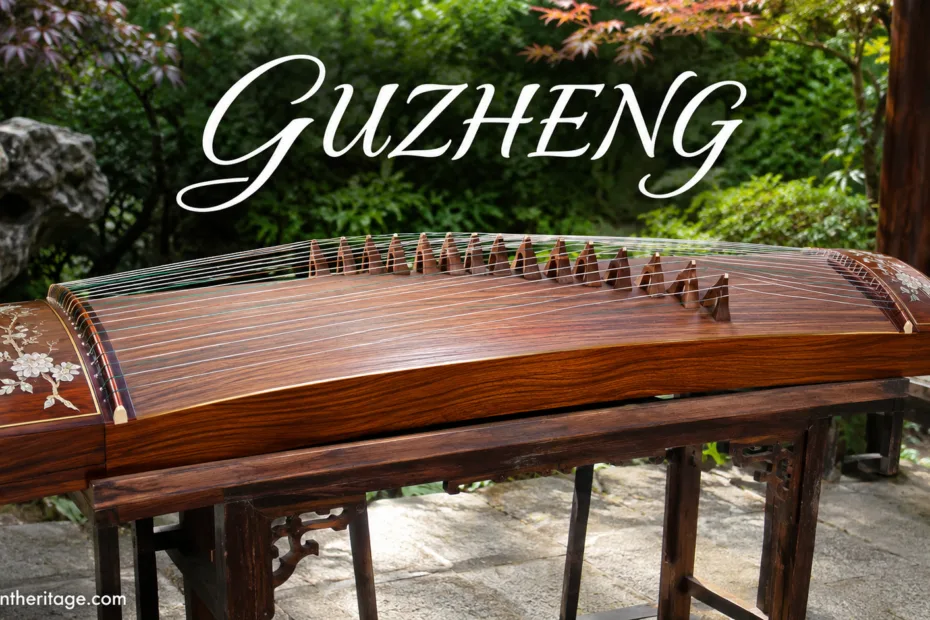
| Feature | Guzheng Details |
|---|---|
| Instrument | Guzheng (古筝 / 古箏), also called zheng or Chinese zither |
| Instrument family | Plucked string instrument; long, hollow-bodied zither with movable bridges |
| Country of origin | China |
| Historical evidence | More than 2,500 years of history, with early archaeological examples dating to the first millennium BCE |
| Common modern form | 21 strings, each supported by an individual movable bridge |
| Historical string counts | Early 12- and 13-string examples; later 14-, 15-, and 16-string forms; modern 18-, 21-, and other extended designs |
| Typical modern length | Approximately 160–165 cm (63–65 inches), depending on the model |
| Soundboard | Commonly paulownia wood in modern instruments; historical construction also includes woods described as wutong |
| String materials | Historically silk and metal; modern instruments commonly use steel-core, nylon-wound strings |
| Common tuning | D major pentatonic: D, E, F♯, A, B, repeated across several octaves |
| Typical modern range | Approximately D2–D6 in standard 21-string D tuning |
| Playing method | Strings are plucked with fingers or finger picks; pressure on the strings changes pitch and creates ornamentation |
| Sound character | Clear upper notes, resonant lower strings, flowing glissandos, sustained vibrations, and expressive pitch bends |
| Traditional settings | Solo performance, regional string ensembles, narrative singing, chamber music, and court entertainment |
| Major regional traditions | Shandong, Henan, Chaozhou, Hakka, Zhejiang, and Fujian, alongside other regional practices |
| Related instruments | Japanese koto, Korean gayageum, Vietnamese đàn tranh, Mongolian yatga, and the older Chinese se |
The guzheng is a Chinese plucked zither whose sound comes from strings stretched across a long wooden body, with a separate movable bridge supporting each string. A player plucks the strings to create clear, ringing notes, then presses or releases them to bend pitches and shape the melody. This combination gives the instrument its characteristic slides, vibrato, and cascading runs. Although today’s guzheng commonly has 21 strings, its history includes earlier instruments with different shapes, materials, tunings, and numbers of strings.
Known in Chinese as zheng (筝 or 箏), the instrument developed through more than two millennia of musical practice. Archaeological discoveries, historical descriptions, regional playing traditions, and surviving museum instruments reveal how its construction and sound changed. The word gu (古) means ancient, so guzheng literally refers to an ancient zheng. The name remains in use for newly manufactured concert instruments.
The Earliest Guzheng: Archaeological Evidence and Ancient Origins
The guzheng’s beginnings are older than the earliest surviving written descriptions. Its precise place of invention remains uncertain, partly because several types of long zithers existed in early China. Archaeological finds are especially valuable here: they reveal actual wooden instruments rather than relying entirely on stories recorded centuries afterward.
Early Zheng Finds in Southern China
Excavations in southern China uncovered early zithers with 12 or 13 strings, including examples from Guixi in Jiangxi Province and Changqiao in Jiangsu Province. Archaeological interpretations place these instruments in the pre-imperial period, commonly around the middle centuries of the first millennium BCE. Dating estimates vary between individual finds and scholarly studies.
The Guixi discoveries include long wooden instruments with thirteen string positions. A 13-string example from the site has been described as approximately 166 cm long, remarkably close to the length of many modern guzhengs. The Changqiao find is associated with a 12-string design and provides another example of early zither construction.
These objects establish that zheng-like instruments existed before the unified Qin dynasty of 221–206 BCE. They also show that fewer strings did not necessarily mean a much smaller instrument. Body proportions, resonance chambers, string attachment methods, and materials differed between surviving examples.
Some original strings, bridges, and other organic components have not survived. Archaeologists therefore work with remaining wooden structures, attachment holes, traces of fittings, and burial contexts to reconstruct how an instrument may have functioned. The Smithsonian’s National Museum of Asian Art discusses these early discoveries and the possibility of multiple regional origins. Reference-1✅
Did the Guzheng Develop from the Ancient Se?
The se (瑟) was another early Chinese zither, generally larger and equipped with many strings. Historical descriptions frequently associate it with 25 strings, although archaeological examples and historical forms varied.
One traditional story describes a se being divided into two smaller instruments, one with twelve strings and another with thirteen. A separate legend associates the zheng with Meng Tian, a figure from the Qin period. These accounts belong to the instrument’s historical folklore. Neither establishes a proven invention event.
The relationship between the se and zheng remains an area of musical and archaeological study. Both belong to China’s early zither traditions, and certain construction features suggest historical connections. Yet the southern discoveries leave room for regional development and more than one line of influence.
Historical distinction: The earliest known written mention of an instrument is not necessarily the date when it was invented. In the guzheng’s case, physical evidence of early zither forms predates several famous textual accounts of its origin.
The Zheng Through China’s Historical Dynasties
The Qin Zheng and Early Written Records
The name Qin zheng (秦箏) reflects the instrument’s early association with the Qin region of western China. The Qin state existed before the establishment of the unified Qin dynasty. Its musical culture included string instruments used alongside singing and percussion.
A passage associated with Li Si and preserved in Sima Qian’s Shiji (Records of the Grand Historian) describes the zheng among musical activities in Qin around 237 BCE. This is an important early written reference because the instrument appears as part of an established musical setting.
The record does not describe a new invention. It indicates that the zheng was already familiar enough to be named in an account of everyday musical practices.
Han Dynasty: Song Accompaniment and Ensemble Music
During the Han dynasty (206 BCE–220 CE), the zheng appeared in musical environments that combined voices, string instruments, and winds. It is associated with xianghe ge, a song-and-dance tradition whose musical organization involved instrumental accompaniment.
The zheng’s sustained tones and adjustable pitches made it suitable for supporting melodic lines. In ensemble settings, its plucked notes could establish rhythmic patterns while the player added ornaments and melodic responses.
Historical descriptions also offer clues about its construction. Fu Xuan’s third-century writing on the zheng describes a hollow instrument with a curved upper surface, a flat underside, and twelve strings supported by bridges. The account combines physical observation with symbolic explanations of the instrument’s form.
Sui and Tang Dynasties: Court Music and Wider Cultural Exchange
During the Sui (581–618) and Tang (618–907) dynasties, the zheng was used in organized musical ensembles, including court entertainment. Tang musical sources document different string configurations, particularly twelve- and thirteen-string instruments.
The zheng was heard in yanyue, or banquet music, and in traditions associated with qingshang yue. It shared musical settings with other plucked and bowed instruments. Its role depended on the repertoire: a zheng could contribute melodic decoration, support a principal tune, or participate in layered instrumental textures.
The Tang period also provides an important historical setting for the transmission of Chinese musical instruments and court repertories to Japan. The Japanese koto developed a distinct musical identity while retaining structural features familiar from earlier East Asian bridged zithers.
Song, Ming and Qing: Regional Music Takes Shape
Through the Song (960–1279), Ming (1368–1644), and Qing (1644–1912) periods, the zheng continued to appear in different musical environments. Court ensembles were one part of its history; local instrumental groups, narrative singing, and regional entertainment were equally important for the survival of particular styles.
Musicians adapted shared melodies to local performance habits. A piece might preserve its recognizable melodic outline while gaining different rhythmic patterns, string bends, ornaments, and phrasing. Much of this knowledge passed directly between performers rather than through fully detailed written scores.
By the later imperial period, fourteen-, fifteen-, and sixteen-string zhengs were part of the instrument’s changing construction history. The sixteen-string form became especially associated with several traditional practices and remained in use after modern 21-string instruments became widespread.
The Guzheng’s Historical Development
- First millennium BCE: Early 12- and 13-string zithers appear in the archaeological record, including southern Chinese examples.
- Third century BCE: Written records associate the zheng with musical life in the Qin region.
- Han dynasty: The instrument participates in song accompaniment and instrumental traditions.
- Sui–Tang period: Zhengs with different string counts are documented in established court music.
- Song–Qing periods: Local repertoire, ensemble practices, and instruments with additional strings develop.
- Twentieth century: Conservatory teaching, revised construction, new strings, and the 21-string concert model reshape performance.
- Contemporary practice: Traditional schools coexist with modern solo, ensemble, experimental, and cross-cultural music.
These stages overlap. Historical zheng forms did not disappear everywhere at the same moment, and the modern 21-string instrument represents one influential branch of a much longer construction tradition.
Guzheng Construction: Wood, Strings, Bridges and Resonance
A guzheng is built around an elongated, hollow wooden soundbox. Its strings run lengthwise above a curved soundboard. One movable bridge supports each string, dividing it into a main sounding section and a shorter section that can be pressed to alter tension.
The Soundboard and Hollow Wooden Body
The soundboard transfers string vibrations into the body of the instrument. Modern guzheng soundboards commonly use paulownia, a relatively light wood valued for its ability to vibrate efficiently. The curved surface provides a broad area for the strings and supports the arrangement of movable bridges.
Historical descriptions also refer to wutong wood. The exact botanical identification matters: historical sources sometimes identify wutong with Firmiana, while modern makers commonly use Paulownia species. The traditional name should not automatically be treated as proof that every historical and modern soundboard was made from the same tree.
Other parts of the body may use denser woods, including rosewood or decorative hardwood veneers. These materials contribute to structural stability, ornamentation, and the finish of the instrument. Internal braces, sound openings, board thickness, and the shape of the resonance chamber also affect vibration.
Movable Bridges and Tuning Hardware
The most recognizable structural feature is the row of individual movable bridges. Each bridge supports one string and transfers its vibration to the soundboard. Moving a bridge alters the effective vibrating length of that string and therefore its pitch.
The bridges are usually wooden, often with a hard contact surface that protects the string and provides a stable bearing point. Their shape, position, and contact with the soundboard influence clarity and sustain.
Traditional instruments could have visible tuning pegs on the upper surface. Many modern guzhengs conceal metal tuning pins beneath a hinged cover near one end of the body. This allows the instrument to retain its long, uninterrupted playing surface while accommodating stronger modern strings.
Silk, Metal and Nylon-Wound Strings
The materials used for guzheng strings changed with regional preferences, manufacturing methods, and the demands of performers.
- Silk strings: Used in older zither traditions, producing a comparatively soft attack and a distinctive surface feel.
- Metal strings: Associated with historical and regional zheng forms; they can give a bright, direct sound and respond strongly to plucking.
- Steel-core, nylon-wound strings: Common on modern concert guzhengs. The combination provides strength, a suitable playing surface, and consistent response across the instrument.
The lowest strings are thicker than the highest ones. Their added mass helps produce lower pitches without requiring every string to have a different length. A modern instrument therefore combines string diameter, material, tension, and bridge placement to cover its musical range.
The Parts of a Modern Guzheng
| Component | Physical Role | Effect on Playing or Sound |
|---|---|---|
| Soundboard | Curved upper wooden surface | Radiates vibrations transferred through the bridges |
| Resonance chamber | Hollow interior of the body | Contributes to resonance and tonal response |
| Movable bridges | Individual supports beneath the strings | Set vibrating lengths and transmit energy to the soundboard |
| Strings | Stretched vibrating elements | Produce the fundamental pitches and harmonic overtones |
| Tuning pins | Adjust overall string tension | Allow fine adjustment of tuning |
| Fixed string supports | Guide and anchor the strings at the ends | Help maintain the instrument’s geometry and string alignment |
| Sound openings | Openings in the underside of the body | Interact with the air resonance inside the instrument |
A documented modern example in the University of Washington’s Ethnomusicology Musical Instrument Collection has 21 metal strings, an individual movable wooden bridge for every string, and a hollow body with three openings on the underside. It provides a useful record of an actual instrument’s construction rather than a generalized diagram. Reference-2✅
How the Guzheng Produces Its Sound
A plucked guzheng string vibrates between the movable bridge and the sounding end of its playing section. The bridge carries part of that motion into the soundboard, which moves a much larger volume of air than the string alone could move.
The resulting tone contains a fundamental pitch and a series of higher-frequency components called partials. Their relative strength affects how bright, rounded, or metallic a note sounds. String thickness, the point of plucking, bridge contact, and the instrument’s wooden body all influence the result.
Pentatonic Tuning Across Four Octaves
The most familiar tuning for a modern 21-string guzheng is the D major pentatonic scale. Its five pitch classes are D, E, F♯, A, and B. These notes repeat across successive registers, generally from D2 on the lowest string to D6 on the highest.
| String Group | Pitches in Standard D Tuning | Register |
|---|---|---|
| 21–17 | D2, E2, F♯2, A2, B2 | Lowest |
| 16–12 | D3, E3, F♯3, A3, B3 | Low-middle |
| 11–7 | D4, E4, F♯4, A4, B4 | Middle |
| 6–2 | D5, E5, F♯5, A5, B5 | Upper |
| 1 | D6 | Highest |
The string numbering runs from 1 at the highest pitch to 21 at the lowest. This arrangement covers four octaves between the two D strings. Alternative tunings and different string counts are also used for particular traditions and compositions.
How Left-Hand Pressure Changes a Note
Unlike an instrument whose pitch can only be changed by stopping a vibrating string at a fret, the guzheng gives the player access to the string section beyond its movable bridge. Pressing that section increases the tension of the sounding segment, raising its pitch.
The performer can then release or vary the pressure. This produces smooth pitch changes, vibrato, and expressive ornamentation. In traditional guzheng music, these movements are an essential part of how melodies are shaped.
For example, the open strings of D pentatonic tuning do not provide G and C♯ as separate pitches within the basic five-note pattern. Players can obtain these additional notes through controlled string bending. The amount of movement depends on the instrument, string, register, and desired expression.
The Difference Between Low and High Guzheng Notes
The low strings tend to produce a fuller bass response with a noticeable resonant decay. Higher strings often have a sharper initial attack and clearer high-frequency components. The balance changes with the way a note is plucked.
A 2026 acoustic study published in BioResources examined the frequency spectra and time-frequency characteristics of a guzheng. The researchers measured notes spanning approximately 73.4 Hz to 1,174.7 Hz, corresponding to D2–D6, and observed different spectral patterns between low and high strings. The findings describe a measured modern instrument; they do not establish the exact sound of historical guzhengs. Reference-3✅
🎵 What makes the guzheng recognizable? Its sound comes from the combination of plucked resonance and continuously adjustable pitch. A melody may contain ringing open notes, rapid glissandos, carefully shaped bends, and subtle changes in vibrato, all within the same musical phrase.
The Regional Schools of Traditional Guzheng Music
China’s regional guzheng traditions developed through local instrumental groups, singing styles, teaching relationships, and repertoire. These traditions are often called zhengpai, or zheng schools. Each has characteristic approaches to melodic ornamentation, rhythm, phrasing, and the use of the left hand.
The usual division between northern and southern styles is helpful for orientation, but it does not describe every regional difference. Some schools combine traits from several neighboring musical traditions, and individual performers develop their own interpretations.
| Regional School | Historical Musical Setting | Recognizable Characteristics |
|---|---|---|
| Shandong | String ensembles, xiansuo music, and narrative singing traditions such as qinshu | Articulated melodic figures, energetic picking patterns, and detailed ornamental movement |
| Henan | Regional narrative music, bantou qu repertoire, and local instrumental practice | Strong melodic accents, broad pitch bends, and expressive rhythmic flexibility |
| Chaozhou | Instrumental traditions of eastern Guangdong, including xianshi yue | Refined pitch inflection, distinctive modal approaches, and carefully controlled ornaments |
| Hakka (Kejia) | Hakka instrumental ensembles and regional melodic repertoire | Subtle left-hand pressure, sustained melodic phrasing, and restrained decorative figures |
| Zhejiang (Wulin) | Hangzhou-area traditions and later concert performance | Flowing melodic passages, rapid finger techniques, and elaborated solo arrangements |
| Fujian (Min) | Local southern Chinese instrumental traditions | Regional melodic patterns, ornamental phrasing, and ensemble-derived performance practices |
Shandong and Henan: Northern Melodic Traditions
Shandong zheng music has close ties to string ensembles and storytelling traditions. The xiansuo repertory includes melodic structures that performers elaborate through variation. Short ornamental figures, repeated notes, and clear articulation contribute to the character of this school.
Henan music is associated with bantou qu instrumental pieces and regional narrative forms. Performers frequently use striking pitch bends and flexible rhythmic treatment to shape a phrase. The left hand can give a sustained note a pronounced expressive movement while the right hand articulates the next melodic figure.
Chaozhou and Hakka: Southern Approaches to Ornamentation
Chaozhou guzheng music is closely connected with the instrumental traditions of eastern Guangdong. Its melodic organization includes modal practices in which the treatment of particular pitches and ornaments can change the character of a piece. Terms such as qing sanliu and zhong sanliu are associated with distinctions in the local musical system.
Hakka, or Kejia, zheng traditions are linked to Hakka instrumental music. Melodic phrasing often emphasizes the expressive movement of individual notes. Gentle pressure changes and ornamentation can carry considerable musical detail without requiring a dense stream of newly plucked notes.
Zhejiang, Fujian and the Transmission of Local Repertoire
The Zhejiang tradition, particularly the Wulin school associated with Hangzhou, contributed to the expansion of solo zheng performance. During the twentieth century, musicians such as Wang Xunzhi helped bring regional techniques and repertoire into formal teaching and concert settings.
Fujian traditions preserve additional southern Chinese approaches to zheng playing. Their musical features are best understood within local instrumental practices rather than as a single fixed technique shared by every performer.
The Shaanxi region also has an important zheng heritage, including modern efforts to develop repertory associated with older regional musical forms. The boundaries between named schools have never been completely fixed.
Why the Same Piece Can Sound Different Between Schools
Traditional zheng pieces often survive through multiple arrangements. Two performances may retain the same recognizable melody while differing in tempo, ornamentation, the duration of notes, or the way phrases are connected.
One player might hold a note and add a gradual upward bend. Another might use several shorter plucked ornaments. Such differences are part of regional musical identity, and they explain why a title alone does not always identify one fixed musical version.
The Playing Techniques Behind Guzheng Music
Guzheng techniques developed around the instrument’s two playing areas: the main string sections used for plucking and the shorter sections used to alter tension. Traditional performance usually assigns much of the melodic articulation to the right hand and pitch shaping to the left. Modern compositions often require both hands to pluck and perform independent musical figures.
Finger Picks and Right-Hand Articulation
Guzheng performers may use natural fingernails or fitted finger picks. Modern picks are commonly made from synthetic materials and attached with tape. Historically, playing materials and methods varied between regions and periods.
The right hand can produce individual notes, pairs of notes, repeated tones, arpeggios, and rapid passages across several strings. The point at which the string is struck affects its timbre: plucking near a bridge generally emphasizes a sharper tone, while playing farther away produces a different balance of overtones.
Pitch Bending, Vibrato and Sliding Notes
Several traditional expressive techniques depend on changing the string’s tension after plucking.
- An yin (按音): Pressing a string to raise its pitch and produce a deliberately altered note.
- Yin (吟): A controlled oscillation of pitch used to give a sustained tone vibrato.
- Rou (揉): A form of repeated pressure movement associated with expressive tonal shaping; its execution varies among traditions.
- Hua yin (滑音): Sliding between pitches by gradually changing string pressure.
- Yao zhi (摇指): Rapid repeated plucking, often used to maintain a continuous melodic tone.
- Gua zou (刮奏): Sweeping across a sequence of strings to produce a glissando.
The distinction between these techniques is musical as well as mechanical. A slowly bending note can change the direction of a phrase, while repeated plucking can sustain a melody long enough for the surrounding strings to resonate.
Two-Handed Playing and Expanded Musical Texture
Modern guzheng repertory makes wider use of both hands for plucking. The left hand may provide accompanying figures, lower-register patterns, or an independent melodic line while the right hand plays above it.
These techniques support more elaborate textures than those found in many older solo arrangements. They also allow composers to combine rapid passages, chords, and contrasting registers without relying on another instrument for accompaniment.
How the Modern 21-String Guzheng Developed
The modern guzheng is the result of changes in instrument building, musical education, and composition during the twentieth century. Traditional zheng playing remained active in regional communities, while larger music institutions introduced new teaching methods and performance expectations.
From Regional Teaching to Conservatory Performance
Earlier zheng instruction often took place through direct relationships between musicians. A teacher demonstrated the melody, and a student learned its ornamentation, rhythm, and characteristic tone through repetition and listening.
As the instrument entered conservatories and formal music programs, teachers began preparing more standardized instructional material and concert arrangements. Numbered musical notation, known as jianpu, became an established way to represent pitches and rhythmic patterns, often supplemented by symbols for guzheng techniques.
Performers connected with particular regional schools influenced this process. Wang Xunzhi helped establish Zhejiang-style teaching, while musicians including Zhao Yuzhai, Cao Dongfu, and Liang Tsai-Ping contributed to the development, teaching, and wider circulation of zheng repertoire.
The Expansion from 16 to 21 Strings
The 21-string guzheng became widely established during the middle decades of the twentieth century. Makers developed longer bodies, improved tuning mechanisms, and string arrangements suited to a broader pitch range and more demanding concert music.
A notable development occurred around 1960, when instrument maker Xu Zhengao worked with guzheng musician Wang Xunzhi on improvements associated with the modern S-shaped 21-string design. The curved string-support arrangement and concealed metal tuning pins became familiar features of later instruments.
The expansion of the lower register made it possible to write fuller bass lines and more widely spaced musical textures. Additional strings also gave composers more room for rapid melodic movement across the instrument.
This transformation involved multiple makers and musicians. The present-day guzheng should not be attributed to a single inventor or treated as an unchanged version of the instrument played in early China.
Why Older 16-String Instruments Remained in Use
The larger concert model did not replace every traditional zheng. Sixteen-string instruments continued to be used in certain regional musical settings, particularly where an established repertoire, tuning approach, and playing technique suited the older construction.
Some traditional musicians also preferred the response of particular metal-string designs. The sound and technique of these instruments cannot always be reproduced simply by performing the same melody on a modern nylon-wound 21-string guzheng.
Experimental Tunings and Mechanical Designs
Instrument makers have explored alternative string counts and mechanical systems intended to change pitches more quickly. Some experimental guzhengs incorporate levers, pedals, or other devices that assist with chromatic performance and rapid changes of tuning.
These designs address a feature of the traditional instrument: its open strings are usually organized around a pentatonic tuning, so many additional pitches require pressure techniques or adjustments to the string setup.
Mechanical innovations offer new compositional options, while the standard 21-string movable-bridge instrument remains the most familiar concert form.
Guzheng Compositions That Shaped Its Repertoire
Guzheng music includes pieces transmitted through regional traditions as well as works composed or arranged for the modern concert instrument. Several frequently performed titles reveal how the repertoire developed and how different musical styles use the instrument’s expressive capabilities.
Yu Zhou Chang Wan — Fishing Boat Song at Dusk (渔舟唱晚)
Yu Zhou Chang Wan is associated with the twentieth-century musician Lou Shuhua, who helped establish the piece in the modern zheng repertoire. It draws upon traditional musical material and uses flowing melodic lines, ornamentation, and increasingly active string patterns.
The piece became a familiar example of the guzheng’s ability to combine measured lyrical passages with faster sequences of plucked notes. Its arrangement history also illustrates the way traditional material could be reshaped for solo concert performance.
Gao Shan Liu Shui — High Mountains and Flowing Water (高山流水)
Gao Shan Liu Shui is a well-known title in Chinese instrumental music. Zheng versions exist in different regional traditions, including Shandong. Its melodic content and ornamentation vary according to the version performed.
The title also appears in guqin repertoire, but that does not make every guzheng performance an arrangement of one identical guqin composition. The history of the title includes distinct instrumental traditions and musical treatments.
Han Ya Xi Shui — Jackdaws Playing in the Water (寒鸦戏水)
Han Ya Xi Shui belongs to the Chaozhou musical tradition. The piece is particularly useful for hearing how local modal practices, controlled pitch bending, and melodic embellishment shape guzheng performance.
Its musical identity depends heavily on phrasing and ornamental treatment. A written sequence of pitches alone cannot fully communicate the expressive details expected in a traditional rendition.
Zhan Tai Feng — Battling the Typhoon (战台风)
Zhan Tai Feng is a modern guzheng composition by Wang Changyuan, developed during the mid-1960s. The work uses fast repeated notes, sweeping movements across the strings, emphatic accents, and contrasting registers.
Its techniques show how twentieth-century composers expanded the instrument’s concert vocabulary. Rapid right-hand activity, forceful glissandos, and extended passages of virtuoso playing became central expressive resources in modern repertoire.
The Musicians Who Carried Guzheng Traditions Forward
| Musician | Contribution to Guzheng Music |
|---|---|
| Wang Xunzhi (1899–1972) | Influential Zhejiang-school musician and teacher who contributed to modern performance and instrument development |
| Lou Shuhua (1907–1952) | Associated with the development and circulation of Yu Zhou Chang Wan as a solo zheng work |
| Cao Dongfu (1898–1970) | Important representative and transmitter of Henan zheng repertoire |
| Zhao Yuzhai (1924–1999) | Shandong-school performer, educator, and contributor to modern guzheng performance |
| Liang Tsai-Ping (1910–2000) | Helped promote zheng teaching, repertoire collection, and concert performance |
| Wang Changyuan (born 1945) | Composer and performer associated with modern virtuosic guzheng repertoire |
These musicians worked within different teaching and performance traditions. Their contributions included preserving regional repertories, developing new techniques, creating compositions, and introducing zheng music to audiences beyond its original local settings.
Guzheng and Other East Asian Zithers
The guzheng belongs to a wider family of East Asian zithers. Several related instruments share long wooden bodies, strings stretched across a resonant surface, and individual supports that help establish pitch. Their musical development reflects different historical contacts and local traditions.
| Instrument | Musical Tradition | Relationship or Distinctive Feature |
|---|---|---|
| Guzheng | China | Commonly 21 strings; movable bridges; extensive pitch bending and glissando techniques |
| Koto | Japan | Traditional 13-string form with movable bridges; developed its own schools, tunings, and repertoire |
| Gayageum | Korea | Traditional 12-string form alongside modern variants; movable bridges and expressive left-hand string manipulation |
| Đàn tranh | Vietnam | Long bridged zither available in different string configurations; extensive ornamentation and pitch inflection |
| Yatga | Mongolia | Plucked zither with regional forms and varying numbers of strings |
| Se | Ancient China | Early multi-string zither closely associated with discussions of the zheng’s origins |
| Guqin | China | Seven-string fretless zither without movable bridges; uses open strings, stopped notes, and harmonics |
Guzheng and Guqin: Two Different Chinese Zithers
The guzheng and guqin are sometimes confused because both are ancient Chinese plucked zithers. Their structures and sound-producing methods are quite different.
A guzheng uses individual movable bridges to support its strings, and the player changes pitch by pressing the non-sounding sections. A guqin typically has seven strings stretched over a long, fretless surface without those bridges. The guqin player produces stopped notes and harmonics by touching the sounding strings at carefully chosen positions.
The guqin is particularly associated with scholarly and contemplative musical traditions. The guzheng has a broader documented history of regional ensemble music, song accompaniment, and solo performance. Both developed substantial bodies of music and specialized playing techniques.
How the Guzheng Relates to the Japanese Koto
The Japanese koto is historically connected with Chinese zither traditions transmitted through early cultural exchange, particularly during the period when Chinese court music was studied and performed in Japan.
The familiar traditional koto has thirteen strings and movable bridges. Over time, Japanese musicians developed independent tuning practices, compositions, playing methods, and instrumental schools. The koto therefore preserves evidence of historical contact while representing a distinct musical tradition.
The Korean gayageum and Vietnamese đàn tranh likewise reflect histories of regional development and musical exchange. Shared physical features are informative, but they do not mean that every surviving design follows a single, fully documented line of descent from one historical guzheng model.
Historic Guzheng Instruments in Museum Collections
Surviving zhengs provide physical evidence of how makers constructed instruments before the widespread use of the modern concert design. Measurements, materials, peg placement, bridge arrangements, and decoration can all help distinguish one historical form from another.
The Nineteenth-Century Chizhou Zheng at the Metropolitan Museum of Art
The Metropolitan Museum of Art in New York preserves a nineteenth-century Chizhou Zheng associated with the K’ai-Sheng Shop in Chizhou, Anhui, China.
- Object
- Chizhou Zheng
- Maker
- K’ai-Sheng Shop
- Period
- 19th century
- Origin
- Chizhou, Anhui, China
- Material
- Wood
- Recorded dimensions
- 99.1 cm long and 12.7 cm wide (39 × 5 inches)
- Collection
- The Metropolitan Museum of Art
- Accession number
- 89.4.48
- Collection acquisition
- 1889, Crosby Brown Collection of Musical Instruments
The instrument is considerably shorter than a typical modern 21-string guzheng. Its documented construction includes metal strings and visible tuning pegs positioned on the upper board. The museum also describes the historical playing technique in which the right hand plucked while the left hand manipulated the strings beyond their bridges.
Its size and hardware demonstrate that historical zheng construction encompassed more than the long, covered-tuning-pin model now common in concert settings. The object’s official museum record gives its measurements, maker attribution, date, provenance, and collection number. Reference-4✅
What Historical Zhengs Reveal About Craftsmanship
Historic instruments preserve details that written descriptions may leave unclear. A surviving body can show how a maker shaped the soundboard, joined the sides, placed the sound openings, and supported the strings.
Bridge marks and attachment points may suggest an earlier string arrangement. Visible tuning hardware can help identify differences between historical and later construction methods. Decorative woodwork may also provide clues about regional production and workshop traditions.
Material condition matters when interpreting these objects. Wood can change with age, and surviving instruments may have missing strings, replacement bridges, or later repairs. Measurements and documented construction provide firmer evidence than assumptions about how an old instrument must have sounded.
The Guzheng in Contemporary Music
The guzheng is heard today in traditional solo performance, Chinese instrumental ensembles, chamber music, large concert productions, and contemporary compositions. Professional teaching has spread through conservatories, community music organizations, and independent musicians in China and internationally.
Concert Repertoire and Modern Composition
Modern composers take advantage of the instrument’s four-octave range, resonant strings, and two-handed techniques. Pieces may include simultaneous melodic lines, rapid repeated notes, wide arpeggios, and passages that combine traditional pitch bending with more elaborate harmonic textures.
Some compositions introduce altered tunings or unconventional playing methods to create sounds outside the usual pentatonic setting. Others retain familiar regional melodic material while expanding the accompaniment and technical demands.
Amplification and Electroacoustic Performance
Acoustic guzhengs can be amplified with microphones or fitted pickup systems. These approaches make the instrument usable in larger ensembles and in performances involving electronic processing.
Amplification does not change the basic method by which a string vibrates. It changes how the instrument’s sound is captured and reproduced. Microphone placement, pickup response, and electronic effects can emphasize different parts of the guzheng’s tone, from the short attack of a plucked note to its sustained resonance.
Keeping Regional Guzheng Music Alive
Traditional repertoire continues to be transmitted through teachers, performers, recordings, and regional ensembles. Preserving a piece involves more than retaining its written notes. Musicians also carry its characteristic rhythm, ornamentation, tuning practices, and left-hand expression.
Modern concert instruments allow a wide range of compositions to be performed on a commonly available design. Historical 16-string zhengs, regional metal-string instruments, and older playing methods remain important to understanding how these traditions developed.
Instrument makers and musicians continue to work with both established designs and new construction methods. The guzheng’s musical identity remains closely connected to the interaction between its movable bridges, resonant wooden body, and the player’s control over each sounding string.
Frequently Asked Questions About the Guzheng
How old is the Chinese guzheng?
The guzheng tradition is more than 2,500 years old. Archaeological examples of early 12- and 13-string zithers date to the first millennium BCE, while written records document the zheng in musical life by the third century BCE. The modern 21-string instrument developed much later.
Who invented the guzheng?
No single inventor has been established by historical evidence. Traditional stories associate the instrument with Meng Tian or with the division of an older se zither. Archaeological discoveries show that early zheng-like instruments existed before the period associated with those accounts.
How many strings does a guzheng have?
The most common modern guzheng has 21 strings, each supported by a separate movable bridge. Historical instruments had other string counts, including 12, 13, 14, 15, and 16. Contemporary experimental designs may have additional strings.
What is the guzheng made from?
A modern guzheng typically has a hollow wooden body, a paulownia soundboard, wooden movable bridges, metal tuning hardware, and steel-core strings commonly wound with nylon. Other woods may be used for structural or decorative components. Historical instruments show different construction choices.
What is the difference between a guzheng and a guqin?
The guzheng commonly has 21 strings and movable bridges. The guqin usually has seven strings and no movable bridges; players use stopped strings and harmonics to obtain different pitches. Their construction, playing techniques, sound character, and musical traditions differ.
Is the guzheng the same instrument as the Japanese koto?
No. The Japanese koto is historically related to Chinese bridged zithers, but it developed distinct tuning systems, performance traditions, and repertoire. Traditional koto models commonly have 13 strings, while the standard modern guzheng has 21.
Why do guzheng players press the strings with their left hand?
Pressing a string on the non-sounding side of its movable bridge increases its tension and raises the pitch of the sounding section. This allows players to produce pitch bends, slides, vibrato, and notes that are not available as separate open strings in the basic tuning.
What tuning is used on a 21-string guzheng?
A common tuning is D major pentatonic, using D, E, F♯, A, and B across four octaves, from approximately D2 to D6. Other tunings are used for particular pieces, regional traditions, and modern compositions.
When did the 21-string guzheng become popular?
The 21-string form became widely established during the twentieth century, especially from the 1950s and 1960s onward. Changes to instrument length, string materials, tuning hardware, and concert repertoire contributed to its adoption.
What types of music are played on the guzheng?
The guzheng is used for traditional regional music, solo instrumental pieces, Chinese ensemble music, chamber compositions, and contemporary works. Its repertoire includes both older melodies transmitted through musical schools and compositions written for the modern concert instrument.
