
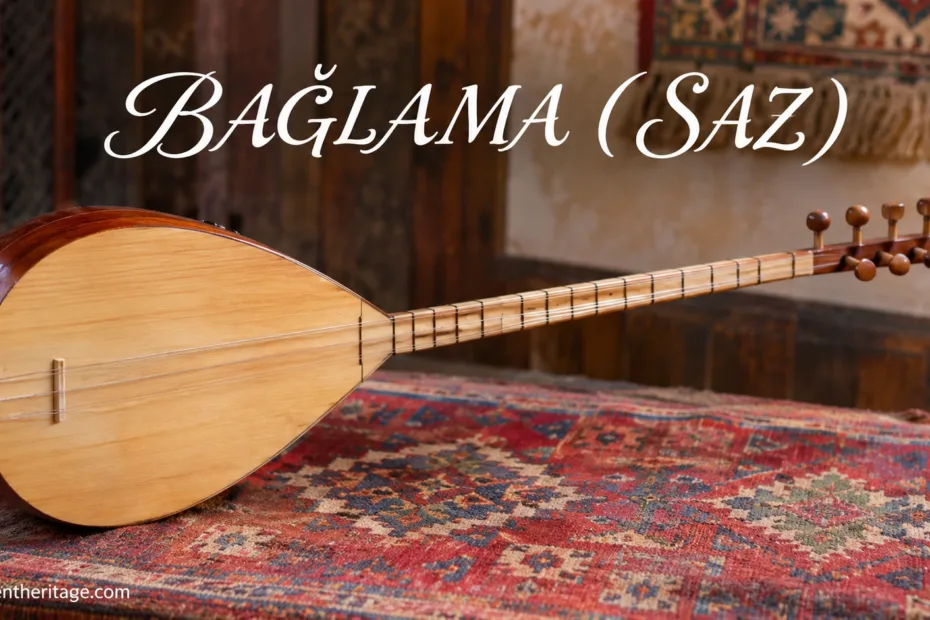
The bağlama, widely known as the saz, is a fretted, long-necked lute closely associated with Anatolian folk music. Its pear-shaped wooden body, thin soundboard, grouped metal strings, and tied frets give it a bright, resonant voice suited to both instrumental melodies and sung poetry. Played with a small plectrum called a tezene or directly with the fingers, the bağlama appears in regional folk traditions, the performances of Anatolian poet-musicians, and contemporary concert music.
| Characteristic | Bağlama (Saz) |
|---|---|
| Instrument classification | Plucked, fretted long-necked lute (chordophone) |
| Cultural association | Anatolia, especially Turkish folk music and related regional traditions |
| Instrument family | Saz or bağlama family, including cura, tambura, divan sazı, and other regional forms |
| Alternative names | Saz, long-neck bağlama, short-neck bağlama; related historical or regional terms include bozuk, çöğür, and tambura |
| Resonator | Pear-shaped wooden bowl, traditionally carved from solid wood or assembled from separate ribs |
| Common body materials | Mulberry, walnut, juniper, and other suitable hardwoods |
| Soundboard | Thin wooden plate, commonly spruce or another suitable softwood |
| Neck and tuning pegs | Wooden neck with friction pegs; construction and hardwood choices vary |
| Strings | Usually metal strings arranged in three courses; seven strings are common, but other configurations exist |
| Frets | Tied frets, traditionally using gut or other cord materials and commonly modern synthetic line |
| Tuning system | Multiple arrangements called düzen, including bozuk, bağlama, and misket |
| Playing techniques | Tezene picking, regional strumming patterns, and fingerstyle şelpe |
| Sound character | Clear, bright attacks, ringing string courses, sustained open-string tones, and flexible melodic ornamentation |
| Musical settings | Türkü repertoire, âşık performance, Alevi-Bektaşi musical traditions, solo playing, and ensembles |
| Historical development | Part of a wider long-necked lute tradition; the modern bağlama developed through changes in construction, strings, fretting, and performance practice |
The name covers more than one instrument size or tuning. A small cura, a short-neck bağlama, and a large divan sazı share important design principles, yet their playing range, proportions, and musical roles can differ considerably.
Bağlama and Saz: Understanding the Names
In everyday Turkish, saz can mean a musical instrument more broadly. In folk music, the word commonly refers to the bağlama and related long-necked lutes. The two terms are therefore often interchangeable in conversation, though saz does not always identify one specific model.
The word bağlama is commonly associated with the Turkish verb bağlamak, meaning “to tie” or “to bind.” An often-repeated explanation connects the name with the frets tied around the neck. This is a plausible linguistic association, although the precise historical development of the instrument’s name is not established by that explanation alone.
Names such as bozuk, çöğür, tambura, cura, and divan sazı may indicate a particular size, construction, historical type, or regional usage. Their meanings have not remained identical everywhere. A traditional instrument name can persist even while the instrument’s physical design changes.
There is also a naming distinction outside Anatolia: the Greek baglamas is a small, high-pitched instrument associated with Greek urban popular music, particularly rebetiko. Despite the related name, it is not simply the standard Anatolian bağlama in miniature. Its proportions, fretting, tuning, and performance traditions differ.
Inside the Bağlama: How Its Wooden Body Produces Sound
The bağlama belongs to the lute family because its strings extend along a neck and pass over a resonating body. A player’s fingers shorten the vibrating portion of the strings against the frets, while the other hand sets them in motion.
Its acoustic design depends on the interaction of several parts. The strings begin the vibration, the bridge transfers much of that energy to the thin wooden top, and the body helps radiate the resulting sound into the surrounding air.
| Turkish Name | Part | Function |
|---|---|---|
| Tekne | Resonating bowl | Forms the hollow body and influences resonance and projection. |
| Göğüs / Kapak | Soundboard | Vibrates in response to the strings through the bridge. |
| Sap | Neck | Supports the frets and provides the playing surface for the left hand. |
| Perde | Fret | Defines the vibrating string length and the positions of musical pitches. |
| Burguluk / Burgu | Pegbox / Tuning peg | Holds the tuning pegs used to adjust string tension. |
| Üst eşik | Nut | Guides the strings at the upper end of the playing neck. |
| Alt eşik / Köprü | Bridge | Supports the strings and transfers vibrations to the soundboard. |
| Tel | String | Produces the initial vibration that becomes the audible musical tone. |
The Tekne: A Pear-Shaped Resonator
The tekne is the hollow, rounded back of the instrument. Its pear-shaped outline widens toward the lower body and narrows where it meets the neck. Both its internal volume and its wooden walls influence the response of the instrument.
A large bowl generally offers a different low-frequency response from a small one, but bowl size alone does not determine the final tone. Wall thickness, soundboard stiffness, bridge position, string tension, and workmanship also affect how efficiently the instrument vibrates.
The Göğüs and the Bridge
The göğüs, also called the kapak, is the thin wooden soundboard covering the bowl. It is usually made from straight-grained softwood selected for its ability to vibrate under string pressure.
On many bağlamas, the bridge is a small, movable wooden component held against the soundboard by string tension. Its position affects the vibrating string length and therefore the accuracy of notes along the neck. Moving it can change intonation even when the open strings are correctly tuned.
Unlike an acoustic guitar, a bağlama does not necessarily have a large round soundhole in the middle of its top. Traditional examples may have an opening near the lower end of the bowl. Other instruments use side openings or modified arrangements. Soundhole location affects how air moves through the body and how the instrument is heard by the player and audience.
The Long, Narrow Neck
The sap is relatively slender and carries a series of tied frets. Its length allows a wide range of notes, while the neck’s stiffness helps keep string action and fret positions stable.
A wooden pegbox holds the tuning pegs, which traditionally work by friction. The player turns each peg to alter tension until the desired pitch is reached. Modern instruments may use different peg materials or mechanical tuning arrangements, particularly on modified stage instruments.
🪵 How a Traditional Bağlama Is Made
Bağlama making combines wood selection, shaping, joining, and acoustic adjustment. A maker must produce a stable instrument while keeping the soundboard responsive and the neck comfortable for the intended playing style.
Oyma Tekne: Carving a Bowl from One Piece of Wood
In oyma tekne construction, the bowl is hollowed from a solid wooden block. Mulberry has a long association with this method, although other woods are also used.
The maker shapes the outside and then removes material from the interior, gradually approaching the desired wall thickness. The challenge is to balance structural strength with the flexibility and mass needed for the intended sound.
A carved bowl has no long seams between individual ribs. Its final character still depends heavily on the original wood, the internal shaping, and the soundboard fitted above it.
Yaprak Tekne: Building a Bowl from Wooden Ribs
The yaprak tekne method uses separate, carefully shaped wooden ribs. Each piece is bent or prepared to match the intended curvature and then joined to its neighbors to create the bowl.
This method allows makers to work with different wood combinations and decorative patterns. The seams require careful fitting, since uneven joints can affect both durability and the quality of the finished body.
| Construction Feature | Oyma Tekne | Yaprak Tekne |
|---|---|---|
| Basic method | Hollowed from a solid block | Assembled from separate wooden ribs |
| Visible structure | Continuous bowl surface | Individual ribs and joining lines |
| Material requirements | A sufficiently large suitable block | Multiple smaller pieces selected for consistency |
| Main workshop challenge | Controlling internal shape and wall thickness | Accurate rib shaping and joining |
| Acoustic result | Neither method guarantees a particular sound quality. Soundboard preparation, dimensions, bridge setup, and workmanship also matter. | |
Choosing Wood for the Bowl, Top, and Neck
Mulberry wood is closely associated with traditional bağlama bowls. Walnut, juniper, chestnut, and other woods appear in different workshop traditions. Makers value wood that can be worked into a stable body with suitable grain and moisture characteristics.
For the soundboard, spruce is a familiar choice because its stiffness-to-weight relationship makes it useful in vibrating wooden plates. Neck woods may include beech, maple, and other sufficiently stable materials.
Wood species alone cannot predict how a finished bağlama will sound. Two instruments made from the same tree species can respond differently because of grain orientation, thickness, drying, construction, and setup. Türkiye’s Ministry of Culture and Tourism documents traditional materials, the instrument’s principal parts, and its plectrum and fingerstyle methods. Reference-1✅
Final Assembly and Acoustic Adjustment
After the bowl, soundboard, and neck are joined, the maker installs the pegs, bridge, string anchor, strings, and frets. The instrument then needs adjustment.
- Neck alignment: The string path must remain usable along the fretted surface.
- Fret placement: Each tied fret must produce the intended pitch relationship.
- Bridge positioning: Open-string tuning and fretted intonation must agree as closely as the chosen musical system requires.
- String action: The distance between strings and frets must allow clean playing without excessive effort.
- Acoustic balance: The response of the three courses is checked for clarity, unwanted buzzing, and uneven volume.
Three Courses of Strings and a Flexible Fret System
One of the bağlama’s defining features is the way its strings are grouped. A typical seven-string instrument has three courses rather than seven independently played strings.
A course is a group of strings intended to be sounded together. Seven-string bağlamas commonly use a combination of two- and three-string courses. The familiar arrangement is three strings in one course and two strings in each of the others, although exact grouping and placement vary.
| String Group | Turkish Term | Typical Musical Function |
|---|---|---|
| Lower course | Alt teller | Frequently carries the principal melody; its precise pitch depends on the tuning. |
| Middle course | Orta teller | Provides alternate melody notes, rhythmic support, or open-string resonance. |
| Upper course | Üst teller | Often supplies an open-string accompaniment, drone, or additional melodic range. |
The words lower and upper describe the courses’ physical positions in the usual playing orientation, not necessarily their pitch. This distinction matters when reading tuning charts.
Steel Strings, Wound Strings, and Octave Doubling
Modern bağlamas commonly use steel strings, sometimes combined with wound strings for lower notes. A wound string contains a central core surrounded by another wire, allowing greater mass without requiring the same construction as a very thick plain string.
Within one course, strings may sound the same pitch in unison. Some are tuned an octave apart, producing a fuller combined sound with more high-frequency detail.
The resulting tone has a characteristic brightness. Small differences in how simultaneously played strings vibrate can also influence the texture of sustained notes.
Why the Frets Are Tied Around the Neck
Traditional bağlama frets are made by wrapping and fastening a material around the neck. Older materials include gut, while modern instruments often use strong synthetic line.
These frets can be repositioned during setup or adjustment. They are not normally moved from note to note while performing.
The arrangement allows makers and players to establish pitch positions that suit the instrument’s musical repertoire. Bağlama fret spacing is not necessarily identical to the twelve equal semitones of a standard Western guitar.
Microtones and Anatolian Melodic Intonation
Turkish folk music uses melodic intervals and expressive pitch relationships that cannot always be represented accurately by ordinary Western semitone divisions. A note may be positioned slightly above or below a familiar piano pitch according to the melodic tradition.
The tied-fret system helps accommodate these differences. Players also influence intonation through fingering pressure and ornamentation.
There is no single fret layout that represents every Anatolian melodic tradition. Modern teaching instruments may follow relatively standardized arrangements, while other instruments retain positions shaped by particular local practices.
The Bağlama Family: Cura, Tambura, Divan Sazı, and Other Types
The bağlama family contains instruments of different body sizes, neck lengths, string arrangements, and sounding ranges. Smaller instruments tend to work in higher registers, while larger models can support lower pitches through longer, heavier strings.
| Instrument | Physical Characteristics | Musical Role |
|---|---|---|
| Cura | Small bowl and short vibrating string length | Bright, high-register melodies; solo and ensemble parts |
| Tambura | Generally larger than the smallest cura, with size varying by local terminology | Melodic playing in an intermediate register |
| Bağlama | Medium-sized family member, available in several neck and body configurations | Folk-song accompaniment, melodic performance, and ensemble playing |
| Çöğür | Historical and regional lute type with variable descriptions and string arrangements | Traditional repertoire; historical forms associated with regional saz practices |
| Divan sazı | Large resonating bowl and relatively long strings | Lower-register accompaniment, sustained tones, and historical performance traditions |
| Meydan sazı | Term associated with particularly large saz-family instruments | Large-instrument traditions; terminology and dimensions differ between sources |
These names should be understood as a traditional family vocabulary rather than a universal set of standardized commercial dimensions. A tambura or çöğür may be described differently depending on the region, period, or maker.
Long-Neck vs. Short-Neck Bağlama
Two familiar modern forms are the uzun sap bağlama (long-neck) and kısa sap bağlama (short-neck). Both can belong to the same broad instrument tradition, but they are organized for different playing geometries.
| Feature | Long-Neck Bağlama | Short-Neck Bağlama |
|---|---|---|
| Turkish name | Uzun sap | Kısa sap |
| Neck proportion | Longer fretted neck | Shorter fretted neck |
| Typical fret arrangement | Often around 23–24 tied frets in familiar modern configurations | Often around 19 tied frets in familiar modern configurations |
| Common tuning association | Bozuk or kara düzen | Bağlama düzeni |
| Left-hand movement | Wider position changes may be needed | More compact reach between positions |
| Melodic layout | Supports established long-neck fingering patterns and regional styles | Places useful melody notes across courses differently, depending on tuning |
| Performance use | Solo playing, âşık traditions, regional tavır, ensemble music | Folk repertoire, vocal accompaniment, şelpe, and concert performance |
Fret counts are descriptions of common configurations, not fixed requirements for every instrument. A short-neck model is also more than a long-neck model with a piece removed. Its scale length, fret positions, string tension, tuning, and fingering system must be considered together.
Düzen: How Bağlama Tuning Systems Work
A bağlama tuning is called a düzen, meaning an arrangement. The term describes how the three courses are tuned in relation to one another. Changing the düzen can alter which notes are available as open strings, how melodies fall under the fingers, and the sound of accompanying drones.
Two of the best-known arrangements are bozuk düzeni, also called kara düzen, and bağlama düzeni. Misket, müstezat, abdal, and other named arrangements belong to the broader practice.
| Düzen | Example Course Pitches | Characteristic Use |
|---|---|---|
| Bozuk / Kara düzen | A – D – G | Widely associated with long-neck bağlama playing and established folk repertoire. |
| Bağlama düzeni | A – D – E | Commonly associated with short-neck bağlama; supports a different distribution of melody and accompaniment notes. |
| Misket düzeni | A – D – F♯ | Used with particular repertories and melodic patterns. |
| Other regional düzenler | Various | Named arrangements whose exact pitches and terminology can vary according to musical practice. |
The examples are written lower course – middle course – upper course. They illustrate relationships between the courses; they do not specify every individual string’s octave or impose a universal concert pitch.
For example, bağlama düzeni can also be expressed as D–G–A when the same interval structure is transposed. A singer’s vocal range, the instrument’s scale length, and the chosen repertoire may determine the actual pitch level. This is one reason tuning instructions from different musicians can appear to disagree.
How Düzen Changes Fingering and Resonance
Consider an open string sounding below a melody. It can continue ringing while the player moves through nearby fretted notes. Changing the tuning changes that open note and may also change which finger positions are convenient.
In one düzen, an important melodic note may be available on an open course. In another, the player may need to fret that note. The resulting performance can have a different pattern of sustain, rhythmic emphasis, and sympathetic resonance.
Ayrık Düzen: Different Intervals Within One String Course
Many basic descriptions assume that strings within each course are tuned in unison or octaves. Traditional saz practice includes another arrangement: ayrık düzen, or split tuning, in which strings belonging to the same course are set to other intervals.
This creates additional pitch combinations whenever the course is sounded. A course can therefore carry more than one pitch class at once, rather than simply doubling a single note.
A 2026 study by music researcher Sinan Ayyıldız examined documented split-tuning practices in traditional saz performances. It identified examples among small two-course instruments associated especially with the Teke region and among multi-string, three-course saz instruments used across a wider area. The research also considered related practices in neighboring musical traditions. Reference-2✅
Understanding the difference: A düzen normally identifies the tuning relationship between string courses. Ayrık düzen draws attention to unequal pitch relationships between individual strings within a course. These are related aspects of tuning, but they describe different levels of the string arrangement.
Tezene and Şelpe: Two Approaches to Playing the Bağlama
The bağlama supports both plectrum-based playing and techniques performed directly with the fingers. Each approach changes how the strings begin vibrating, how notes connect, and how rhythmic patterns are articulated.
Tezene: The Traditional Plectrum Technique
A tezene is a small plectrum used to pluck or strum the strings. Traditional examples have been made from cherry bark and other flexible materials; modern players commonly use synthetic picks.
The player controls downward and upward strokes, alternating between individual courses and broader movements across several strings. Even when the melody stays on one course, the direction and timing of strokes shape the rhythmic character.
- Single-course picking: Articulates a melody with controlled attacks.
- Alternating strokes: Supports repeated notes and continuous rhythmic movement.
- Tremolo: Uses rapid successive strokes to prolong the impression of a note.
- Multi-course strumming: Combines open and fretted pitches for accompaniment.
- Rhythmic soundboard contact: Adds percussive emphasis in certain performance styles.
Şelpe: Fingerstyle Playing Without a Plectrum
Şelpe refers to plectrum-free playing traditions in which the fingers produce the notes. It includes plucking, striking, and other hand techniques that can generate complex rhythmic and melodic textures.
Some forms of şelpe use both hands to create notes directly on the strings and fretted neck. Parmak vurma, a finger-striking or tapping approach, allows pitches to be articulated through direct finger contact, sometimes without a separate pick attack.
Because different fingers can act independently, a player may combine melody notes with open-string accompaniment or produce contrasting rhythmic layers. The technique can also reveal softer string attacks and percussive sounds that are less prominent in ordinary tezene playing.
Musicians including Erol Parlak and Erdal Erzincan have contributed to the study, teaching, and concert development of plectrum-free bağlama techniques. These contemporary approaches build upon older regional fingerstyle practices rather than representing a completely separate instrument tradition.
| Playing Element | Tezene | Şelpe |
|---|---|---|
| Sound production | Plectrum contacts the strings | Fingers pluck, strike, or tap the strings |
| Note attack | Often clearly defined and bright | Varies from soft plucking to sharp finger strikes |
| Rhythmic character | Controlled picking and strumming patterns | Independent finger movements and percussive combinations |
| Melodic possibilities | Single-course melodies, tremolo, and ornaments | Melodic lines, simultaneous notes, and two-hand techniques |
| Traditional context | Many regional folk and âşık styles | Regional fingerstyle traditions and contemporary solo performance |
Regional Tavır: The Distinct Playing Styles of Anatolia
The Turkish term tavır describes a characteristic manner of musical performance. On the bağlama, it often refers to recognizable picking patterns, rhythmic accents, ornamentation, and relationships between the melody and accompanying strings.
A melody’s written notes do not necessarily communicate its full regional character. The way a player accents a beat, brushes across neighboring courses, or ornaments a phrase can be equally important.
| Regional Tavır | Musical Association | Playing Character |
|---|---|---|
| Zeybek tavrı | Western Anatolia and zeybek repertoire | Characteristic strumming and accent patterns adapted to the rhythmic structure of zeybek melodies. |
| Teke tavrı | Teke region of southwestern Anatolia | Distinctive rapid picking figures and accents associated with regional dance melodies. |
| Konya tavrı | Konya folk repertoire | Specific course-crossing and picking figures, including the characteristic upper-course contact known as üst tele takma. |
| Sürmeli / Yozgat tavrı | Yozgat and central Anatolian traditions | Melodic embellishment combined with recognizable strumming sequences. |
| Âşıklama tavrı | Poet-musician and folk-song traditions | Picking patterns that support melody, poetic phrasing, and rhythmic accompaniment. |
Regional names describe families of practices, not one permanent sequence of strokes for every song. Individual performers vary their techniques, and related picking movements can appear in more than one tavır.
Some regional accents also depend on the chosen tuning. A phrase that naturally uses an open string in one düzen may require a different fingering or picking movement when the instrument is retuned.
The Historical Development of the Anatolian Bağlama
The bağlama belongs to a much older tradition of long-necked plucked instruments found across Anatolia, Central Asia, and neighboring regions. Its history involves changes in instrument form, naming, construction, and musical practice rather than a single documented invention.
The Kopuz Connection
The kopuz is frequently discussed in relation to the ancestry of Turkish long-necked lutes. Historical sources describe instruments under this name in several Turkic-speaking traditions, although the term has referred to different physical types.
Some historical kopuz instruments were plucked, while other instruments sharing related names were bowed. The available evidence does not establish one unchanged kopuz design from which every later bağlama can be traced.
Connections between these instruments are best understood through changing musical traditions, construction methods, and historical terminology. Similar silhouettes alone cannot prove a direct, uninterrupted line of descent.
Changes in Strings, Frets, and Resonating Bodies
Long-necked lutes have been made with different resonating materials, string types, and neck arrangements. Over time, the instruments used in Anatolian musical life came to include wooden soundboards, multiple metal strings, grouped courses, and varied fret layouts.
The development of wire strings changed the available tension, brightness, and durability of the instrument. Multiple-string courses allowed musicians to reinforce notes and combine different pitch registers.
Frets also became closely connected with particular local systems of intonation. As repertoire and performance settings changed, musicians and makers adapted fret placement, tuning, and instrument proportions.
The Bağlama in Recording and Music Education
During the twentieth century, radio performances, commercial recordings, organized folk-music ensembles, and formal teaching gave bağlama playing new settings beyond local performance communities.
Teaching methods helped document fingering, regional tezene patterns, and tuning systems. At the same time, individual artists continued to transmit techniques through observation, listening, and direct instruction.
Musicians such as Âşık Veysel, Neşet Ertaş, Arif Sağ, Musa Eroğlu, and Erkan Oğur are associated with different aspects of the saz’s recorded and performed repertoire. Their approaches illustrate the range of vocal accompaniment, regional expression, solo technique, and contemporary interpretation found within the broader tradition.
The Bağlama in Âşık Poetry, Türkü, and Semah
The bağlama is closely connected with the human voice. It accompanies songs, supports the rhythm of verse, and provides melodic passages between sung lines. Its open strings and flexible tuning systems make it well suited to music in which a single melodic line carries much of the expression.
Âşıklık: The Saz of the Poet-Musician
An âşık is a poet-musician whose performance may combine singing, instrumental playing, storytelling, and improvisation. The saz accompanies verse in forms associated with the Anatolian oral tradition.
A performer may begin with a short instrumental phrase, introduce a sung stanza, and then return to the instrument between lines. The melodic accompaniment supports the syllabic structure and emotional tone of the poetry.
The âşıklık tradition also includes learning through apprenticeship and the transmission of melodies and poetic forms across generations. UNESCO inscribed Türkiye’s Âşıklık (minstrelsy) tradition on the Representative List of the Intangible Cultural Heritage of Humanity in 2009. The inscription concerns the living performance tradition, in which the saz has an established role, rather than recognizing a single bağlama model as a separate heritage element. Reference-3✅
Türkü: Accompanying Anatolian Folk Songs
A türkü is a Turkish folk song, often associated with a particular locality, event, poetic expression, or musical tradition. Bağlama accompaniment may closely follow the vocal melody or provide an independent rhythmic pattern.
Open-string drones help maintain a tonal reference while a singer moves through a melody. Short instrumental responses between vocal phrases are another familiar feature of bağlama performance.
Folk repertoire includes both relatively free rhythmic singing and strongly patterned dance-related music. The player’s timing, ornaments, and choice of tuning adapt to these different musical settings.
The Bağlama in Alevi-Bektaşi Musical Practice
The saz has a recognized place in Alevi-Bektaşi cultural and ceremonial music. Within a cem gathering, a musician known as a zakir may perform devotional poetry and musical passages using the bağlama.
The instrument also accompanies semah, a ceremonial form involving rhythmic movement and music. Melodic structure, pace, and accompaniment vary among communities and regional traditions.
In these settings, the bağlama’s musical function is connected with poetry, oral transmission, and the continuity of established ceremonial repertoire. Its role is understood through the particular practice in which it is played.
🎵 The Sound of a Bağlama: Attack, Resonance, and Ornament
A typical acoustic bağlama produces a clear, metallic-edged string tone supported by the resonance of its wooden body. The initial attack can be sharp, especially with a firm plectrum, followed by a ringing decay.
The instrument’s sound depends on more than its wood or body shape. String gauge, course arrangement, tuning, bridge position, fret setup, and playing technique all influence the result.
- Attack: A firm tezene stroke produces a more defined beginning to a note than a soft finger pluck.
- Resonance: The soundboard and bowl respond to the energy transferred through the bridge.
- Course doubling: Multiple strings sounding together create a denser tone than a single string.
- Open-string sustain: Unfretted courses can continue ringing beneath a moving melody.
- Ornamentation: Rapid finger movements, slides, repeated notes, and melodic decorations shape regional expression.
- Pitch organization: Fret placement and tuning influence the intervals heard in a performance.
Why Two Bağlamas Can Sound Different
Two instruments with similar external dimensions may produce noticeably different tones. One may respond quickly to delicate finger movements, while another produces a stronger attack when strummed. The difference may come from soundboard thickness, bowl geometry, string tension, or bridge adjustment.
Playing position also changes the sound. Plucking close to the bridge generally emphasizes a brighter, firmer attack, while playing farther from it often produces a rounder response. The exact result depends on the instrument and the flexibility of the plectrum or fingers.
Acoustic, Amplified, and Electric Bağlama
The acoustic bağlama remains widely used in solo performance, small groups, folk ensembles, and teaching. Its sound can also be captured by microphones or amplified using built-in or attached pickup systems.
Electro-Acoustic Bağlama
An electro-acoustic bağlama retains an acoustic resonating body while incorporating a means of electronic amplification. Piezoelectric pickups, contact transducers, or other pickup arrangements can be used to send the vibration to an amplifier or recording system.
Pickup placement and design affect which parts of the instrument’s vibration are emphasized. The amplified signal may therefore sound different from a microphone recording made at a distance.
Electric Saz and Contemporary Performance
Electric saz instruments use electronic amplification as a central part of their performance design. Some feature modified bodies, magnetic pickups, and controls that allow the player to adapt volume and tone for stage use.
Amplification supports bağlama performance in larger ensembles and in musical settings that include electric instruments, electronic effects, and modern recording production.
Traditional fingering, tuning concepts, and many tezene patterns remain relevant even when the instrument’s sound is amplified or electronically processed.
Bağlama Compared with Other Long-Necked Lutes
The bağlama shares structural ideas with several plucked instruments, particularly long-necked lutes from Anatolia and nearby regions. Similarity in body shape or playing method does not mean that their fret systems, tuning, and repertoire are interchangeable.
| Instrument | Similarity to Bağlama | Distinguishing Feature |
|---|---|---|
| Turkish tambur | Long fretted neck and plucked-string construction | Different body proportions, tuning, and a strong association with Ottoman classical music. |
| Azerbaijani saz | Related long-necked lute traditions and poet-musician performance | Distinct regional construction, tuning arrangements, and aşıq repertoire. |
| Greek bouzouki | Metal strings, fretted neck, and plucked lute design | Different body and fret construction, tuning practice, and musical repertoire. |
| Greek baglamas | Related name and compact plucked-string construction | Small body and different fret, tuning, and performance traditions. |
| Oud | Wooden resonating bowl and plucked strings | Shorter neck, normally without frets, and a different arrangement of string courses. |
| Dutar | Long-necked plucked lute used across Central Asian traditions | Commonly associated with two strings and different regional construction and playing systems. |
The bağlama’s combination of tied frets, multiple courses, flexible düzen tunings, and regional tezene techniques is especially useful for distinguishing it from other instruments that may appear similar at first sight.
Historic Saz Instruments: What Museum Collections Preserve
Surviving saz instruments provide physical evidence of earlier construction methods. Their bowls, neck joints, pegs, fret materials, and string arrangements can be examined independently of later descriptions of how such instruments were played.
An Early Twentieth-Century Saz in the British Museum
The British Museum records a Turkish saz dated to the early twentieth century, catalogued as Eu1972,01.8. It is approximately 136.5 cm long, with a carved, pear-shaped wooden body and a long, narrow neck.
The instrument has two small round soundholes in the lower part of its bowl. Its soundboard includes strips of contrasting wood, and both the neck and peghead are attached using V-shaped joints.
The peghead carries nine T-shaped tuning pegs, and the museum records eight surviving original steel strings. Red nylon tied frets remain on the neck, while a silk tassel is attached near the peghead. These details identify construction choices that can be compared with contemporary instruments. Reference-4✅
- Collection
- British Museum
- Object
- Turkish saz, museum number Eu1972,01.8
- Dating
- Early twentieth century
- Recorded length
- 136.5 cm
- Notable construction
- Carved wooden bowl, V-jointed neck, nine tuning pegs, and tied nylon frets
- Surviving string evidence
- Eight of the nine original steel strings recorded as present
What Historic Construction Reveals
A surviving instrument can document its bowl construction, decorative methods, string attachment points, and neck proportions. Its physical details may also indicate whether it was designed for a particular number of courses or an unusually long vibrating string length.
Some questions require additional evidence. A museum instrument does not automatically reveal its original tuning, the exact music performed on it, or whether every present component belongs to the same period.
Replacement strings, altered bridges, and repaired frets can change an instrument’s appearance. For that reason, collections benefit from careful records of earlier restorations and from comparisons with other surviving examples.
Preserving a Traditional Wooden Bağlama
A bağlama contains several materials that respond differently to their surroundings. Wooden bowls and soundboards exchange moisture with the air, strings remain under tension, and tied frets may gradually wear or shift.
For a regularly played instrument, stable storage conditions help maintain neck alignment, bridge position, and tuning behavior. Rapid environmental changes can place additional stress on wooden joints and thin soundboards.
Parts That Carry Historical Evidence
- Original frets: Their materials and positions may document an older tuning or intonation practice.
- Bridge and string anchor: Their construction can reveal earlier approaches to string spacing and vibration transfer.
- Wooden joints: Neck and body connections provide information about workshop techniques.
- Surface finish: Varnish, polish, decoration, and wear patterns may preserve evidence of manufacture and use.
- Pegs and string arrangement: These components can help identify alterations to the number or grouping of strings.
- Maker’s marks and inscriptions: Where present, they may contribute to dating, provenance, and workshop attribution.
On a historically important saz, apparently minor modifications can alter evidence that is difficult to recover. Conservation work therefore places value on recording condition, distinguishing original parts from replacements, and selecting treatments appropriate to the instrument’s materials.
The original sound of a century-old instrument cannot always be reconstructed with certainty. Measurements, surviving components, historical recordings, and documentation may each reveal a different part of its musical history.
Frequently Asked Questions About the Bağlama
Is a bağlama the same instrument as a saz?
In Turkish folk-music usage, the words often refer to the same instrument. Saz can also be a broader term for musical instruments or members of the long-necked lute family, while bağlama commonly identifies a particular family within that tradition.
How many strings does a traditional bağlama have?
Seven strings arranged in three courses are common on modern bağlamas. Six-, eight-, nine-, and other string configurations also exist. The number varies with instrument size, regional practice, construction period, and playing method.
What is the difference between long-neck and short-neck bağlama?
The long-neck version has a greater fretted neck length and is commonly associated with bozuk or kara düzen. The short-neck form uses a more compact playing geometry and is commonly associated with bağlama düzeni. Each supports different fingering patterns, although musicians may use more than one tuning on either type.
Why does the bağlama have movable frets?
Its frets are traditionally tied around the neck rather than permanently installed as metal bars. Their positions can be adjusted during setup to match the desired intonation and accommodate pitch relationships used in particular musical traditions.
What is the most common bağlama tuning?
Bozuk or kara düzen, commonly illustrated by A–D–G from lower to upper course, is widely associated with long-neck bağlama. Bağlama düzeni, often illustrated by A–D–E, is commonly associated with the short-neck form. Actual pitches may be transposed for the instrument or singer.
Can a bağlama be played without a pick?
Yes. Plectrum-free methods are commonly grouped under the term şelpe. Players use the fingers to pluck, strike, and tap the strings, allowing different attacks, rhythmic combinations, and melodic textures.
What wood is traditionally used for a bağlama?
Mulberry is strongly associated with traditional bowls, while walnut, juniper, and other woods are also used. Spruce is a common soundboard material. Neck and peg woods vary according to the maker and the instrument’s intended construction.
Where did the bağlama originate?
The modern bağlama developed within the long-necked lute traditions of Anatolia. Its history is often connected with older kopuz and related lute traditions across Central Asia and neighboring regions. The available evidence does not establish a single inventor or exact invention date for the modern instrument.
Is a cura a smaller bağlama?
The cura is a small, generally higher-pitched member of the bağlama family. It shares several construction and playing principles with larger saz instruments, although string arrangements, tunings, and regional designs can vary.
What makes the bağlama sound different from a guitar?
The bağlama commonly uses three grouped courses rather than the guitar’s usual six separately played strings. Its tied frets, flexible tuning arrangements, pear-shaped resonator, and traditional picking methods give it different possibilities for pitch organization, open-string resonance, and melodic ornamentation.
