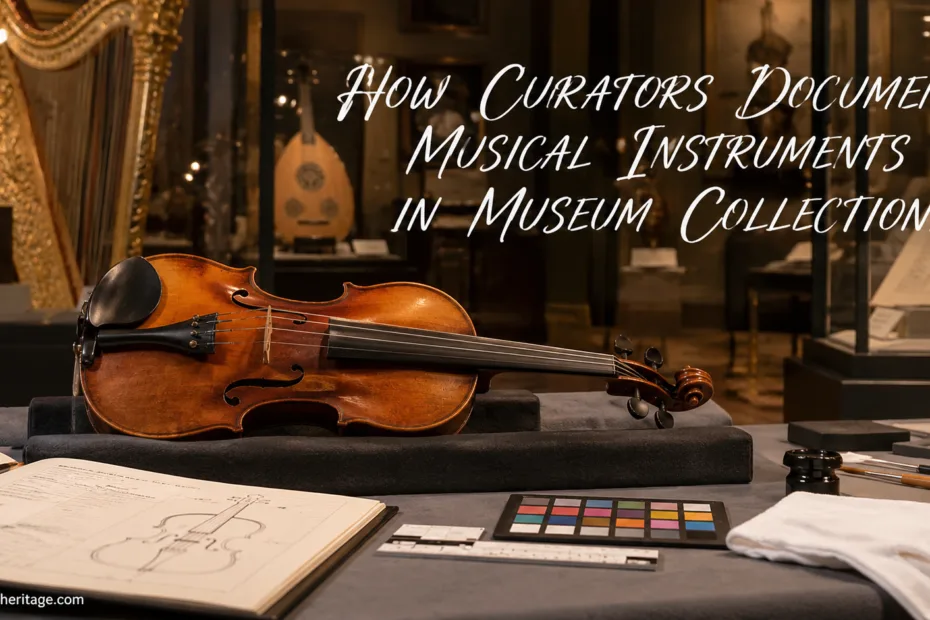
A museum record for a musical instrument can contain far more than a name, maker and date. Curators and collections staff may document its construction, measurements, materials, marks, provenance, alterations, condition, classification and current location, while photographs and technical examinations preserve details that words alone cannot describe. Some fields are straightforward. Others remain uncertain for years and are revised when better evidence appears.
| Record area | What may be documented | Why it matters for musical instruments |
|---|---|---|
| Identity | Object number, preferred name, alternative names, classification | Keeps the physical object connected to its museum record and related components |
| Production | Maker, workshop, manufacturer, place, date, attribution | Separates documented manufacture from probable or uncertain attribution |
| Construction | Materials, components, techniques, mechanical features | Records how the instrument was built and which parts may have changed |
| Measurements | Family-specific dimensions, bore, string length, body dimensions, compass | Allows useful comparison between related instruments |
| Marks | Labels, stamps, signatures, serial numbers, inscriptions, repair marks | Preserves physical evidence without assuming every mark identifies the maker |
| History | Ownership, acquisition, performers, collections, documented use | Builds provenance from identifiable evidence |
| Condition | Cracks, wear, corrosion, loose parts, missing components, earlier repairs | Records the object’s physical state at a particular time |
| Function | Playable state, tuning, sounding parts, performance restrictions | Distinguishes an instrument that can produce sound from one suitable for museum performance |
| Digital documentation | Photography, audio, radiography, CT data, 3D records where needed | Preserves visual, acoustic or internal information for research |
| Collections control | Storage location, movements, loans, associated objects | Helps staff track instruments and detachable components |
🏷️ The Museum Identity Comes First
Before detailed research begins, the museum needs a reliable way to distinguish one object from every other object in its care. A unique object number connects the physical instrument with catalogue data, condition records, photographs, location information and later research.
This becomes less simple when an instrument arrives with detachable or associated material. A violin may have a bow and case. A trumpet may arrive with several mouthpieces. A bagpipe can contain a bag, chanter, drones and stocks. A zither may have a tuning key, while a drum may retain its original sticks.
The museum has to decide whether these are parts of one catalogued object, separately numbered objects, accessories or associated material. Whatever system is chosen, their relationship needs to remain visible in the record.
Object identity and association are different. A historic bow stored with a violin may be closely associated with it without being part of the violin itself. Separate documentation prevents that distinction from disappearing.
Modern collections practice also treats cataloguing as an ongoing process, rather than a record that becomes permanently finished after accession. New research, conservation work and newly identified sources can change what is known about an instrument. Reference-1✅
Naming and Classifying an Instrument
An instrument name can look obvious until several naming traditions meet in the same record. Museums may need to preserve a preferred catalogue term, a name supplied by a donor, a historic name, a regional term, another-language name and an organological classification.
These fields do different jobs. Object name identifies what the museum calls the instrument. Classification places it within a structured system. Cultural or historical names preserve terminology connected with particular sources and contexts.
Hornbostel-Sachs adds a structural layer
Musical instrument databases often use the Hornbostel-Sachs system because it classifies instruments according to how sound is generated. In the MIMO vocabulary, the broad classes include idiophones, membranophones, chordophones, aerophones and electrophones. Beneath those classes are much narrower categories for particular sound-producing mechanisms. Reference-2✅
A violin can therefore be recorded as a violin while also being classified as a bowed chordophone. A museum does not have to choose one description and discard the other. The fields answer different questions.
Name, classification and variant should remain separate
Object name: Violin
Classification: Bowed chordophone
Variant or description: Four-string violin with later fittings
The exact fields and terminology vary between collections.
Maker, Workshop, Place and Date
A name printed or handwritten inside an instrument is valuable evidence, but it does not automatically settle authorship. Curators compare the inscription with construction, materials, workmanship, documented workshop practice, serial information and earlier records.
This is especially important with instruments that have been repaired, assembled from parts or relabelled during a long working life. The label itself still deserves documentation. Its presence is a physical fact even when the interpretation remains uncertain.
Attribution language records different levels of confidence
- Made by — authorship is supported strongly enough for the museum to state it directly.
- Attributed to — available evidence supports a maker, but the identification is not treated as fully settled.
- Workshop of — the object is connected with a workshop rather than securely with one individual maker.
- Possibly by — evidence points toward a maker but remains limited.
- Formerly attributed to — an earlier identification is retained as part of the record’s history.
- Maker unknown — the evidence does not support a responsible attribution.
Uncertainty is useful catalogue information. A carefully recorded “maker unknown” can be more useful to future research than a precise name unsupported by the object.
Date information is handled in the same way. An exact documented year, a date derived from a serial sequence, an approximate period and a stylistic estimate should not be presented as though they carry the same level of certainty.
Physical Marks Are Recorded Separately from Their Interpretation
Musical instruments can carry several generations of markings. A curator may encounter a maker’s stamp beside a retailer label, an old collection number, a repair inscription and a later owner’s initials on the same object.
- maker labels and printed labels;
- brands, stamps and signatures;
- serial and model numbers;
- patent or manufacturing marks;
- repairers’ labels and dated repair notes;
- handwritten tuning or setup notes;
- ownership inscriptions;
- earlier museum or collection numbers.
A useful record separates what is physically present from what the mark is thought to mean. If an inscription reads “J. MARTIN / 1898,” the transcription can preserve those exact words while another field discusses whether J. Martin was a maker, dealer, owner or repairer.
📏 Measurements Depend on the Instrument Family
Height, width and depth are rarely enough for serious musical-instrument documentation. Curators choose measurements that describe the parts affecting construction, scale, playing geometry and comparison with related examples.
| Instrument family | Measurements that may be useful | What they can help describe |
|---|---|---|
| Bowed strings | Body length, upper and lower bouts, rib depth, neck length, vibrating string length | Body proportions, setup and relationships among related instruments |
| Plucked strings | Body dimensions, scale length, neck, fingerboard, bridge position, string spacing | Construction geometry and playing setup |
| Woodwinds | Total length, joint lengths, bore information, bell diameter, tone-hole positions | Bore design, fingering arrangement and construction |
| Brasswinds | Tube length where practical, bell dimensions, bore features, valve arrangement | Instrument form, mechanical layout and comparison |
| Drums | Shell diameter, depth, membrane diameter, tensioning arrangement | Shell construction and playing dimensions |
| Keyboard instruments | Case dimensions, compass, key dimensions, string lengths where relevant | Keyboard range, scale design and internal arrangement |
Measurements should also record what was actually measured. “Length: 600 mm” is less useful than “overall length including mouthpiece” or “body length excluding endpin.” A future researcher needs to be able to understand and, where possible, repeat the measurement.
🪵 Materials Are Recorded Component by Component
Describing a stringed instrument simply as “wood” removes much of the information preserved in its construction. Museums may document materials according to component: soundboard, back, ribs, neck, fingerboard, fittings, strings, keys, membranes, metalwork, coatings and decorative elements.
The level of detail depends on what can be identified responsibly. Visual examination may support an identification in one case while another material requires specialist analysis. When certainty is limited, the record can say so rather than turning an estimate into a fact.
- Soundboard
- Spruce (visual identification)
- Back and ribs
- Maple
- Fingerboard
- Ebony; possibly a later replacement
- Pegs
- Dark hardwood; species not recorded
- Varnish or coating
- Recorded separately from the underlying wood where examination allows
This approach also makes later replacements easier to see. An instrument is not always a single untouched group of original materials. Parts can belong to different moments in its working history.
Provenance Is More Than the Museum’s Acquisition Record
Acquisition history explains how an instrument entered the collection. Provenance can extend much further, tracing earlier owners, performers, workshops, collections, sales and documented locations.
A museum may investigate purchase records, collection inventories, workshop ledgers, correspondence, photographs, performance programmes, sale catalogues and earlier object files. The resulting chain is often incomplete. Gaps remain visible rather than being filled with assumptions.
Reported history is preserved, but labelled correctly
A donor may provide valuable information such as a family association with a particular performer or ensemble. If that association has not yet been verified independently, it can still be recorded as reported family history rather than being presented as established ownership.
Evidence type matters. An ownership inscription on the instrument, a dated photograph and a later recollection can all contribute to provenance, but they do not provide identical kinds of evidence.
🔧 Repairs, Alterations and Condition Need Separate Records
Historic instruments were often maintained as working objects before entering museums. Bridges were replaced, cracks repaired, keys altered, pads renewed, tuning systems changed, membranes replaced and mechanical parts adjusted. These changes can carry information about use, workshop practice and earlier maintenance.
A catalogue description and a condition record therefore serve different purposes. “Eight brass keys” describes the instrument. “Two keys are loose” describes its condition at the time of examination.
Catalogue description
Records what the object is.
Example: spruce soundboard with two f-shaped soundholes.
Condition observation
Records its present physical state.
Example: repaired crack extending from the lower edge of the soundboard.
Condition documentation may note cracks, deformation, corrosion, surface wear, loose joints, missing pieces, detached components and earlier treatments. Repeated assessments create a dated history of physical change, which is why museum collection standards treat condition checking as a record that can develop over time. Reference-3✅
“Playable” Does Not Answer Every Museum Question
A historic instrument may still produce sound yet be unsuitable for regular performance. Curators and conservators can distinguish between several states: capable of sounding, physically playable, prepared for a controlled performance, or restricted from playing.
The decision can depend on fragile materials, joints, old repairs, mechanical wear, strings, reeds, membranes and the amount of handling required. Keyboard instruments add another layer because their actions, strings, soundboards and structural loading interact as one system.
A sound recording also needs documentation
If a museum records an instrument, the audio is most useful when it is connected to information about the instrument’s state at that session. Relevant metadata can include the performer, recording date, tuning, pitch reference, strings or reeds in use, replaced components and preparation carried out before recording.
The recording then documents the sound of that particular instrument in a defined setup. It does not need to claim that the sound is identical to what listeners would have heard when the instrument was newly made.
📷 Photography Is Part of the Evidence Record
A single attractive photograph is rarely sufficient for collections documentation. Museum photography is usually intended to make the instrument identifiable and to preserve details useful to later examination.
- a complete object view;
- front, back or other family-appropriate orientations;
- side and angled views where they reveal construction;
- maker labels, stamps and inscriptions;
- mechanisms, joints and fittings;
- areas of repair or alteration;
- serial numbers and other identifying marks;
- detachable parts and associated accessories when needed.
Musical-instrument digitisation projects have developed specialised recording practices because a flute, piano, drum and harp cannot all be photographed meaningfully with the same set of views. MINIM-UK, for example, describes using MIMO-derived cataloguing and photography methods, including instrument-specific fields and preferred photographic positions where practical. Reference-4✅
Technical imaging is used when the question requires it
Some investigations go beyond ordinary photography. Depending on the instrument and research question, specialists may use radiography, computed tomography, 3D recording, photogrammetry or internal examination. These methods can reveal construction that is hidden from normal view.
- internal bracing and joints;
- wall thickness or bore construction;
- hidden fasteners;
- internal cracks;
- earlier structural repairs;
- construction features that cannot be reached safely;
- relationships between internal mechanical components.
Such methods are selected for a purpose. Ordinary visual documentation remains sufficient for many catalogue questions, while technical imaging is reserved for cases where it adds information that cannot be obtained safely in a simpler way.
💾 How the Information Becomes a Digital Museum Record
The visible online catalogue is often only part of the record. A collections database can separate information into fields so that names, makers, dates, dimensions, materials, places and classifications can be searched and updated without turning the entire entry into one long paragraph.
Object information
- object number
- preferred name
- classification
- maker or manufacturer
- place and date
- materials and techniques
- measurements
- inscriptions and marks
History and management
- provenance
- acquisition
- associated people
- condition
- conservation
- location and movement
- photographs and digital files
- research notes
Controlled vocabularies make those records easier to connect. If one catalogue uses “violin,” another uses a translated term and a third preserves an older local name, authority records can keep the terms related while maintaining one searchable preferred concept.
Structured data also allows records to travel between systems
Musical-instrument projects may map local catalogue fields to shared cultural-heritage data structures such as LIDO. The museum can retain its own internal database while presenting selected fields in a form that another catalogue or aggregation service can interpret.
The record develops in stages
- The instrument enters the museum’s documentation system.
- A unique identity and basic object information are established.
- Associated parts and accessories are linked.
- Measurements, materials, marks and photographs are added.
- Condition and earlier alterations are recorded.
- Provenance and maker information are researched.
- Specialist examination may refine the date, attribution or construction description.
- Exhibition, storage, conservation, loan or recording activity generates further documentation.
- Later research can revise earlier interpretations while preserving the history of those changes.
Museum Records Change When the Evidence Changes
An older catalogue may identify an instrument by maker and date with great confidence. A later examination may find that the construction does not fit that attribution. Another researcher may discover a workshop ledger or dated photograph. The record can then be revised without pretending the earlier identification never existed.
An attribution can develop over time
Earlier record: Violin, maker named on internal label, late eighteenth century.
Later examination: Construction differs from securely documented examples by that maker.
Revised record: Maker uncertain; label transcribed and photographed; earlier attribution retained in record history.
This distinction between observation and interpretation is one of the most useful habits in museum documentation. The dimensions of a body, the wording of a label and the position of a repair are observations. A proposed maker, date or sequence of alterations may be an interpretation based on those observations.
Conflicting evidence is kept visible
An instrument can carry several pieces of evidence that do not agree neatly. A label may suggest one date, construction another, and an ownership note a third. Rather than forcing every field into a single tidy narrative, a useful record preserves the conflict and identifies which statements are documented, inferred or still unresolved.
- Observed
- Information directly recorded from the object, such as dimensions, marks or construction features.
- Documented
- Information supported by an identifiable archival, collection or published record.
- Attributed
- An identification based on comparison and specialist assessment.
- Reported
- Information supplied by an owner, donor or earlier source that is preserved with its status clearly stated.
- Unknown
- A field that available evidence does not currently resolve.
Documentation Changes with the Instrument Being Examined
The same museum principles apply across collections, yet the useful evidence is not identical for every instrument. A violin, transverse flute, snare drum, piano and electronic instrument present different construction questions.
| Example | Documentation may give extra attention to |
|---|---|
| Violin | Body proportions, vibrating string length, arching, varnish, internal label, fittings, repaired cracks, bow association |
| Flute | Bore, sections or joints, embouchure, tone-hole arrangement, key system, maker marks, replacement pads or mechanism |
| Drum | Shell material, diameter and depth, membrane, tensioning system, bearing edges, decoration, sticks or beaters |
| Piano | Keyboard compass, action, stringing, frame, soundboard, serial number, case construction, mechanical alterations |
| Electronic instrument | Controls, circuitry or modules, interfaces, power requirements, hardware revisions, firmware or software relationships where relevant |
This is why musical-instrument cataloguing benefits from organological knowledge. General museum documentation identifies the object and manages its history; instrument expertise determines which construction details are worth recording in depth.
What a Well-Developed Instrument Record Can Preserve
A mature museum record may eventually connect several forms of evidence that were created at different times. Not every instrument will have every field, and some records remain deliberately brief when the evidence is limited.
- Identity: object number, preferred name and related components.
- Classification: instrument family and controlled vocabulary terms.
- Production: maker, workshop, manufacturer, place and date with the appropriate confidence level.
- Physical description: construction, materials, dimensions and decorative features.
- Marks: transcriptions and photographs of labels, stamps, serial numbers and inscriptions.
- History: provenance, acquisition, ownership and documented performer associations.
- Alterations: replacements, repairs and structural modifications.
- Condition: dated observations that can be compared with later assessments.
- Function: playable state, setup information and restrictions where these are documented.
- Media: catalogue photography, detail images, audio and technical imaging when available.
- Collections management: storage location, movement history, loans and conservation activity.
- Research history: revised dates, changed attributions and unresolved questions.
An instrument may spend most of its museum life in storage rather than on display. Detailed documentation keeps its materials, makers, measurements, ownership evidence, alterations and unanswered questions available to curators, conservators, makers, musicians and researchers without requiring repeated handling of the physical object.
Questions About Musical Instrument Documentation
What information do museums record about musical instruments?
Museums may record an object’s number, name, classification, maker, date, place of manufacture, materials, construction, dimensions, inscriptions, provenance, condition, repairs, photographs, location and associated people or objects. The exact fields depend on the collection and the instrument.
Does a maker’s label prove who made an instrument?
No. A label is physical evidence that should be transcribed and photographed, but attribution can also require examination of construction, materials, workmanship, serial information and documented examples. Museums can record uncertain or former attributions separately.
Why do curators take so many measurements of one instrument?
Different measurements describe different aspects of construction. A violin’s body dimensions and vibrating string length, a flute’s bore and tone-hole arrangement, or a drum’s shell diameter can support comparison, identification and later research more effectively than overall height and width alone.
Are repaired parts included in museum documentation?
Yes. Repaired, replaced or altered parts can form part of the instrument’s documented history. A museum may distinguish an original component from a later replacement while recording both.
What is the difference between provenance and acquisition history?
Acquisition history records how the museum obtained the object. Provenance can trace earlier ownership, collections, performers, sales and locations before the instrument entered the museum.
Do museums record whether an old instrument can still be played?
They may. Playable condition can be documented separately from permission to use the instrument. An instrument may still make sound while its materials, repairs or mechanical condition make regular performance unsuitable.
Why are museum catalogue records sometimes changed?
New archival evidence, specialist examination, conservation work or better material identification can change a maker attribution, date, provenance statement or construction description. Well-managed records preserve those revisions rather than presenting earlier research as though it never existed.
What is Hornbostel-Sachs used for in museum collections?
Hornbostel-Sachs provides a structured way to classify musical instruments according to their sound-producing principle. Museums can use it alongside ordinary instrument names, allowing a record to retain both familiar terminology and an organological classification.
