| Feature | What it means | Why it matters to the sound |
|---|---|---|
| Instrument family | Idiophone; the body of the bowl itself vibrates to create sound Reference-1✅ | No string, reed, membrane, or air column makes the main tone. The metal or crystal wall is the voice. |
| Common names | Singing bowl, standing bell, resting bell, Himalayan bowl, Tibetan-style bowl, rin bowl, temple bowl | Different names often point to different shapes, places of use, or playing traditions. |
| Main sound methods | Struck with a mallet or rubbed around the rim | A strike gives a bell-like attack; rim rubbing feeds energy into the bowl until the tone blooms. |
| Usual materials | Bronze alloys, bell metal, brass-like alloys, quartz crystal, and newer composite materials | Material hardness, density, and elasticity shape sustain, brightness, warmth, and volume. |
| Sound character | Layered tone, slow shimmer, audible beating, overtones, long decay | The bowl rarely gives one plain pitch. It carries a cluster of partials that move around each other. |
| Shape influence | Rim thickness, wall curve, diameter, base size, and hammering pattern | Small changes can alter pitch, response, volume, and how easily the bowl “sings.” |
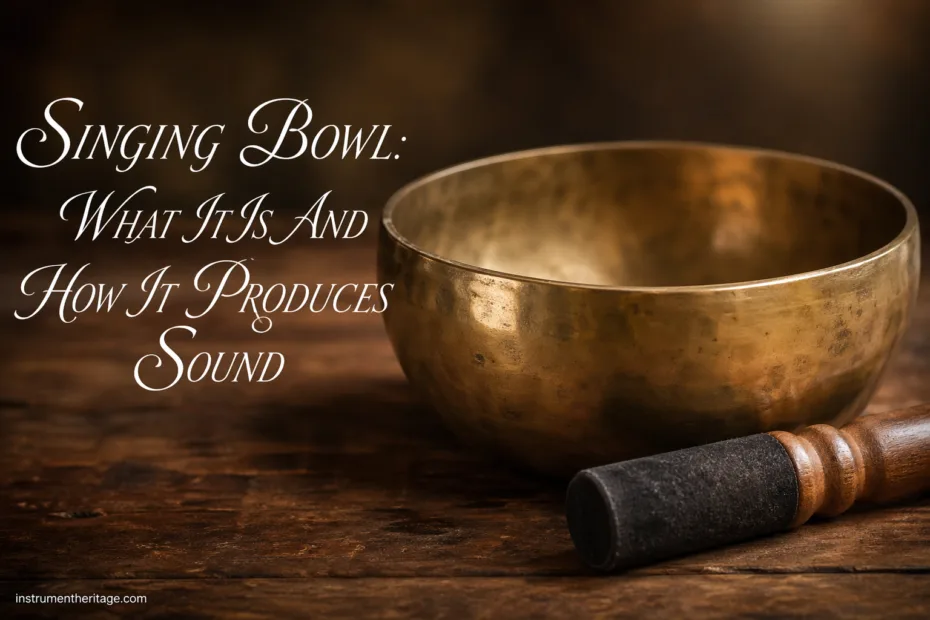
A singing bowl looks simple until you hear one properly. A rounded vessel sits on a cushion or in the hand, a mallet touches the rim, and the sound begins to open like a circle on water. No strings. No holes. No hidden mechanism. The bowl itself is the instrument. Its wall bends in tiny waves, its rim moves in and out, and the air around it carries a tone that feels steady at first, then slightly alive. That soft wobble is not decoration; it is part of the physics.
Most people meet the singing bowl through meditation rooms, yoga studios, recordings, or small music shops. Yet it also belongs in a wider family of standing bells, struck idiophones, friction-played vessels, bronze ritual instruments, and acoustic sound objects. It can be understood as craft, as music, as material science, and as a listening tool. One bowl can teach a lot about resonance.
- 🥣 Bowl-shaped idiophone
- 🔔 Resting bell family
- 🎵 Rich overtones
- 🪵 Played with a mallet
- ⚙️ Resonance-driven sound
What a Singing Bowl Really Is
A singing bowl is a bowl-shaped musical vessel that produces tone when its wall vibrates. In organology, that places it among idiophones: instruments whose own solid body produces the sound. A xylophone bar, a cymbal, a bell, and a singing bowl all share this broad idea, even though they feel very different in the hand.
The bowl is usually placed with its open rim facing upward. That is why it is often called a standing bell or resting bell. Unlike a hanging bell, it does not need a clapper inside. It is supported from below, and the rim remains free to vibrate. The Met describes a Japanese dobachi as a resting bell and notes a useful difference: a bell vibrates most strongly near the edges, while a gong vibrates most strongly nearer the center Reference-2✅
That edge behavior matters. When the rim is free, it can flex in repeated patterns. The bowl is not simply “ringing” as a solid lump. Its wall is breathing in tiny motions too fast to see, and those motions push the surrounding air into sound waves.
🥣 The bowl is the resonator and the sound source
On a guitar, the string starts the vibration and the wooden body helps amplify it. On a singing bowl, the body starts the vibration and also radiates it. The rim, wall, belly, and base all take part. That is why two bowls with the same diameter can still sound unlike each other.
How a Singing Bowl Produces Sound
The sound begins with energy. You give the bowl a small push by striking it or rubbing it. The bowl turns that physical touch into vibration. The vibration moves through the wall, reaches the rim, and travels into the air as audible tone. Simple enough. The details are where it gets interesting.
Striking the bowl: the bell-like voice
When you tap the outer wall or rim with a mallet, the bowl responds with a clear attack. The first moment can be bright, almost like a small bell. Then the tone spreads out. Some frequencies fade fast; others hang in the air. A well-made bronze bowl may leave a long, warm trail after the strike, especially when the rim is even and the alloy has good elasticity.
The place of the strike changes the sound. A tap near the rim often gives more shimmer. A lower tap on the side can feel rounder. A harder mallet brings out more high partials; a padded mallet softens the attack. This is why players often test a bowl from several contact points rather than judging it from one tap.
Rubbing the rim: the “singing” effect
Rim playing works differently. The player presses a wooden, suede, or leather-wrapped mallet against the outside rim and moves it in a steady circle. The contact is not a single event. It is a repeated push. If the speed, pressure, and angle fit the bowl, the rim begins to pull energy from the motion. The tone grows. It may start as a faint hum, then become full and steady.
This is close in feeling to rubbing a wet finger around the rim of a glass, though a metal bowl has its own weight, resistance, and overtone behavior. The mallet alternately grips and slips against the rim. That small cycle feeds vibration. Too little pressure, and the tone never catches. Too much pressure, and the motion chokes. The sweet spot feels like guiding a wheel that already wants to turn.
Listen for this: a good rim tone does not simply get louder. It changes shape. You may hear a main pitch, then a higher ring, then a slow pulse between them. That pulse is part of the bowl’s beating pattern, created when nearby frequencies rub against each other in the ear.
Resonance: why the tone blooms
Every bowl has natural vibration patterns. When playing motion lines up with one of those patterns, resonance appears. The sound grows because each new push arrives at the right time, like nudging a swing at just the right moment. The Hong Kong Science Museum explains that striking or rubbing the edge creates vibration, and that size, thickness, material, and mallet choice all affect the tone; it also notes how water can lower vibration frequency and make the sound deeper Reference-3✅
Resonance is the reason a light circular motion can create a large sound. The player is not forcing volume by muscle alone. The bowl is cooperating. Once the right vibration mode wakes up, the wall can flex more widely, and the air hears the result.
Standing waves and the invisible shape of sound
A singing bowl does not vibrate evenly like a balloon expanding in all directions. Its rim can form wave patterns. Some parts of the rim move outward while other parts move inward. A moment later, they switch. These shapes are called modes. You cannot usually see them in an empty bowl, but you can hear them as tone color.
When water is placed inside a bowl, those hidden motions can become visible. The surface may ripple in neat patterns. At stronger vibration levels, the water can form standing waves, and in some demonstrations droplets may jump from the surface. That does not make the bowl magical. It makes it a beautiful classroom for vibration, liquid motion, and acoustic energy.
Materials: Bronze, Bell Metal, Crystal, and the Feel of the Tone
Material is not a small detail in a singing bowl. It is the voice’s skin and bones. A bowl needs enough stiffness to spring back after bending, enough mass to carry sustain, and enough internal balance to avoid a dull or unstable tone.
Bronze and bell-metal bowls
Traditional-style metal singing bowls are often made from bronze-family alloys, mainly copper with tin and sometimes small amounts of other metals. Exact formulas vary. A hard, ringing alloy can hold a long tone, but it is also less forgiving in shaping. A softer alloy may feel warmer yet lose some brightness.
The phrase seven-metal bowl appears often in shops and popular writing. It should be treated carefully. Some bowls may contain trace elements, and some makers may use multi-metal recipes, but a romantic metal list does not automatically prove age, origin, or sound quality. The ear and the craft matter more than a sales phrase. A plain bronze bowl made with care can sound deeper and more stable than a bowl sold with a long mythical recipe.
Hammered bowls and cast bowls
A hammered metal bowl is shaped through repeated blows, annealing, and finishing. Hammer marks may remain as shallow dimples. These marks are not just visual texture; they can show how the bowl was worked. Hammering can create slight asymmetries, and those tiny irregularities often add life to the sound. The tone may feel earthy, grainy, and complex.
Cast bowls are made by pouring molten metal into a mold, then trimming, polishing, or tuning the form. Casting can give a smoother look and more repeatable shape. Some cast bowls sound clear and strong; others feel plain. The method alone does not decide quality. Wall thickness, alloy, cooling, finishing, and tuning all matter.
Quartz crystal singing bowls
Quartz crystal singing bowls are newer in the broader history of these instruments. They are usually made from high-purity silica formed into a bowl shape. Their sound is often glassy, bright, and direct. Many produce a strong pitch center with a long, smooth sustain. Compared with bronze bowls, crystal bowls can feel more even and less woody in their overtone motion.
They are also fragile. A bronze bowl may survive normal handling for decades; a crystal bowl asks for a softer touch. The sound can be lovely, but the material behaves more like glass than metal.
| Build choice | Typical sound effect | What to notice when listening |
|---|---|---|
| Thicker rim | More mass, often stronger fundamental pitch | The tone may feel grounded, but it can need more energy to start. |
| Thinner rim | Faster response, brighter edge | The bowl may sing easily, though it can become sharp or glassy if too thin. |
| Wide diameter | Lower pitch range and broad sustain | Listen for slow waves and a wide, room-filling body. |
| Small diameter | Higher pitch, quicker response | Useful when a clear bell-like accent is wanted. |
| Hammered metal wall | Complex partials and moving shimmer | Small irregularities can create a living, slightly uneven tone. |
| Smooth crystal wall | Clean, bright, long sustain | The sound may feel more focused and less metallic. |
Shape, Rim, and Tuning: Why Two Bowls Never Behave the Same
A singing bowl’s pitch is not decided by diameter alone. The wall curve, rim weight, base size, and metal thickness all pull the sound in different directions. Think of the bowl as a small landscape. The rim is the ridge, the belly is the valley, and vibration travels through all of it.
A bowl with a broad open mouth often speaks with a wide, generous tone. A bowl with steeper sides can feel more focused. A heavy base may stabilize the instrument but can also reduce some free movement. A very even rim helps smooth circular playing. A slightly uneven rim may add character, though too much unevenness can make the mallet chatter.
🎵 Pitch center
The pitch you hum after hearing the bowl is usually the perceived main tone. It may not be the only strong frequency, but it gives the ear a home.
🔊 Overtone spread
The higher tones above the pitch center create brightness, shimmer, and tension. In many bowls, these partials move slowly against each other.
🌀 Beating
When two close frequencies sound together, the ear hears a pulse. This can feel like a gentle wave inside the tone.
🪵 Response
Response is how easily the bowl begins to sing. It depends on rim condition, mallet surface, pressure, speed, and the bowl’s natural modes.
Mallets: The Small Tool That Changes Everything
A singing bowl mallet is more than a stick. It is the bridge between hand and bowl. Wood, suede, felt, leather, and rubber-like surfaces all speak differently.
- Plain wood gives a clear, bright attack and can wake up high overtones fast.
- Suede-wrapped mallets grip the rim more gently and often make rim singing easier for beginners.
- Padded mallets soften the strike and bring out a rounder, less sharp tone.
- Large mallets suit larger bowls because they can transfer energy without sounding thin.
- Small mallets can make small bowls speak clearly, but they may sound scratchy on a large heavy rim.
The angle matters too. A vertical mallet can scrape. A slightly angled mallet may glide. Pressure is a balancing act: firm enough to grip, light enough to let the rim move. Once the bowl catches, the player often needs less force, not more.
Practical listening note: when testing a bowl, hear it both struck and rim-played. Some bowls have a beautiful struck tone but resist singing. Others sing easily yet have a weak strike. The best choice depends on the musical use, not on one universal rule.
History and Cultural Use Without the Fog
Singing bowls are often linked with Himalayan and Tibetan cultural settings, and with meditation, chanting, ritual sound, and personal listening practices. Related resting bells also appear in East Asian traditions, including Japanese rin and dobachi. The family is wide. The labels overlap. A bowl in a temple setting, a bowl in a sound bath, and a bowl used by a composer in a studio may share acoustic principles while living in very different musical spaces.
The history is sometimes told with more certainty than the evidence allows. Many modern claims about exact ancient origins, secret formulas, or fixed planetary metal recipes are repeated from shop language rather than careful instrument study. A better approach is calmer: singing bowls sit at a crossing point of metal craft, bell making, ritual sound, trade, modern wellness practice, and experimental music. That story is already interesting. It does not need decoration.
In present-day use, the bowl appears in several places:
- Music performance: composers and percussionists use bowls for sustained tones, soft accents, drone layers, and unusual textures.
- Meditation and breath work: the long decay gives listeners a clear sound to follow without a busy melody.
- Sound baths: bowls are often paired with gongs, chimes, frame drums, bells, and voice.
- Personal practice: many people use one bowl at home as a listening object, a timing cue, or a gentle start to quiet activity.
- Acoustic demonstrations: water-filled bowls make vibration visible through ripples and wave patterns.
A cautious wellness note belongs here. Some studies have looked at singing bowl sound meditation and mood-related measures, including tension and well-being, but a bowl should not be presented as a medical treatment or a replacement for care. It is safer and more accurate to describe it as a sound-based listening practice that some people find calming. One PubMed-indexed observational study examined singing bowl sound meditation in relation to mood, tension, and well-being Reference-4✅
Similar Instruments and Close Relatives
The singing bowl becomes easier to understand when placed beside its neighbors. It is not a gong, not a cup chime, not a handbell, and not a glass harmonica, though it shares pieces of behavior with each of them.
| Instrument | How it makes sound | How it differs from a singing bowl |
|---|---|---|
| Standing bell / resting bell | Supported from below; struck or sometimes rim-played | A singing bowl is a type of this wider family when it is bowl-shaped and played for sustained tone. |
| Japanese rin or dobachi | Bell-like vessel, often struck in temple or meditative settings | Often deeper in ritual context and may be larger, with different stands, beaters, and playing customs. |
| Gong | Flat or slightly curved metal disc, usually struck | A gong radiates strongly from its broad surface; a bowl’s rim and wall geometry shape the sound differently. |
| Handbell | Hollow bell with handle and internal clapper | The clapper excites the bell from inside; the singing bowl is usually struck or rubbed from outside. |
| Glass harmonica | Glass bowls or rims rubbed by wet fingers | It shares friction-driven resonance, but its material and keyboard-like layout create a different musical language. |
| Bell plate | Flat metal plate, struck | It gives bell color without the vessel shape, so the overtone behavior is less bowl-like. |
What to Hear Inside a Singing Bowl Tone
A singing bowl rewards slow listening. The first sound is only the doorway. After a strike, notice the attack, then the body, then the tail. Does the pitch stay stable? Does it wobble? Does a high ring appear after the lower tone fades? Does the bowl feel smooth, rough, bright, dry, or warm?
Rim playing gives another set of clues. A responsive bowl starts singing without a fight. The tone should grow in a controlled way, not jump into harsh scraping. Some bowls produce a clean single-feeling drone. Others produce a restless shimmer. Neither is automatically better. A composer may want complexity. A meditation leader may prefer steadiness. A collector may love a bowl with a slightly smoky, uneven color.
- Fundamental
- The pitch that feels like the main note, even when several tones are present.
- Overtone
- A higher vibration that colors the main tone and gives the bowl its shimmer.
- Decay
- How long the sound lasts after the bowl is struck or after rim motion stops.
- Mode
- A pattern of vibration in the bowl wall, such as rim sections moving in opposite directions.
- Beating
- A slow pulse heard when close frequencies interfere with each other.
Care, Handling, and Honest Expectations
A singing bowl is sturdy only in the way its material allows. Bronze bowls can handle normal use, but hard drops may crack, warp, or flatten the rim. Crystal bowls need more caution. A small chip can change the tone or create a weak point.
- Keep the rim clean so the mallet can move smoothly.
- Use a cushion or stable surface that does not choke the bowl’s base.
- Do not strike harder than needed; volume should come from resonance, not force.
- Store crystal bowls with space around them, away from hard edges.
- Let old metal bowls keep some patina unless cleaning is truly needed. Over-polishing can remove character.
There is also the matter of tuning. Many bowls are sold with note names such as C, D, or F. That can be useful, but it is not the whole story. A bowl may be near a named pitch while its overtones pull the ear elsewhere. For musical work, record the bowl, check it with a tuner if needed, then trust the ear. The shimmer is part of the instrument, not a flaw to erase.
Why the Singing Bowl Still Holds Attention
The singing bowl survives in modern listening because it offers something rare: a sound that is simple to start and difficult to fully explain. A beginner can make it ring within seconds. A careful player can spend years learning how pressure, speed, mallet surface, room acoustics, and bowl shape change the voice.
It is part instrument, part resonant object. The best bowls do not shout. They invite the ear closer. One tap, one circle around the rim, and the metal begins to draw a line through the air.
Singing Bowl FAQ
What is a singing bowl?
A singing bowl is a bowl-shaped idiophone. Its own body vibrates when struck or rubbed, producing a sustained tone with overtones and a slow decay.
How does a singing bowl produce sound?
It produces sound through vibration. A mallet transfers energy to the bowl, the wall and rim flex in natural vibration patterns, and those motions push air outward as sound waves.
Why does rubbing the rim make the bowl sing?
Rubbing gives the rim repeated energy. When the motion matches one of the bowl’s natural vibration modes, resonance builds and the tone grows stronger.
Is a singing bowl the same as a bell?
It is closely related to a bell, especially a standing or resting bell. The difference is mainly in shape, support, and playing style. A singing bowl is usually supported from below and played from the outside.
What are singing bowls made from?
Many are made from bronze-family alloys, including copper and tin. Modern bowls may also be cast from other alloys or made from quartz crystal.
Why do singing bowls have overtones?
The bowl wall can vibrate in more than one pattern at the same time. Each pattern creates a different frequency, so the ear hears a layered tone rather than one plain note.
Can water change the sound of a singing bowl?
Yes. Water adds mass and interacts with the vibrating wall, often lowering the apparent frequency and changing the sustain. Strong vibration can also create visible ripples or standing wave patterns.
Are crystal singing bowls different from metal singing bowls?
Yes. Crystal bowls usually sound brighter, smoother, and more pitch-centered, while metal bowls often have a warmer, more complex overtone spread. Crystal bowls are also more fragile.
