| Aspect | Detail |
|---|---|
| Instrument name | Ondes Martenot, also known as ondes musicales, meaning “Martenot waves” or “musical waves.” |
| Inventor | Maurice Martenot, a French musician and radio-minded instrument maker. |
| First public appearance | 3 May 1928 at the Paris Opéra, using an early prototype quite different in shape from later models.Reference-1✅ |
| Instrument family | Electronic musical instrument, usually classed as an electrophone. |
| Sound production | Electronic oscillators create a controllable tone; the instrument uses the heterodyne principle to turn very high frequencies into an audible musical pitch. |
| Pitch control | A finger ring on a ribbon or wire, later joined by a keyboard capable of lateral vibrato. |
| Expression control | A left-hand pressure key, often called the touche d’intensité, shapes attack, volume, and phrasing. |
| Texture | Monophonic: it normally sings one note at a time, more like a voice, flute, or cello line than a chord-playing keyboard. |
| Main materials | Wooden cabinet, metal rail and wire parts, copper and electronic components, switches, valves or later transistor circuits, and dedicated loudspeakers. |
| Best-known tone quality | A smooth, vocal, gliding sound that can feel close to a human voice, a bowed string, or a pure sine-like tone. |
The Ondes Martenot does not behave like a normal keyboard, and that is the first thing to understand. A piano begins with a hammer. A violin begins with a bow. This French electronic instrument begins with a controlled electrical tone, then gives the player a way to bend it, breathe through it, and shade it by hand. The result is not a machine pretending to be an orchestra. It is a solo voice with wires, wood, pressure, and touch behind it.
For many listeners, the Ondes Martenot sounds familiar before it looks familiar. It can float over an orchestra like a high soprano line, slide between notes without steps, or settle into a soft, humming color that feels almost acoustic. That is its charm. The instrument is electronic, yes, but its playing style is deeply physical. The right hand shapes pitch. The left hand releases the sound. The ear follows tiny movements.
What the Ondes Martenot Sounds Like
The sound of the Ondes Martenot is often described as vocal, but that word only gets halfway there. A voice has breath and muscle. The Ondes Martenot has voltage and touch. When played gently, it can glow like a bowed glass tone. When pushed harder, it can take on a sharper, reedier edge. The same note can feel calm, trembling, silvery, or almost string-like depending on the player’s hand pressure and chosen timbre.
Its famous glide is not a gimmick. The ribbon lets the player move through pitch in a continuous line, so the note can lean, sigh, and arrive late by a hair. That is why the instrument sits so well beside strings, flute, women’s voices, and slow orchestral textures. It does not simply jump from C to D. It can travel there.
🎵 The main idea: the Ondes Martenot is electronic in source, but human in gesture. Its pitch, volume, attack, and color depend on small movements that are closer to bowing and singing than to pressing a standard synthesizer key.
The voice-like line
A good Ondes Martenot line has a living edge. It does not sit flat. The player can add vibrato with the keyboard, stretch a pitch with the ring, or keep the sound almost still. That fine control gives the instrument its strange emotional directness. It can sound innocent. It can sound distant. It can sound like a note remembered rather than a note struck.
Why it feels different from a synthesizer
Modern synthesizers can copy many waveforms, but the Ondes Martenot is not only about waveform. Its character comes from the playing system: ribbon, pressure key, timbre switches, and diffuseurs working as one handmade instrument. A preset may imitate the surface. The Ondes Martenot has fingers under the surface.
How the Instrument Is Built
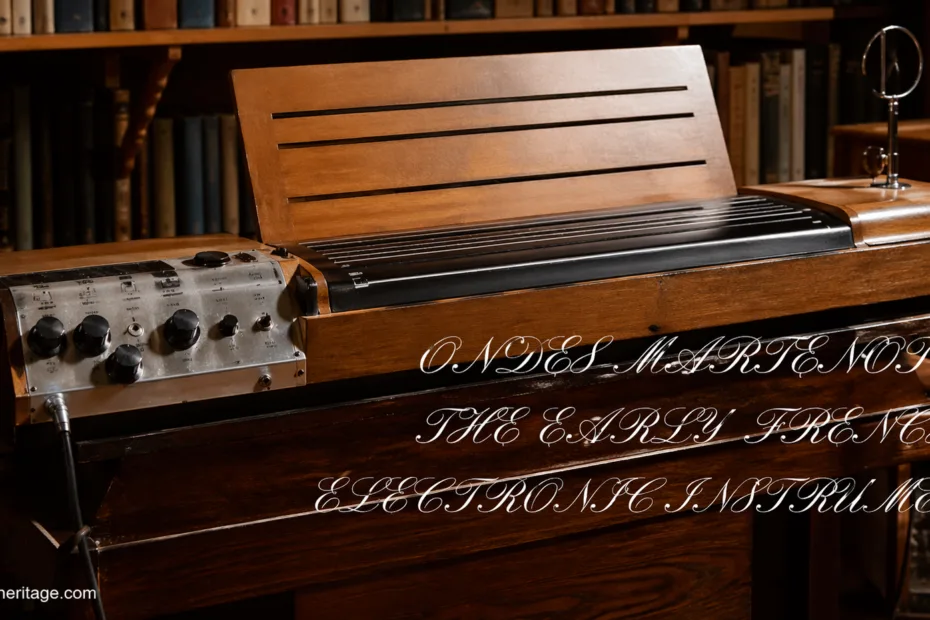
The classic Ondes Martenot looks like a narrow keyboard instrument with a small control drawer on the left and a ribbon running in front of the keys. Its body is usually made around a wooden cabinet, with metal rails, electrical components, and a dedicated speaker system. The instrument feels part laboratory, part salon instrument. Wood, wire, copper, and current all have a job.
The early tone source used electronic oscillators. In simple terms, two very high frequencies interact, and the audible musical note comes from the difference between them. Britannica describes this as oscillating radio tubes producing pulses at two supersonic frequencies, with the lower audible result amplified through a loudspeaker.Reference-2✅
| Part | What it does | Why it matters musically |
|---|---|---|
| Ribbon and ring | The player wears or holds a ring connected to a wire or ribbon and moves it along the pitch rail. | Allows smooth glissando, exact slides, and very vocal phrasing. |
| Keyboard | Later models include a keyboard that can shift sideways for vibrato. | Gives the player familiar note positions while keeping a flexible, singing pitch. |
| Touche d’intensité | A pressure-sensitive left-hand control that releases and shapes the sound. | Controls attack, volume, and phrasing with tiny changes in pressure. |
| Timbre drawer | Switches and controls change the color of the electronic tone. | Lets the same melody move from pure and flute-like to nasal, stringy, or bright. |
| Diffuseurs | Special loudspeakers and resonators project the sound. | The speaker is not just output; it becomes part of the instrument’s voice. |
The expression key is the hidden heart
Many people notice the ribbon first, because it is visually unusual. Players often talk just as warmly about the left-hand expression key. Without pressure, there is silence. With slight pressure, the sound blooms. Press harder, and the tone grows. Release it too fast, and the note can vanish like a candle being pinched out.
This is why the Ondes Martenot can phrase so beautifully. The player does not merely choose loud or soft. The player shapes the beginning of the note, the swell, the fade, and the little swell inside a sustained tone. That gives the instrument a breathing quality, even though no air passes through it.
The diffuseurs: speakers with personality
The Ondes Martenot’s loudspeakers, often called diffuseurs, are one of its most overlooked features. A plain amplifier would make the instrument audible. Martenot wanted more than that. Different diffuseurs color the tone in different ways, a little like changing from a plain room to a wooden hall, then to a shimmering resonant chamber.
- Diffuseur principal: the main loudspeaker, usually the most direct and clear.
- Diffuseur métallique: a speaker linked with metal resonance, adding a bright, ringing edge.
- Diffuseur palme: a resonating speaker with sympathetic strings, giving the tone a halo-like shimmer.
- Resonance-based projection: some setups use the speaker as a tone-shaping body, not just a volume device.
The Musée de la musique describes a 1930–1934 Ondes Martenot with one mobile diffuseur holding two loudspeakers, plus a left-side drawer for timbre controls and the expression/intensity key.Reference-3✅ That detail matters because it shows how early the instrument already depended on touch, color, and projection as a single design.
How Musicians Play the Ondes Martenot
The Ondes Martenot asks for two kinds of discipline at once. The player must know pitch placement with care, then shape tone with the sensitivity of a singer. It is easy to make a slide. It is much harder to make a slide that lands with taste. That is where the instrument becomes serious musicianship, not a novelty sound.
Right hand: pitch, glide, and vibrato
On the ribbon, the right index finger controls pitch by moving the ring along a marked keyboard-like scale. Because the pitch is continuous, the player must trust the ear. There is no fret. No piano hammer catches the note for you. The hand must stop in exactly the right place.
On later keyboard models, the right hand can also play pitches more like a standard keyboard, but with a special twist: the keys can move laterally. That sideways motion creates vibrato. A normal piano key goes down and comes back up. An Ondes Martenot key can waver, which is why a held note can feel alive even without a ribbon slide.
Left hand: attack, volume, and color
The left hand works in the control drawer. It presses the expression key and changes timbre settings. This hand decides whether a note speaks softly, blooms slowly, or appears with a firmer edge. In that sense, the Ondes Martenot splits the musician’s task: one hand finds the note, the other gives it a body.
🎚️ A small movement can change the whole phrase
On many instruments, volume is set before the note begins. On the Ondes Martenot, volume is part of the gesture itself. A player can press into a note as if leaning into a bow stroke, then pull back without breaking the line. That is why slow melodies can feel so close and personal.
Why intonation is demanding
The ring technique is beautiful because it is free. That freedom comes with a cost. The player must learn where every pitch lives along the ribbon, then control slides without overshooting. Vibrato must be wide enough to breathe but not so wide that the line loses center. Simple melodies expose everything. No hiding place.
This is one reason trained ondists are rare. The instrument is not only hard to find; it has its own grammar. A pianist can understand the keyboard, and a string player may understand the pitch sensitivity, but the Ondes Martenot combines both with electronic tone control. It rewards patience.
A Short History of the Ondes Martenot
Maurice Martenot was not trying to make a cold technical object. He was interested in musical line, expression, and the way electronic sound could be handled with the finesse of a bowed instrument. That is why the Ondes Martenot grew into something different from many early electrical experiments. It was built for phrasing.
The public story begins in Paris in 1928. Early prototypes used a wire or ribbon control and a separate expression system. Around the early 1930s, seated keyboard playing became part of the design, and the instrument slowly gained the form most listeners now recognize: a long keyboard, a ribbon in front, a control drawer, and special speakers.
By the 1930s, Martenot was refining not only the instrument’s pitch system but also the way its tone reached the room. That matters. Many electronic instruments of the period were fascinating in theory, yet awkward in musical use. The Ondes Martenot survived because its design kept asking a simple question: can a player phrase with it?
- 1928
- Public debut of the Ondes Martenot in Paris.
- Early 1930s
- Keyboard-based models and more refined performance controls appear.
- 1937
- Models from this period show a seven-octave keyboard and multiple diffuseurs, including metallic and palme types.Reference-4✅
- Mid-20th century
- French composers and specialist performers help build a serious concert repertoire.
- Later decades
- The instrument remains a rare but loved voice in concert music, film scoring, and art-minded popular music.
Why France mattered to its identity
The Ondes Martenot belongs strongly to French musical culture, not just because of its inventor. Its early life is tied to French conservatory training, Parisian concert life, instrument workshops, and composers who were curious about new colors without giving up melody or form. That gave the instrument a home.
It also explains why the Ondes Martenot never became a mass-market keyboard. It was closer to a crafted concert instrument than a household electronic device. Many examples were built or adjusted with player needs in mind. The result is a lineage of instruments with family resemblance rather than factory sameness.
Music Written for the Ondes Martenot
The Ondes Martenot entered music history because composers heard something they could not get elsewhere. It could sing above an orchestra without sounding like a flute. It could merge with strings without becoming a violin. It could hold a pitch in a way that felt pure, then bend out of it like liquid metal. That unique color shaped its repertoire.
Concert music and orchestral writing
Olivier Messiaen is the composer most closely linked with the instrument in many listeners’ minds. His Turangalîla-Symphonie uses the Ondes Martenot as a solo color beside piano and orchestra. The instrument does not sit politely in the background. It rises, bends, sings, and gives the score a glowing thread of sound.
Messiaen also wrote for multiple Ondes Martenot in Fête des belles eaux, where several instruments create waves of color together. The idea is very different from a single solo line. One Ondes can sound like a voice. Several can become a moving surface.
Other composers associated with the instrument include Arthur Honegger, Darius Milhaud, André Jolivet, Edgard Varèse, Charles Koechlin, and later Tristan Murail. Their uses differ. Some treat the instrument as a lyrical singer. Others use it for color, resonance, or a tone that sits between acoustic and electronic space.
Cinema, stage, and popular recordings
The Ondes Martenot also moved beyond the concert hall. Its sound has appeared in cinema, theatre music, and popular recordings because it can suggest distance, tenderness, memory, or mystery without needing many notes. A single sustained tone can change the emotional temperature of a scene.
In popular music, the instrument is often noticed when artists want something more fragile and hand-shaped than a standard synthesizer pad. Jonny Greenwood’s use of the instrument helped many younger listeners discover it, but the Ondes Martenot had already earned a long life before that. It did not need revival to be real. It needed ears ready for it.
🎼 Listening note: when an Ondes Martenot line enters a piece, notice whether it behaves like a melody, a color, or a shadow around another instrument. The same instrument can do all three, often within a few minutes.
Materials, Maintenance, and Craft
An Ondes Martenot is not just a circuit inside a box. The wooden case gives the player a stable physical surface. The ribbon system must move smoothly. The keyboard needs a special lateral action for vibrato. The expression key must respond to very small pressure changes. The speakers need to project tone without flattening its color. Every part affects playability.
Older instruments may include valve electronics, delicate wiring, aged capacitors, custom switches, and mechanical parts that do not have easy off-the-shelf replacements. Later versions may use transistor circuits, yet the same problem remains: the Ondes Martenot is a specialist instrument. Repair is part electronics, part instrument restoration, part historical care.
| Area | Material or mechanism | Effect on the player |
|---|---|---|
| Cabinet | Wooden body and fitted panels | Gives the instrument a stable, tactile feel during seated playing. |
| Pitch rail | Wire, ribbon, ring, and guide markings | Controls smooth pitch travel and accurate landing points. |
| Keyboard | Mechanical key action with lateral movement | Allows vibrato that feels closer to hand motion than to a switch effect. |
| Control drawer | Switches, buttons, pressure control, and timbre circuits | Shapes attack, intensity, and tone color in real time. |
| Diffuseurs | Speaker cones, resonant metal, or sympathetic strings | Changes how the electronic tone enters the room. |
Why the speaker system is part of the instrument
With many electronic instruments, the speaker is treated as separate equipment. On the Ondes Martenot, the diffuseur can be part of the voice. The palme, with sympathetic strings, is especially easy to misunderstand if you only think in electronic terms. It adds a resonant shimmer after the tone is produced, almost like a small acoustic afterglow.
That is one reason recordings can vary so much. A close microphone on the main speaker may capture a clean line. A room recording with a resonant diffuseur may capture something wider and more fragile. Same instrument family. Different breath.
Ondes Martenot and Similar Early Electronic Instruments
The Ondes Martenot is often grouped with the theremin because both instruments use electronic oscillation and continuous pitch. They are cousins, not twins. The theremin is played without touch. The Ondes Martenot is all about touch. That single difference changes the musician’s whole relationship with pitch, phrasing, and control.
| Instrument | Main control method | Sound character | How it differs from the Ondes Martenot |
|---|---|---|---|
| Theremin | Hands move in the air near antennas | Smooth, vocal, often very fluid | No physical contact with pitch control; the Ondes uses ring, ribbon, keyboard, and pressure. |
| Trautonium | Finger presses a wire over a rail | More reedy, electrical, and filter-shaped | Uses a different playing surface and tone-shaping approach. |
| Ondioline | Small expressive keyboard with timbre controls | Imitative, colorful, often playful | More compact and keyboard-centered; the Ondes has a deeper ribbon tradition and diffuseur system. |
| Novachord | Polyphonic keyboard | Warm electronic chords and pads | Built for chords; the Ondes Martenot is mainly a monophonic singing line. |
| Early modular synthesizer | Patch cables, oscillators, filters, keyboards, sequencers | Wide electronic range | More open-ended in sound design; the Ondes is a crafted performance instrument with a defined playing tradition. |
Why the Ondes Martenot still has its own place
The Ondes Martenot has survived because it does one thing with rare elegance: it turns a single electronic tone into a line that feels played by hand. Many instruments can glide. Many can sustain. Many can change color. Fewer can make those actions feel so connected.
That connection is the point. The player is never far from the sound. A small pressure change matters. A tiny pitch drift matters. A different diffuseur changes the whole color of the room. It is a delicate instrument, but not a weak one. Its strength is sensitivity.
Why Musicians Still Care About It
The Ondes Martenot offers something many digital tools still chase: a tone that feels simple at first, then reveals fine shades under the fingers. It does not need hundreds of layers. One note can carry a phrase if the player knows how to release it, bend it, and let it fade.
For composers, the instrument gives a special color between acoustic and electronic sound. For performers, it offers direct contact with pitch and intensity. For instrument makers and restorers, it remains a lesson in design: technology becomes musical when the body can understand it.
- It is expressive: the pressure key and ribbon make phrasing highly personal.
- It is rare: original instruments and trained players are limited, so each performance feels close to a living tradition.
- It is flexible: it can serve melody, atmosphere, orchestral color, or chamber texture.
- It is tactile: the musician’s hands shape nearly every part of the sound.
The instrument’s quiet lesson
The Ondes Martenot reminds us that electronic music did not begin as a world of buttons and screens. It also began with touch, listening, tuning, and craft. A wire under the finger. A pressure key under the left hand. A speaker built to shimmer. That is a very human kind of electronics.
And when the instrument sings well, the technology disappears for a moment. You hear a line. You follow it. That is enough.
Ondes Martenot FAQ
Is the Ondes Martenot the same as a theremin?
No. Both are early electronic instruments with smooth pitch control, but the playing method is different. The theremin is played without touching the instrument, while the Ondes Martenot uses a ring, ribbon, keyboard, pressure key, and timbre controls.
Why does the Ondes Martenot sound so vocal?
Its pitch can move continuously, and the player controls intensity by hand. That lets notes swell, fade, slide, and vibrate in ways that feel close to singing or bowed string playing.
Can the Ondes Martenot play chords?
Traditional Ondes Martenot playing is monophonic, meaning it normally produces one note at a time. Its musical strength is not chord playing; it is expressive single-line phrasing.
What are diffuseurs on the Ondes Martenot?
Diffuseurs are special loudspeakers or resonant speaker units used with the instrument. Different diffuseurs change the color of the sound, from direct and clear to bright, ringing, or shimmering.
Why is the Ondes Martenot rare today?
It was never a mass-produced household instrument. Many examples were handmade or adjusted for specialist use, and the playing technique requires dedicated study. Original instruments also need careful maintenance.
Which composer is most associated with the Ondes Martenot?
Olivier Messiaen is one of the names most closely linked with the instrument, especially through Turangalîla-Symphonie and Fête des belles eaux. Other composers also wrote important music for it, including Honegger, Milhaud, Jolivet, and Varèse.
