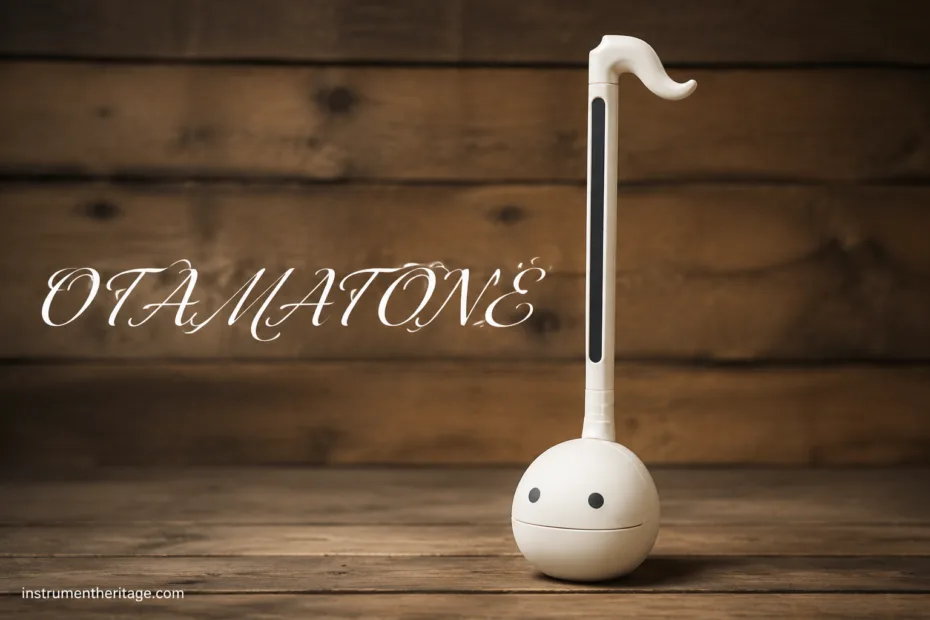
The Otamatone is a Japanese electronic musical instrument shaped like an oversized musical note. A player presses and slides along its black stem switch to control pitch, then squeezes the soft face to open the mouth and alter the tone. It looks playful, but the playing method is real: pitch placement, portamento, vibrato and hand control all matter if you want a clean melody rather than a string of approximate notes.
| Instrument type | Electronic musical instrument with continuous-position pitch control on the stem |
|---|---|
| Origin | Japan |
| Original release | December 2009 |
| Creator | Maywa Denki |
| Standard size | 67 × 270 × 133 mm |
| Standard power | 3 AAA batteries |
| Main controls | Stem switch, movable silicone mouth, power/volume switch and three-position octave switch |
| Pitch layout | No fixed keys or printed note markers; finger position determines pitch |
| Common techniques | Push, portamento, wah-wah and vibrato |
| Modern development | Otamatone Q, dated to June 2026, adds a wider playing surface and a percussion mode |
The standard model is listed by Otamatone as a 270 mm instrument powered by three AAA batteries, with two volume settings, three octave settings and a practice sheet for locating notes on an otherwise unmarked stem. Reference-1✅
How the Otamatone Actually Works
The Otamatone does not use strings, reeds or a vibrating air column. Its pitch is generated electronically, while the player controls that pitch through the long black stem switch. Pressing a point on the switch produces a note; moving to a different point changes the pitch. Sliding while maintaining pressure produces a smooth transition rather than a sequence of clearly separated keys.
The stem switch is not a touchscreen
The black strip may look like a touch-sensitive fingerboard, but the official playing instructions describe it as a switch that must be pressed or squeezed. On the standard layout, the upper part of the playable strip gives lower notes and moving downward gives higher notes. There are no frets, piano-style keys or factory-printed note positions.
Easy to sound, harder to place accurately. A first-time player can make a note almost immediately. Playing the same melody in tune on repeated attempts takes more control because the fingers must return to approximate pitch positions on an unmarked surface.
The face changes the tone
The round head is made from soft silicone. Squeezing its cheeks opens the mouth. That movement changes the sound into the familiar wah-wah effect associated with the instrument. The mouth is therefore part of the acoustic expression of a performance, not only a character feature.
The curved piece at the top is different. It completes the note-shaped silhouette and can rotate, but it does not control the sound. This small distinction matters because the playable black stem and the decorative top are easy to confuse when the instrument is seen only in photographs.
Octave control expands the usable register
Standard Otamatones use a three-position octave selector: LOW, MID and HI. The switch shifts the general register while the stem still determines the exact pitch within that setting. This gives the player several usable pitch zones without making the physical stem longer.
Why the Otamatone Sounds Vocal
The Otamatone’s sound is electronic, yet its strongest expressive feature comes from how the player shapes it by hand. A sustained note can remain plain, slide into another pitch, wobble with vibrato or change color as the mouth opens and closes. The result often feels voice-like because pitch movement and tone shaping happen in one continuous gesture.
- Push: press one point on the stem switch to produce a pitch.
- Portamento: keep pressure on the stem and slide the finger so one pitch moves continuously into another.
- Wah-wah: squeeze and release the cheeks to open and close the silicone mouth while a note is sounding.
- Vibrato: move or shake the stem slightly while holding a note to create controlled pitch fluctuation.
These movements explain why a simple tune can sound very different in two players’ hands. Finger position sets pitch, while timing, sliding and mouth movement shape the phrase.
Why tuning by ear takes practice
A piano gives each semitone a fixed key. A fretted guitar gives the finger a metal fret as a physical reference. The Otamatone gives the player a continuous strip with no permanent note labels. That makes muscle memory and listening unusually important for such a small electronic instrument.
- A practice sheet can provide temporary position references.
- A chromatic tuner can help locate exact notes more reliably.
- Small tape marks can turn difficult intervals into repeatable hand positions.
- Slow melodies are useful for learning spacing before adding slides and vibrato.
The challenge is not producing sound. It is finding the intended pitch again, especially after changing octave settings or moving between wide intervals.
Construction and Playing Layout
The standard Otamatone is compact and deliberately simple. The electronic controls sit behind a character-like body, the long playing surface forms the stem of the musical-note shape, and the flexible head provides a movable mouth. The head’s soft silicone construction is functional because it must flex repeatedly under finger pressure.
🎵 Pitch side
The playing hand presses the black stem switch. Moving along the strip changes pitch, and sliding produces connected pitch movement.
🙂 Expression side
The supporting hand grips the head/body area and squeezes the cheeks. The mouth movement alters the audible character while the other hand continues controlling pitch.
This two-hand layout is one reason the Otamatone behaves differently from a small keyboard synthesizer. One hand is not merely holding the instrument; it can actively shape the sound. The control scheme is sparse, but both hands can remain musically involved.
Is the Otamatone a Toy or a Real Instrument?
It can fit both descriptions depending on context. The Otamatone has a playful appearance, simple switches and character editions, yet it also gives the player direct control over pitch, register, portamento, vibrato and tone shaping. Those are musical controls rather than prerecorded sound effects.
Calling it only a toy misses the part that becomes obvious when someone tries to play a recognizable melody accurately. There are no fixed semitone buttons to guarantee the right note. The player has to develop position memory and ear control. Calling it a conventional synthesizer is also incomplete, because the Otamatone’s identity depends heavily on its physical stem and movable silicone mouth rather than a keyboard, patch panel or standard controller layout.
A useful description: the Otamatone is an electronic musical instrument with a toy-like physical design. That wording accounts for both its approachable form and its genuinely variable musical control.
The Maywa Denki Idea Behind the Otamatone
The Otamatone came from Maywa Denki, the Japanese art unit produced by Nobumichi Tosa. Maywa Denki presents many of its creations as “products” and its performances as product demonstrations, combining mechanical design, sound-making devices and stage performance in a deliberately unusual industrial presentation.
The instrument belongs to Maywa Denki’s Voice Mechanics line of ideas, which explores machines that reproduce or reshape features associated with vocal sound. That context helps explain the Otamatone’s movable mouth: the face is tied to sound control rather than being added only for decoration.
The original Otamatone appeared in 2009. In 2010 it received the grand prize in the High Target Toy category of the Japan Toy Awards. Maywa Denki later reported two million Otamatone-series units sold in total as of August 2023. Reference-2✅
- 2009
- Standard Otamatone released.
- 2010
- Japan Toy Awards grand prize in the High Target Toy category.
- 2012 era
- Larger performance-oriented Deluxe versions expanded the idea beyond the original compact body.
- 2016
- Otamatone Techno added smartphone connectivity and external audio options.
- 2019
- Otamatone neo brought OTM Link to a body closer to the standard size.
- 2026
- Otamatone Q introduced a wider playing surface and percussion mode.
How the Otamatone Family Has Changed
“Otamatone” no longer refers to one exact body. The lineup includes versions aimed at portability, easier pitch control, external audio, app connectivity and simplified melody playback. It is also useful to separate a model from an edition: a character-themed Otamatone may use the same underlying controls as its standard or Deluxe base model.
| Model | Playing idea | What changes | Best understood as |
|---|---|---|---|
| Standard | Continuous stem + movable mouth | Original 27 cm layout, three octave settings | The classic Otamatone experience |
| Q | Continuous stem + percussion mode | Shorter body, wider switch, power LED, Q button | A newer, easier-to-handle variant |
| Deluxe | Same basic playing method | Larger body and stem, external audio connection on current Deluxe versions | A performance-oriented large model |
| Techno | Deluxe-style playing + OTM Link | Smartphone/app connection, headphone/speaker output and DC input | A connected electronic model |
| neo | Standard-scale idea + OTM Link | Compact connected model with app support | A smaller app-capable option |
| Melody | Button-led playback | Built-in melodies and a much smaller body | A simplified model type |
Otamatone Q changes the physical playing surface
The Otamatone Q is one of the clearest updates to the core design rather than just a new color or character shell. The official lineup dates it to June 2026. It measures 69 × 220 × 75 mm, runs on three AAA batteries and uses a wider tail/stem switch than the standard-size model. Its stated range is over two octaves, and pressing the Q button activates a percussion mode. Reference-3✅
The percussion feature is especially unusual for the family because it adds a second performance role to the same object. In percussion mode, the stem switch is divided into three sections that trigger bass drum, snare drum and agogo sounds rather than functioning only as a melodic pitch strip. The model also includes a power indicator light, a small but practical change for a battery-operated instrument.
Techno turns the Otamatone into a connected controller
The Otamatone Techno keeps the larger Deluxe-style body but adds OTM Link, a four-pole 3.5 mm connection used with compatible smartphones or tablets. The official Otamatone Studio app can change sounds and scales, while the instrument also provides a 3.5 mm stereo output for headphones or external speakers and a DC input for compatible power adapters. The Techno is listed at 440 mm tall and uses three AA batteries. Reference-4✅
That does not turn the Techno into a normal keyboard synth. The physical Otamatone technique remains: press, slide, move the mouth and add vibrato. The connection expands the available timbres and routing options while preserving the unusual hand control that defines the instrument.
Otamatone Compared with Similar Playing Ideas
No common instrument is an exact mechanical match for the Otamatone. The most useful comparisons focus on control behavior: continuous pitch placement resembles fretless playing, electronic tone generation overlaps with small synthesizers, and smooth slides can remind listeners of a theremin even though the physical technique is completely different.
| Instrument | How pitch is controlled | Fixed note positions? | Sound source | Main similarity to Otamatone |
|---|---|---|---|---|
| Otamatone | Pressing and sliding on a stem switch | No permanent note markers | Electronic | Direct continuous-position pitch control |
| Theremin | Hand position in electromagnetic fields | No | Electronic | Smooth pitch movement without a keyboard |
| Violin / fretless strings | Finger position changes vibrating string length | No frets | Acoustic string vibration | Pitch depends on precise finger placement |
| Stylophone | Stylus contacts a printed keyboard | Yes, visually separated | Electronic | Compact direct-contact electronic melody playing |
The theremin comparison is useful for the ear because both can produce sliding electronic melodies, but their technique is nearly opposite: the theremin is played without touching its pitch antennas, while the Otamatone requires physical pressure on the stem. A violin comparison is more useful for understanding intonation, since both ask the player to learn where pitch positions fall without relying on piano-style keys.
Why the Moving Mouth Matters in Performance
Most electronic instruments separate the sound controls from any visual “face.” The Otamatone does the opposite. When the player squeezes the head, the mouth visibly opens at the same moment the sound changes. The audience can therefore see part of the tone-shaping gesture as it happens.
This visible link between gesture and sound is central to the instrument’s identity. A sustained note with a closed mouth, a pulsing wah effect and a wide slide can all be played on the same pitch-control surface, yet they are perceived differently both by ear and by sight. The character movement is part of the playing technique.
What each hand is doing
- Stem hand: chooses pitch, slides between notes and can introduce vibrato.
- Head hand: supports the body and opens or closes the mouth for wah-like tone changes.
- Switch controls: set the octave range and basic output level before or during a performance.
Otamatone FAQ
Is the Otamatone a real musical instrument?
Yes. It is an electronic musical instrument with controllable pitch, octave settings and expressive techniques such as portamento, vibrato and wah-wah. Its playful physical design does not remove the need for real pitch control when playing melodies.
How does an Otamatone make different notes?
The player presses different positions on the black stem switch. On the standard layout, moving lower on the playable strip raises the pitch. Sliding while pressing produces a continuous pitch change.
Does squeezing the mouth change the pitch?
The mouth is mainly used for tone shaping and the wah-wah effect. Exact pitch is controlled on the stem, while vibrato can be added by moving the stem during a sustained note.
Why is the Otamatone difficult to play in tune?
The standard stem has no fixed keys, frets or permanent note markers. Players learn pitch positions by ear, repetition, a tuner, a practice sheet or temporary markings.
Who created the Otamatone?
The Otamatone was created by the Japanese art unit Maywa Denki and released as a commercial electronic instrument in 2009.
What is different about the Otamatone Q?
The Q is a smaller 2026 model with a wider playing switch, a stated range of more than two octaves, a power indicator and a Q button that activates percussion mode.
Is the Otamatone Techno played differently?
The basic technique remains familiar: press the stem, slide between pitches, use the mouth for wah-like changes and move the stem for vibrato. The Techno adds OTM Link, app-based sound options, external audio output and DC power support.
