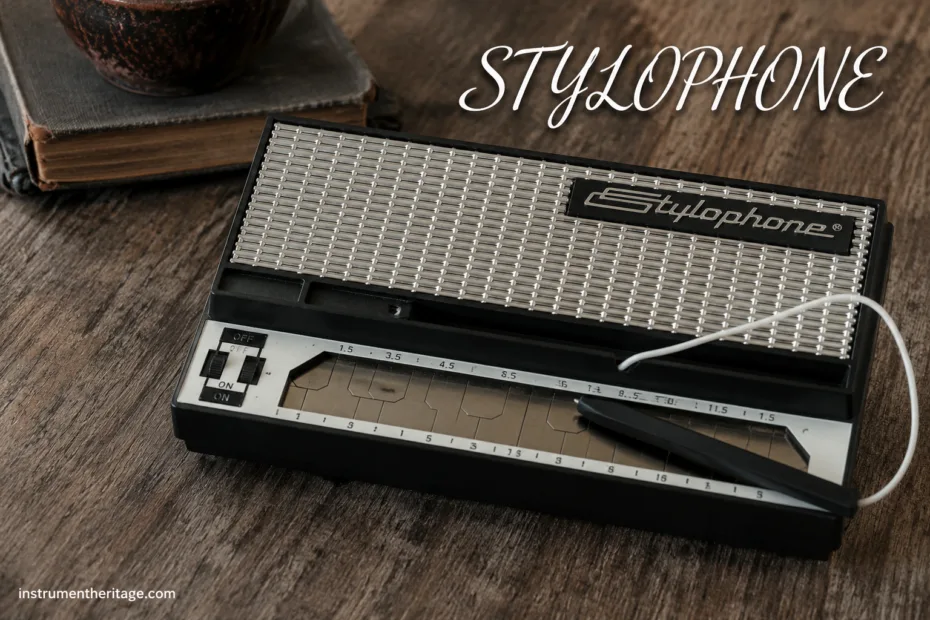
| Feature | Original Stylophone | Modern S-1 |
|---|---|---|
| Instrument family | Monophonic electronic organ and pocket synthesizer | Compact electronic instrument based on the classic stylus interface |
| Designer | Brian C. Jarvis | Produced under the revived Stylophone and Dubreq name |
| Development and release | Concept and British patent priority in 1967; commercial production in 1968 | Part of the modern Stylophone range |
| Playing surface | Exposed metal contacts arranged like a small keyboard | Touch-sensitive metal note segments |
| Note selection | Conductive hand-held stylus attached by a flexible wire | Attached conductive stylus |
| Polyphony | One note at a time | One note at a time |
| Pitch range | Twenty note contacts covering roughly one and a half octaves | Three selectable octave ranges |
| Tone generation | Transistor oscillator with resistor-selected pitches | Classic Stylophone-style electronic voice |
| Expression | Articulation from stylus contact, sliding and switched vibrato | Articulation from stylus movement, octave selection and vibrato |
| Main materials | Plastic case, metal contacts, printed circuit board and electronic components | Metal and plastic |
| Sound output | Small internal loudspeaker; some versions also provide an external output | Built-in speaker, 3.5 mm line input and 3.5 mm line output |
| Historic museum example | 155 × 100 × 35 mm and approximately 0.25 kg Reference-1✅ | Not applicable |
| Modern dimensions | Not applicable | 18 × 12 × 4.5 cm |
| Power | Internal batteries | Three AA batteries |
Small enough to rest in one hand, the Stylophone turns a strip of metal contacts into a playable electronic keyboard. A wired stylus replaces the moving keys found on a piano or organ. Touch one contact and a note appears immediately. Lift the stylus and it stops. Slide across several contacts and the instrument produces a clipped, stair-stepped run with a sound that is dry, direct and unmistakably electronic.
The instrument emerged during the late 1960s, when transistor circuits were making electronic products smaller and less expensive. Its layout was economical: a simple oscillator, a miniature loudspeaker, a battery supply and a printed circuit board that served two jobs at once. The board carried electronic parts inside the case, while its exposed conducting areas formed the keyboard outside it.
That clever use of the circuit board helped give the Stylophone its identity. It was sold in a playful consumer format, yet its operating principle was that of a genuine electronic musical instrument. Musicians could play melodies, double vocal lines, add narrow lead tones or send its output through recording equipment and effects.
🎹 What Kind of Instrument Is a Stylophone?
The Stylophone belongs to the electrophone family because electricity generates and amplifies its tone. It is also commonly described as a pocket synthesizer, miniature electronic organ or stylus-operated keyboard. Each description catches part of its design.
Calling it a keyboard does not mean that it contains conventional keys. Its note contacts do not travel downward, trigger hammers or open valves. They remain fixed. The player completes an electrical connection by touching a contact with the conducting tip of the stylus.
Why it is monophonic
The classic circuit has a single note-producing oscillator. One selected resistance determines the oscillator’s pitch at any given moment, so the instrument produces one melodic note rather than a chord.
Touching two note areas does not turn it into a two-voice synthesizer. Depending on the exact contact and circuit behaviour, one pitch may dominate or the oscillator may respond unpredictably. The musical language of the Stylophone is therefore based on melody, rhythm and articulation.
Its limited voice count is not an incomplete version of a larger keyboard. It shapes the way the instrument is played. Short motifs, doubled melodies, narrow bass figures and sliding ornaments suit it naturally.
🕰️ From a Toy-Piano Repair to a New Electronic Instrument
The Stylophone grew from work carried out by British engineer Brian C. Jarvis. Accounts preserved by heritage collections connect the idea with Jarvis repairing a small electronic piano for his niece in 1967. The repair led him toward a simpler playing system: exposed metal note contacts selected by a wired conducting stylus.
The dates 1967 and 1968 are both encountered in Stylophone histories, and they refer to different stages. The British patent family claims priority from 11 April 1967. Finished commercial instruments entered production in 1968.
The patent identifies Jarvis as the inventor and describes conducting contacts, a wired stylus, a battery-powered transistor oscillator, a loudspeaker, resistor-selected notes and an optional vibrato circuit. Reference-2✅
Dubreq and compact consumer electronics
Jarvis worked with the company Dübreq, a name connected with its earlier dubbing and recording activities. The spelling often appears without the umlaut as Dubreq. The company’s background in sound and electronic equipment gave the Stylophone a practical setting in which to develop.
The instrument was designed around parts and manufacturing methods that could keep its case small and its internal layout economical. Rather than fitting a row of separate mechanical switches beneath plastic keys, the design exposed the printed circuit board’s contact areas directly to the player.
Early promotion presented the Stylophone as approachable home entertainment. Mail-order availability and television demonstrations helped it reach households beyond specialist musical-instrument shops. Millions were produced during the original manufacturing period, and British production ended in 1975. Reference-3✅
A small instrument enters professional studios
The Stylophone’s domestic presentation did not stop musicians from treating it as studio equipment. Its thin electronic tone occupied a different frequency space from piano, organ, guitar or orchestral instruments. It could trace a melody without covering the whole arrangement.
David Bowie’s use of the instrument on Space Oddity in 1969 remains its most widely recognised recorded appearance. The nasal buzz blends with the recording’s other electronic and acoustic colours rather than behaving like a full keyboard part. Kraftwerk, Pulp, Blondie, The White Stripes and other performers later used Stylophone instruments in different musical settings.
⚡ How the Original Stylophone Circuit Produces Notes
The original instrument uses a compact form of resistance-controlled oscillation. An oscillator repeatedly changes an electrical signal at an audible rate. Faster repetition produces a higher pitch; slower repetition produces a lower one.
Each metal note contact is associated with a resistor or part of a resistor network. When the stylus touches a contact, it closes the relevant electrical path. That resistance sets the oscillator near the intended musical frequency. The signal then passes through an amplifier stage and reaches the internal speaker.
- The battery supplies the electronic circuit.
- The player touches a note contact with the conductive stylus tip.
- The stylus completes a path through the selected resistor network.
- The oscillator begins running at the selected frequency.
- The amplifier raises the signal to a useful level.
- The loudspeaker converts the electrical signal into audible sound.
- Lifting the stylus breaks the path and stops the note.
The printed circuit board is also the keyboard
This is one of the design’s most interesting details. The printed circuit board is not hidden entirely inside the case. Selected conducting areas remain exposed through an opening and become the playing surface.
A piano keyboard needs moving keys, guides, pivots and action parts. The Stylophone replaces that mechanical assembly with flat conducting shapes. Fewer moving parts mean less depth, which helps explain the instrument’s pocket-sized case.
What the stylus actually does
The stylus is not a digital pen and it does not read handwriting or position data. Its tip is simply an electrical contact. The attached wire connects that contact back to the tone circuit.
When the metal tip meets a metal note area, current can travel through the selected route. The player’s gesture functions as a switch. This gives the Stylophone a direct physical logic: touch means sound; separation means silence.
Vibrato and tuning
The classic vibrato system uses a slower oscillator to modulate the audible tone. Instead of holding one perfectly fixed frequency, the pitch moves gently above and below its centre. The effect adds motion to sustained notes and softens the instrument’s otherwise rigid pitch.
Original units also include an internal or externally accessible tuning adjustment, depending on the version. This changes the oscillator’s overall pitch so the instrument can be aligned with another instrument. Vintage circuits may need occasional adjustment because component values, battery voltage and temperature can affect oscillator tuning.
🔊 Why the Stylophone Sounds Buzzy
The familiar Stylophone voice is rich in upper harmonics. It is often described as square-wave-like, though the waveform produced by a real vintage circuit and heard through its small speaker is not necessarily a mathematically perfect square wave.
Square-like signals contain a strong fundamental pitch plus a ladder of odd-numbered harmonics. Those upper frequencies create the penetrating, reedy edge associated with the instrument. The case and miniature speaker then colour the result further.
Electronic character
- Harmonic, square-like oscillator tone
- Immediate note onset
- Fast cutoff when contact ends
- Audible vibrato when switched on
- Slight pitch variation in older units
Acoustic character
- Strong upper-midrange presence
- Limited low-frequency depth from the small speaker
- Light plastic-cabinet resonance
- Focused sound at close range
- A different balance through an external amplifier
The speaker is part of the instrument’s voice
Listening only to a direct electrical output does not reveal the whole character of a classic Stylophone. Its small built-in speaker removes much of the lowest energy and emphasises the nasal upper range. The plastic enclosure adds its own light resonance.
Connecting the instrument to a larger speaker or recording interface usually gives the tone more body. It may also reveal low-level noise, oscillator edges and tuning movement that are less obvious through the internal speaker. Neither presentation is more authentic. They are two useful versions of the same source.
Why notes start and stop so sharply
Many synthesizers use an envelope generator to shape attack, decay, sustain and release. The original pocket Stylophone offers little or no adjustable envelope shaping. A note appears when electrical contact is made and ends when contact is lost.
This behaviour gives melodies a naturally staccato outline. A player can hold a note, but its volume does not swell like a bowed string or fade like a plucked string. External delay, reverb, filtering or amplifier response can reshape that plain electronic contour.
✍️ The Stylus as a Musical Interface
The stylus changes the relationship between hand movement and pitch. A pianist presses downward. A guitarist stops or bends a string. A Stylophone player taps, drags and lifts a conducting point across a flat map of notes.
Tapping individual notes
Clean tapping produces the clearest melodic articulation. The stylus should meet the centre of a note area rather than hover between neighbouring contacts. Since the contacts are close together, small hand movements are enough to play a tune.
The lack of moving keys means there is almost no mechanical travel. A note begins at contact, so rhythm depends on the timing of the stylus rather than the downward motion of a key.
Sliding between contacts
Dragging the stylus across the keyboard produces a fast sequence of separate pitches. This is a stepped glissando, not the continuously changing pitch heard from a trombone, theremin or fretless string instrument.
A slow slide exposes each note as a small step. A quick sweep compresses those steps into a bright electronic flourish. Sliding across the upper row of sharp and flat contacts can produce less predictable contours because their shapes and spacing differ from the lower row.
Holding and repeating notes
Keeping the stylus still sustains the selected pitch for as long as reliable contact is maintained. Rapidly lifting and returning the stylus creates repeated pulses. With vibrato active, a held note gains gentle movement while retaining the instrument’s firm onset.
Contact pressure is not usually a volume control. Pressing harder may help a worn or dirty contact connect, but the classic interface does not provide the velocity sensitivity of a modern electronic keyboard. Expression comes mainly from timing, note length, sliding, vibrato and external processing.
🧰 Materials and Physical Construction
The original Stylophone combines inexpensive consumer materials with a smart internal arrangement. Its shell is moulded plastic. The exposed keyboard areas are metal conductors on a printed circuit board, while a small loudspeaker sits behind a grille in the upper part of the case.
Plastic enclosure
Plastic keeps the enclosure light, electrically insulating and suitable for repeatable moulding. Internal posts and screw points hold the circuit board, speaker and battery compartment in position. The case also forms a storage groove or resting place for the attached stylus on many versions.
Metal contact keyboard
The keyboard needs a conductive surface that can withstand repeated touching and sliding. Its segmented arrangement visually echoes black and white piano keys, yet the geometry is adapted to flat circuit-board contacts rather than mechanical key levers.
Surface oxidation, dust or residue can make an old contact less responsive. The relevant material is thin and functional, so abrasive polishing can do more harm than gentle cleaning. The aim is electrical contact, not a mirror finish.
Stylus, cable and tip
The stylus body provides a comfortable grip around a conducting tip. A flexible insulated cable carries the electrical connection back into the case. This wire is one of the few parts that moves constantly, making its entry points worth examining on an older instrument.
Speaker and battery compartment
The built-in speaker allows the Stylophone to function without an amplifier. Its modest diameter suits the case but shapes the frequency balance. Batteries make the unit fully portable, which was central to its identity long before pocket-sized electronic music devices became common.
🎛️ Original Variants, the 350S and Later Revivals
The word Stylophone can refer to the original pocket instrument or to a broader family of later products. These versions share a name and often a stylus-based interface, but they do not all use the same circuitry, keyboard range or sound engine.
| Version | Period | Distinguishing features |
|---|---|---|
| Original standard Stylophone | From 1968 | Compact 20-note contact keyboard, single oscillator, internal speaker and vibrato |
| Bass Stylophone | Original production era | Lower pitch range suited to bass lines and low melodic parts |
| Treble Stylophone | Original production era | Higher pitch range with a brighter register |
| Stylophone 350S | Early 1970s | Larger contact keyboard, two styluses, added voices and photo-sensitive expression control |
| Modern S-1 | Revival era | Classic shape, three octave settings, vibrato, volume control and modern audio connections |
| Beat and Beatbox models | Later range | Stylus-triggered percussion, bass sounds and loop-oriented controls |
| GEN series | Later range | Expanded synthesis controls such as filtering, modulation, envelope shaping or delay, depending on model |
| Modern experimental models | Current range | Stylophone-inspired samplers, theremin-style instruments and modular electronic devices |
Standard, bass and treble versions
The familiar standard model occupies the middle register. Bass and treble variants transpose the same basic playing idea into lower or higher ranges. Their purpose is straightforward: the bass model places the buzzing voice beneath an arrangement, while the treble model places it above.
The larger 350S
The Stylophone 350S expands the concept into a broader electronic keyboard. It has a longer metal playing surface, two styluses and several selectable tonal colours. A light-sensitive control allows hand movement above a sensor to alter aspects of the sound.
The 350S is not simply an oversized case around the pocket circuit. Its added controls give it a wider performance vocabulary, while the twin-stylus arrangement allows quicker movement across the enlarged keyboard.
The modern S-1
The current S-1 preserves the attached stylus, metal note surface, internal speaker and recognisable rectangular form. It adds a three-position octave selector, volume control and 3.5 mm connections for integration with other equipment. The manufacturer lists metal and plastic construction, three AA batteries and dimensions of 18 × 12 × 4.5 cm. Reference-4✅
Descriptions of revival instruments sometimes blur the difference between analogue circuitry and an analogue-style sound. Production versions have changed over time, so the outer design alone should not be used to identify the exact internal tone-generation method. A component inspection or service document is more reliable when circuit type matters.
🎙️ How the Stylophone Fits into Recordings
The Stylophone rarely needs to imitate a piano or full synthesizer. Its value in an arrangement comes from its narrow, harmonically active voice. Even at modest volume, it can remain audible beside softer instruments.
Melody doubling
Following a sung or played melody adds a thin electronic edge without turning the part into a broad chordal layer. Slight tuning movement between the Stylophone and the original melody can create a gentle beating effect.
Short lead phrases
Because every note begins sharply, the instrument works well for concise lead figures, repeated hooks and call-and-response parts. A long exposed solo requires careful phrasing, but a short line can be recognised immediately.
Bass and rhythmic pulses
A lower-pitched version or octave setting can provide a lean bass pattern. The result has less physical depth than a bass guitar or large synthesizer oscillator, yet its upper harmonics help the pitch remain clear on small speakers.
External effects
Delay stretches short notes into repeating patterns. Reverb places the dry oscillator in a larger acoustic space. Filtering can soften the upper harmonics, while distortion thickens them. A pitch shifter or octave effect can make a single-note performance occupy several registers.
- Delay: turns clipped notes into rhythmic echoes.
- Reverb: adds a tail that the original circuit does not create.
- Low-pass filtering: reduces the brightest harmonics.
- Chorus: creates the impression of several slightly detuned voices.
- Overdrive: adds density and compression.
- Looping: builds repeated melodic layers from a monophonic instrument.
Recording the internal speaker
A microphone captures the speaker, grille and plastic enclosure together. This method preserves the small-speaker colour that listeners often associate with the instrument.
A direct output produces a cleaner electrical signal and avoids room noise. Recording both methods on separate tracks allows the focused direct tone to be blended with the more textured sound of the cabinet.
🔍 Stylophone and Related Electronic Instruments
The Stylophone is often grouped with other compact electronic instruments because of its size and playful appearance. Their playing systems differ more than their dimensions suggest.
| Instrument | Pitch control | Pitch movement | Typical voice | Main difference from a Stylophone |
|---|---|---|---|---|
| Stylophone | Conductive stylus touching fixed metal notes | Stepped | Bright, buzzy electronic tone | Uses separate contact areas for chromatic notes |
| Theremin | Hand position near antennas | Continuous | Smooth electronic tone | Played without touching the instrument |
| Ribbon-controller synthesizer | Finger or stylus position on a strip | Usually continuous | Depends on the connected synthesizer | Often allows seamless pitch bends between notes |
| Mini electronic keyboard | Moving keys or touch pads | Stepped | Digital or analogue, depending on model | May offer chords, velocity or preset sounds |
| Otamatone | Finger pressure along a pitch strip | Mostly continuous | Soft, vocal-like electronic tone | Pitch is guided by position rather than fixed metal keys |
| Clavioline | Conventional keyboard | Stepped, with performance controls | Early electronic lead voice | Much larger and designed as a keyboard instrument |
🧽 Caring for an Original or Vintage Stylophone
A vintage Stylophone contains ageing electronic parts, exposed contact surfaces and a permanently attached stylus cable. Care should focus on clean electrical contact, stable battery connections and gentle handling.
Before installing a battery
- Inspect the battery compartment for old leakage or corrosion.
- Check that battery clips and wires remain firmly attached.
- Look for cracked plastic around screws and case joints.
- Examine the stylus cable where it enters the pen and the case.
- Turn controls gently before applying power.
Cleaning the contact surface
Loose dust can be removed with a clean, soft brush. Light residue may be wiped with a barely damp, lint-free cloth after the battery has been removed. Liquid should not be allowed to run through the keyboard opening.
Harsh abrasives can remove plating, scratch printed markings or alter the contact surface. A contact that fails only in one area may need careful electrical inspection rather than harder rubbing.
Tuning an older unit
Allow a vintage instrument to settle after power-up before judging its tuning. Fit a fresh battery, select a central note and compare it with a reliable tuner. Adjustments should be small. The tuning control shifts the whole instrument, so correcting one note cannot repair uneven spacing caused by ageing resistor values.
Removing old batteries during storage protects the contacts and circuit board from leakage. Store the instrument in a dry indoor setting, with the stylus cable resting loosely rather than folded sharply around the case.
Questions About the Stylophone
Is the Stylophone a synthesizer or a toy?
It has been sold through the toy and consumer-electronics markets, but it is also a playable electronic musical instrument. The original contains an oscillator, pitch-selecting resistor network, amplifier, speaker, vibrato circuit and tuning control. Its compact construction does not change the musical function of those parts.
Was the Stylophone invented in 1967 or 1968?
Brian C. Jarvis developed the idea in 1967, and the related British patent application claims priority from 11 April 1967. Commercial instruments were manufactured and released in 1968. Both dates are therefore used, depending on whether the writer means invention or public production.
How does touching the keyboard make a sound?
The conducting stylus closes an electrical connection when it touches one of the exposed metal contacts. The selected contact connects a particular resistance to the oscillator circuit, setting the pitch. The resulting electrical signal is amplified and played through the speaker.
Can a Stylophone play chords?
The classic Stylophone is monophonic and is designed to produce one note at a time. Chord-like textures can be created by recording several melodic passes, using a looper or adding pitch-shifting effects.
Does sliding the stylus create portamento?
Sliding across the classic keyboard normally triggers a rapid series of fixed note contacts. The result is a stepped glissando. True portamento moves continuously through all frequencies between two notes, which requires a different form of pitch control.
Why do vintage Stylophones drift out of tune?
The pitch depends on analogue electronic components and battery voltage. Resistors, transistors and tuning controls can change slightly with age or temperature. A weak battery may also alter the oscillator’s behaviour.
Why does the built-in speaker sound thinner than an external amplifier?
The internal speaker is small and mounted in a shallow plastic enclosure. It reproduces the bright middle and upper frequencies efficiently but has limited low-frequency output. A larger external speaker can reveal more body in the oscillator signal.
Are original and modern Stylophones internally identical?
No. Modern instruments preserve the general appearance and stylus-playing method, but circuitry, power requirements, connections, controls and tone generation can differ between models and production periods.
What made the Stylophone unusual in the late 1960s?
It placed a battery-powered electronic melody instrument in a case small enough to hold in one hand. The exposed circuit-board keyboard removed the need for a bulky mechanical key assembly, while the attached stylus made the operating principle visible to the player.
Which Stylophone model is associated with the original design?
The small rectangular 20-note model from 1968 is the classic design. The larger 350S, bass and treble versions belong to the original production era but have different ranges or controls. The modern S-1 recreates the familiar pocket format with updated features.
