
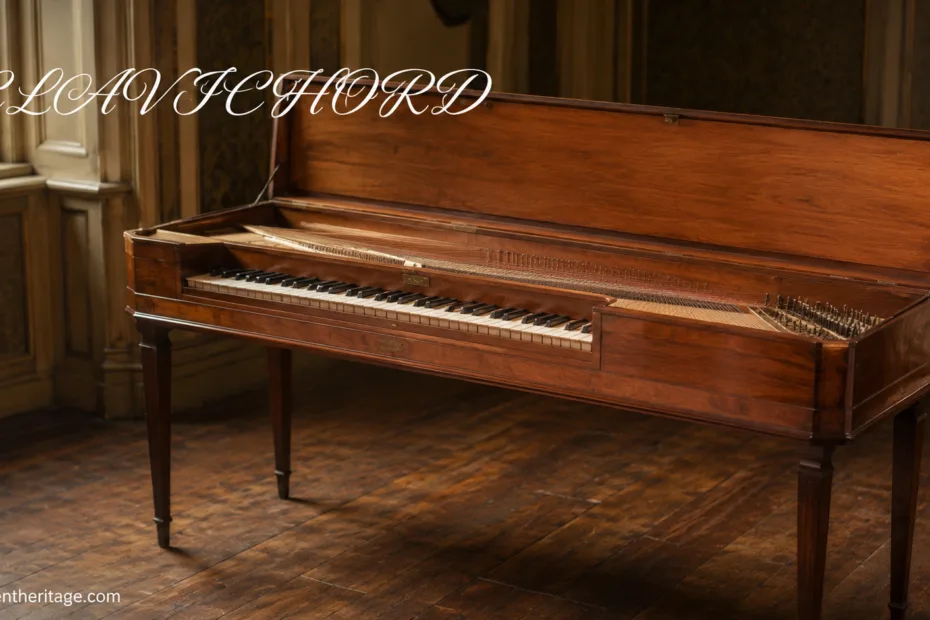
The clavichord is a small stringed keyboard instrument with an unusually direct voice. Pressing a key lifts a narrow metal tangent into a string, and that tangent remains against the string for as long as the note is held. The sound is soft—often softer than ordinary conversation—but the player can shape the attack, alter the loudness within a narrow range, and even add a delicate pitch motion called Bebung. Long before the piano became the familiar household keyboard, the clavichord served musicians as a practice instrument, a teaching tool, a composing companion, and a private instrument for closely shaded performance.
| Feature | Clavichord detail |
|---|---|
| Instrument family | Keyboard-operated struck string instrument; also classed as a type of zither or chordophone |
| Sound-producing part | A small metal blade called a tangent |
| String contact | The tangent stays in contact with the string while the key remains depressed |
| Usual sound level | Very quiet, suited to a small room and close listening |
| Dynamic response | Attack and loudness respond to finger speed and pressure, though the overall dynamic range is narrow |
| Special expression | Bebung, a controlled pitch fluctuation made through changing finger pressure after the note begins |
| Common historical forms | Fretted, partly fretted, unfretted, and pedal clavichords |
| Typical materials | Wooden case and keys, thin spruce-family soundboard, metal strings and tangents, wooden bridge, woven damping cloth |
| Main historical use | Private music-making, composition, teaching, keyboard practice, and organ training |
| Relationship to the piano | Earlier touch-sensitive string keyboard with a different action; the clavichord and early piano later existed side by side |
What Is a Clavichord?
A clavichord is a rectangular keyboard instrument in which the keys operate metal tangents beneath stretched strings. Its case may resemble a plain chest or a compact table-top keyboard, but the action inside is unlike that of a piano or harpsichord. A piano hammer strikes and leaves the string. A harpsichord plectrum plucks it. The clavichord tangent strikes, divides, and continues touching the string.
That continuing contact gives the player a physical connection to the speaking length of the string. The fingertip is not separated from the sound by a complex train of hammers, escapements, or jacks. A key acts as a simple lever, and the tangent at its far end becomes the temporary boundary of the vibrating string. This is why the instrument can feel surprisingly alive even when its tone is barely filling the room.
The name reflects its design. The word is linked to terms for “key” and “string,” a useful description of an instrument whose keyboard communicates almost directly with its strings.
🔧 How the Clavichord Produces Sound
The clavichord action looks simple because it is simple. Its musical response, though, depends on tiny changes in movement and pressure. Historical examples show that the basic principle remained remarkably consistent: a key lever carries a metal tangent that rises from below and touches the string near one end of its speaking length.Reference-1✅
The sound cycle, step by step
- The finger depresses a key. The key pivots on a balance point like a narrow seesaw.
- The rear of the key rises. A metal tangent fixed into the key moves upward.
- The tangent contacts the string. This impact starts the vibration.
- The tangent defines the note. The speaking section lies between the tangent and the bridge; the tangent therefore acts somewhat like a movable nut.
- The bridge transfers energy. String vibration passes through the bridge into the soundboard and then into the surrounding air.
- The key remains held. The tangent stays against the string, allowing continued control through the fingertip.
- The key is released. The tangent falls away and the non-speaking section of string meets woven cloth, stopping the vibration.
The woven cloth is easy to overlook, yet it is essential. It lies among the strings on the side that should not ring. When a tangent touches a string, the tangent separates the active section from the cloth-damped section. When contact ends, the cloth quiets the whole string. There is no separate piano-style damper rising and falling above every note.
Tangent
A narrow strip of brass, iron, or another suitable metal. Its upper edge contacts the string. Its position helps determine pitch, and its shape affects the clarity of the attack.
Bridge and soundboard
The bridge carries vibration to a thin wooden soundboard. Because the instrument uses low-energy string excitation, the soundboard must respond freely without behaving like the heavier structure of a modern piano.
🎶 Sound, Touch, and the Art of Playing Quietly
The clavichord does not project like a concert piano. Its energy enters the string near the end of the speaking length, the soundboard is small, and the tangent remains part of the vibrating system. The result is a close, dry, finely textured tone. Bass notes can have a soft growl. Middle notes often sound woody and clear. Treble notes may carry a thin, silvery edge.
Its limited loudness is not the same as lack of expression. A player can control how quickly the tangent reaches the string, how firmly the key settles, how steadily pressure is maintained, and how the note is released. Acoustic measurements of clavichord playing have shown relationships between tangent motion, sound level, and pitch change, confirming how much the result depends on the player’s hand.Reference-2✅
Why pressure changes pitch
Once the tangent has contacted the string, additional downward finger pressure pushes the tangent slightly farther against it. This raises the string tension and can lift the pitch. Too much uneven pressure makes notes bend unintentionally. Controlled pressure produces one of the clavichord’s most characteristic effects.
Bebung is created by gently varying pressure on a held key. The sounding pitch moves in a small, expressive pulse. It is not produced by a separate wheel, lever, or stop; the finger itself shapes the vibration.
What good clavichord touch feels like
- Quiet preparation: fingers rest close to the key surface rather than dropping from a height.
- Controlled descent: the key moves with enough speed to start a clear tone but not enough force to distort the pitch.
- Stable holding pressure: each finger supports its note without wobbling unless Bebung is intended.
- Balanced chords: every finger reaches the tangent point with similar control, preventing one note from sounding pinched or sharp.
- Clean release: lifting the key ends the sound and shapes articulation as clearly as the attack.
The instrument exposes uneven technique. A heavy thumb, weak inner finger, or nervous after-pressure becomes audible. That honesty made the clavichord useful for training. It teaches that keyboard expression does not begin with arm weight alone; it begins at the moment a fingertip meets resistance.
Fretted, Partly Fretted, and Unfretted Clavichords
The term fretted can confuse guitar players because a clavichord has no fingerboard with fixed metal frets. Here, fretting means that two or more keys use different tangents to play different pitches on the same pair of strings. Each tangent touches that shared string at a different point, shortening it by a different amount.
| Design | String arrangement | Playing character | Practical effect |
|---|---|---|---|
| Fretted clavichord | Several notes may share one string pair | Often compact, direct, and lively | Fewer strings to tune, but notes sharing a course cannot sound independently at the same time |
| Partly fretted clavichord | Some notes have their own strings while others share | Balances freedom with a lighter string load | Common musical conflicts can be avoided while keeping the instrument relatively compact |
| Unfretted clavichord | Each key has its own string pair or course | Full chromatic independence and often a rounder response | More strings, more tuning, a larger case, and greater total tension |
Fretting patterns were planned around musical use. Builders tried to make notes share strings when those notes were unlikely to be required together. Yet the layout still affects fingering, ornaments, legato, and certain chromatic passages. A player may need to separate two notes slightly if their tangents act on the same course.
Unfretted clavichords became more common as builders gave every key an independent string course. This removed the shared-string restriction, though it added weight, tension, and tuning work. Historical construction research also traces the instrument’s basic design to the monochord and explains how fretted and unfretted layouts changed the relationship between keys, tangents, and strings.Reference-3✅
- Why fewer strings can help
- A lighter string load lets the case and soundboard respond with less structural restraint. Many fretted instruments therefore feel quick and vivid under the fingers.
- Why independent strings help
- An unfretted layout permits any chromatic combination within the keyboard compass and makes changes of temperament easier because each pitch has its own course.
- Why neither form is automatically better
- The musical result depends on the maker’s scale design, stringing, soundboard, key geometry, tangent work, and the repertoire being played.
🪵 Materials and Craftsmanship
A clavichord may look modest from outside, yet its response depends on careful wood selection and precise geometry. The case must be stiff enough to hold string tension while allowing the soundboard to move. Keys need predictable balance. Tangents must meet the strings cleanly. A small error can change pitch, touch, or tone.
Case and internal structure
Historical cases were commonly made from available softwoods and hardwoods, sometimes painted, veneered, or left visually plain. The case sides, bottom, wrestplank, hitchpin rail, braces, and corner blocks share the work of holding tension. Unlike a modern piano, a historical clavichord usually has no massive cast-iron frame. Its scale and string load are designed around a wooden structure.
Soundboard and bridge
The soundboard is usually a thin, resonant softwood panel, often spruce or a related material chosen for low weight and useful stiffness. A wooden bridge is glued to it. The bridge receives vibration from the speaking strings and spreads that motion across the board. Grain direction, thicknessing, bridge placement, and barring all influence how freely the instrument speaks.
Strings and tangents
Clavichord strings are metal, commonly brass in much of the compass, with iron or steel used according to historical model and scale. They are often arranged in pairs called courses. Two strings sounding together can add body and complexity, but only when their tuning is close enough to blend.
Tangents may be made from brass, iron, or another suitable metal. Their upper edges are shaped and aligned by hand. A tangent that leans, twists, or meets the string at the wrong place can create an unclear attack or inaccurate pitch. On a fretted instrument, tangent position is also part of the temperament; bending or shifting a tangent changes where the string is divided.
Keys, coverings, and damping cloth
The key levers are wooden and may carry contrasting natural and accidental coverings made from regionally available materials. Their balance points, lengths, and weights shape the touch. Woven cloth passes between the non-speaking portions of the strings. Its density and placement must stop unwanted ringing without choking the speaking section.
A builder works in fractions
Small differences matter: a tangent moved slightly forward changes pitch, a key balanced differently changes control, and a soundboard made too heavy can resist the weak energy arriving from the strings. The clavichord rewards light construction and accurate fitting, not brute strength.
📜 A History Shaped by Private Music-Making
Monochord roots and early keyboards
The clavichord’s working idea is closely related to the monochord, an old teaching and measuring instrument built around a stretched string and a movable point that divides its sounding length. Instrument makers transformed that principle by adding many strings, a keyboard, and separate tangents positioned for different notes. Written and visual evidence places recognisable clavichords by the early fifteenth century, while the design may have developed earlier.
Renaissance households and teaching rooms
Compact clavichords suited rooms where a large organ or louder plucked keyboard would have been impractical. They could support lessons in fingering, counterpoint, accompaniment, tuning, and composition. Their quietness also allowed long practice without turning the entire household into an audience. For many owners, that privacy was part of the instrument’s purpose.
The eighteenth-century clavichord
During the eighteenth century, builders expanded keyboard compasses, refined unfretted designs, adjusted string scales, and explored larger cases. The clavichord became closely associated with sensitive solo playing in parts of central and northern Europe, while regional forms also appeared elsewhere. The instrument remained useful for instruction and composition, but it was not limited to mechanical practice. Its control of attack, release, and after-pressure supported music built from speech-like phrasing and finely graded articulation.
Coexisting with the fortepiano
The clavichord did not suddenly transform into the piano. The instruments use different actions, and they shared musical life for many decades. The early piano offered stronger projection and a wider path toward public and ensemble use. The clavichord retained a special place where quietness, portability, low mechanical complexity, and direct touch mattered.
Revival and present-day building
As larger pianos became common, clavichord building became less frequent. Interest returned through the early-music movement, museum study, surviving instruments, workshop drawings, and experimental reconstruction. Present-day makers build copies and historically informed new instruments, while performers use them for Renaissance, Baroque, Classical-era, and newly written repertoire.
The Clavichord Before the Piano
The clavichord is often called a predecessor of the piano because both are keyboard-controlled string instruments and both respond to the player’s attack. That description is useful, but incomplete. The piano’s ancestry also includes the hammered dulcimer, monochord traditions, harpsichord case construction, and several experiments in hammer action. Yamaha’s historical overview places the clavichord among the instruments that helped lead toward the piano while distinguishing its tangent action from the piano hammer.Reference-4✅
The most revealing connection is touch sensitivity. A clavichord player could make a note gentler or firmer before the piano existed. Yet the physical result was different. A piano hammer escapes and rebounds, leaving the string free. A clavichord tangent stays attached to the key and string, so continued pressure becomes part of the note.
What the piano gained
- Greater projection
- A wider dynamic span
- Longer sustain in larger instruments
- Stronger support for ensembles and concert rooms
- Independent strings without clavichord-style fretting
What remained unique to the clavichord
- Direct after-pressure on the speaking string
- Bebung controlled from the key
- A small mechanical action
- Close-range tone suited to private listening
- Immediate feedback about finger balance
Music, Repertoire, and Playing Context
Historical keyboard music was not always assigned to one instrument with modern precision. Terms such as clavier could refer broadly to a keyboard, leaving performers to choose among clavichord, harpsichord, organ, or early piano according to place, range, texture, and purpose. Many contrapuntal pieces, dances, inventions, preludes, fugues, sonatas, and teaching works can be convincing on the clavichord.
Music that suits its voice
- Two- and three-part counterpoint
- Short preludes and fugues
- Dance-suite movements
- Keyboard sonatas with speech-like phrasing
- Ornamented slow movements
- Teaching pieces focused on touch
- Private improvisation
- Composition and harmonic testing
Carl Philipp Emanuel Bach is strongly connected with expressive clavichord playing and wrote about the value of sensitive keyboard touch. Music associated with the Empfindsamer Stil, or sensitive style, can make good use of sudden rests, sighing figures, small dynamic inflections, flexible timing, and carefully controlled ornaments. Johann Sebastian Bach’s inventions, suites, and many preludes and fugues are also played on clavichord, though the instrument’s compass and fretting pattern must suit the chosen work.
Because the clavichord is quiet, it rarely serves as a continuo instrument in a normal ensemble. It works best alone or with an exceptionally soft partner in a small room. The listener must be close. That changes musical attention: tiny releases, inner voices, and differences between fingers become easier to notice than grand volume.
Pedal Clavichords and Organ Practice
A pedal clavichord extends the idea of the household practice instrument. It adds a pedal keyboard for the feet, often with a separate low-register string box. Some historical arrangements combined more than one manual clavichord with a pedal instrument, creating a compact practice setup that mirrored the layout of an organ.
This arrangement let an organist work on hand-and-foot coordination, counterpoint, articulation, and pedal technique without needing airflow, pipes, or a large building. The sound remained small, but the physical demands were real. A pedal clavichord was not simply a miniature organ; it was a touch-sensitive training instrument with its own string response.
The pedal clavichord reveals the instrument’s wider role. It trained not only fingers but also timing, independence, balance, and the coordination needed for multi-keyboard organ music.
Clavichord Compared with Related Keyboard Instruments
| Instrument | How sound begins | Does the sounding part remain in contact? | Dynamic control from touch | Typical setting |
|---|---|---|---|---|
| Clavichord | Metal tangent strikes the string | Yes, until the key is released | Yes, within a narrow range; after-pressure can also affect pitch | Private room, study, teaching, solo playing |
| Harpsichord | Plectrum plucks the string | No | Little change from individual key speed; contrast comes mainly from registers, manuals, texture, and articulation | Solo, chamber music, continuo, larger rooms |
| Fortepiano | Small hammer strikes the string and escapes | No | Yes, with a broader span than the clavichord | Solo and ensemble music |
| Modern piano | Felt-covered hammer strikes the string and escapes | No | Yes, across a wide dynamic range | Home, studio, ensemble, concert hall |
| Organ | A key opens a path for air or triggers an electrical action | Not a struck-string system | Usually not through key speed on traditional organs | Church, hall, studio, practice room |
Clavichord or harpsichord?
Their cases may look related, but their playing behavior is far apart. A harpsichord speaks more brightly and carries farther because its strings are plucked. Once the plectrum has released a string, the player shapes the phrase mainly through timing, articulation, registration, and texture. The clavichord gives less volume but more control at the fingertip during the held note.
Clavichord or fortepiano?
Both respond to attack, yet a fortepiano’s hammer rebounds. That permits freer string vibration and stronger projection. The clavichord tangent remains the endpoint of the speaking string, allowing Bebung and pitch shading but limiting volume. One instrument throws sound outward; the other keeps it close.
Tuning, Temperament, and Maintenance
Clavichord tuning involves more than turning pins. The strings, bridge, tangents, key travel, and damping cloth form one system. On a fretted instrument, two or more notes may share a course, so their pitch relationship depends on the exact positions of their tangents. A change of temperament may require careful tangent adjustment rather than tuning-pin work alone.
Routine points a player notices
- Unisons: paired strings should blend without a distracting beat unless a mild historical color is intended.
- Tangent alignment: each tangent must meet its course squarely and at the correct speaking point.
- Damping: woven cloth should stop released notes cleanly without touching the active segment.
- Key balance: keys need free movement, stable pivots, and enough return force.
- Humidity: wooden parts respond to seasonal moisture changes, which can affect tuning, key fit, and soundboard behavior.
- String condition: corrosion, kinks, or mismatched wire can change tone and reliability.
Historical pitch levels and temperaments vary. A clavichord built after a particular surviving model may be happiest at the scale, wire choice, and pitch intended by its maker. Forcing it toward modern piano tension can upset touch and structure. The instrument’s design sets the limits.
How a Clavichord Changes the Way Music Is Heard
A loud instrument reaches the listener. A clavichord asks the listener to move closer. In a quiet room, its apparent size grows after the ear adjusts. The small attack noises, gentle string bloom, short decay, and pressure-shaped pitch become part of the musical language.
This close scale also changes performance choices. Dense chords can cover inner detail, while transparent textures remain clear. Long notes need support through timing and voicing because the sound fades quickly. Ornaments work best when each note has enough space to speak. Silence is not empty; it is part of the phrasing.
The quiet tone has a practical purpose
The clavichord allowed musicians to repeat passages, test harmonies, study fingerings, and compose in domestic rooms. Its low volume supported concentration, while its sensitive action revealed whether the hands were balanced.
Clavichord Questions
Is a clavichord the same as a small piano?
No. Both instruments use keyboards and strings, but their actions differ. A piano hammer strikes and rebounds from the string. A clavichord tangent strikes the string and remains in contact until the key is released.
Why is the clavichord so quiet?
The tangent excites the string near the end of its speaking length, and only a small amount of energy reaches the soundboard. The case and soundboard are also much smaller than those of a piano.
Can a clavichord play loud and soft?
Yes, though its dynamic range is narrow. Faster or firmer key movement can produce a stronger tone, while gentler movement produces a softer one. Excess pressure can also raise the pitch.
What is Bebung?
Bebung is a clavichord expression made by gently varying pressure on a held key. Because the tangent remains against the string, this pressure creates a small pitch fluctuation similar to a controlled vibrato.
What does fretted clavichord mean?
It means that more than one key can use the same pair of strings. Each key has a tangent placed at a different point, so it creates a different pitch from that shared string course.
Can every chord be played on a fretted clavichord?
Not always. Two notes assigned to the same string course cannot sound independently together. Builders arranged fretting patterns to reduce common conflicts, but the player still needs to understand the layout.
Did the clavichord become the piano?
Not directly. The clavichord helped establish touch-sensitive keyboard playing, but the piano developed through several lines of instrument making, including hammer mechanisms, dulcimer ideas, harpsichord-style string layouts, and earlier keyboard traditions.
Was the clavichord only used for practice?
No. Practice and teaching were major uses, but the clavichord was also played for private performance, composition, improvisation, and the study of expressive keyboard touch.
What music can be played on a clavichord?
Much Renaissance, Baroque, and eighteenth-century keyboard music can work, provided the compass and fretting layout fit the piece. Counterpoint, suites, sonatas, inventions, preludes, fugues, and ornamented slow movements often suit its clear, intimate tone.
Are clavichords still made today?
Yes. Specialist builders make copies of surviving instruments, reconstructions based on historical evidence, and new clavichords shaped by traditional principles. They are used by performers, students, composers, collectors, and early-keyboard researchers.
