| Aspect | Details |
|---|---|
| Origins | Developed by Bernard and François Baschet in the early 1950s; the Musée de la musique record for its 1980 instrument also places the design work in that decade and describes the Cristal Baschet as a meeting point between sculpture and playable instrument. Reference-1✅ |
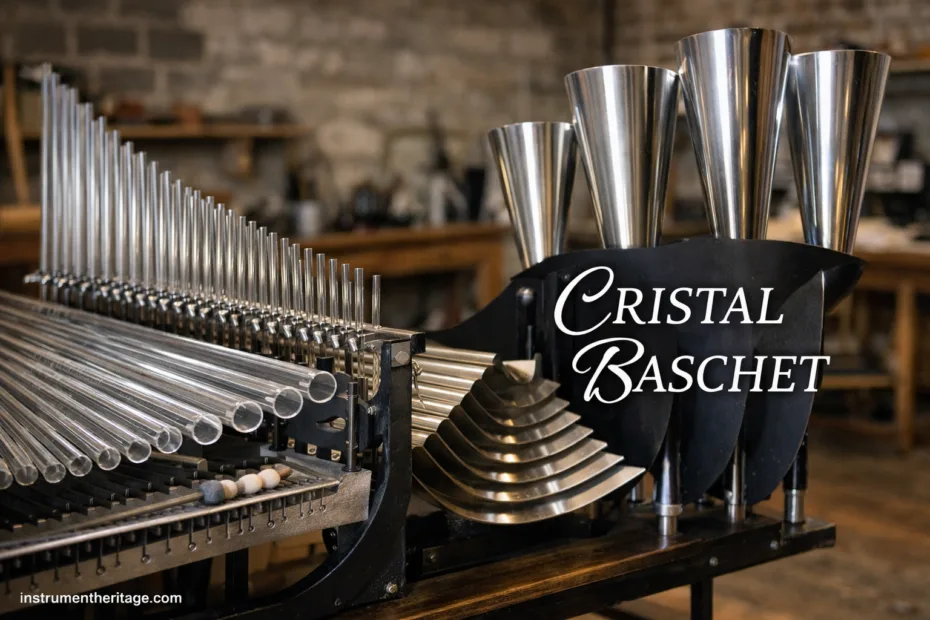
| How sound starts | The player rubs wet fingers on glass rods. The resulting friction sets a tuned metal system in motion, then a collector plate and sound diffusers push that vibration into the room. The acoustics paper breaks this into four parts: excitation, resonator, collector, and diffuser. Reference-2✅ |
| Range and layout | Many instruments sit around four and a half octaves, while other models can run smaller or larger. Thomas Bloch notes a usual range of 4.5 octaves, with models spanning roughly 3.5 to 6 octaves, and describes the familiar line of chromatically tuned glass rods. Reference-3✅ |
| Main materials | Glass for touch, metal for tuning and transfer, and resonating parts such as fiberglass cones, metal sheets, and fine metal “moustaches” or whiskers for added color and projection. |
| Acoustic identity | Fully acoustic, but often mistaken for an electronic instrument because of its long sustain, smooth attack, and floating overtone cloud. |
| Musical feel | It can sing a line like a bowed instrument, hold chords with a glassy shimmer, and slide between notes in a way that feels almost vocal. |
| Construction logic | The pitch is not “just the glass.” The glass rod is the rubbing surface; the tuned metal assembly beneath it does much of the note-fixing work. |
| Living legacy | The Baschet association continues preservation work and states that it operates with the Baschet heirs to protect the instruments and their intellectual legacy. Reference-4✅ |
Cristal Baschet does not behave like a polite keyboard instrument. You do not press a key and wait for a neat little note to arrive. You wet your fingers, touch glass, and pull sound out by friction. What comes back is long, clear, a little metallic, a little vocal, and strangely physical. It feels less like switching on a note and more like coaxing one into the air. That is a big part of its charm. So is the way it blurs categories: sound sculpture, concert instrument, acoustic experiment, and crafted object all at once.
Why it feels so different
Most first-time listeners focus on the glass. Fair enough. The surprise is that the Cristal Baschet is really a conversation between glass, metal, and radiating surfaces. The fingertip starts the motion, but the instrument’s body decides how that motion will bloom, spread, and linger.
- Friction idiophone
- Fully acoustic
- Glass + metal + fiberglass
- Sound sculpture
- Sustained tone
🛠 How the instrument is built
The Cristal Baschet looks futuristic even when it is standing still, but its layout is easier to understand than it first appears. A row of glass rods sits where a keyboard might sit on another instrument. Those rods are touched directly by the player. Beneath and around them sits the real acoustic engine: tuned metal rods, a metal collector, and large radiating parts that throw the sound outward. Some instruments use fiberglass cones. Some use dramatic folded sheets of metal. Some add the thin metal “moustaches” that brighten the upper register. Nothing is there by accident.
One thing many short articles miss: the glass rod is not simply the whole note-maker. It is the contact surface, almost like a bow held still while the finger becomes the moving force. The pitch is shaped by the tuned metal system attached to it. That detail matters because it explains why the instrument can sound both glassy and solid at the same time. The brightness comes from the touch point. The body comes from the metal and the diffusers.
What each part does
- Glass rods
- The player’s contact point. They reward moisture, steady drag, and a calm hand.
- Vibrating rods
- Tuned metal elements that help fix the pitch and carry the motion forward.
- Collector
- A metal support plate that gathers and passes vibration to the radiating parts.
- Diffusers
- Cones and sheets that turn local vibration into room-filling sound.
Why the shape matters
The large cone or folded metal leaf is not decoration with a side job. It is part of the instrument’s speaking voice. Change that radiator and you change the way the note opens, how far it carries, and how its upper partials hang in the room. That is why the Cristal Baschet feels closer to instrument making than gadget design. Shape and sound are tied together.
🎵 Why the tone behaves this way
The basic motion is friction. Simple word. Busy physics. Your fingertip grips the wet glass for a split second, then releases it, then grabs again. That fast alternation is the same family of behavior players know from bowed strings: a cycle of sticking and slipping. On the Cristal Baschet, that cycle feeds the tuned metal parts, and the radiators do the rest. The result is a tone that does not jump out with a hard front edge. It emerges.
That slow, blooming attack is why the instrument can sound ghostly from far away and almost intimate from a few feet away. Up close, you hear the little grain of friction, the slight hiss before the pitch settles, the fine metallic halo around the main note. At a distance, those details fuse into a floating line. Very few acoustic instruments move between those two impressions so easily.
Listen for three layers: the clean center of the pitch, the metallic shimmer around it, and the way the room keeps catching the tail of the note. That last part is easy to miss on a phone speaker. In person, it is everything.
The other thing worth noticing is projection. People often hear a Cristal Baschet and assume there must be some hidden electronics involved. There usually are not. The instrument’s radiating surfaces do a lot of work, which is why the sound can feel oddly detached from the player’s hands. You see fingers on glass, but the air in the room seems to light up somewhere else.
🕰 Where it came from, and why it mattered
The Cristal Baschet came out of the Baschet brothers’ search for new acoustic forms in the 1950s. That search was not only musical. It was sculptural. Material-minded. Public-facing. They were not chasing a prettier piano or a stranger organ. They were asking what happens when industrial-age materials are treated as musical bodies in their own right. The answer was a family of sound structures, and the Cristal became the best-known member of that family.
This matters because the instrument did not arrive as a novelty toy with an unusual timbre. It arrived inside a larger idea: that an instrument could also be a visual object, a piece of acoustic research, and a new social way of meeting sound. That background helps explain why the Cristal Baschet feels so unlike orchestral furniture. It is not trying to disappear into tradition. It keeps its structure visible. It shows you the mechanism. It almost invites you to think with your eyes before you listen with your ears.
It also belongs to a longer glass-friction lineage. People had already learned that rubbed glass could sing. The Baschets pushed that lesson into a different body: straighter lines, tuned metal partners, bold radiators, and a stage presence that made the instrument look as modern as it sounded. That shift is a big part of its identity. The Cristal is not merely “glass music.” It is engineered resonance with glass as the player’s doorway into it.
🧱 Why these materials were chosen
A lot of writing about the Cristal Baschet stops at “glass rods plus wet fingers.” That is the postcard version. The more interesting story sits in the material mix.
- Glass gives a smooth, stable rubbing surface. It is clear in both senses: visually obvious and acoustically honest. The finger can grip it, release it, and repeat that motion cleanly.
- Metal rods bring mass, stiffness, and dependable tuning behavior. They help turn a rubbed gesture into a pitch with spine.
- Fiberglass cones are light and efficient. They radiate sound well without making the instrument feel thick or sluggish.
- Folded metal sheets add projection and a sharper edge to the sound image. They also give the instrument that unmistakable sculptural silhouette.
- Fine metal whiskers are small, but they matter. They can wake up the upper partials and give the high notes extra sparkle.
Wood still has a place as frame or support in some setups, but the Cristal Baschet does not lean on a violin-style wooden box for its personality. Its voice comes from a more exposed system. You can almost hear the materials arguing with one another in a good way: hard glass, elastic metal, light composite surfaces, open air.
One subtle but important point
The instrument’s visual form is not separate from its acoustic behavior. A broad cone, a folded sheet, or a cluster of whiskers changes more than appearance. It changes radiation, color, and how the note occupies space. On a Cristal Baschet, design choices are heard as much as they are seen.
✋ What playing it actually asks from the musician
Playing the Cristal Baschet is tactile in a very direct way. No reed to hide behind. No bow hair between you and the speaking surface. Just skin, water, glass, and control. That makes the technique feel exposed at first. It also makes it wonderfully expressive once the hand settles down.
- Moisture matters. Too dry, and the note can fray or refuse to speak. Too wet, and the contact can get slippery in the wrong way.
- Speed matters. A slow drag can bloom gently; a quicker motion can wake the note faster and brighten the tone.
- Pressure matters. Press too hard and the sound can choke. Too light, and the pitch may never lock in.
- Contact area matters. A fingertip, two fingers, or a broader touch can each produce a different response.
- Patience matters. The instrument likes a player who listens while the note is forming, not after it has already formed.
Because the note grows out of friction, the Cristal Baschet is wonderful at sustained melody, gentle swells, and sliding shapes between fixed pitches. It can sound almost like a singer carrying a vowel through a room. Then, a second later, it can turn cooler and more metallic. Chords have their own beauty here. They do not stack like piano chords. They hover. They rub against each other softly, with a sheen that stays in the air a little longer than you expect.
Some models and setups also open the door to more percussive color, which is another detail often skipped in short overviews. People hear one floating melody online and assume the instrument only does one thing. Not really. A skilled player can shape attacks, control vibrato, use partial muting, build clusters, and work with the room in a very physical way. Small changes in touch make a big difference. It is an instrument that rewards ears before ego.
Practical feel: the Cristal Baschet sits somewhere between keyboard logic and bowed-string logic. The notes are laid out in order, but the hand has to draw the sound, not trigger it.
🔎 Similar instruments, and where the Cristal Baschet stands apart
The nearest family resemblance is to other glass-friction instruments, though the Cristal Baschet has its own build logic and stage presence. It is also often compared to electronic instruments because of its tone color, even though the sound-making process is fully acoustic.
| Instrument | How the sound begins | What makes it feel different |
|---|---|---|
| Cristal Baschet | Wet fingers rub glass rods coupled to tuned metal elements. | Projection comes from external radiators, so the sound seems to bloom away from the player’s hands. |
| Glass harmonica | Wet fingers touch rotating glass bowls. | Usually rounder and more uniform in speaking quality, with less of the visible sculptural hardware. |
| Glass harp | Wet fingers rub separate tuned glasses. | More intimate and direct, but generally less architected in its resonance system. |
| Ondes Martenot | Electronic tone shaped by keyboard and expressive controls. | It may live in a similar emotional color range, but the mechanism is entirely different. |
If you want the shortest distinction, here it is: the Cristal Baschet is not just a glass instrument. It is a glass-to-metal-to-air instrument. That middle step changes everything. It gives the sound more body, more radiated presence, and a stronger sense of crafted architecture than you get from many other rubbed-glass designs.
That is also why it keeps attracting instrument makers, composers, acousticians, and plain old curious listeners. It offers a rare balance. The mechanism is visible. The sound is unfamiliar but not alien. The player’s touch stays human and exposed. No screen. No hidden speaker. Just material, friction, and listening.
❓ FAQ
Is the Cristal Baschet the same thing as a glass harmonica?
No. They are related through rubbed glass, but they are built differently. A glass harmonica uses rotating bowls, while the Cristal Baschet uses glass rods coupled to tuned metal parts and external sound diffusers.
How do you play a Cristal Baschet?
You wet your fingers and rub the glass rods. That friction starts the vibration, and the instrument’s metal and radiating parts shape the pitch and projection.
Is the Cristal Baschet electronic?
No. It is an acoustic instrument. It can sound electronic to the ear because of its long sustain and unusual overtone color, but the sound is produced mechanically.
What gives the instrument its unusual tone?
The tone comes from friction on glass, transfer into tuned metal elements, and radiation through cones, metal sheets, and other resonating parts. That layered path gives it both clarity and shimmer.
Can it play chords and glissandos?
Yes. It can sing single melodic lines, hold chords, and move between notes with smooth slides. Those sliding gestures are one of its most striking musical features.
Are all Cristal Baschets the same size and range?
No. Different models exist. Many instruments are around four and a half octaves, but smaller and larger versions have also been made.
Why do players keep water close by?
Because the instrument depends on wet-finger friction. Without the right moisture level, the glass rods will not respond properly and the tone becomes much harder to control.
