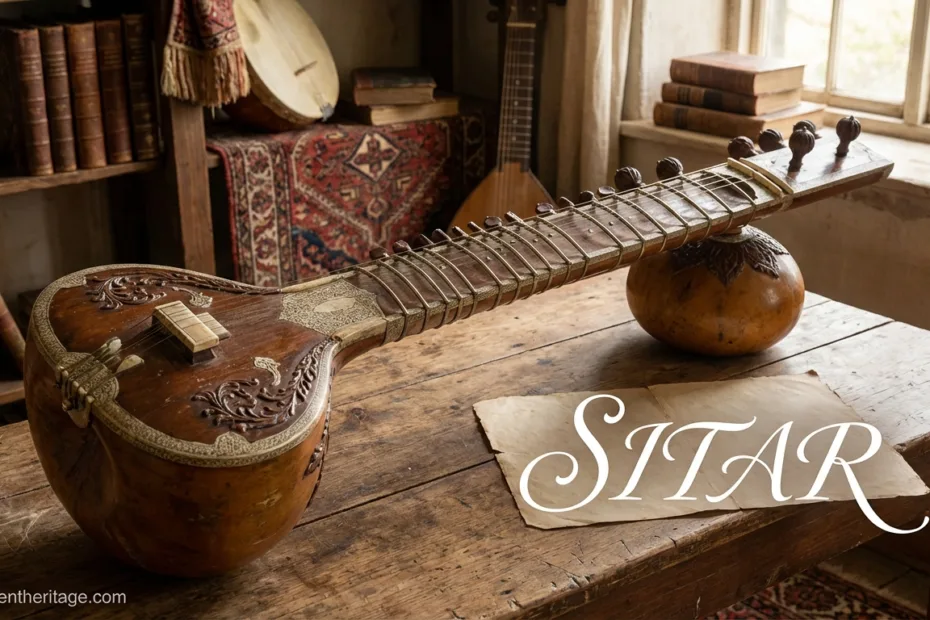
Imagine a sound that doesn’t just start and stop but blooms, buzzes, and bends into the spaces between the notes. That is the Sitar. It is not merely a plucked string instrument; it is a sophisticated musical instrument designed to mimic the fluidity of the human voice. While the guitar strikes a chord and fades, the Sitar sings. Originating from the rich cultural history of the Indian subcontinent, this long-necked lute has moved beyond its royal Mughal courts to become a symbol of Hindustani classical music and psychedelic exploration alike.
The magic lies in its engineering. It carries a hidden choir of strings—the sympathetic strings—that resonate without ever being touched, creating a natural reverb that digital pedals still struggle to replicate. Whether you are a musicologist, a curious listener, or someone fascinated by the physics of sound, understanding the Sitar requires diving into a world of pumpkins, teak wood, and intricate jawari work.
The Anatomy of a Sitar: More Than Meets the Eye
To the untrained eye, the Sitar looks like a very long guitar with a large gourd at the bottom. However, every inch of its construction is deliberate, serving the purpose of resonance and tonal flexibility. The instrument is a marvel of organic acoustics.
| Primary Material (Wood) | Toon (Red Cedar) or Teak |
| Resonator (Tumba) | Dried Pumpkin or Gourd |
| Total Strings | 18 to 21 (Depending on the style/Gharana) |
| Movable Frets | 20 curved metal frets |
| Bridge Material | Deer Horn, Camel Bone, or Ebony |
🪵 The Tumba (Resonator)
The main body is not wood bent into shape; it is a literal vegetable. A large, dried pumpkin or gourd (kaddu) forms the primary resonator. It is incredibly fragile but offers a depth of sound that wood cannot match. The face is covered with a wooden plank called the Tabli, which acts as the soundboard.
🏗️ The Dandi (Neck)
Extending from the gourd is a massive hollow neck, usually carved from Tun wood or Teak. Unlike a guitar neck, the Dandi is hollow, acting as a secondary resonating chamber. This allows the sound to travel up to the player’s ear.
The String Matrix: Tarab vs. Main Strings
This is where the Sitar separates itself from Western lutes. You don’t just have strings to play; you have strings that listen. Reference✅
- Main Strings (Baaj & Jod): Usually 6 or 7 strings run over the curved frets. These are the ones the musician plucks and bends to create melody and rhythm.
- Sympathetic Strings (Tarab): Running underneath the frets are 11 to 13 smaller strings. These are never strummed directly during a melody. Instead, they are tuned to the specific scale (Raga) of the performance. When the main string hits a matching note, the Tarab strings vibrate spontaneously due to sympathetic resonance.
Origins: A Persian-Indian Hybrid?
The history of the Sitar is often wrapped in folklore, making it hard to separate myth from musicology. A popular legend attributes the invention to the 13th-century poet and polymath Amir Khusrau. While Khusrau was instrumental in fusing Persian and Indian musical traditions, the Sitar as we know it likely didn’t exist in his time.
Most music historians agree that the Sitar evolved over centuries, solidifying its form in the 18th century during the late Mughal Empire. It is widely considered a hybrid, a musical marriage between:
- The Persian Setar (meaning “three strings”).
- The Indian Veena (specifically the Rudra Veena).
The instrument gradually adapted to the demands of Khayal singing (a style of classical vocal music), requiring an instrument that could mimic the sliding, gliding nature of the human voice. By the mid-19th century, master craftsmen had added the sympathetic strings, transforming a simple lute into the complex acoustic synthesizer we see today.
The Mystery of the “Jawari” (The Buzz)
If you listen closely to a Sitar, you hear a buzzing quality, almost like a distortion pedal set to low gain. In Western music, a buzz is usually a defect. in Indian classical music, it is the soul. This phenomenon is called Jawari (literally meaning “life” or “vivacity”).
- The Flat Bridge Principle
- On a guitar, the string touches the bridge at a sharp point. On a Sitar, the bridge is wide and gently sloped. As the string vibrates, its length changes slightly, causing it to graze against the sloping surface of the bridge repeatedly.
- Rich Overtones
- This grazing action filters the vibration, amplifying the high-frequency overtones. The result is a sound rich in harmonics, described as nasal or metallic.
Crafting and maintaining this bridge is an intricate skill. A “Jawarimaker” must file the bone surface with incredible accuracy. Take too much off, and the sound becomes lifeless. Leave too much, and the string rattles uncontrollably. It is a fine balance of physics and craftsmanship.
Technique: Bending the Note
Playing the Sitar is physically demanding. It requires callused fingers, precise posture, and a deep understanding of micro-tones (Shrutis).
The Mizrab 💍
The player wears a heavy wire plectrum called a Mizrab on the right index finger. Unlike a guitar pick, the Mizrab is worn tightly around the finger, allowing for powerful upward and downward strokes (Da and Ra). The continuous rhythmic striking creates a pattern known as Jhala.
Meend: The Art of Pulling
The defining characteristic of Sitar playing is the Meend (glissando). Because the frets are curved and raised high off the neck, the player can pull the main string laterally across the fretboard. Reference✅
By pulling the string, a skilled player can bend the pitch by as much as five or six notes from a single fret position. This allows them to slide between notes without plucking again, mimicking the continuous flow of a vocalist. This technique turns distinct notes into a fluid curve of sound.
- Gamak: A heavy, oscillating shake of the note.
- Krintan: Hammer-on and pull-off combinations.
- Zamzama: Complex, rapid clusters of notes using pulls.
- Murki: A quick, subtle trill often used in lighter classical styles.
Gharanas: The Schools of Thought
Not all Sitars are the same, and neither are the players. The instrument varies slightly depending on the Gharana (musical lineage/school) it belongs to.
1. The Imdadkhani Gharana (The Vilayat Khan Style)
This style focuses heavily on the “singing” quality of the instrument (Gayaki Ang). The Sitar used here often lacks the upper bass strings to allow for deeper note bending. It is simpler in construction but harder to master regarding tonal purity.
2. The Maihar Gharana (The Ravi Shankar Style)
Famous globally due to Ravi Shankar, this style incorporates the bass strings (Kharaj) to explore the lower octaves. It borrows heavily from the older Dhrupad style (Tantrakari Ang). These Sitars usually have an extra small gourd (tumba) at the top of the neck to balance the sound.
Maintenance: A Living Instrument
Owning a Sitar is like owning a classic car; it requires constant tuning and adjustment. The organic materials react dramatically to temperature and humidity.
⚠️ The Humidity Factor
Since the main body is a gourd and the face is thin wood, the Sitar is highly susceptible to cracking. Extreme dryness can split the Tabli, while high humidity can cause the neck to warp or the pegs (Kuntis) to slip.
Tuning the Sympathetic Strings:
Before every performance, the player must tune the 11-13 sympathetic strings to the specific scale of the Raga being played. If the musician changes the Raga, they must stop and retune all the sympathetic strings. This is why you often see Indian classical musicians spending several minutes tuning on stage—they are literally reprogramming the instrument’s reverb.
From Courts to Woodstock
The Sitar remains the most recognized ambassador of Indian music in the West. This cultural crossover exploded in the 1960s, largely driven by George Harrison of The Beatles, who studied under Pandit Ravi Shankar. Songs like “Norwegian Wood” and “Within You Without You” introduced the buzzing drone of the Sitar to pop radio.
However, the instrument is not just a relic of the psychedelic era. Today, it is used in fusion jazz, film scores, and electronic music. Its unique timbre cuts through dense mixes, providing an instant organic, mystical texture that no synthesizer can perfectly emulate.
Frequently Asked Questions
What is the difference between a Sitar and a Veena?
The Veena is an older, stick-zither instrument with two gourds and fixed frets, deeply rooted in the Dhrupad tradition. The Sitar is a later evolution, a lute with one main gourd and movable frets, designed for the faster, more fluid Khayal style of music.
Why does the Sitar have two layers of strings?
The top layer (main strings) is for playing the melody. The bottom layer (sympathetic strings or Tarab) vibrates automatically when matching notes are played, creating a natural reverb and background drone.
Is it difficult to learn the Sitar?
Yes, it has a steep learning curve. The sitting position (cross-legged), the pain on the fingertips from the wire strings, and the complexity of the music theory (Raga system) make it a challenging instrument to master.
What is the ball at the top of the Sitar for?
That is the upper resonator or Tumba. While not present on all Sitars, it helps amplify the bass frequencies and balances the weight of the long neck.
