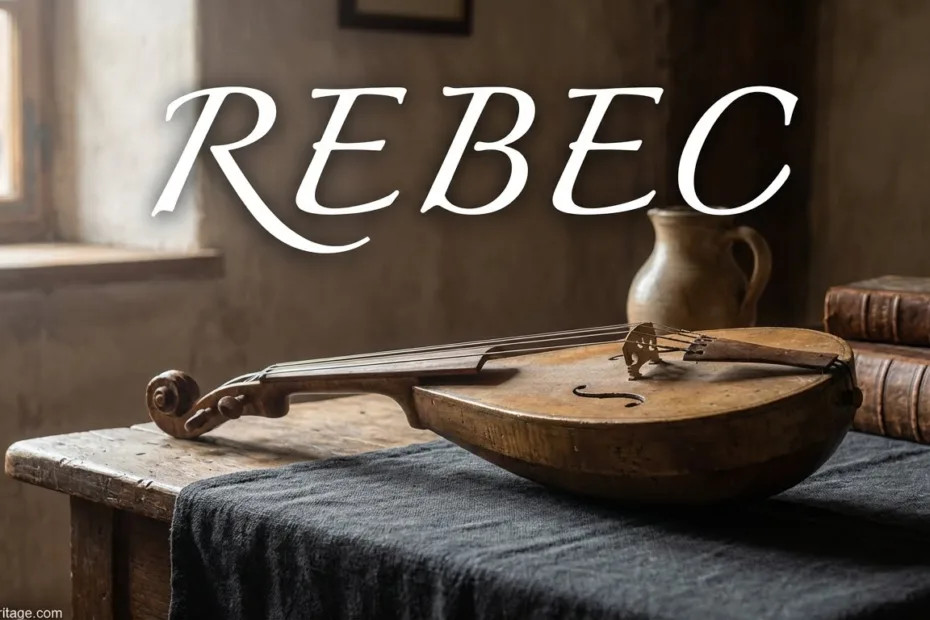
The Rebec is the spunky, loudmouthed grandfather of the modern violin. While today’s orchestras are dominated by the refined Stradivarius, the medieval world danced to the piercing, nasal cry of this pear-shaped powerhouse. It didn’t start in Europe, though. This instrument is a traveler, a survivor, and a bridge between Eastern and Western musical traditions.
If you were walking through a noisy 13th-century marketplace or watching a rowdy village dance, you wouldn’t hear a polite cello. You would hear the Rebec cutting through the chatter. It is small, carved from a single block of wood, and holds a history that stretches back to the deserts of the Middle East.
From Desert Sands to European Courts
The story of the Rebec is a classic tale of cultural exchange. It didn’t just appear in Europe; it was brought there. Its direct ancestor is the Arabic Rabāb (or Rebab), a spiked fiddle played in the Islamic world. When the Moors established Al-Andalus in what is now Spain, they brought their poetry, their architecture, and their instruments.
💡 Historical Twist: The name itself is a giveaway. The Arabic Rabāb evolved into the French Rebec, the Italian Ribeca, and the English Rybybe. It is one of the clearest examples of how Islamic culture terraformed European music.
By the 11th century, the instrument had shed its skin—literally. The original Rabāb often had a skin belly (like a banjo), but European makers replaced this with wood to better suit their climate and materials. This created the European Rebec we recognize in paintings of angels and gargoyles.
The Anatomy: A Pear Sliced in Half
If you look at a violin, you see distinct parts: a neck, a body, and ribs. The Rebec is different. It is organic and seamless. The most defining feature of a Rebec is that the body and neck are carved from a single block of wood. There are no glued seams separating the neck from the soundbox.
Think of a pear cut vertically down the middle. That is your Rebec. It has a rounded back, which makes it rock slightly if you place it on a table, unlike the flat-backed guitars or viols.
🎻 Quick Specs: The Rebec
| Body Shape | Piriform (Pear-shaped), rounded back. |
| Material | Hardwood (Maple, Walnut) carved from one solid piece. |
| Strings | Typically 3 gut strings (sometimes 2 or up to 5). |
| Tuning | Usually in Fifths (often G-D-A, similar to a modern violin). |
| Pegbox | Sickle-shaped or flat, often ending in a carved scroll. |
The fingerboard is often just a raised part of the body, and the top (the soundboard) is glued flat onto the hollowed-out “bowl.” This construction makes it incredibly durable—perfect for the traveling minstrels who carried them in sacks on their backs from town to town Reference✅.
A Voice That Cuts Through Glass
Do not expect the warm, chocolatey tone of a modern viola. The Rebec was the electric guitar of the Middle Ages. Its sound is often described as nasal, bright, and penetrating. This wasn’t an accident; it was a feature.
Medieval music was often performed outdoors or in noisy great halls. A quiet instrument would be lost. The Rebec’s sharp attack and high frequencies allowed the melody to be heard clearly over the stomping feet of dancers and the clatter of plates. It was the ultimate dance machine, driving the rhythm for circles of revelers.
- It was played with a convex bow (curved outward like an archery bow).
- It was held high on the shoulder, under the chin, or sometimes resting on the arm (playing da braccio).
- It was used for monophonic melodies, rarely for complex chords.
Spot the Difference: Rebec vs. Vielle
In medieval iconography, you will often see two bowed instruments side by side. It is easy to confuse them, but they are distinct species. The Vielle (Medieval Fiddle) was the other major player, but it had a different personality and construction.
Compare: Rebec vs. Vielle
Rebec has a rounded, bowl-like back. Vielle has a flat back.
Rebec is carved from one solid block. Vielle is built from separate glued parts (ribs/sides).
Rebec tapers into the neck (Pear). Vielle has a distinct neck joint (Oval/Boxy).
Rebec was often rustic/secular. Vielle was more common in courtly/polyphonic music.
While the Vielle eventually evolved toward the Viol family (Viola da Gamba), the humble Rebec is the true ancestor of the violin in terms of tuning (fifths) and playing position (on the shoulder) Reference✅.
Frequently Asked Questions
Common Questions
Is the Rebec difficult to play?
For a modern violinist, it is relatively easy to pick up because the tuning (usually fifths) and hand position are similar. However, the lack of a raised fingerboard and the tension of gut strings require a different bowing technique and finger pressure.
Why does the Rebec have a sickle-shaped head?
The sickle-shaped pegbox is a holdover from its Arabic ancestors. It helps with balance and string tension, but largely it became a stylistic trademark of the instrument during the Middle Ages.
Are Rebecs still played today?
Yes! They are very popular in “Early Music” ensembles that specialize in Medieval and Renaissance music. There are also folk variations in Eastern Europe and Spain that are direct descendants of the Rebec.
Did the Rebec have frets?
Generally, no. Most historical Rebecs were fretless, allowing for sliding notes and microtones, which hints at its Middle Eastern origins. However, some later illustrations do show tied gut frets.
