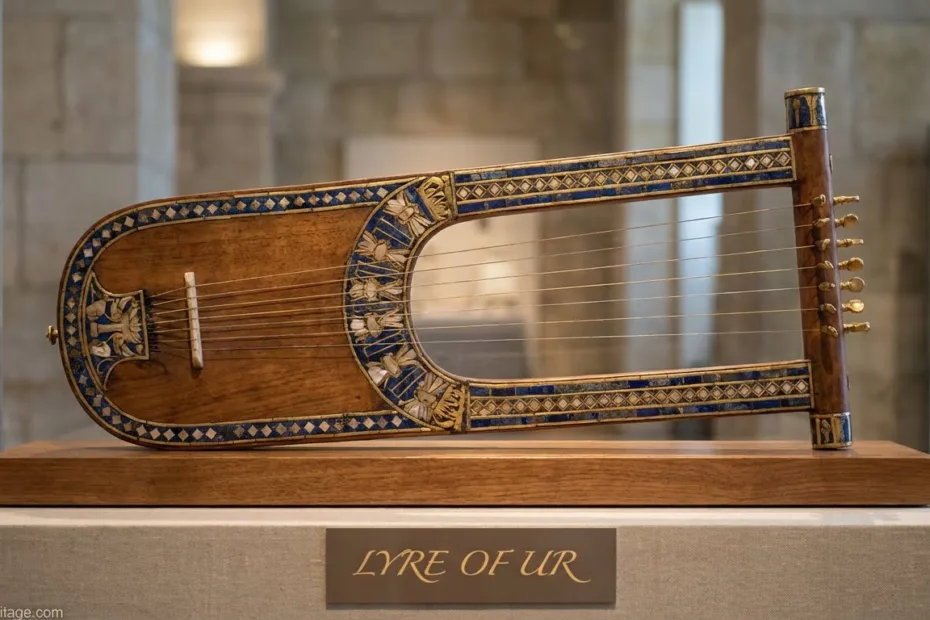
Imagine peeling back layers of earth to reveal a voice that hasn’t been heard in 4,500 years. That is exactly what happened when archaeologists uncovered the Royal Cemetery of Ur in modern-day southern Iraq. Among the treasures found in these ancient Sumerian graves, the Lyres of Ur stand out not just as artifacts, but as sophisticated machines of sound that connected humanity to the divine. These weren’t simple noise-makers; they were masterpieces of gold, lapis lazuli, and engineering, predating the Pyramids of Giza. They offer us a rare glimpse into the complex musical culture of early civilization.
Unearthing the Oldest String Instruments
When excavation director Sir Leonard Woolley discovered the “Great Death Pit” in 1929, he didn’t initially find pristine instruments. The wooden bodies had decayed millennia ago. What remained were the cavities left in the soil, adorned with non-perishable decorations like gold plating and shell inlays. Using a brilliant technique, Woolley poured plaster of Paris into these holes, effectively casting the shape of the vanished wood. This process allowed the world to see the Lyres of Ur in their original glory.
Why Are They So Important?
The Lyres of Ur are widely considered the world’s oldest surviving string instruments. They prove that by 2550 BCE, Mesopotamia had:
- A fully developed musical system and theory.
- Complex trade networks (sourcing materials like lapis lazuli from Afghanistan).
- Highly specialized craftsmanship combining metallurgy and carpentry.
These instruments were buried with high-ranking individuals, likely to provide music in the afterlife. The most famous among them is the Great Lyre (often called the Bull-headed Lyre), which features a striking golden bull’s head.
The Bull: A Symbol of Power and Sound
One cannot look at these lyres without locking eyes with the bearded bull. This imagery wasn’t accidental. In Sumerian mythology, the bull was often associated with Shamash (Utu), the sun god and judge of justice. However, the bull also represented the deep, resonant sound of the instrument itself—a low, thrumming vibration similar to a bull’s bellow.
The Great Lyre found in the “King’s Grave” features a head made of gold leaf over a wooden core, with a beard and eyes crafted from lapis lazuli. This blue stone was incredibly precious, symbolizing the night sky or deep water.
Reference✅
Anatomy of the Lyres
The construction of these instruments reveals a standardized design, suggesting a professional class of instrument makers (luthiers) existed in Ur.
- The Soundbox: Usually trapezoidal or boat-shaped, designed to amplify the vibration of the strings.
- The Uprights: Two arms rising from the soundbox, often decorated with bands of gold or silver.
- The Yoke: The crossbar connecting the uprights, where the strings were tied.
- Tuning Levers: Interestingly, these lyres likely used wooden sticks or levers to tighten the strings, a mechanism for tuning that predates modern pegs.
The strings themselves were likely made from gut (animal intestine), which produces a warm, plucky tone. While the wood and strings disintegrated, the detailed measurements taken during excavation have allowed experts to build playable replicas.
A Tale of Three Lyres
While the “Great Lyre” gets the most attention, excavation PG 789 and PG 1237 yielded several distinct instruments. Each has a unique character and resides in a different part of the world today.
| Instrument Name | Key Materials | Iconography | Current Location |
|---|---|---|---|
| The Great Lyre | Gold, Lapis Lazuli | Golden Bull with Lapis beard | Penn Museum, Philadelphia |
| The Queen’s Lyre | Gold, Lapis, Shell, Red Limestone | Heavy gold bull head, intricate inlays | The British Museum, London |
| The Silver Lyre | Sheet Silver | Silver bull head, cow-like shape | The British Museum, London |
| The Boat-Shaped Lyre | Silver, Shell | Stag statue, high prow shape | Penn Museum, Philadelphia |
The Queen’s Lyre, discovered in the grave of Queen Puabi, is particularly stunning. It is slightly smaller than the Great Lyre but heavily decorated.
Reference✅
How Was the Music Played?
We can’t listen to a recording from 2500 BCE, but we can make educated guesses based on cuneiform tablets and iconography. Musicians held the instrument upright, often supported by a strap. They used both hands: one to damp the strings and the other to pluck, or perhaps using a plectrum.
The music was likely pentatonic or heptatonic (5 or 7 note scales). These instruments were not solo acts; they were part of an ensemble that included singers, flutes, and drums. The scenes depicted on the lyres themselves show animals playing music, hinting at a culture where music was integral to both feasts and religious rituals.
- Tuning Mechanism
- Small wooden levers or sticks were used to twist the string tension against the yoke.
- String Count
- Usually between 8 and 11 strings, allowing for a decent melodic range.
- Playing Style
- Played vertically, likely with both hands (dampening and plucking techniques).
The Tragic Loss and Restoration
History is fragile. While the lyres survived 4,500 years underground, the Golden Lyre of Ur (held in the National Museum of Iraq) suffered severe damage during the looting of the museum in 2003 following the invasion of Iraq. The gold bull’s head was stolen (later recovered), and the reconstructed body was broken.
However, this tragedy sparked a global interest in restoring and understanding these instruments. Projects like the Lyre of Ur Project have brought together musicians and archaeologists to build authentic replicas using Sumerian tools and materials (like Cedar of Lebanon). These replicas have given us the closest experience to hearing what Queen Puabi might have heard in her court.
Frequently Asked Questions
What is the Lyre of Ur made of?
The original wooden parts decayed, but the surviving decorations include gold, silver, lapis lazuli, shell, and red limestone. The reconstructions use wood like cedar.
How many Lyres of Ur were found?
Leonard Woolley excavated several lyres and harps. The most famous are the Great Lyre, the Queen’s Lyre, the Silver Lyre, and the Boat-Shaped Lyre.
Where can I see the original Lyres of Ur?
The surviving instruments are divided primarily between the British Museum in London, the Penn Museum in Philadelphia, and the National Museum of Iraq in Baghdad.
Did the lyres have a religious purpose?
Yes, they were found in royal graves and likely played a role in funeral rites and religious ceremonies dedicated to Sumerian deities.
