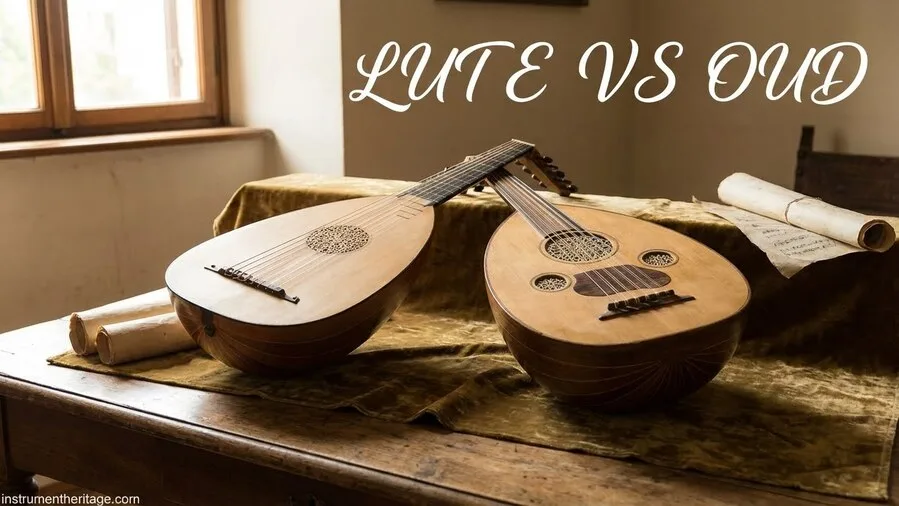
If you squint your eyes a little bit while looking at a stage, you might mistake an Oud for a Lute, or vice versa. It is an honest mistake; after all, they are basically siblings separated by geography and time. Both have that distinctive, bulbous pear shape, a bent neck that looks like it’s looking back at you, and a history that stretches back centuries. However, once you pick them up—or listen to a master play them—the differences become as clear as day and night. One is the voice of the European Renaissance, organized and polyphonic, while the other is the soul of Middle Eastern maqam, fretless and infinitely expressive.
The Short Answer
The most notable difference lies on the neck: The Lute has frets (tied gut or nylon) which allow for chordal playing and Western harmony, while the Oud is fretless. This lack of frets allows the Oud player to slide between notes and play microtones (quarter tones), which are central to Middle Eastern music, something the Lute cannot achieve.
The Family Tree: Origins and Evolution
To understand why these instruments are different, you have to look at where they grew up. The Oud is the ancestor. Its name comes from the Arabic al-ʿūd, which literally means “the wood”. It has been the “Sultan of Instruments” in the Arab world for thousands of years. It didn’t just stay there, though; it traveled across North Africa and entered Europe through Moorish Spain (Al-Andalus).
When the Europeans got their hands on the Oud during the medieval period, they adapted it. They added frets to suit their evolving musical tastes, which relied heavily on chords and harmonizing multiple melodies at once. This adaptation became the Lute. So, in a way, the Lute is the European grandchild of the Oud.
Key Historical Distinction
While the Oud remained the primary vehicle for melodic improvisation in the East, the Lute became the essential tool for polyphonic composition in the West, eventually leading to the guitar. Reference✅
Construction: The Body and The Neck
At a first look, the construction appears identical. Both feature a deep, round back made of multiple ribs of wood glued together. This is often called the “bowl.” However, the design differs greatly to support their specific musical functions.
The Neck and Pegbox
The Oud typically has a very short neck compared to the body size. It feels compact. The pegbox (where the tuners are) is bent back at a dramatic angle, usually 45 to 90 degrees. This high tension is necessary because the Oud has no frets to stop the string vibration; the tension does the work.
The Lute, particularly later Baroque versions, often has a longer neck to accommodate more strings and bass notes. The defining feature, however, is the frets. These are usually loops of gut tied around the neck. You can actually move them slightly to adjust the tuning, which is a nightmare for beginners but a blessing for period accuracy.
The Soundboard (The Face)
On an Oud, you will often see one large sound hole or three smaller ones (often covered with intricate carved rosettes). It usually lacks internal bracing that is too heavy, allowing the face to vibrate freely for that dark, resonant sound.
The Lute has a single, large, ornate rosette carved directly into the wood of the top. The internal barring (bracing) is different, designed to support the tension of higher-pitched strings used in Western tuning.
The Playing Experience: Frets vs. Fretless
This is where the rubber meets the road. If you are a guitarist, the Lute will feel somewhat familiar. You press a string behind a fret, and you get a specific, clean note. This allows you to play complex chords and counterpoint (playing a bass line and a melody simultaneously). It is precise, mathematical, and polite.
The Oud is a different beast entirely. Because it is fretless, like a violin or cello, your finger placement must be exact. If you are a millimeter off, you are out of tune. However, this “flaw” is its greatest power. It allows for:
- Glissando: Sliding smoothly from one note to another.
- Vibrato: Rocking the finger to make the note “sing” or weep.
- Microtones: Playing notes that exist between the standard keys on a piano. These are essential for Maqam scales used in Turkish, Arabic, and Persian music.
Analogy time: Playing the Lute is like typing on a keyboard—precise, distinct buttons. Playing the Oud is like painting with a brush—fluid, continuous strokes where colors blend into each other.
Strings and Technique
Both instruments use courses, which are pairs of strings tuned to the same note (like a 12-string guitar). This gives them that shimmering, chorus-like effect and volume.
- Lute Strings
- Historically made of gut (sheep intestine). Modern players often use Nylgut (synthetic gut). Baroque lutes can have up to 13 courses (24+ strings)!
- Lute Technique
- Played with the fingertips of the right hand. This allows for plucking multiple strings at once for chords.
- Oud Strings
- Usually nylon or silk wound with silver/copper. Typically has 11 strings (5 pairs + 1 single bass drone string).
- Oud Technique
- Played with a long, thin plectrum called a risha (historically an eagle feather). It is percussive and melodic, rarely chordal.
Sound Profile Comparison
If you closed your eyes, could you tell them apart? Absolutely. The Lute tends to have a brighter, sweeter, and more delicate sound. It decays relatively quickly, which is why lute music often sounds “busy”—the player has to keep playing notes to keep the sound alive.
The Oud is darker, deeper, and more resonant. Because it is played with a risha, the attack is stronger. It has a “woody” thump to it. The lack of frets also gives it a slightly muffled, warm quality compared to the sharp clarity of a fretted note. Reference✅
Comparison Table: Quick Overview
| Feature | The Lute | The Oud |
|---|---|---|
| Neck | Fretted (Tied gut/nylon) | Fretless (Smooth wood) |
| Primary Region | Europe (Renaissance/Baroque) | Middle East, North Africa, Turkey |
| Playing Tool | Fingertips (mostly) | Risha (Plectrum/Pick) |
| Musical Focus | Harmony, Chords, Polyphony | Melody, Maqam, Microtones |
| Sound Character | Bright, Delicate, Precise | Deep, Warm, Resonant, Slidey |
Which One Should You Choose?
Choosing between a lute and an oud is not just about choosing an instrument; it is about choosing a musical language. If you love Bach, Dowland, and the idea of reading complex sheet music to play multiple lines at once, the Lute is your path. It connects you to the history of Western Classical music.
If you are drawn to improvisation, the mystical sound of scales that sound “exotic” to Western ears, and you want the freedom to express emotion through slides and quarter tones, the Oud is calling your name. It is less about reading dots on a page and more about feeling the mode.
Frequently Asked Questions
Is the Oud harder to play than the Lute?
They are difficult in different ways. The Oud is physically harder for intonation because it has no frets—you must have a good ear to play in tune. The Lute is mentally harder because the repertoire often requires reading complex tablature and playing polyphonic music (multiple simultaneous melodies) with complex fingerpicking patterns.
Can I play Lute music on an Oud?
Technically, yes, you can play the melodies. However, you cannot play the chords effectively. Lute music relies on playing 3 or 4 notes at once (polyphony), which is very difficult on the fretless Oud played with a pick. The style and flavor will be completely different.
Why does the Oud have a bent neck?
The sharply bent pegbox (often near 90 degrees) is designed to reduce the tension on the nut (the piece of bone/wood at the top of the neck). Since the Oud has no frets and low action, this angle helps keep the strings firmly seated in the nut slots and improves the transfer of vibration.
