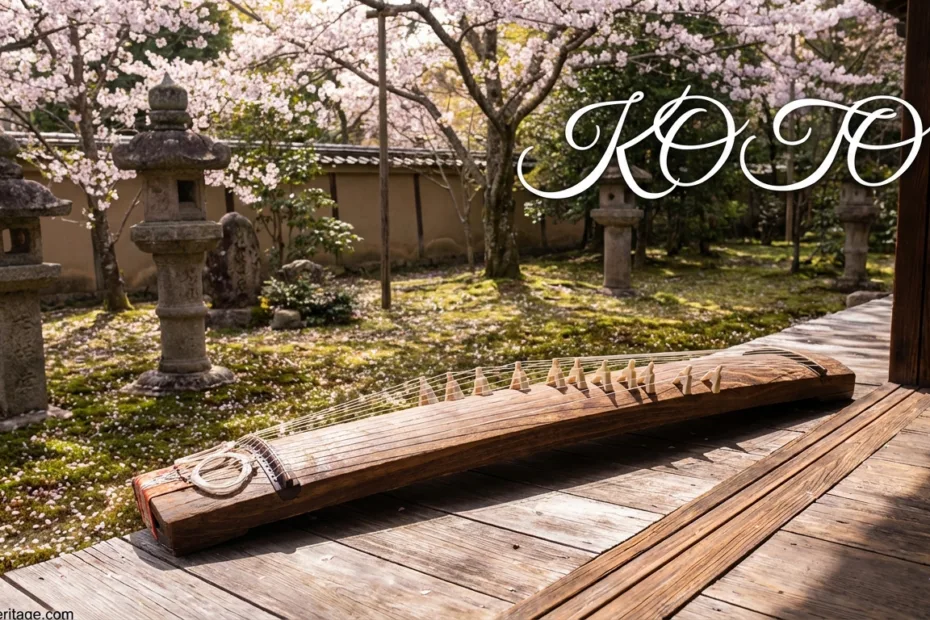
Imagine a dragon lying on the shore, its long, curved body echoing the sound of the waves. This isn’t just a poetic metaphor; it is the spiritual and physical embodiment of the Koto. As the national instrument of Japan, this thirteen-stringed zither commands a presence that goes far beyond simple musicality. It carries the weight of centuries of court rituals, the quietude of Zen philosophy, and the dynamic energy of modern fusion. Unlike instruments that you simply hold, the Koto demands that you sit before it, engaging in a physical conversation with Paulownia wood and silk strings.
While many Western observers might lump all “long board with strings” instruments into one category, the Koto stands apart with its movable bridges and its unique capacity for pitch bending. It is a canvas where silence (Ma) is just as important as the sound itself. Whether you are hearing the crashing waves of the famous piece “Haru no Umi” or the subtle plucking in a traditional tea house, the Koto speaks a language of nature and elegance.
From Chinese Courts to Japanese Souls
The story of the Koto is a classic tale of cultural adoption and adaptation. It didn’t purely originate in Japan; rather, it traveled across the sea from China during the Nara period (710–794). Initially, it was known as the Gakuso and was heavily influenced by the Chinese Guzheng. However, strictly labeling it as a “Japanese version of the Guzheng” does a disservice to the massive evolution it underwent on the archipelago.
For centuries, the Koto was locked away within the Imperial Court. It was the exclusive domain of nobility and court musicians performing Gagaku (orchestral court music). Ordinary people were forbidden from learning it. This exclusivity created an aura of mystery and prestige around the instrument that persists to some degree even today. It wasn’t until the Edo period that the Koto truly found its voice among the common people, thanks to a revolutionary figure who broke all the rules.
🎻 The Blind Master: Yatsuhashi Kengyo
You cannot discuss Koto history without bowing to Yatsuhashi Kengyo (1614–1685). A blind musician of immense talent, he is considered the father of modern Koto. He took the instrument out of the royal courts and taught it to commoners. More importantly, he developed the Hirajoshi scale, a tuning system that defines the “Japanese sound” we recognize today. Before him, the music was entirely different; he single-handedly engineered the solo Koto repertoire.
By the 17th century, the instrument had become a staple of domestic education for wealthy merchant daughters. Playing the Koto became synonymous with grace, discipline, and marital eligibility. It transitioned from a ritualistic tool of the Emperor to the emotional soundtrack of the Japanese interior.
Anatomy of a Wooden Dragon
The physical structure of the Koto is steeped in mythology. The instrument is conceptually treated as a dragon lying on the ground. This isn’t just fanciful language; the parts of the instrument are literally named after dragon body parts. The upper surface is the Ryuko (Dragon’s Back), and the underbelly is the Ryufuku (Dragon’s Belly).
The Paulownia Wood (Kiri)
The body is carved from Paulownia wood, known in Japan as Kiri. This wood is chosen for its incredible resonance and lightweight properties. The way the grain is cut matters immensely for both aesthetics and sound quality. The most prized instruments feature Itame (swirling wood grain) or the incredibly straight and tight Masame grain. A master craftsman will hollow out the interior of the log, carving sound grooves (Ayasugi) inside the body to enhance the tone texture Reference✅.
The length typically runs about 182 centimeters (roughly 6 feet). It is a massive piece of timber that dominates a room. The soundboard is slightly convex, mimicking the curvature of the dragon’s back, which allows the sound to project outward and upward, filling the tatami room with warmth.
- Ryukaku (Dragon Horns)
- The white bridge at the head of the instrument where strings pass over.
- Ryubi (Dragon Tail)
- The tail end of the Koto, where the strings are tied and anchored.
- Ryuzetsu (Dragon Tongue)
- The decorative area at the head, often adorned with蒔絵 (Makie) lacquer work.
The Movable Bridges (Ji)
Here is the engineering magic: The Ji. Unlike a guitar or piano where bridges are fixed, Koto bridges are movable. Made traditionally from ivory or plastic today, these small pillars are slid up and down the board to change the pitch of each string. This means a player can retune the entire instrument in seconds by physically shifting the bridges, allowing for a fluidity between different musical scales that fixed-bridge instruments simply cannot achieve.
The strings themselves were traditionally made of twisted silk. Silk produces a warm, organic, and slightly “scratchy” sound that is deeply beloved by purists. However, silk is fragile and breaks easily under tension. Today, most performers use Tetron (a synthetic polyester) which offers high durability and a brighter, sharper tone, though it lacks the subtle “breath” of silk.
Mastering the Strings: Tsume and Oshide
Playing the Koto is a full-body experience, even though you are sitting down. The musician wears three picks called Tsume on the thumb, index, and middle fingers of the right hand. The left hand has no picks but is arguably the more important hand for expression.
The nuances of Koto playing involve a vocabulary of specific strokes. There is the Sha-sha-ten (a rhythmic strumming pattern), the Hiki-iro (pulling the string after plucking to bend the pitch downward), and the Ura-ren (rapidly brushing the strings with the back of the nails). Watching a master play is mesmerizing; their hands dance over the “dragon” like fluttering butterflies, yet the pressure they apply to the strings requires great physical strength.
The Great Divide: Ikuta vs. Yamada
In the world of Koto, you generally belong to one of two major schools (Ryu): Ikuta-ryu or Yamada-ryu. While an untrained eye might not see the difference immediately, the distinctions in posture, picks, and repertoire are important and deeply preserved by tradition.
Ikuta School
- Origin: Founded by Ikuta Kengyo in the late 17th century in Kyoto.
- The Picks (Tsume): Uses square-edged picks.
- Posture: The player sits at an angle to the instrument. This angle allows the square edge of the pick to hit the string cleanly.
- Style: Focuses heavily on instrumental technique and complex fingerwork.
Yamada School
- Origin: Founded by Yamada Kengyo in the late 18th century in Edo (Tokyo).
- The Picks (Tsume): Uses round-ended or pointed picks.
- Posture: The player sits directly facing the instrument (frontal).
- Style: Places a stronger emphasis on singing (Uta) accompanying the instrument. The sound is often louder and more theatrical.
The rivalry—or rather, the distinct separation—between these schools has helped preserve a wide variety of playing techniques. A Yamada player might emphasize the dramatic storytelling capability of the instrument, while an Ikuta player might dazzle with technical precision and instrumental interludes known as Te-goto.
The 17-String Monster and Global Fusion
If Yatsuhashi Kengyo was the father of traditional Koto, then Miyagi Michio (1894–1956) is the revolutionary of the 20th century. He dragged the Koto into the modern era, introducing Western musical elements and inventing the 17-string Koto (Jushichigen).
The standard Koto has 13 strings and covers a range similar to a viola or the middle of a piano. The 17-string Koto acts as the bass, filling the low-end frequencies that traditional Japanese ensembles lacked. It is a massive, deep-voiced instrument that requires immense force to pluck. Miyagi’s most famous piece, “Haru no Umi” (The Sea in Spring), is a staple duet for Koto and Shakuhachi (bamboo flute) and is played almost universally in Japan during New Year celebrations.
Today, the Koto is not just a museum piece. You will find it in jazz ensembles, playing alongside electric guitars, and even in pop music. Contemporary artists are pushing the boundaries of what the “dragon” can do, using percussive hits on the wood body and complex polyrhythms that would have shocked the courtiers of the Nara period.
Zithers of the East: A Comparison
It is easy to confuse the Koto with its Asian cousins. While they share a common ancestor, the developmental paths have differed greatly. Here is a breakdown of how the Koto stacks up against the Chinese Guzheng and Korean Gayageum.
| Instrument | Origin | Strings | Playing Character |
|---|---|---|---|
| Koto | Japan | 13 (Standard) | Stoic, heavy use of silence (Ma), played with 3 finger picks. Tension is high. |
| Guzheng | China | 21 (Modern) | Fluid, rippling water sounds, played with 4-8 finger picks (often on both hands). Lower tension. |
| Gayageum | Korea | 12 (Traditional) | Percussive, earthy, often played with bare fingers (no picks), emphasizing deep vibrato. |
The Gayageum sound is more intimate and raw due to the skin-on-string contact, whereas the Guzheng is often dazzling and harp-like. The Koto sits somewhere in the middle—capable of sharpness thanks to the picks, but retaining a disciplined, structured resonance Reference✅.
🎼 Notation: Reading the Columns
Unlike Western music which reads left-to-right on a staff, traditional Koto music is written in vertical columns of Kanji characters. Each character represents a string number. Rhythmic timing is indicated by lines or dots next to the characters. It reads top-to-bottom, right-to-left, just like traditional Japanese literature.
Common Questions About the Koto
Is it difficult to learn the Koto?
Physically, the Koto can be demanding. Pressing the strings (Oshide) requires great finger strength and calluses. However, producing a basic sound is easier than on a violin or wind instrument. The challenge lies in mastering the fine details of pitch bending and timing.
How much does a Koto cost?
Prices vary wildly based on the wood grain. A beginner student model (practice koto) might cost around $500 to $1,000 USD. However, a professional concert instrument made from high-quality Paulownia with intricate Makie gold lacquer designs can easily exceed $10,000 to $20,000 USD.
Why do Koto players wear picks on only three fingers?
Tradition dictates the use of the thumb, index, and middle fingers for the main melody and harmony. The ring and pinky fingers are anchored to the soundboard to provide stability and leverage for the hand. Using more fingers is generally reserved for modern, experimental techniques or Chinese Guzheng styles.
What does the Koto sound symbolize in Japanese culture?
The Koto represents the transience of nature. Its decaying notes (sounds that fade into silence) are linked to the concept of Mono no Aware—the bittersweet awareness of the impermanence of things, much like the falling of cherry blossoms.
