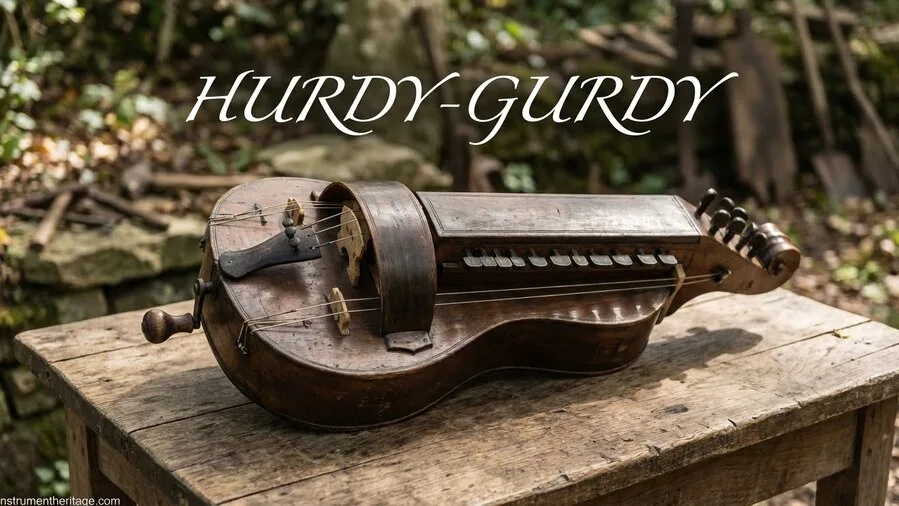
Imagine a musical instrument that looks like a violin crossed with a typewriter, sounds like a bagpipe, and is played by cranking a wheel. This mechanical oddity is the Hurdy-Gurdy. Far from being a simple relic of the past, this instrument—known in French as the vielle à roue—is a marvel of acoustic engineering that has survived for over a thousand years. It has traveled from the sacred halls of medieval churches to the dusty hands of street beggars, and finally, to the stages of modern folk metal bands. It is a drone instrument, a string instrument, and a keyboard instrument all rolled into one complex, wooden package. To understand the hurdy-gurdy is to understand the evolution of European mechanical music itself.
From Sacred Giant to Street Survivor: A History
The story begins not with the portable instrument we see today, but with a massive, two-person behemoth called the Organistrum. Emerging in Northern Spain around the 10th or 11th century, the Organistrum was strictly a church instrument. It was so large that it required two people to operate: one to crank the massive wheel and another to physically pull the large keys (tangents) to change the notes. It wasn’t built for speed; it was built for slow, meditative drone accompaniment to Gregorian chants.
As the centuries progressed, the instrument shrank. By the 13th century, it evolved into the smaller symphonia (or chifonie), which a single person could play. However, as musical tastes shifted towards more complex polyphony that the hurdy-gurdy’s drones couldn’t handle, the instrument fell from grace. By the 17th century, it was famously known as the “Beggar’s Lyre”. It became the soundtrack of the peasantry, the blind, and the destitute in France and Germany.
Then, a strange twist of fate occurred in the 18th-century French court. During the Rococo period, aristocracy became obsessed with a romanticized version of “peasant life” (think of Marie Antoinette playing shepherdess). Suddenly, the hurdy-gurdy was fashionable again. Luthiers like Baton and Louvet began building exquisite instruments using bodies of old guitars or lutes, inlaid with ivory and mother-of-pearl. This era gave us the standard vielle à roue shape we recognize today.
The Machine Inside: Anatomy of a Hurdy-Gurdy
The hurdy-gurdy is often described as a mechanical violin, but that simplifies the brilliant engineering underneath the hood. It relies on friction, just like a violin, but the “bow” is an infinite, rotating wooden wheel.
Key Components Breakdown
- The Wheel (Le Roue)
- A polished wooden disc, usually made of pear wood or maple. It rubs against the strings to create vibration. It must be perfectly true (round) and coated in rosin.
- The Cotton (Le Coton)
- This is important. Players must wrap tiny wisps of cotton around the strings where they touch the wheel. The cotton protects the string from being cut by the wheel and softens the tone. Without cotton, the instrument sounds harsh and unpleasant.
- The Tangents
- Unlike a guitar where you press the string against a fretboard, the hurdy-gurdy has small wooden wedges called tangents inside a keybox. When you press a key, the tangent pushes against the string to shorten its vibrating length, changing the pitch.
- The Melody Strings (Chanterelles)
- These are the strings that play the tune. A hurdy-gurdy usually has two or three, tuned in unison or octaves.
- The Drones (Bourdons)
- These strings bypass the keybox and play a continuous single note, providing the bagpipe-like background hum.
The interplay between these parts creates a wall of sound. Because the wheel turns constantly, there is no silence between notes unless the player stops cranking. This creates a relentless, driving energy that is characteristic of the instrument.
The Buzzing Bridge: The “Dog”
If you listen to a hurdy-gurdy performance, you will hear a rhythmic buzzing sound, almost like a snare drum, accompanying the melody. This is not accidental percussion; it is the Trompette string and a tiny piece of loose wood called the Dog (or chien in French).
The mechanism is genius in its simplicity. The trompette string rests on a loose bridge (the dog) that sits in a notch on the instrument’s body. When the player cranks the wheel smoothly, the dog stays still. But when the player applies a sudden burst of speed or “snap” with their wrist—known as the coup de poignet—the increased vibration causes the dog to lift off the soundboard and hammer back down repeatedly.
This allows the player to tap out complex rhythms (4/4, 3/4, syncopation) solely by manipulating the crank, while their left hand plays the melody on the keys. It turns the hurdy-gurdy into a melody, drone, and percussion section all at once.
| Tuning Name | Key Structure | Typical Use |
|---|---|---|
| G/C Tuning | Melody in G, Drones in C/G | Standard for French Folk and Bourbonnais styles. Offers a warm, deep resonance. |
| D/G Tuning | Melody in D, Drones in G/D | Common in traditional Hungarian playing and modern folk revival. Brighter sound. |
| A/D Tuning | Melody in A, Drones in D/A | Used in smaller instruments or strictly for accompanying singers in specific ranges. |
Regional Variations: From Galicia to Hungary
While the French vielle à roue is the most famous, the hurdy-gurdy evolved differently across Europe. The instrument adapted to the local folk music needs of each region.
The Hungarian Tekerő
The Hungarian Tekerő (or Tekerőlant) is distinct from its French cousin. It typically has a heavier, more primitive construction and a wider wheel. The buzzing bridge mechanism is often more aggressive, suited for the rhythmic drive of Hungarian Csárdás dances. The sound is often described as “raspy” or “growling” compared to the sweeter French tone.
The Spanish Zanfona
In Galicia and Northern Spain, the Zanfona remained popular alongside the bagpipes (Gaita). It often features a boxier shape (guitar-shaped bodies are less common in older models) and focuses heavily on drone power to cut through the loud, piercing sound of Galician pipes.
The Ukrainian Lira
The Ukrainian and Russian Lira was traditionally associated with wandering blind bards known as lirnyky. These instruments were often simpler, with fewer keys and sometimes lacking the buzzing bridge entirely, as they were used primarily to accompany religious epic songs and psalms rather than dance music.
The Modern Renaissance: Metal and Soundtracks
For a long time, the hurdy-gurdy was a museum piece or a niche folk curiosity. However, the late 20th and early 21st centuries have seen a massive explosion in popularity, largely driven by the Folk Metal genre and fantasy media.
Bands like Eluveitie (Switzerland) brought the hurdy-gurdy to the main stage of heavy metal festivals. The gritty, distorted sound of the instrument blends perfectly with electric guitars. In this context, the hurdy-gurdy is often electrified, fitted with pickups and run through distortion pedals, transforming the medieval drone into a sonic wall of noise.
Modern luthiers are now building “high-tech” gurdies. Makers like Wolfgang Weichselbaumer have redesigned the internal mechanics, using modern bearings and adjustable bridges to create instruments that are stable, loud, and capable of virtuoso performances that would have been impossible on an 18th-century instrument.
Maintenance: The Daily Struggle
Owning a hurdy-gurdy is a lifestyle choice. It is widely considered one of the most high-maintenance instruments in existence. It is sensitive to humidity and temperature changes. A shift in weather can cause the keys to stick or the wheel to warp slightly.
The player must constantly adjust the “shims” (pieces of paper under the strings) to get the pressure on the wheel exactly right. Too much pressure, and the note sounds choked; too little, and it whistles. Then there is the cotton. Applying the cotton to the string is a skill that takes months to master. It must be even, light, and tight. A bad cotton job ruins the sound instantly. This constant tinkering is why hurdy-gurdy players often say they spend “half their time tuning and the other half playing out of tune.”
Hurdy-Gurdy Frequently Asked Questions
Is the hurdy-gurdy difficult to learn?
Yes, it presents a challenging learning process. While pressing keys is intuitive (like a piano), the right hand (cranking) requires complex coordination to maintain a steady speed while performing rhythmic “snaps.” Furthermore, the care of the instrument (cottoning and tuning) is a skill in itself that beginners must learn right away.
Why are hurdy-gurdies so expensive?
They are not mass-produced in factories. Each hurdy-gurdy is hand-built by a skilled luthier. The internal mechanism (the keybox and wheel axle) requires extreme precision—tolerances of a fraction of a millimeter. A beginner model typically starts around $1,500-$2,000, while professional instruments can exceed $10,000.
What is the difference between a Hurdy-Gurdy and a Barrel Organ?
Although both use a crank, they are totally different. A Barrel Organ is a wind instrument (using bellows and pipes) that plays a pre-programmed song via a pinned barrel or paper roll. The Hurdy-Gurdy is a string instrument where the player has full control over the melody and rhythm in real-time.
Can I build my own hurdy-gurdy from a kit?
Yes, kits exist (such as the Nerdy Gurdy), and they are a great entry point for those on a budget. However, assembling them requires patience and a good understanding of mechanics. A poorly assembled kit will be unplayable, so attention to detail during the build is critical Reference✅.
