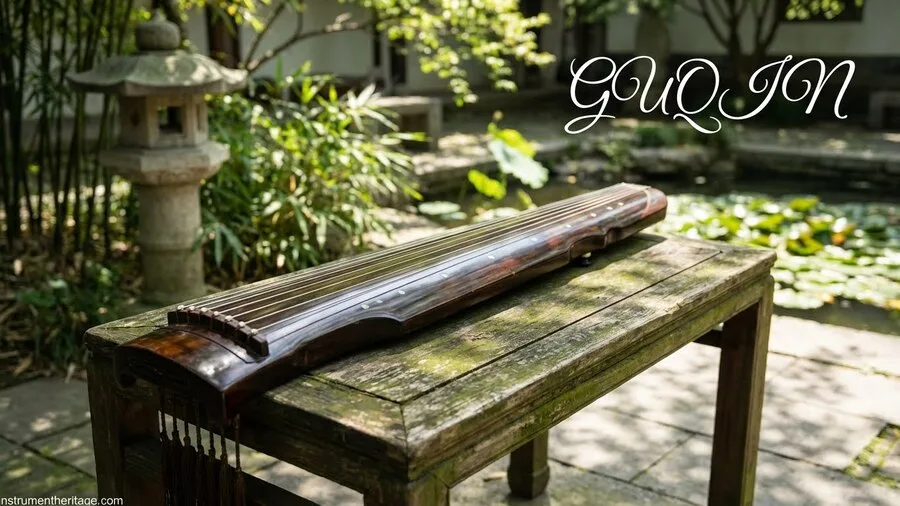
The Guqin is not just a musical instrument; it is a philosophy wrapped in silk and wood. Often called the “instrument of the sages,” this ancient Chinese zither has a history that stretches back over 3,000 years. Unlike loud, performative instruments designed to entertain crowds, the Guqin was traditionally played for oneself or a close friend, aiming for cultivation of character rather than applause. Its sound is quiet, deep, and incredibly nuanced, requiring the listener to lean in and truly listen.
The Instrument of the Literati: History and Significance
In ancient China, music wasn’t just entertainment; it was a way to govern the state and the self. The Guqin occupied the highest position in the musical hierarchy. It was the preferred instrument of the Junzi (the noble gentleman or scholar) and was inextricably linked to Confucian philosophy. If you look at historical paintings, you will often see a scholar sitting by a stream or under a pine tree, Guqin in lap, contemplating nature.
The Four Arts of the Chinese Scholar
To be considered a truly cultivated person in ancient China, one had to master four specific disciplines. The Guqin was the very first among them:
- Qin (The Guqin): Musical cultivation.
- Qi (Weiqi/Go): Strategy and logic.
- Shu (Calligraphy): Aesthetics and writing.
- Hua (Painting): Visual expression.
The instrument is so vital to human heritage that in 1977, a recording of the famous piece “Flowing Water” (Liu Shui) performed by master Guan Pinghu was included on the Voyager Golden Record sent into space by NASA.Reference✅ Decades later, UNESCO proclaimed the art of the Guqin a Masterpiece of the Oral and Intangible Heritage of Humanity.Reference✅
Anatomy: A Mirror of the Universe
The physical construction of a Guqin is heavy with symbolism. It isn’t just a box with strings; it represents the world. The top board is usually round, symbolizing Heaven, while the bottom board is flat, symbolizing Earth. The length of the instrument was traditionally 3 chi, 6 cun, and 5 fen (ancient measurements), representing the 365 days of the year.
- Standard Dimensions
- Approx. 120–125 cm length
- Primary Woods
- Top: Paulownia (light, resonant); Bottom: Catalpa (hard, reflective)
- Surface Finish
- Thick layers of raw lacquer mixed with deer antler powder (creates a hard, smooth surface)
- Strings
- Traditionally twisted silk; modern players often use steel cores wrapped in nylon
One of the most distinct features is the lack of bridges. Unlike guitars or violins where strings are elevated by a bridge, Guqin strings are pressed directly onto the wood surface. The surface has 13 inlays called Hui (usually made of mother-of-pearl, gold, or jade). These aren’t frets; they mark nodal points for harmonics. The 13 markers symbolize the 12 months of the year plus the intercalary month used in the lunar calendar.
Sound, Notation, and “The Forbidden Finger”
The sound of the Guqin is characterized by three distinct timbres, known as the Three Sounds:
| Sound Type | Description | Symbolism |
|---|---|---|
| San Yin (Open Sound) | Plucking an open string without pressing. Resonant and grounding. | Represents Earth. |
| Fan Yin (Harmonics) | Lightly touching the string at nodal points. Bell-like, pure, and floating. | Represents Heaven. |
| An Yin (Stopped Sound) | Pressing the string fully against the wood and sliding. Expressive and vocal. | Represents Humans. |
Playing the Guqin involves a complex dance of fingers. There are over 50 different finger techniques just for the right hand (plucking) and the left hand (sliding/vibrato). Interestingly, the little finger is strictly forbidden from being used. It is considered “forbidden” in traditional technique, often purely aesthetic to maintain the hand’s elegance, known as the “Forbidden Finger” rule.
Decoding the Notation
If you looked at a sheet of Guqin music, called Jianzi pu, you wouldn’t see notes like C or D. Instead, you see complex characters that look like instructions. This notation system, developed around the Tang Dynasty, tells the player where to place the finger, which string to pluck, and how to pluck it. It is a tablature system focused on physical action rather than abstract pitch.
Confusion Alert: Guqin vs. Guzheng
It is incredibly common to confuse the Guqin with the Guzheng. They look somewhat similar to the untrained eye, but they are radically different beasts in terms of sound, construction, and history.
Key Differences Overview
Guqin has 7 strings vs. Guzheng has 21+ strings.
Guqin has NO bridges vs. Guzheng has movable bridges under each string.
Guqin is very quiet/intimate vs. Guzheng is loud and resonant.
Guqin is meditative/scholarly vs. Guzheng is romantic/folkloric.
The Guzheng is often used for dramatic, sweeping glissandos (that water-ripple sound) often heard in movies. The Guqin, by contrast, is subtle. It focuses on the silence between the notes and the sliding tones that mimic a human voice or a sigh.
Preservation and Modern Revival
For a time during the mid-20th century, the Guqin almost vanished, with fewer than 100 active master players left in China. However, recent decades have seen a massive resurgence. Young musicians are rediscovering the instrument, mixing electric pickups with traditional silk strings, and even incorporating it into ambient and electronic music. Yet, the core of the tradition remains: it is an instrument for self-cultivation. To play the Guqin is to speak to one’s own heart.
Frequently Asked Questions
Is the Guqin hard to learn?
Yes, it has a steep learning curve. While making a sound is easy, mastering the subtle left-hand slides and interpreting the complex tablature (Jianzi pu) takes years of dedicated practice. It requires patience and a quiet mind.
Why are Guqin strings made of silk?
Traditionally, silk was used because it produces a warm, mellow, and organic tone that eliminates the metallic “twang.” Silk strings are quieter and change pitch with temperature, but they are prized by purists for their rich texture and reduced finger noise.
How much does a good Guqin cost?
Because making a Guqin is a labor-intensive art involving carpentry and layers of lacquer that take months to dry, quality instruments are expensive. Beginner models might start around $500, but professional concert instruments easily range from $5,000 to over $50,000, especially antique ones.
Can I play Western music on a Guqin?
Technically yes, but it is difficult. The Guqin is tuned to a pentatonic scale and its technique is designed for sliding tones and harmonics specific to Chinese musical aesthetics. Western chords and chromatic scales are not native to the instrument’s design.
