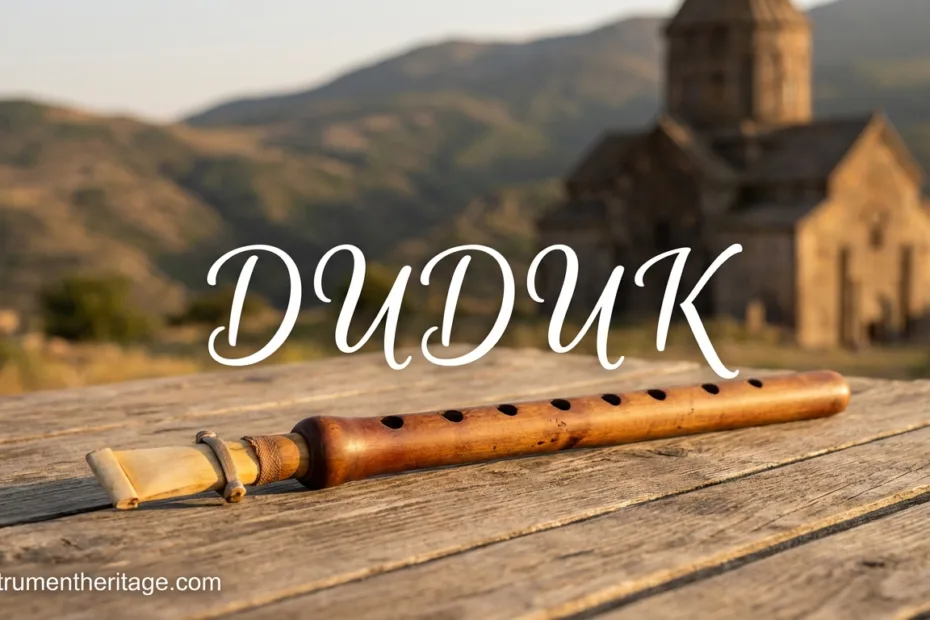
Imagine a sound that feels less like an instrument and more like a human voice quietly weeping, or perhaps praying. It’s a vibration that seems to bypass the ears and resonate directly in the chest. This is the Duduk. While the world is full of woodwind instruments, few possess the deep, rich texture of this ancient Armenian masterpiece. It doesn’t scream for attention like a saxophone or pierce the air like an oboe; instead, it wraps the listener in a blanket of warm, melancholic nostalgia. Known natively as the Tsiranapogh (literally “apricot pipe“), it is a reflection of how a simple piece of wood, when carved with centuries of wisdom, can capture the entire emotional spectrum of a culture.
For music lovers, composers, and history enthusiasts, understanding the Duduk is about more than just mechanics; it’s about exploring one of the oldest surviving double-reed instruments in the world. Whether you first heard it in the background of a blockbuster movie or are discovering it now, the journey into its sound is unforgettable.
A Voice from the First Century
The history of the Duduk is somewhat shrouded in the mists of time, but it is unquestionably ancient. While many modern wind instruments evolved greatly during the Renaissance or Industrial Revolution, the Duduk has remained consistent in its form. Historians and musicologists estimate its existence stretches back at least 1,500 years, with some evidence suggesting it was played as early as the reign of King Tigran the Great (95–55 BC). Unlike instruments that were reserved for royalty, the Duduk has always been the voice of the people—present at simple village gatherings and solemn ceremonies alike.
Its significance is so profound that in 2008, UNESCO inscribed the Duduk and its music on the Representative List of the Intangible Cultural Heritage of Humanity Reference✅. This wasn’t just an award for a physical object, but recognition of the entire cultural ecosystem surrounding it—the craftsmanship, the playing techniques, and the music itself.
The “Tsiranapogh”: Why Apricot Wood?
One might wonder, why not use oak, maple, or ebony? The secret to the Duduk’s signature sound lies specifically in the apricot wood (Prunus armeniaca). In the past, makers experimented with bone and other timbers, but they found that the density and porosity of the apricot tree created a unique resonance that other materials could not replicate.
- Scientific Name
- Prunus armeniaca
- Why this wood?
- It offers the perfect balance of density and resonance, creating a “soft” tone rather than a harsh or nasal one.
- Aging Process
- The wood must be aged for years (often 5 to 7) to ensure stability and prevent cracking.
When the wood is properly aged and treated (often with natural oils), it produces a tone that is described as soft, pear-like, and deeply resonant. Instruments made from other woods often sound shrill or too aggressive. The apricot wood dampens the high frequencies just enough to leave that characteristic warm, mourning hum that the instrument is famous for.
The Ghamish: The Heart of the Sound
If the apricot body is the skeleton, the reed is the soul. The Duduk’s reed, known as the Ghamish (or Yegheg), is a massive double reed compared to its western cousins. If you look at an oboe reed, it is delicate and narrow. The Ghamish, however, is wide, flattened, and substantial.
This width is important. It requires the player to apply substantial lip pressure to control the pitch, but it also allows for deep vibration, creating a rich texture that is almost cello-like in quality. The reed is typically made from cane found along the Arax River.
Duduk vs. The Oboe: A Sonic Distinction
People often call the Duduk an “Armenian Oboe,” but this is a bit misleading technically. While they are both double-reed instruments, the physics of their sound production differs greatly, leading to two completely different sonic worlds.
| Feature | Duduk | Western Oboe |
|---|---|---|
| Bore Shape | Cylindrical (consistent width) | Conical (gets wider at the end) |
| Reed Size | Large, wide, substantial | Small, narrow, delicate |
| Sound Character | Velvety, warm, lower volume | Bright, piercing, projecting |
| Vibrato Source | Lip pressure (mostly) | Diaphragm (mostly) |
The Art of “Dam” and Circular Breathing
When you listen to traditional Duduk music, you will rarely hear silence. The melody floats over a continuous, unwavering low note. This is not a synthesizer; it is a second Duduk player known as the Damkash.
The Damkash provides the “Dam” (the drone). To do this, they employ a difficult technique called circular breathing. This involves storing air in the cheeks and pushing it out through the instrument while simultaneously inhaling through the nose. It creates an unbroken stream of sound that can last for minutes or even hours.
- The Soloist: Plays the complex, ornamented melody.
- The Damkash: Holds the tonic note, grounding the music and creating a hypnotic atmosphere.
This duality represents a conversation—one voice grounded and constant, the other exploring the highs and lows of emotion. It is widely said that without the Dam, the Duduk loses its context; the drone represents the earth or the history upon which the melody (the individual life) dances.
From Village Weddings to Hollywood Blockbusters
For centuries, the Duduk was a local treasure, heard primarily in the Caucasus at weddings, funerals, and folk gatherings. However, in the late 20th century, the sound went global, largely thanks to the virtuoso Djivan Gasparyan.
Gasparyan, a master who brought the instrument to world stages, collaborated with Western musicians like Peter Gabriel (notably on the soundtrack for The Last Temptation of Christ). But the real explosion of fame came with the soundtrack for the film Gladiator (2000), composed by Hans Zimmer. The mournful, otherworldly sound during the film’s most emotional scenes introduced millions of people to the Duduk, even if they didn’t know the instrument’s name Reference✅.
Since then, it has become the “go-to” instrument for film composers wanting to evoke sadness, ancient deserts, or otherworldly isolation. You can hear its influence in:
Game of Thrones Battlestar Galactica Avatar Dune
Caring for the Apricot Pipe
If you decide to acquire a Duduk, be warned: it is a living thing. The apricot wood is sensitive, but the reed is even more temperamental. It changes with the weather.
Owner’s Tips
- Humidity Control: If the reed dries out, it closes up and won’t make a sound. If it’s too wet, it plays flat. Professional players often carry a damp sponge in their reed case.
- Oiling: The internal bore of the wooden body needs occasional oiling (often walnut or almond oil) to protect it from moisture in the player’s breath.
- Break-in: A new reed is stiff. It takes hours of playing to “open up” and deliver that warm, fuzzy tone.
The Duduk is not just an instrument; it is a storyteller. Whether it is conveying the joy of a wedding dance or the sorrow of a lost history, it speaks a language that requires no translation. It reminds us that sometimes, a simple piece of apricot wood and a breath of air can express more than a thousand words ever could.
Frequently Asked Questions
Is the Duduk hard to learn for beginners?
Yes, it has a steep learning curve. While the fingering system is relatively simple (similar to a recorder), mastering the embouchure (lip pressure) to stay in tune is very difficult. The large reed requires strong jaw muscles and precise breath control to prevent the sound from becoming flat or “quacking.”
What is the range of a standard Duduk?
The range is quite limited compared to modern orchestral instruments. It typically spans just over one octave (a tenth, usually). This limitation forces the musician to rely on expression, dynamics, and ornamentation rather than running up and down many scales.
Can I use a saxophone reed on a Duduk?
No. The Duduk uses a specialized double reed (Ghamish) that is cylindrical at the base and flattened at the tip. A single reed like a saxophone reed will not fit or function on a Duduk.
What key is the Duduk usually in?
The most common Duduk is the Tenor Duduk in the key of A. This is the standard size used for most famous recordings and solos. However, they are also made in G, Bb, C, and D, each offering a slightly different timbre (lower keys are deeper/sadder, higher keys are brighter).
