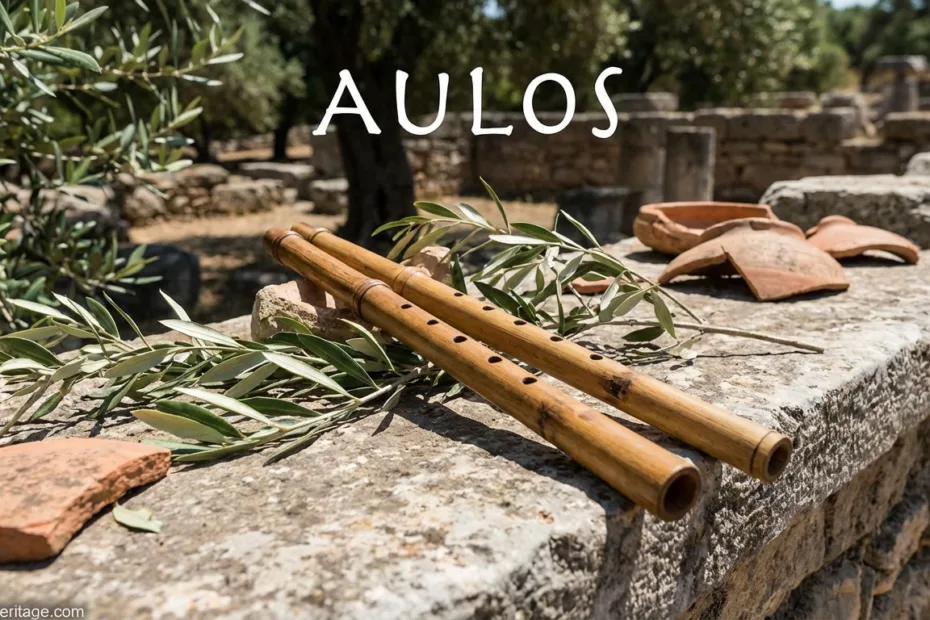
Imagine standing in the bustling agora of ancient Athens or sitting on the stone steps of the Theater of Dionysus. Above the chatter of the crowd, a piercing, rhythmic, and buzzing sound cuts through the air. It isn’t the gentle strumming of a harp or the soft breath of a flute. It is raw, loud, and ecstatic. This is the sound of the Aulos, the most iconic and misunderstood instrument of the ancient Greek world. Often wrongly translated as a “flute” in old textbooks, the Aulos was actually a powerhouse of sound, more akin to a double-barreled oboe or a bagpipe without the bag. It was the soundtrack to sacrifice, the rhythm of the Spartan phalanx, and the voice of tragedy.
For centuries, this instrument remained a mystery, its perishable reeds lost to time. However, through intricate archaeological detective work and modern reconstruction, the Aulos has returned to life, reminding us that the ancient world was not a quiet place of white marble, but a vibrant, noisy landscape of color and sound. In this deep dive, we will explore the engineering, the mythology, and the sheer physical endurance required to play the heavy metal instrument of antiquity.
| Instrument Family | Woodwind (Double Reed) |
| Classification | Aerophone |
| Primary Materials | Cane (Arundo Donax), Deer Bone, Ivory, Bronze |
| Associated Deities | Dionysus, Athena, Apollo (adversarial) |
| Key Accessory | Phorbeia (Leather cheek strap) |
| Cultural Era | Archaic to Roman Period (c. 700 BC – 400 AD) |
Not a Flute: Correcting the History
One of the most persistent errors in history classes is calling the Aulos a “double flute.” A flute is an instrument where you blow across a hole (like a beer bottle or a modern concert flute). If you picked up an Aulos and blew across it, you would hear nothing but wind. The Aulos is a reed instrument. Specifically, it utilized a double reed, much like a modern oboe, bassoon, or the Middle Eastern zurna.
The distinction is important because of the sound. Flutes are generally mellow and airy. The Aulos was piercing, buzzing, and loud. It was designed to be heard outdoors, over the roar of a crowd in a stadium, or across a battlefield. When you see ancient vase paintings of a musician with two pipes in their mouth, their cheeks puffed out, they are generating enough pressure to vibrate two stiff reeds simultaneously.
Anatomy of the Ancient Pipes
The construction of an Aulos was a feat of ancient engineering. It wasn’t just two sticks with holes. It was a complex mechanism involving precision drilling, thermal fitting, and acoustic tuning. Let’s break down the parts that made this instrument sing.
1. The Bombyx (The Body)
The main pipes were called the Bombyx. While early versions might have been simple river cane, professional instruments were masterpieces of craftsmanship. The most prized material was the tibia (shinbone) of a deer. Why deer bone? Ancients believed that the active lifestyle of the stag made its bones harder and more resonant than the lazy bones of a donkey or cow. Other materials included boxwood, ivory, and later, metal clad in bronze.
2. The Holmos and Hypholmion
At the top of the pipe sat the Holmos and Hypholmion. These were bulbous sockets, often shaped like cups or bulbs. They acted as the transition point between the reed and the pipe, functioning similarly to the “staple” on a modern oboe but also acting as a resonance chamber to amplify the buzzing of the reed.
3. The Glottis (The Reeds)
The soul of the Aulos was the Glottis (reed). These were cut from Arundo Donax, the giant cane that still grows wild around the Mediterranean today. The harvesting of cane was a ritual in itself; it had to be cut at specific times of the year to ensure the right hardness. Unlike modern reeds which are smoothed by machines, these were hand-scraped. Since the reeds were organic, none have survived from antiquity, forcing modern researchers to reverse-engineer them based on the bore size of the pipes Reference✅.
The Double Pipe Mystery
Why did they always play two pipes (known as diaulos) at once? There are two main theories supported by ethnomusicologists:
- The Drone Theory: One pipe played a low, continuous note (drone) while the other played the melody. This creates a sound similar to Scottish bagpipes.
- The Polyphony Theory: The player fingered different notes on both pipes simultaneously, creating complex harmonies or dissonances that sounded like two people playing at once.
Most modern reconstructions suggest that skilled players could switch between these techniques, using the two pipes to create a “wall of sound” that was incredibly rich and textured.
The Phorbeia: The Leather Strap of Power
If you look at ancient Greek pottery depicting Aulos players, you will almost always see a strange leather harness wrapped around their face. This is the Phorbeia (Latin: Capistrum). It looks almost like medical gear or a muzzle, but it was an essential part of the instrument’s design.
Playing the Aulos required massive air pressure. Unlike a flute where the air flows freely, a double reed offers high resistance. To maintain a continuous sound, players used a technique called circular breathing—breathing in through the nose while simultaneously pushing air out of the mouth with the cheek muscles. This allows for a sound that never stops, not even for a breath.
The Phorbeia served three critical functions:
- Cheek Support: It prevented the cheeks from ballooning out painfully and suffering muscle fatigue during long performances.
- Lip Seal: It helped hold the lips tight against the mouthpiece, preventing air from leaking out the sides of the mouth under high pressure.
- Aesthetic Control: The Greeks valued physical beauty (kalos). Puffing your face out until it turned red was considered ugly and undignified. The strap hid this distortion.
The Sound of Ecstasy
What did it actually sound like? If you are expecting the sweet, melodic tones of a Hollywood soundtrack set in Greece, think again. The Aulos was the instrument of Dionysus, the god of wine, ritual madness, and ecstasy. Its sound was meant to incite emotion, trance, and movement.
Descriptions from ancient texts use words like “shrill,” “wailing,” and “rousing.” It operated in a frequency range that human ears find particularly intense. Modern reconstructions reveal a sound that is:
- Buzzing like a giant insect.
- Nasal and piercing.
- Rich in overtones, creating a psycho-acoustic effect that can feel disorienting or hypnotic.
This sonic profile explains why the Aulos was the instrument of choice for the Chorus in Greek tragedies. It could cut through the open air of the amphitheater and support the singing and dancing of 12 to 50 chorus members without amplification.
Athena’s Curse and the Flaying of Marsyas
The Aulos wasn’t just an instrument; it was a character in one of the most brutal myths of antiquity. The story highlights the cultural tension between “rational” control and “emotional” chaos.
- The Invention
- The goddess Athena is credited with inventing the Aulos. She fashioned it from deer bone. However, when she played it at a banquet for the gods, Hera and Aphrodite laughed at her. Athena went to a stream to look at her reflection and saw her face puffed up and distorted by the effort of playing. Disgusted by the loss of her dignity, she threw the instrument away and cursed anyone who picked it up.
- The Hubris of Marsyas
- The satyr Marsyas found the discarded Aulos. Because it was made by a goddess, it played beautifully almost by itself. Marsyas became so confident—and arrogant—that he challenged Apollo, the god of music and the Lyre, to a contest.
- The Contest
- The contest was judged by the Muses. Initially, the contest was a draw. But Apollo then turned his Lyre upside down and played it, or in some versions, sang while playing. He challenged Marsyas to do the same. Obviously, you cannot sing while blowing into a wind instrument Reference✅.
- The Punishment
- Marsyas lost. For the hubris of challenging a god, Apollo had Marsyas tied to a pine tree and flayed alive. His skin was said to have been hung in a cave, and it would move and vibrate whenever an Aulos was played nearby, echoing the tragic connection between the instrument and suffering.
This myth tells us a lot about how the Greeks viewed the instrument. The Lyre (Apollo) represented logic, mathematics, and calm. The Aulos (Marsyas/Dionysus) represented emotion, pain, and the uncontrollable forces of nature.
The Soundtrack of Daily Life
Despite the scary myths, the Aulos was the “workhorse” instrument of Greece. It was far more common than the Lyre in everyday scenarios.
1. The Spartan War Machine
We often think of drums driving an army, but the Spartans marched to the sound of the Aulos. The shrill, piercing notes kept the phalanx in step. Thucydides, the historian, noted that Spartans didn’t use the music to get “hyped up” but rather to maintain a steady, terrifyingly calm rhythm as they advanced into battle Reference✅.
2. The Symposium
At the Symposium (drinking parties), female Aulos players (Auletrides) were hired to provide entertainment. These women were often skilled professionals who could play complex melodies to accompany poetry recitations or drinking games like kottabos.
3. Sacrificial Rituals
When a bull or goat was sacrificed to the gods, it was essential that the animal did not hear any “bad omens” (like a sneeze or a cry of pain) and that the crowd remained focused. The loud, continuous drone of the Aulos served as an acoustic curtain, masking the sounds of the slaughter and creating a holy atmosphere.
4. The Olympics and Sport
Athletes in the gymnasium often trained to Aulos music. The rhythm helped long jumpers time their run-ups and discus throwers coordinate their spins. There were even solo Aulos competitions at the Pythian Games, which were as prestigious as the athletic events.
Resurrecting the Ancient Sound
For a long time, the Aulos was considered a “dead” instrument. Museums were full of the bone pipes, but without the reeds, they were silent. In recent decades, a dedicated group of researchers and musicians has worked to resurrect the Aulos.
The challenge was the reed making. By studying the bore of the surviving pipes and comparing them to folk instruments like the Sardinian Launeddas (a triple pipe that has survived since antiquity), scholars have successfully recreated the double reeds. Today, you can hear the Aulos played in reconstructed ancient theaters. The sound is shocking to modern ears—it is raw, vibrant, and undeniably powerful, bridging a 2,500-year gap in our auditory history.
Frequently Asked Questions
Was the Aulos difficult to play?
Extremely. It required great physical stamina. The air pressure needed to vibrate two stiff double reeds is much higher than for a modern clarinet or flute. Players often suffered from cheek strain, which is why they wore the leather strap for support.
Why is the Aulos associated with Dionysus?
The Aulos produced a “passionate” and “exciting” sound that was believed to induce trance states. This fit perfectly with the worship of Dionysus, the god of wine and ritual madness, contrasting with the calm, rational plucking of Apollo’s Lyre.
Are there any surviving Aulos instruments today?
Yes, many bone and metal pipes (the bombyx) have survived and are displayed in museums like the British Museum and the Louvre. However, the wooden reeds (glottis) have all rotted away, so modern players must reconstruct the reeds based on educated guesses and acoustic physics.
What is the difference between an Aulos and a Flute?
The main difference is the sound production. A flute is an “edge-blown” instrument (air split across a hole). The Aulos is a double-reed instrument (air forced between two pieces of cane). This makes the Aulos technically an ancestor of the oboe, not the flute.
