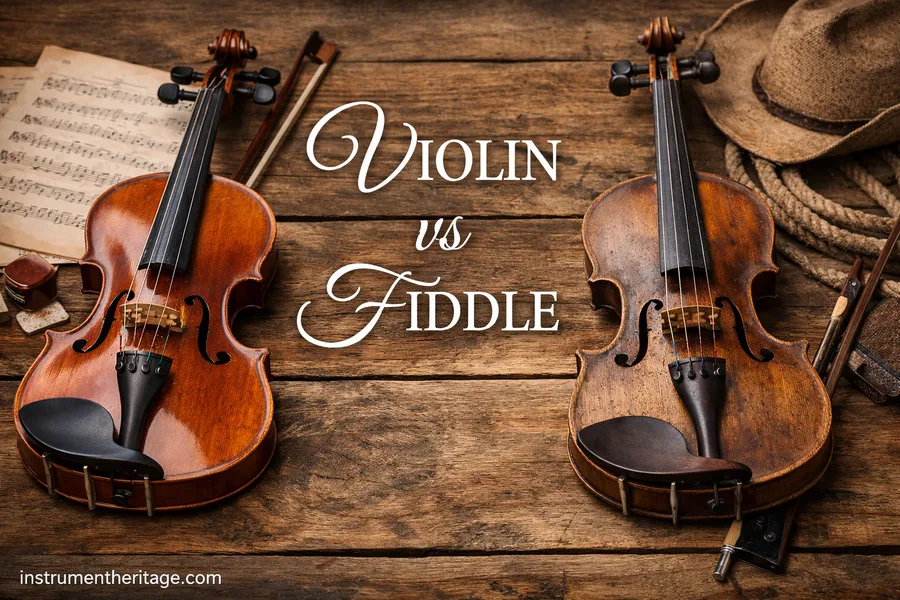
| Feature | Violin (Classical Context) | Fiddle (Folk Context) |
|---|---|---|
| Physical Instrument | Identical body (usually). | Identical body (usually). |
| Bridge Shape | Curved/Arched (to isolate single notes). | Flatter (to play two or more strings at once/drones). |
| String Material | Synthetic core or Gut (warm, complex tone). | Steel core (bright, loud, cuts through banjos). |
| Tuners | Pegs + 1 Fine Tuner (E string). | Often 4 Fine Tuners (for quick stage tuning). |
| Playing Posture | Strict chin & shoulder rest, scroll high. | Relaxed, sometimes chest/arm hold, scroll lower. |
| Music Notation | Strictly reads sheet music. | Often plays by ear (aural tradition). |
| Primary Genres | Baroque, Romantic, Orchestral, Chamber. | Bluegrass, Old Time, Irish, Cajun, Scottish. |
Explore the Details
It’s The Same Box (Mostly)
There is an old musician’s joke that floats around orchestra pits and bluegrass festivals alike: “What is the difference between a violin and a fiddle?” The punchline usually involves a beer being spilled on one of them, or perhaps the fact that a violin has ‘strings’ while a fiddle has ‘strangs.’ But jokes aside, if you walked into a music shop today and pointed at a wooden instrument with four strings, an f-hole, and a chin rest, you would be looking at an object that can comfortably live in both worlds. It is the Schrödinger’s cat of the music world—simultaneously a violin and a fiddle until someone picks it up and starts to play.
The distinction is rarely about the wood, the varnish, or the maker. It is almost entirely about the attitude, the application, and the soul of the music being created. While a classical violinist might treat the instrument like a delicate artifact of high art, a fiddler often treats it like a rhythmic engine designed to make people dance. Yet, despite this massive overlap, there are genuine, subtle technical tweaks that dedicated players make to their instruments to suit their specific style. Understanding these nuances opens up a fascinating window into music history.
The “Hardware”: Physical Setup Differences
While you can play Mozart on a “fiddle” and “Turkey in the Straw” on a “violin,” professionals often modify their setup to make their jobs easier. Think of it like a car: a sedan can drive on both a highway and a dirt road, but you might put different tires on it depending on where you drive most often. Here is how the anatomy shifts between the concert hall and the barn dance.
1. The Bridge Geometry
This is arguably the most notable mechanical difference. On a classical violin, the bridge is carved with a clear arch. This curvature is important because it allows the violinist to bow the A string hard without accidentally hitting the D or E strings. Classical repertoire demands cleanliness, precision, and the isolation of single melodic lines.
Conversely, a fiddler—especially in American Old Time or Cajun styles—often prefers a flatter bridge. Why? Because fiddling relies heavily on double stops (playing two strings at once) and drones. A flatter bridge reduces the the range of motion required by the right arm to cross strings, making fast, rhythmic shuffling much more efficient. It allows the bow to bite into two strings simultaneously with consistent pressure.
2. The Strings attached
If you look closely at the tailpiece, you will find another clue. Classical players generally prefer strings with a synthetic core (like Perlon) or, for period-correct baroque music, gut strings. These materials offer a complex, rich, and warm over-tone series that projects beautifully in an acoustically treated hall.
Fiddlers, however, often opt for steel core strings. Steel strings have distinct advantages for folk music:
- Durability: They hold up better in humid outdoor festivals or sweaty pub sessions.
- Brightness: They produce a piercing, bright sound that can cut through the noise of banjos, guitars, and stomping feet.
- Response: They respond instantly to the quick, choppy bowing techniques used in bluegrass.
- The Tuner Situation
- Classical violins usually have only one “fine tuner” (on the high E string). Fiddles often have four fine tuners on the tailpiece. Fiddlers frequently use “cross-tuning” (changing the tuning of the strings for specific songs, like AEAE), and having fine tuners on all strings makes these on-the-fly adjustments much faster.
The “Software”: Technique and Posture
The instrument doesn’t change much, but the human operating it certainly does. The divergence in technique is where the “Violin vs. Fiddle” debate truly comes alive. It is a clash of philosophies: standardization versus individual expression.
The Hold
In a conservatory, you are taught a very specific way to hold the violin: on the left shoulder, held in place by the jaw (chin rest), with the scroll high and the instrument parallel to the floor. This maximizes the ability to shift positions (move the hand up the neck) without dropping the instrument.
Fiddlers are famously non-conformist. While many modern fiddlers use a standard hold, historical and traditional players often hold the instrument playing against the chest, or resting in the crook of the arm. This lower position limits the ability to play high notes (positions), but that is fine—fiddle music is mostly played in “first position” (near the scroll). This “chest hold” also allows the player to sing more easily while playing, a common trait in folk traditions.
The Bow Arm
Classical bowing is about the long line—the legato. The goal is often to make the bow change inaudible, creating an endless ribbon of sound. The weight comes from the natural gravity of the arm and pronation of the index finger.
Fiddling is all about the rhythm. The bow is the drum kit of the ensemble. Techniques include:
- The Shuffle: A rhythmic pattern (like the Nashville shuffle: long-short-short) that drives the beat.
- The Chop: Popularized by bluegrass legends, this involves dropping the bow onto the string near the frog to create a percussive “chck” sound, mimicking a snare drum.
- Sawstroke: Rapid back-and-forth bowing on individual notes, common in Old Time music.
🎶 Vibrato: To Wobble or Not to Wobble?
In classical romantic music, vibrato (wiggling the finger to oscillate the pitch) is a constant. It adds warmth and projection. In many fiddle traditions, vibrato is used sparingly or not at all. In Irish traditional music, for example, the “warmth” comes from ornamentation (cuts, rolls, and grace notes) rather than continuous vibrato. An excess of vibrato can actually ruin the authentic sound of a reel or jig.
Global Fiddling Traditions
When we say “fiddle,” we aren’t just talking about American country music. The fiddle is a global phenomenon. Every culture that encountered the violin took it, adapted it, and made it their own. This adaptability is why the violin family is one of the most successful inventions in human history.
🇮🇪 Irish & Celtic
Perhaps the most famous fiddling style outside the US. Irish fiddling is highly ornamented. The bowing is often fluid, with slurs linking many notes together. The focus is on the melody; you rarely hear double stops or chords in traditional Irish playing. It is lyrical, fast, and relies heavily on ornamentation like the “roll” (a rapid turn of notes) to emphasize the rhythm.
🇺🇸 American Bluegrass
Invented in the 1940s (largely attributed to Bill Monroe’s band), Bluegrass fiddling is high-octane. It draws from jazz and blues. Bluegrass fiddlers improvise solos (breaks) high up the neck, use extensive double stops, and have a “bluesy” intonation. It is aggressive and precise.
🇺🇸 Old Time (Appalachian)
Distinct from Bluegrass, Old Time is meant for dancing. The fiddler is not soloing; they are leading the rhythm. The bowing is extremely rhythmic and often syncopated. Tunings are frequently changed (Cross-A or Cross-G) to allow for sympathetic ringing of open strings, creating a wall of sound.
🇺🇸 Cajun
Down in Louisiana, the fiddle speaks French. Cajun fiddling is rhythmic and raw. It almost always uses double stops—one string plays the melody while the adjacent open string drones constantly. This was originally to provide a full sound before amplification existed, allowing a single fiddler to fill a noisy dance hall.
Buying Guide: Should You Buy a “Fiddle”?
This is where beginners often get confused. You see an instrument listed online as a “Bluegrass Fiddle” and another as a “Student Violin.” Which one do you buy?
Here is the secret: Buy a violin.
Manufacturers rarely make a distinction in the factory. A “fiddle” listed in a shop is usually just a violin that has been set up with steel strings and perhaps a flatter bridge. If you are a beginner, simply buy a decent quality violin. As you learn your preferred style, you can swap the strings or have a luthier adjust the bridge.
Look for:
- Solid wood (Spruce top, Maple back).
- Real ebony fittings (pegs and fingerboard).
- A comfortable chin rest.
- A carbon fiber or brazilwood bow.
Avoid:
- “Violin Shaped Objects” (VSOs) sold in supermarkets.
- Painted varnish that is too thick (kills the sound).
- Plastic pegs (they slip and won’t tune).
There is, however, one modern exception: the 5-String Fiddle. These are becoming increasingly popular in the folk and jazz worlds. They add a low C string (like a viola) to the standard G-D-A-E configuration. While classical violins are strictly 4-string, if you see a 5-string acoustic, it is almost certainly built with the “fiddler” market in mind.
The Electric Crossover
We cannot discuss this topic without mentioning electric violins. In the classical world, electrics are niche (used mostly for silent practice). In the fiddle world—especially in rock, country, and metal—electric violins are standard gear. Solid-body instruments eliminate feedback at high volumes, allowing a fiddler to compete with electric guitars and drum kits. This is where the term “fiddle” truly sheds its wooden skin and becomes purely about the role the instrument plays in the band.
Frequently Asked Questions
Can I play classical music on a fiddle?
Absolutely. Physically, it is the same instrument. However, if your “fiddle” has a very flat bridge, you might find it difficult to play complex classical passages that require isolating the middle strings without hitting the others.
Are fiddle strings different from violin strings?
Often, yes. Fiddlers tend to prefer steel core strings for a brighter, louder sound and tuning stability. Classical violinists usually prefer synthetic core (perlon) or gut strings for a warmer, more complex tone.
Is a fiddle cheaper than a violin?
Not necessarily. While extremely expensive antiques (like Stradivarius) are usually owned by classical soloists or foundations, top-tier professional fiddles made by modern luthiers can cost thousands of dollars. However, “fiddle music” is often associated with more accessible, modest instruments compared to the multi-million dollar world of high-end classical.
What is “Cross-Tuning”?
Cross-tuning (or scordatura) is the practice of re-tuning the violin strings to open chords, such as AEAE or DDAD. This allows the fiddler to play with more open strings, creating a louder, resonant drone effect. It is very common in American Old Time music but rare in standard classical repertoire.
{
“@context”: “https://schema.org”,
“@type”: “FAQPage”,
“mainEntity”: [{
“@type”: “Question”,
“name”: “Can I play classical music on a fiddle?”,
“acceptedAnswer”: {
“@type”: “Answer”,
“text”: “Absolutely. Physically, it is the same instrument. However, if your ‘fiddle’ has a very flat bridge, you might find it difficult to play complex classical passages that require isolating the middle strings without hitting the others.”
}
}, {
“@type”: “Question”,
“name”: “Are fiddle strings different from violin strings?”,
“acceptedAnswer”: {
“@type”: “Answer”,
“text”: “Often, yes. Fiddlers tend to prefer steel core strings for a brighter, louder sound and tuning stability. Classical violinists usually prefer synthetic core (perlon) or gut strings for a warmer, more complex tone.”
}
}, {
“@type”: “Question”,
“name”: “Is a fiddle cheaper than a violin?”,
“acceptedAnswer”: {
“@type”: “Answer”,
“text”: “Not necessarily. While extremely expensive antiques (like Stradivarius) are usually owned by classical soloists or foundations, top-tier professional fiddles made by modern luthiers can cost thousands of dollars. However, ‘fiddle music’ is often associated with more accessible, modest instruments compared to the multi-million dollar world of high-end classical.”
}
}, {
“@type”: “Question”,
“name”: “What is ‘Cross-Tuning’?”,
“acceptedAnswer”: {
“@type”: “Answer”,
“text”: “Cross-tuning (or scordatura) is the practice of re-tuning the violin strings to open chords, such as AEAE or DDAD. This allows the fiddler to play with more open strings, creating a louder, resonant drone effect. It is very common in American Old Time music but rare in standard classical repertoire.”
}
}]
}
