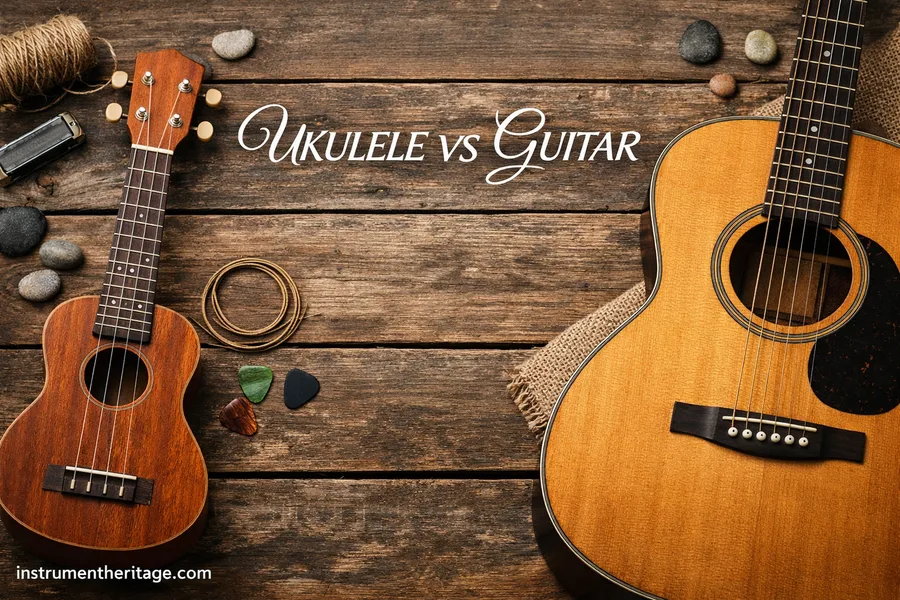
The eternal debate between the ukulele and the guitar is more than just a choice of size; it is a choice of voice, philosophy, and musical approach. While they look like distinct relatives in the string family, the gap between them—in terms of mechanics, history, and playability—is wider than most beginners realize. Whether you are looking to strum a breezy island tune or shred a complex solo, understanding the micro-nuances of these instruments is the only way to make the right call.
| Feature | Ukulele 🎶 | Guitar 🎸 |
|---|---|---|
| String Count | 4 Strings (usually Nylon) | 6 Strings (Steel or Nylon) |
| Standard Tuning | G-C-E-A (Re-entrant) | E-A-D-G-B-E (Linear) |
| Scale Length | 13″ to 19″ (Short scale) | 24″ to 25.5″ (Long scale) |
| Tension | Low (~7-15 lbs per string) | High (~24-35 lbs per string) |
| Sonic Range | ~2 Octaves (Treble focused) | ~4 Octaves (Bass to Treble) |
| Primary Origin | Hawaii (via Portugal) | Spain / Europe |
Explore the Differences
Size, Scale, and Ergonomics: The Physical Reality
The most immediate difference is physical stature. A standard acoustic guitar is a bulky beast compared to the diminutive ukulele. This isn’t just about storage space; it fundamentally changes how you interact with the instrument. The guitar demands a full-body embrace. You wrap your right arm over the bout, and your left arm extends significantly away from your torso to reach the first fret.
📏 Scale Length Matters
The “scale length” is the vibrating length of the string (from nut to saddle). This physics dictate how “tight” the strings feel.
- Guitar: A scale length of roughly 25.5 inches creates higher tension. You need finger strength to press down steel strings.
- Ukulele: A soprano uke has a scale of about 13 inches. The strings are slack, soft, and incredibly forgiving on uncalloused fingertips.
For children or adults with smaller hands, the fret spacing on a guitar can feel like doing gymnastics. A ukulele’s frets are crowded closer together. While this is great for small hands, people with thick fingers might actually find a soprano ukulele too cramped, making complex chord shapes difficult to articulate clearly without muting adjacent strings.
String Theory: Tuning and Range
Here is where the personalities of the instruments diverge sharply. The guitar is the Swiss Army Knife of music; the ukulele is a specialized tool.
The Linear vs. Re-entrant Tuning
A standard guitar uses linear tuning (E-A-D-G-B-E). As you move from the top string (Low E) to the bottom string (High E), the pitch goes consistently higher. This gives the guitar a massive range, covering deep bass notes that you can feel in your chest to piercing highs.
The ukulele, specifically the soprano, concert, and tenor sizes, typically uses re-entrant tuning (g-C-E-A). Notice the lowercase ‘g’. The top string is actually higher in pitch than the middle strings. This is often called “High-G” tuning. This creates a close-harmony, harp-like effect where strumming up or down doesn’t drastically change the “bass” perception because there is no true bass.
Material Science: Nylon vs. Steel
While classical guitars use nylon strings, the vast majority of popular music (Rock, Country, Blues) is played on steel-string acoustics. Steel strings produce a bright, loud, and sustaining ring but require significantly more pressure to fret.
Ukuleles almost exclusively use nylon or fluorocarbon polymers. These materials have a lower density and lower tension. This is why the ukulele has that characteristic “plunky” decay—the notes don’t sustain as long as a steel-string guitar, encouraging a busier, rhythmic strumming style to fill the sonic space.
Sonic Landscapes: Timbre and Volume
Imagine the guitar as a grand piano and the ukulele as a celesta. The guitar moves air. The large body cavity acts as a powerful resonator (Helmholtz resonance), amplifying low frequencies effectively. This makes the guitar a self-sufficient accompanying instrument. You can play a root-note bassline and a chord on top, sounding like a full band.
The ukulele lacks this bass register. Its sound is dominant in the mid-to-high frequencies (1kHz – 4kHz range). Because it sits in a higher frequency pocket, it cuts through a mix incredibly well without muddying up the low end. This is why ukuleles are fantastic for layering in recordings but might sound “thin” if you are trying to cover a heavy rock ballad solo.
- Guitar Tone
- Resonant, full-bodied, sustaining, authoritative, bass-heavy.
- Ukulele Tone
- Percussive, bright, sweet, intimate, short decay.
The Learning Curve: Which is Easier?
If we are strictly talking about the “path to the first song,” the ukulele wins by a landslide. The barrier to entry is almost non-existent.
Why the Ukulele is the “Instant Gratification” Instrument:
- One-Finger Chords: You can play a C Major chord on a ukulele with just one finger. On a guitar, a C Major requires three fingers stretching over three frets.
- Less Pain: The low tension of nylon strings means you won’t bleed or develop painful blisters in the first week. You can practice longer.
- Fewer Strings to Mute: With only four strings, strumming freely is less chaotic. On a guitar, beginners often accidentally hit the wrong strings, causing dissonance.
However, mastering the ukulele is deceptive. Because it has fewer strings and a limited range, playing complex arrangements requires advanced fretboard gymnastics up the neck. The guitar is harder to start, but its logical linear layout makes scale patterns and music theory somewhat more visual once you get past the initial physical hurdles.
Price, Portability, and Practicality
The ukulele is the ultimate travel companion. A soprano uke fits in a backpack and can be taken on a plane as a carry-on without raising an eyebrow. A guitar requires a dedicated hard case and often needs to be checked in (a terrifying prospect for musicians) or bought a separate seat.
| Category | Ukulele Budget | Guitar Budget |
|---|---|---|
| Entry Level (Toy-ish) | $20 – $40 | $50 – $100 |
| Student (Playable) | $50 – $150 | $150 – $300 |
| Solid Wood (Pro) | $300 – $800+ | $800 – $3000+ |
You can get a professional-grade, solid Koa wood ukulele for the price of a mediocre laminated wood guitar. If budget is a massive constraint, your money goes further in the ukulele market.
Variations: It’s Not Just One Size
Don’t fall into the trap of thinking all ukuleles are tiny and all guitars are acoustic. Both families have deep lineages.
The Ukulele Family
- Soprano: The classic, smallest size. Traditional “plink-plonk” sound.
- Concert: Slightly larger, louder, more room for fingers.
- Tenor: Preferred by soloists. Deeper tone, longer neck.
- Baritone: The impostor! It is tuned D-G-B-E (just like the top 4 strings of a guitar). If you play guitar, you can instantly play a Baritone uke.
The Guitar Family
While the Steel String Acoustic is the standard strummer, the Classical (Nylon) bridges the gap in feel with the ukulele. Then there is the Electric Guitar, which relies on pickups and amplifiers, changing the physics entirely by allowing for infinite sustain and effects.
Decision Matrix: Which One Fits You?
Still on the fence? Let’s break it down by personality type and musical goal.
Choose Ukulele If:
- You want to sing while playing immediately.
- You have limited storage space or travel constantly.
- You have very small hands or arthritis.
- You prefer happy, bright, rhythmic music.
- You are on a tight budget.
Choose Guitar If:
- You want deep bass notes and a full sonic spectrum.
- You want to play heavy rock, blues, or metal.
- You are willing to endure 2-4 weeks of finger pain.
- You want to be a “one-man band” with full accompaniment.
- You aspire to learn advanced music theory visually.
Common Questions
Can I use guitar chords on a ukulele?
Not exactly. While the shapes might look similar, the notes will be different because of the tuning. However, if you use a Baritone Ukulele (tuned D-G-B-E), the chord shapes for the top four strings of a guitar transfer directly.
Is a ukulele just a toy guitar?
Absolutely not. While cheap plastic versions exist, a proper ukulele is a serious luthier-made instrument. Virtuosos like Jake Shimabukuro have proven the ukulele is capable of incredible melodic complexity and emotional depth.
Does learning ukulele help with guitar later?
Yes. It teaches you fret hand coordination, rhythm, and strumming patterns. Moving from uke to guitar will require adjusting to the larger size and string tension, but your musical foundation will already be solid.
Why does the ukulele sound “happy”?
This is largely due to the re-entrant tuning (High-G) and the lack of low bass frequencies. The tight clustering of high-pitched notes creates close harmonies that the human ear perceives as light, bright, and cheerful.
{
“@context”: “https://schema.org”,
“@type”: “FAQPage”,
“mainEntity”: [{
“@type”: “Question”,
“name”: “Can I use guitar chords on a ukulele?”,
“acceptedAnswer”: {
“@type”: “Answer”,
“text”: “Not exactly. While the shapes might look similar, the notes will be different because of the tuning. However, if you use a Baritone Ukulele (tuned D-G-B-E), the chord shapes for the top four strings of a guitar transfer directly.”
}
}, {
“@type”: “Question”,
“name”: “Is a ukulele just a toy guitar?”,
“acceptedAnswer”: {
“@type”: “Answer”,
“text”: “Absolutely not. While cheap plastic versions exist, a proper ukulele is a serious luthier-made instrument. Virtuosos like Jake Shimabukuro have proven the ukulele is capable of incredible melodic complexity and emotional depth.”
}
}, {
“@type”: “Question”,
“name”: “Does learning ukulele help with guitar later?”,
“acceptedAnswer”: {
“@type”: “Answer”,
“text”: “Yes. It teaches you fret hand coordination, rhythm, and strumming patterns. Moving from uke to guitar will require adjusting to the larger size and string tension, but your musical foundation will already be solid.”
}
}, {
“@type”: “Question”,
“name”: “Why does the ukulele sound happy?”,
“acceptedAnswer”: {
“@type”: “Answer”,
“text”: “This is largely due to the re-entrant tuning (High-G) and the lack of low bass frequencies. The tight clustering of high-pitched notes creates close harmonies that the human ear perceives as light, bright, and cheerful.”
}
}]
}
