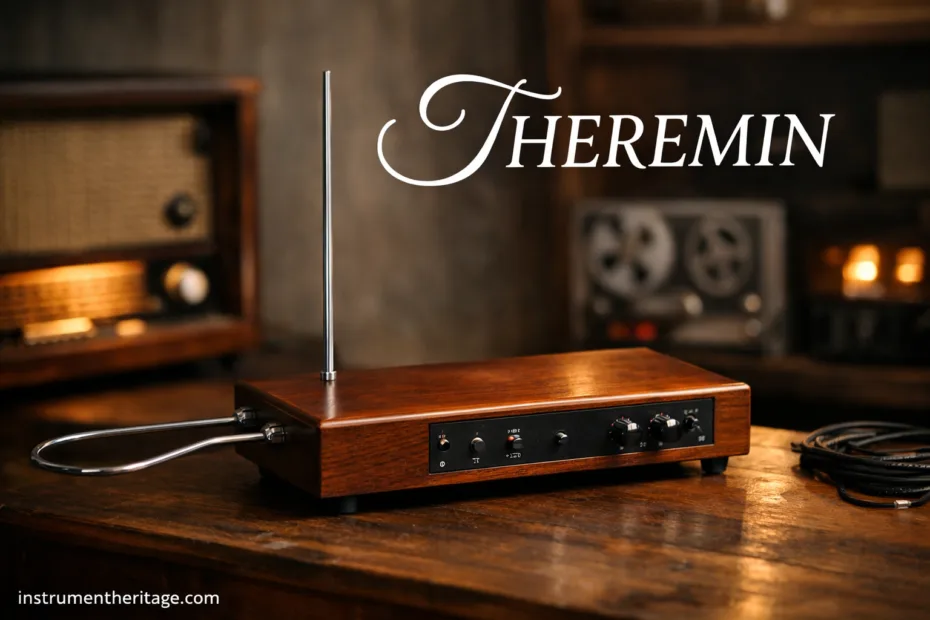
Imagine an instrument you never touch. You stand before it, waving your hands in the air like a conductor summoning a storm, and out comes a sound that is part human voice, part cello, and part alien signal. This is the Theremin, the only musical instrument in history that is played without physical contact. For over a century, it has stood as a bridge between the physical world and the electromagnetic ether, challenging our very definition of how music is made.
While often associated with spooky sound effects in 1950s sci-fi movies, the theremin is actually a sophisticated electronic instrument requiring immense discipline. It relies on the invisible laws of physics—specifically capacitance and electromagnetic fields—to translate movement into melody.
| Official Name | Thereminvox / Aetherphone |
| Inventor | Leon Theremin (Lev Sergeyevich Termen) |
| Invention Date | 1920 (Patented 1928) |
| Classification | Electronic Musical Instrument |
| Sound Source | Heterodyning Oscillators |
| Primary Control | Proximity (Capacitance) – No touch |
| Famous Virtuoso | Clara Rockmore |
The Accidental Invention
The story of the theremin begins in the chaotic aftermath of the Russian Revolution. In 1920, a young Soviet physicist named Lev Termen (anglicized as Leon Theremin) was working on a government project to create a proximity sensor for measuring the density of gases. He noticed something strange: the device emitted a tone that changed pitch when he moved his hand near it.
Recognizing the musical potential, Termen, who was also a trained cellist, modified the device. He first called it the Aetherphone (sound from the ether). He demonstrated it to Vladimir Lenin, who was so impressed he reportedly took a lesson on the spot. By the late 1920s, Leon Theremin was touring the United States, wowing audiences at Carnegie Hall with what looked like pure sorcery.
The Spy Connection
Leon Theremin’s life reads like a thriller. After his success in America, he was abruptly removed from New York in 1938 and returned to the Soviet Union (historians debate whether he was kidnapped or fled debt). He was imprisoned in a sharashka (a secret lab system) where he developed listening devices for the KGB, including “The Thing”—a bug hidden inside a wooden seal of the U.S. Great Seal that hung in the American ambassador’s office in Moscow for seven years undetected.Reference✅
How the Magic Works: Heterodyning
To understand the theremin, you have to understand capacitance. Your body is electrically conductive. When you stand near the theremin’s antennas, you and the antenna form a capacitor (a component that stores electrical charge), with the air acting as the insulator.
The Two Antennas
- Vertical Antenna (Pitch): This controls the musical note. Moving your hand closer increases the capacitance, which raises the pitch. Moving it away lowers the pitch.
- Horizontal Antenna (Volume): This loop antenna controls loudness. Moving your hand closer dampens the signal (making it quieter). lifting it away makes it louder.
Analogy: Think of the theremin like a radio that is slightly out of tune. When you tune a radio, you hear a high-pitched whine that drops in pitch as you get closer to the station. The theremin harnesses this effect (called the Heterodyne principle) to create music.
Inside the box, there are two high-frequency radio oscillators. One is fixed, and the other varies based on your hand position. The theremin calculates the difference between these two frequencies. This difference is an audio signal low enough for human ears to hear. Reference✅
The Art of Air: Playing Technique
The theremin is deceptively simple to generate sound with, but notoriously difficult to play well. Unlike a piano or guitar, there are no visual markers, no keys, and no frets. You are playing in empty space. A movement of a few millimeters can be the difference between a beautiful note and an off-key screech.
Clara Rockmore, a Lithuanian violin prodigy who couldn’t play violin due to bone issues, became the master of the theremin. She developed the technique of “aerial fingering,” using precise movements of her thumb and fingers to pluck notes out of the air with staccato precision, rather than just sliding around (glissando) like a ghost.
- Why is it so hard?
- Intonation depends entirely on muscle memory and ear training. Even the player’s breathing or a person walking by can slightly alter the electromagnetic field and shift the pitch.
The “Good Vibrations” Confusion
If you ask someone to name a song with a theremin, they almost always say “Good Vibrations” by The Beach Boys. They are, technically, wrong.
Theremin vs. Tannerin
The Beach Boys needed an instrument that was easier to control in a live pop setting than the volatile theremin.
Electro-Theremin (Tannerin)
Traditional Theremin
Source: Reference✅
The Moog Connection and Modern Revival
The theremin might have vanished into history if not for Robert Moog. Before he invented the famous Moog Synthesizer, Bob Moog started his career as a teenager selling DIY theremin kits in the 1950s. He loved the instrument and dedicated his life to perfecting electronic sound based on what he learned from Leon Theremin’s designs.
Today, the Moog Etherwave is the standard for modern players. The instrument has moved beyond 1950s sci-fi soundtracks (like The Day the Earth Stood Still) and found a home in experimental rock, classical performances, and avant-garde sound art. Bands like Led Zeppelin (Jimmy Page used one during “Whole Lotta Love”) helped cement its status in rock history, albeit often used more for texture and noise than precise melody.
Theremin Frequently Asked Questions
Is the theremin dangerous to play?
No. While it uses electricity and radio frequencies, the electromagnetic field generated around the antennas is very weak and completely harmless to the human body.
Can anyone learn to play the theremin?
Yes, but it has a steep learning curve. Making noise is easy, but playing recognizable scales and melodies requires excellent relative pitch and fine motor control. It is often compared to learning a fretless string instrument like the violin.
How much does a theremin cost?
Prices vary widely. You can buy DIY soldering kits for under $100. Professional-grade instruments like the Moog Etherwave usually range between $400 and $900. Vintage RCA theremins from the 1920s are incredibly rare collectors’ items worth thousands.
Does a theremin need an amplifier?
Yes. The theremin itself generates an electrical audio signal, but it does not have built-in speakers (usually). You need to connect it to an external amplifier or speaker system to hear the sound.
