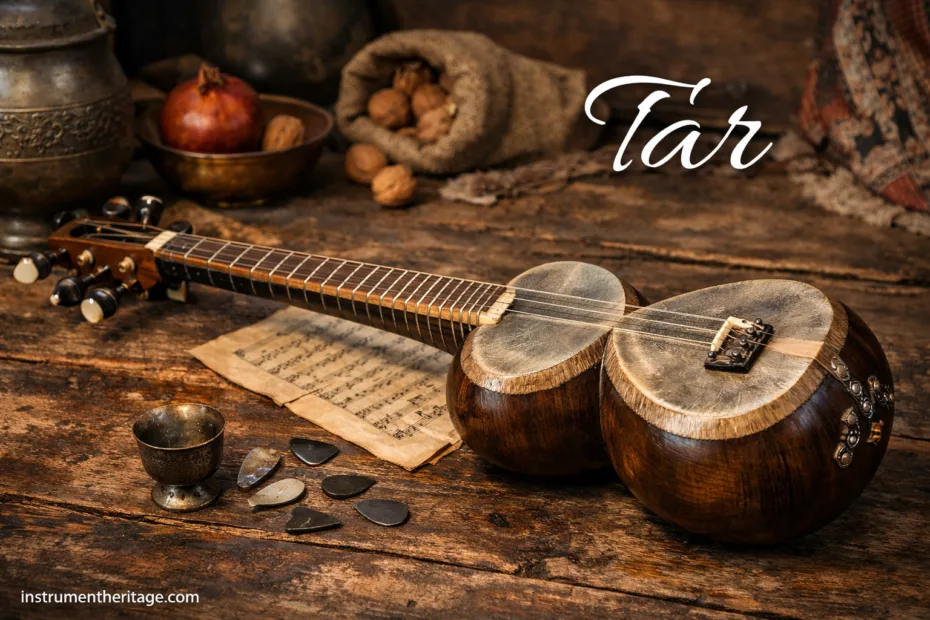
| Aspect | Details |
|---|---|
| Instrument family | A plucked long-neck lute with a waisted, double-bowl body and a membrane face; in organological terms, a fretted chordophone. |
| Where it belongs | Most closely tied to Persian classical music, especially radif, dastgah, and solo or small-ensemble performance. |
| Body and wood | The resonator is usually carved from mulberry wood, often in one piece; the neck is commonly walnut or another dense hardwood, chosen for stability and clean fret response. |
| Face and bridge | A thin skin membrane stretches across the body instead of a wooden soundboard, with a small bridge made from horn, bone, or similar hard material. That single choice changes everything about the attack. |
| String layout | The modern Persian tar is a six-string instrument in three double courses, a layout that gives both solidity and shimmer in the upper partials.Reference-1✅ |
| Frets | Tied, movable frets let the player nudge intonation with more freedom than a fixed-fret instrument. That matters in Persian modal music, where pitch is not always treated like a piano keyboard. |
| Typical tone | Bright, quick, focused at the front of the note, yet still singing enough to carry melodic phrases. It can sound dry and percussive one moment, liquid the next. |
| Right-hand tool | A small metal plectrum, usually called mezrab or mizrab, often softened in the hand with wax or another grip material. |
| Historical shape | The tar in its present form is usually placed around the late eighteenth century, and museum records describe that mature design as a mulberry-bodied, membrane-faced Iranian lute.Reference-2✅ |
| What makes it special | It sits between lyricism and bite. A setar whispers; a santur sparkles; a kamancheh bows and bends. The tar speaks. |
The Persian tar is one of those instruments that tells you what it is almost instantly. One note is enough. You hear a fast, clean edge, then a compact bloom, then a line that feels carved rather than washed in color. It is a lute, yes, though that word barely covers the feel of it in the hands. The body sits like a double cup of wood and skin. The frets are movable. The plectrum is small and sharp. And the whole instrument seems built for a musical language that cares deeply about nuance, contour, and the tiny emotional turns inside a melody. That is why the tar matters so much in Persian art music.
- 🎵 Persian classical repertoire
- 🪵 Mulberry body
- 🪶 Metal plectrum
- 🎼 Movable frets
- 🧵 Skin membrane face
- 🎶 Six strings / three courses
🪵 Shape, wood, membrane, and why the tar feels so alive
The Persian tar does not follow the logic of a flat-topped wooden lute. Its body is waisted and deeply sculpted, usually from mulberry, a wood long valued in West and Central Asian instrument making for its balance of strength, low weight, and lively resonance. Mulberry is not flashy. It is practical. It gives the body enough stiffness to keep definition in the attack, yet enough warmth to stop the sound from turning brittle.
The face is where things get interesting. Instead of a wooden soundboard, the tar uses a thin membrane. That membrane is extremely responsive to the pick stroke. A small change in angle, force, or contact point can shift the voice from crisp and dry to supple and almost vocal. Museum notes on Persian tar examples describe the modern double-chambered body, a very thin skin face, and a fret layout of around twenty-six movable gut frets.Reference-3✅
What a maker is really balancing
- Body mass: too heavy, and the instrument loses sparkle; too light, and the tone can go papery.
- Skin tension: tighter usually means quicker response and more bite; looser can bring warmth but may blur articulation.
- Bridge weight: a small change here alters attack, sustain, and overtone balance more than many listeners expect.
- Neck geometry: if the neck angle and string height are not right, ornaments become tiring and the tar stops feeling agile.
- Fret placement: tied frets are not just markers; they are part of the tuning philosophy of the instrument.
The neck is long enough to give melodic room, but not so long that the instrument feels stretched out or distant under the left hand. Tied frets sit on the neck like adjustable reference points rather than fixed metal bars. That sounds like a small detail. It is not. It is one reason the tar fits Persian modal practice so well. Players can refine pitch relationships in a way that feels more human and less grid-like.
The plectrum is also part of the design story. A brass or metal mezrab gives the tar its cut. Pluck the same melodic figure on a soft wooden-voiced lute and it may glide. On tar, it can speak in short, precise syllables. That is part of the instrument’s charm. Notes do not just arrive; they land.
The body is not simply decorative
Those paired bowls are visually memorable, though they are not there for looks alone. The divided body helps shape the instrument’s projection and tonal contour. Persian examples are commonly described with two unequal heart-like openings covered by membrane, paired with three double courses of strings. That geometry gives the tar a voice that feels focused in the middle register, agile in ornaments, and surprisingly present in an ensemble without needing sheer volume.
A useful way to hear the tar: think of the setar as a fine ink line and the tar as a reed pen. Both can be delicate. The tar just leaves a firmer mark.
🎶 Sound character, touch, and the kind of phrasing the tar invites
The Persian tar is often described as bright, though bright is only the first layer. A better description is articulate. The note begins quickly, with a compact burst of energy from the membrane, and then settles into a singing line that can carry fine ornaments very clearly. On a well-made tar, tremolo does not smear. Grace notes stay visible. Repeated notes remain alive rather than mechanical.
This is why the instrument works so well in radif performance. Persian melodic practice depends on inflection, measured pacing, and tiny shifts in weight between notes. The tar can outline those turns with unusual clarity. It handles lyrical phrases beautifully, yet it also thrives on rhythmic figures such as chaharmezrab, where the right hand’s precision becomes part of the music’s drama.
What listeners usually notice first
- The fast edge of the attack
- The dry, clean definition of ornaments
- The slight rasp or grain that gives the tone character
- The way double courses add body without making the line muddy
What players notice first
- How sensitive the membrane is to touch
- How much right-hand angle changes tone color
- How the movable frets affect intonation and fingering choices
- How demanding the instrument is when the setup is even slightly off
There is also a tactile side to the tar that many short descriptions miss. It asks a lot from both hands. The right hand must stay controlled, because the plectrum can make the instrument bark if the stroke gets stiff. The left hand must be exact, because the frets are narrower reference points than modern metal frets and the modal language needs confidence, not guesswork. A fine tar rewards that discipline with a sound that feels close to speech. Not polite speech. Expressive speech.
📜 How the Persian tar took its modern form
The name tar simply means “string” in Persian, and the instrument belongs to the wider family of long-neck lutes that stretch across Iran, the Caucasus, Anatolia, and beyond. The Persian tar in its current, recognizable form is usually placed in the late eighteenth century, with museum records also linking early mature examples to Shiraz and describing a design that later spread outward and developed regional branches.
That matters because the Persian tar is not just an old generic lute with a famous name. It is a fairly specific historical design. The modern double-chambered body is often connected to the older rabab family, though the tar’s voice, playing technique, and repertorial role are very much its own. By the nineteenth century, it appears clearly in visual and material records, and from there it becomes one of the defining solo instruments of Persian art music.
The late Qajar period and the early twentieth century are especially important. This is when named masters, teaching lineages, and more fixed repertorial transmission begin to matter in the way modern musicians still recognize. Figures such as Aqa Hosayn-Qoli, Mirza Abdollah, and Darvish Khan helped shape the performance language associated with tar and setar. Later, players such as Ali Naqi Vaziri, Abdolhossein Shahnazi, Houshang Zarif, and Hossein Alizadeh pushed the instrument through new phases of pedagogy, concert life, and personal style.
One detail that often gets skipped: the tar’s history is not only about shape. It is also about teaching systems, written methods, and how musicians decided the instrument should sound in public performance.
A telling example comes from the twentieth century. Encyclopaedia Iranica notes that Ali Naqi Vaziri’s Dastur-e tar, published in Berlin in 1922, is the first known publication of its kind devoted to the study of a Persian musical instrument.Reference-4✅ That may sound like a bibliographic footnote. It is more than that. It marks the moment when the tar moved further into written pedagogy without losing its older oral tradition.
So the instrument’s history has two braided strands. One is craft: wood, skin, bridge, frets, strings, and body design. The other is transmission: master to student, repertoire to repertoire, phrase to phrase. The tar survives because both strands stayed active.
🎼 Repertoire, modal language, and what the tar does inside Persian music
The Persian tar is deeply bound to radif, the canonic repertory of Persian classical music. Radif is not a stack of tunes in the casual sense. It is a learned melodic archive, arranged through dastgah and related modal groupings, inside which smaller melodic units, often called gusheh, are memorized, shaped, and reanimated in performance. The tar has long been one of the clearest vehicles for that repertory because it can show contour, timing, accent, and ornament with remarkable precision.
That precision does not make the music stiff. Quite the opposite. Once a player has internalized the repertory, the tar becomes a place for interpretation. A phrase can be stretched, tightened, darkened, brightened, or leaned on in different places. A cadential turn can feel patient in one performance and urgent in another. The instrument supports that elasticity because its sound is compact and its frets are movable. It never quite feels trapped in a hard mechanical grid.
Where the tar sits in performance
- As a solo instrument, it can carry an entire modal unfolding with enough contrast to hold attention.
- With voice, it works as both partner and guide, supporting the line while answering it.
- In a small ensemble, it often pairs beautifully with kamancheh, ney, santur, and tombak.
- In instrumental settings, it handles both measured and non-measured sections with equal authority.
Another thing worth noticing: the tar is not only lyrical. It can be strikingly rhythmic. Pieces built around repeated strokes, patterned accents, and quick ornaments give the instrument a muscular side. This is where the metal plectrum and membrane face really show their value. They let the player carve time into distinct shapes. A wooden-faced lute can sing. The tar can sing and cut.
That mixture of line and pulse helps explain why so many listeners remember the instrument after hearing it only once or twice. The sound is neither soft-focus nor over-sustained. It is clean, slightly grainy, and emotionally direct. Nothing feels blurred.
🛠️ What experienced makers and players listen for in a good tar
A good Persian tar should feel balanced before it even feels beautiful. The bass side must not collapse into a dull thud. The upper strings should not turn thin and glassy. The notes need enough separation for modal detail, yet enough body for phrases to connect. When players speak fondly about a tar, they often mean three things at once: response, clarity, and character.
- Response
- How quickly the note speaks, especially in ornaments, repeated strokes, and tremolo.
- Clarity
- Whether individual notes stay distinct in fast passages and whether the instrument keeps its center when played softly.
- Character
- The particular color of the voice: woody, dry, warm, wiry, nasal, mellow, or sharply projecting.
- Setup
- Skin tension, fret placement, bridge fit, neck relief, string choice, and action height all shape the final result more than decoration ever will.
Old instruments and new instruments can both be excellent, though not for identical reasons. Older tars may carry a loosened, seasoned response that players love. Newer ones can feel tighter, more focused, and sometimes more stable. Neither is automatically better. The real question is whether the instrument opens up under the hand. Does it invite phrasing? Does it keep its dignity when played quietly? Does it let the player color the mode rather than merely outline notes? Those are the tests that matter.
🎻 The Persian tar beside its close relatives
The easiest mistake is to treat every similarly named instrument as basically the same thing. They are not. The Persian tar has relatives, cousins, and neighbors, though its own build and musical role remain distinct.
| Instrument | Main build traits | Tone profile | Where it differs from Persian tar |
|---|---|---|---|
| Persian tar | Waisted double-bowl body, skin face, long fretted neck, three double courses | Focused, articulate, bright-edged, capable of both lyric phrasing and rhythmic bite | The reference point here: a membrane-faced Persian lute built for modal nuance and detailed ornament |
| Setar | Smaller all-wood body, very light frame, long neck, delicate picking style | Soft, intimate, inward | Quieter, lighter, and more private in mood; less percussive and less forceful in attack |
| Azerbaijani tar | Related name and lineage, altered body outline, expanded stringing, different hold and repertorial life | Brighter and more projecting in many settings | A separate regional development with its own technique and musical identity, not just a minor variant |
| Rabab / rubab | Older plucked lute family with carved body and skin face, often heavier and more earthy in voice | Dry, woody, deep-grained | The Persian tar may owe something to older rabab-type design thinking, yet the final voice and repertory are different |
| Tanbur / tanbur | Pear-shaped wooden body, long neck, usually wooden face rather than membrane | Open, ringing, often more overtone-rich in a different way | Closer to other long-neck lute families than to the tar’s waisted membrane-bodied design |
The comparison with setar is especially useful because the two instruments share repertorial ground. Many learners assume the tar is simply a louder setar. It is not. The setar moves like a brush on paper. The tar moves like a pen with pressure behind it. That does not make one better. It just means the music arrives through different physical means.
🎵 Why the tar still feels current
The Persian tar remains current because it solves an old musical problem beautifully: how to keep a modal tradition precise without making it rigid. Its movable frets allow flexibility. Its membrane gives definition. Its six strings supply enough density to support serious melodic work without burying detail. And its repertory still leaves room for personality. That mix is rare.
It also helps that the instrument carries history without sounding trapped by it. A nineteenth-century museum tar, a twentieth-century conservatory method, and a present-day concert performance all belong to the same thread. The materials still matter. The old lineages still matter. Yet the instrument stays open to new hands. That is usually the sign of a living instrument, not a museum relic.
FAQ
Is the Persian tar the same instrument as the sitar?
No. They are different instruments with different structures, histories, and sound ideals. The shared ending in the name comes from the Persian word for “string,” but the Persian tar is a membrane-faced long-neck lute, while the sitar developed in South Asia with a different body design, bridge system, and string concept.
Why does the Persian tar use a skin membrane instead of a wooden top?
The membrane gives the tar its quick attack, strong articulation, and very touch-sensitive response. It helps ornaments speak clearly and gives the instrument a crisp edge that a wooden face usually softens.
How many strings does a Persian tar have?
The modern Persian tar usually has six strings arranged in three double courses. Players may tune them differently depending on repertoire, register, and personal approach.
Why are the frets movable?
Movable frets let the player refine pitch placement for Persian modal music. That flexibility is useful because melodic practice often asks for interval shades that do not fit neatly into a fixed equal-tempered layout.
Is the Persian tar the same as the Azerbaijani tar?
No. They are related but distinct instruments. The Azerbaijani tar developed along its own path, with different body details, stringing, playing posture, and repertorial use. The Persian tar remains tied most closely to Persian classical music and its own craft tradition.
