| Instrument Family | Percussion (Membranophone) | Classification | Variable-tension hourglass drum |
| Primary Origin | West Africa (Oyo Empire, Ghana Empire) | Key Materials | Hardwood (Mahogany/Cordia), Goatskin/Lizard skin, Leather thongs |
| Playing Method | Stick and hand combination, arm compression | Tonal Range | Variable (can span over an octave) |
| Cultural Role | Communication, Rituals, Praise Singing, Griot Storytelling | Associated Ethnic Groups | Yoruba, Hausa, Dagomba, Wolof, Mandinka |
| Regional Names | Gangan, Dundun, Tama, Kalangu, Odondo, Lunna | Notable Modern Usage | Afrobeats, Juju Music, Highlife, Jazz Fusion |
Communication wasn’t always digital; long before fiber optics and satellites wrapped the globe, the forests and savannahs of West Africa had their own high-speed network. The Talking Drum is not merely a percussion instrument designed to keep a beat. It is an ancient piece of audio technology, a linguistic tool capable of mimicking the prosody, tone, and rhythm of human speech. While the Western world often views drums solely as rhythmic engines, in West African societies—particularly among the Yoruba, Hausa, and Dagomba—this instrument served as a literal voice, broadcasting messages of birth, warning, war, and celebration across miles. It represents a sophisticated marriage of acoustics and linguistics that continues to baffle and fascinate musicologists today.
💡 Cultural Insight: In many West African traditions, the Talking Drum is not just “played.” The drummer is often referred to as a storyteller or historian. The instrument holds the genealogy of kings and the collective memory of the village.
The Anatomy: Engineering a Voice
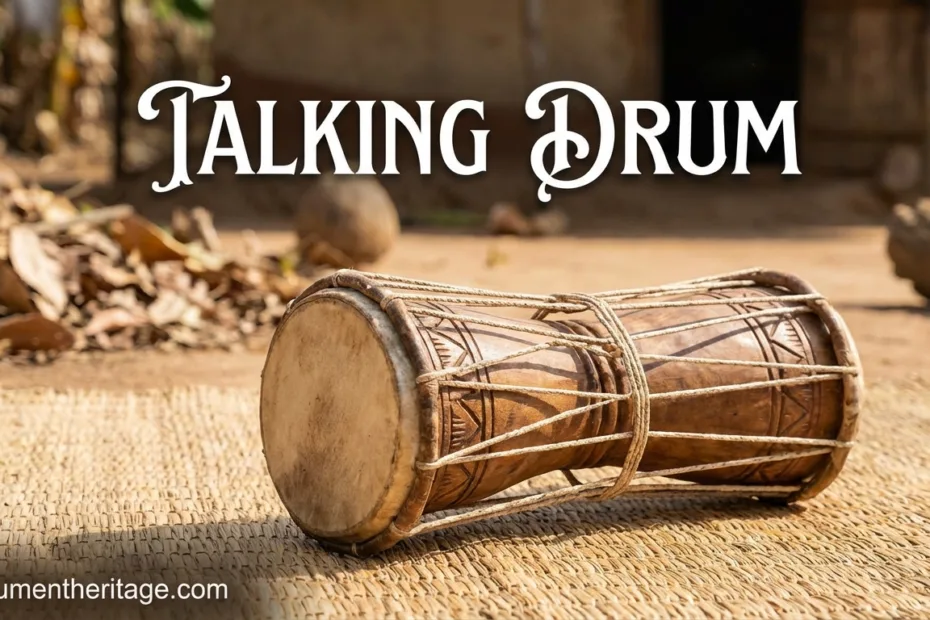
To understand how a drum can “talk,” you have to look at its unique architecture. It is distinctly different from the rigid cylindrical drums found in other parts of the world. The Talking Drum is an hourglass-shaped pressure drum. This shape is not for aesthetics; it is a functional requirement for the physics of pitch bending.
The body is carved from a single block of solid wood. Historically, carvers select density-rich woods like Apa (Afzelia africana) or Omo (Cordia millenii) because they resonate loudly and can withstand the immense pressure applied during playing. The shell has two drumheads, one on each end, connected by a network of leather tension cords (often made from twisted rawhide or antelope skin) that run the length of the drum body.
🔬 Physics of the Pitch
The magic happens in the cords. When the drummer squeezes the drum under their arm, the cords tighten. This tension pulls the two drumheads closer to the wooden shell. According to the laws of acoustics, increasing tension on a membrane raises its frequency (pitch). By relaxing the arm, the cords loosen, and the pitch drops. This allows the drum to slide seamlessly between notes, creating a glissando effect that mimics the rising and falling intonation of human speech.
The drumheads themselves are critical. They are typically made from goatskin, though in some smaller variations like the Senegalese Tama, lizard skin (monitor lizard) is prized for its sharp, high-frequency cracking sound. The skin must be treated and shaved to a specific thickness—too thick, and it won’t respond to subtle pressure changes; too thin, and it will burst under the force of the curved striker.
The Linguistic Connection: How it Actually “Talks”
Many people assume “talking drum” is a metaphor. It is not. The capability of the drum to speak relies entirely on the nature of the languages in its region of origin. West African languages like Yoruba, Hausa, and Dagbani are tonal languages. In English, pitch conveys emotion (like raising your voice at the end of a question), but in a tonal language, pitch determines the definition of the word itself.
For example, in Yoruba, the syllable “jo” can mean “to dance,” “to resemble,” or “please,” depending entirely on whether it is spoken with a high, mid, or low tone. The Talking Drum replicates these tonal phonemes. The drummer does not tap out “Morse code”; they reproduce the melody of the sentence.
- Low Tone (Do): The drummer relaxes the arm completely.
- Mid Tone (Re): Slight pressure is applied to the cords.
- High Tone (Mi): Hard compression squeezes the cords tight.
This allows skilled drummers to recite poetry, praise guests, or hurl insults, all without saying a word. However, because the drum cannot reproduce consonants/vowels, context is key. Drummers often use stereotyped phrases or well-known proverbs so the listener can easily decode the message based on the rhythmic and tonal pattern.Reference✅
Historical Roots and the Oyo Empire
Tracing the exact birth date of the Talking Drum is difficult due to the oral nature of West African history, but it is deeply embedded in the history of the Old Oyo Empire (modern-day Nigeria) and the Ghana Empire. It was the instrument of royalty and statecraft. Kings (Obas) would have personal drummers who acted as their mouthpiece.
Before the arrival of colonial forces, the Talking Drum was the primary method of mass communication. A message could be relayed from one village to the next in a relay system, covering hundreds of miles in a few hours—faster than a messenger on a horse. This “jungle telegraph” was so effective that during colonial conflicts, distinct efforts were sometimes made to ban or confiscate the drums to prevent organized resistance.
- 📜 The Griot Tradition
- In Mali, Senegal, and Guinea, the drum is the companion of the Griot (or Jeli). These are the hereditary keepers of history. A Griot does not just play music; they use the drum to accompany the oral retelling of centuries of births, deaths, battles, and treaties.
- 🛡️ War and Peace
- On the battlefield, the drums were used to signal troop movements and boost morale. In times of peace, they were essential for the Egungun festivals, guiding the movements of masquerades who represent ancestral spirits.
Mastering the Technique
Playing the Talking Drum requires a high degree of physical coordination. It is one of the few instruments where the musician must control pitch and rhythm simultaneously with different muscle groups. The drum is tucked under the non-dominant arm (left arm for right-handed players). A shoulder strap keeps it secure.
The drummer holds a unique stick, known as a Gidigbo or curved striker. This stick has a flattened head and is curved at a near 90-degree angle. This shape allows the player to strike the center of the head flatly while the hand remains in a comfortable position.
While the dominant hand strikes the head with the stick, the non-dominant arm squeezes the cords. A master drummer can oscillate their arm pressure rapidly to create a warbling vibrato or snap the tension tight to create a sharp “crack” sound. The fingers of the hand holding the drum also play a role; they dampen the skin to shorten the sustain or tap the head for subtle ghost notes.
Regional Variations and Names
The “Talking Drum” is a generic Western term. In West Africa, the instrument has specific names and slight structural variations depending on the ethnic group and region.
| Region / People | Name | Characteristics |
|---|---|---|
| Nigeria (Yoruba) | Gangan / Dundun | The Dundun is actually a family of drums of various sizes. The Iya Ilu (“Mother Drum”) is the largest and leads the ensemble. |
| Senegal / Gambia (Wolof) | Tama | Generally smaller and pitched higher. Played with rapid-fire virtuosity, often heard in Mbalax music. |
| Ghana (Ashanti/Akan) | Dondo / Odondo | Often used in Highlife music and traditional ensembles. Usually medium-sized with a warm tone. |
| Northern Ghana (Dagomba) | Lunna | Specifically associated with the court historians and ancestral worship. |
| Nigeria (Hausa) | Kalangu | Often used during farming festivals and butcher’s guild celebrations. |
Modern Evolution and Global Reach
The Talking Drum did not stay in the village. It migrated to the city and then to the world stage. In the 20th century, musical pioneers began integrating this traditional instrument into electric ensembles. King Sunny Adé, the master of Juju music, brought the Talking Drum to global prominence. His bands often featured multiple talking drummers weaving complex polyrhythmic webs that underpinned electric guitars and synthesizers.
In Senegal, Youssou N’Dour revolutionized the sound of the Tama, making it a lead instrument in the genre known as Mbalax. The rapid, machine-gun-like crack of the Tama became a sonic signature of Senegalese pop music. Even in the West, artists like Peter Gabriel and specialized jazz percussionists have utilized the talking drum for its emotive, voice-like quality that no synthesizer can perfectly replicate.Reference✅
🎵 Cinematic Soundscapes: You have likely heard the Talking Drum in Hollywood scores. Its ability to produce eerie, sliding pitches makes it a favorite for composers creating tension or signaling an “exotic” or primal atmosphere in film soundtracks like Black Panther.
Preservation and Future
Today, the art of the Talking Drum faces challenges. The urbanization of West Africa means fewer young people are undergoing the rigorous apprenticeship required to master the “speech” aspect of the drum. While many can play the rhythms, the deep knowledge of the drum poetry and proverbs is becoming rarer. However, cultural institutes and new waves of Afrobeat artists are keeping the sound alive, sampling the drum and ensuring its unique voice continues to resonate in the digital age.
Frequently Asked Questions
Can a Talking Drum play distinct musical notes like a piano?
Not exactly in the same way. While a piano has fixed steps (semitones), the Talking Drum has continuous pitch. It moves through the frequencies fluidly (microtones). However, a skilled player can hit specific relative pitches to match the tonic, dominant, and subdominant of a song.
Is it difficult to learn the Talking Drum?
Yes, it has a steep learning curve. The rhythmic aspect is challenging enough, but mastering the “talking” aspect—coordinating the arm pressure to match specific linguistic tones—requires years of practice and a deep understanding of the local tonal language.
What is the stick made of?
The curved stick (Gidigbo) is usually carved from a strong, flexible wood. It is often wrapped in leather or fabric at the grip to prevent slipping, while the striking head is flat to ensure good contact with the drum skin without puncturing it.
How far can the sound of a Talking Drum travel?
In the quiet of the rural countryside, specifically at night or early morning, the sound of a large Talking Drum (like the Iya Ilu) can travel between 4 to 7 miles (approx. 6–11 km). The low frequencies carry effectively through the air.
{
“@context”: “https://schema.org”,
“@type”: “FAQPage”,
“mainEntity”: [{
“@type”: “Question”,
“name”: “Can a Talking Drum play distinct musical notes like a piano?”,
“acceptedAnswer”: {
“@type”: “Answer”,
“text”: “Not exactly in the same way. While a piano has fixed steps (semitones), the Talking Drum has continuous pitch. It moves through the frequencies fluidly (microtones). However, a skilled player can hit specific relative pitches to match the tonic, dominant, and subdominant of a song.”
}
},{
“@type”: “Question”,
“name”: “Is it difficult to learn the Talking Drum?”,
“acceptedAnswer”: {
“@type”: “Answer”,
“text”: “Yes, it has a steep learning curve. The rhythmic aspect is challenging enough, but mastering the “talking” aspect—coordinating the arm pressure to match specific linguistic tones—requires years of practice and a deep understanding of the local tonal language.”
}
},{
“@type”: “Question”,
“name”: “What is the stick made of?”,
“acceptedAnswer”: {
“@type”: “Answer”,
“text”: “The curved stick (Gidigbo) is usually carved from a strong, flexible wood. It is often wrapped in leather or fabric at the grip to prevent slipping, while the striking head is flat to ensure good contact with the drum skin without puncturing it.”
}
},{
“@type”: “Question”,
“name”: “How far can the sound of a Talking Drum travel?”,
“acceptedAnswer”: {
“@type”: “Answer”,
“text”: “In the quiet of the rural countryside, specifically at night or early morning, the sound of a large Talking Drum (like the Iya Ilu) can travel between 4 to 7 miles (approx. 6–11 km). The low frequencies carry effectively through the air.”
}
}]
}
