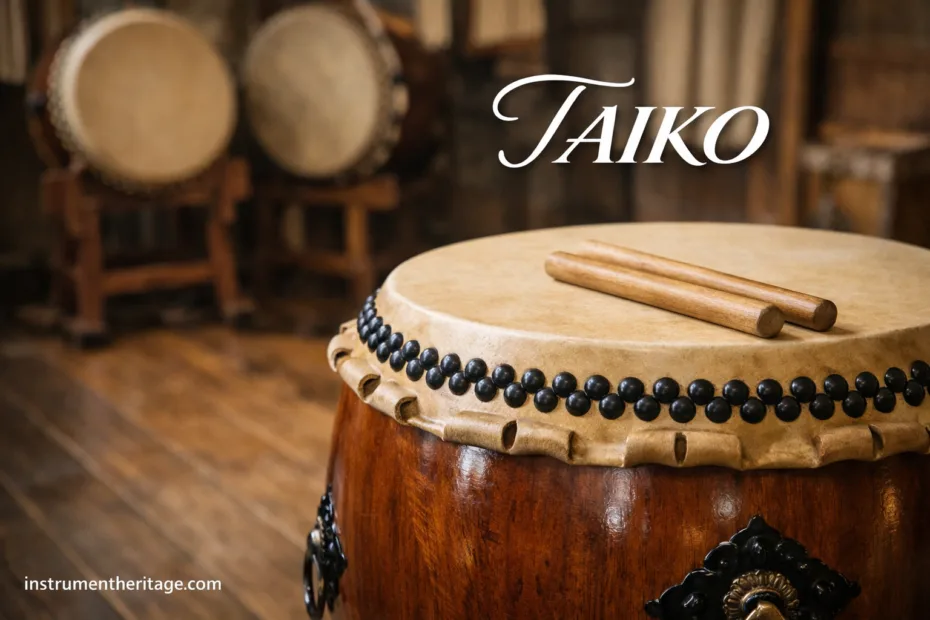
| Classification | Membranophone (Percussion Instrument) |
| Origin | Japan (Roots in China/Korea, modernized in 20th century) |
| Primary Materials | Keyaki (Zelkova wood) for the body; Cowhide for the heads |
| Traditional Roles | Religious ceremonies (Buddhism/Shinto), Classical theater (Noh/Kabuki), Warfare, Festivals (Matsuri) |
| Playing Method | Struck with wooden sticks called Bachi |
| Key Variations | Nagado-daiko, Shime-daiko, Okedo-daiko, Odaiko |
| Resonance Characteristics | Deep, thundering bass (low frequency) to sharp, high-pitched attacks |
Imagine a sound so deep it doesn’t just hit your ears; it rattles your ribcage and aligns with your heartbeat. That is the essence of Taiko. While the word technically just translates to “drum” in Japanese, outside of Japan, it refers to a spectacular, physically demanding art form known as kumi-daiko (ensemble drumming). This isn’t just about keeping a beat. It is a collision of music, martial arts, and spiritual discipline.
The Taiko is a beast of an instrument. Carved often from massive, single logs of ancient trees, these drums carry the soul of the wood and the spirit of the maker. Unlike a standard drum kit tucked at the back of a stage, the Taiko demands the spotlight. It requires the player to throw their entire body into every strike, creating a visual dance that is just as important as the thunderous audio.
Discover Taiko Drumming
From Mythology to the Battlefield: The History
To understand the Taiko, you have to look back—way back. We are talking about an instrument that predates recorded history in Japan. Archaeological evidence suggests drums were used in the Jomon period, thousands of years ago. But the story gets really interesting when you look at the legends.
⚡ The Myth of Amaterasu
According to Japanese folklore, the sun goddess Amaterasu hid in a cave, plunging the world into darkness. An older goddess, Ame-no-Uzume, emptied a sake barrel and danced wildly upon it, creating a rhythmic, stomping rhythm. The noise intrigued Amaterasu enough to peek out, bringing light back to the world. Many drummers consider this the divine birth of Taiko music.
Moving from myth to reality, the Taiko had two very practical jobs in ancient Japan: communication and warfare. Before radios or phones, how did you tell a village miles away that a storm was coming or that the borders were breached? You hit the biggest drum you could find. The low frequency of a large Taiko can travel incredible distances.
On the battlefield, the Jingai-daiko (war drum) was used to intimidate enemies and issue commands to troops. Imagine standing in a silent field and suddenly hearing a thunderous, synchronized booming. It was psychological warfare at its finest. Later, as Buddhism arrived from China and Korea, the drums found a new home in temples, marking the time and accompanying the chanting of sutras.
The Modern Ensemble (Kumi-Daiko)
Here is a twist that surprises most people: the high-energy, multi-drum group performances we see today are actually quite new. Until the mid-20th century, Taiko was mostly played solo or as accompaniment in theater (like Noh and Kabuki) and festivals.
In the 1950s, a jazz drummer named Daihachi Oguchi wondered, “Why not play these like a drum kit?” He arranged drums of different sizes and pitches and gathered a group of players. This birthed the kumi-daiko style. It transformed the drum from a background timekeeper into a lead instrument capable of complex, layered symphonies Reference✅.
The Art of Building a Giant
Making a traditional Taiko is not a weekend DIY project. It is a process that can take years, sometimes decades. The quality of the sound is entirely dependent on the wood and the tension of the skin.
The gold standard for a Taiko body is Keyaki (Zelkova wood). It is incredibly dense, hard, and has a beautiful grain. But here is the kicker: to make a proper Nagado-daiko, the body is carved from a single solid log. This method is called kurinuki.
The drying process alone tests a craftsman’s patience. Once the log is roughly shaped, it must dry for three to five years (or longer for massive drums) to prevent cracking later. If the wood warps after the drum is finished, the instrument is ruined.
The Skin (Kawa)
The drumheads are almost exclusively made from cowhide. For the massive Odaiko, the skin comes from large cows, and finding a hide without scars or blemishes large enough is a challenge in itself. The skin is soaked, stretched over the rim using hydraulic jacks (or traditionally, ropes and leverage), and then secured.
There are two main ways to secure the head, which defines the drum type:
- Byou-uchi (Tacked): The skin is stretched tight and nailed into the wood with heavy iron tacks called byou. These drums cannot be tuned after they are made. The pitch is set for life.
- Shime (Laced): The skin is sewn onto an iron ring, and ropes are used to lash the head to the body. These can be tuned by tightening the ropes, similar to a snare drum.
The Taiko Family: Shapes and Sizes
Walking into a dojo, you will see a variety of drums. They aren’t just different sizes; they have different personalities and roles in the music.
| Drum Name | Description & Role |
| Nagado-daiko | The “standard” Taiko. Barrel-shaped, tacked heads. It provides the core rhythm and the iconic deep, resonant boom. This is the versatile workhorse of the ensemble. |
| Shime-daiko | Small, high-pitched, and rope-tuned. It acts like the “snare” or the timekeeper (Ji-uchi). It cuts through the bass with a sharp, piercing “crack” sound. |
| Odaiko | The “Big Drum.” These are the massive giants on stands. Playing one requires immense physical strength. Its sound is felt in the floorboards more than heard with the ears. |
| Okedo-daiko | A stave-construction drum (like a barrel made of slats, not a single log). It is lighter and often strapped over the shoulder, allowing the drummer to move and dance while playing. |
The interplay between the sharp Shime, the rolling Nagado, and the thunderous Odaiko creates the full sonic spectrum of a performance.
More Than Just Hitting: Kata and Kiai
If you watch a Taiko performance, you will notice something immediately: the drummers don’t just stand there. They squat, they lunge, they swing their arms in wide arcs. This visual aspect is called Kata (form).
Kata is borrowed heavily from martial arts. A drummer must have a grounded stance (low center of gravity) to generate power without hurting their back. The way the stick (bachi) is raised is just as stylized as the way it hits the drum. It is about energy flow. If the form is weak, the sound is weak.
- 🥋 The Concept of Kiai
- Have you ever heard drummers shouting while playing? That isn’t just excitement. It is Kiai—a release of spirit energy. It helps the drummers synchronize their breathing and adds an explosive human element to the mechanical rhythm.
The Gear
Taiko players typically wear distinct clothing designed for movement and aesthetics:
- Happi: A traditional straight-sleeved coat, often emblazoned with the group’s crest (mon).
- Tabi: Split-toed shoes that provide grip on the stage while allowing the toes to spread for balance.
- Hachimaki: A headband that catches sweat and symbolizes determination.
- Bachi: The drumsticks. They vary wildly in size and wood type depending on the drum. For a Shime-daiko, the bachi are thin and tapered bamboo. For an Odaiko, they are thick, baseball-bat-sized clubs made of cypress or oak.
Taiko in Society and Religion
Even today, the Taiko is not just a concert instrument; it is a sacred tool. In Shinto shrines, the drum is a bridge between the human world and the kami (spirits). The low rumble is thought to purify a space, scaring away bad energy and inviting blessings.
In Japanese Buddhism, the drum sets the pace for chanting. The rhythm helps monks enter a meditative state. Outside of the temple, the drum is the heartbeat of the Matsuri (festival). You cannot have a Japanese summer festival without the sound of drums accompanying the Bon Odori dance. It is the sound of community gathering.
Globally, Taiko has become a symbol of Japanese identity and community building. In North America and Brazil, where there are large Japanese diaspora communities, Taiko groups became a way for younger generations to reconnect with their heritage while creating something new and loud Reference✅.
The Discipline of Learning
Learning Taiko is deceptively hard. A beginner might think, “I just hit it, right?” Wrong. The first few months of training are often spent just learning how to stand and how to hold the sticks. Blisters are a rite of passage. There is a saying that you don’t play the drum with your hands; you play it with your hips and your hara (gut/center).
Many groups practice Kuchishoga, a phonetic system for learning rhythms. Instead of reading sheet music, players memorize sounds like “Don” (a deep hit), “Ka” (a rim shot), or “Tsu” (a quiet tap). If you can sing the rhythm (“Don Don Ka Ra Ka”), you can play it. This oral tradition keeps the connection between the voice and the drum alive.
Frequently Asked Questions
What is the difference between Taiko and Western drums?
Taiko drums are generally made with tacked heads (cannot be tuned) and thick wooden shells, producing a deeper, more resonant sustain. Western drums usually have thinner shells and plastic heads that are tuned with tension rods. Also, Taiko is played with a full-body martial arts movement, whereas Western drumming is mostly wrist and arm action.
Why do Taiko players yell while playing?
This shouting is called Kiai. It serves to synchronize the group’s breathing, focus the player’s energy, and add emotional intensity to the performance. It is a technique shared with Japanese martial arts like Kendo and Karate.
What is the big Taiko drum called?
The massive drum usually placed on a high stand is called an Odaiko (literally “Big Drum”). These can be several feet in diameter and are played with large, heavy wooden bachi.
How hard is it to learn Taiko?
Physically, it is very demanding. It requires great cardiovascular fitness, core strength, and flexibility. Musically, the rhythms can range from simple heartbeats to complex polyrhythms. It is accessible to beginners but can take years to truly master.
{
“@context”: “https://schema.org”,
“@type”: “FAQPage”,
“mainEntity”: [{
“@type”: “Question”,
“name”: “What is the difference between Taiko and Western drums?”,
“acceptedAnswer”: {
“@type”: “Answer”,
“text”: “Taiko drums are generally made with tacked heads (cannot be tuned) and thick wooden shells, producing a deeper, more resonant sustain. Western drums usually have thinner shells and plastic heads that are tuned with tension rods. Also, Taiko is played with a full-body martial arts movement, whereas Western drumming is mostly wrist and arm action.”
}
}, {
“@type”: “Question”,
“name”: “Why do Taiko players yell while playing?”,
“acceptedAnswer”: {
“@type”: “Answer”,
“text”: “This shouting is called Kiai. It serves to synchronize the group’s breathing, focus the player’s energy, and add emotional intensity to the performance. It is a technique shared with Japanese martial arts like Kendo and Karate.”
}
}, {
“@type”: “Question”,
“name”: “What is the big Taiko drum called?”,
“acceptedAnswer”: {
“@type”: “Answer”,
“text”: “The massive drum usually placed on a high stand is called an Odaiko (literally “Big Drum”). These can be several feet in diameter and are played with large, heavy wooden bachi.”
}
}, {
“@type”: “Question”,
“name”: “How hard is it to learn Taiko?”,
“acceptedAnswer”: {
“@type”: “Answer”,
“text”: “Physically, it is very demanding. It requires strong cardiovascular endurance, core strength, and flexibility. Musically, the rhythms can range from simple heartbeats to complex polyrhythms. It is accessible to beginners but takes a lifetime to master.”
}
}]
}
