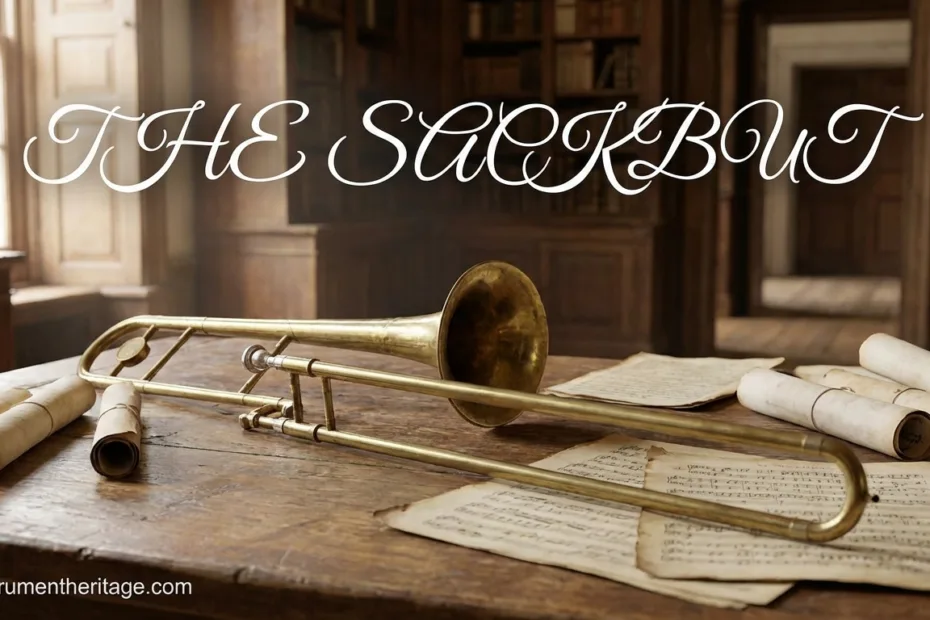
If you were to walk into a 16th-century cathedral in Venice, you wouldn’t hear the loud, metallic sound of a modern marching band. Instead, you might hear a tone so smooth and vocal that you’d mistake it for a choir of baritones. This was the sackbut, the elegant precursor to the modern trombone. While its name might seem amusing today, for centuries it was considered the only instrument worthy of accompanying the human voice in sacred music. It is a remarkable creation that has barely changed in 500 years, bridging the gap between the medieval world and the modern symphony.
The Sackbut Overview
Before diving into the history, here is a quick breakdown of the instrument’s defining characteristics.
| Feature | Details |
|---|---|
| Primary Era | Renaissance (1400s) to Baroque (1700s) |
| Family | Brass (Aerophone) |
| Material | Hammered brass alloy (thinner than modern brass) |
| Key Innovation | Telescopic slide for chromatic capability |
| Sound Quality | Mellow, vocal, blending, soft attack |
| Common Sizes | Alto, Tenor, Bass (and rarely Contrabass) |
What’s in a Name? (The “Pull-Push”)
The word “sackbut” often sounds peculiar to modern English speakers, but its origins are quite literal and descriptive. It comes from the Middle French words “saquer” (to pull) and “bouter” (to push). Put them together, and you have a “pull-push” instrument. This describes exactly what the player does with the slide.
In Italy, where the instrument saw massive popularity, it was known simply as the trombone (meaning “large trumpet”). In Germany, it was (and still is) called the Posaune. However, in England, the descriptive French term stuck, evolving into “sackbut.”
A Brief History of the “Divine” Instrument
The sackbut didn’t just appear out of nowhere; it was a technological breakthrough. Before the sackbut, brass instruments like the trumpet were limited to the harmonic series—they could only play bugle-call notes (like C, G, C, E, G). If a composer wanted a note in between, they were out of luck.
1. The Renaissance Birth
Around the mid-15th century, likely in Burgundy or Northern Italy, instrument makers applied a telescopic slide to a trumpet. This was revolutionary. Suddenly, a brass player could play every note in the chromatic scale by simply extending or retracting the slide. This made the sackbut the most advanced brass instrument of its time, centuries before valves were invented for trumpets and horns.
2. The Golden Age of Venice
The sackbut found its true home in the cathedrals of Venice, particularly St. Mark’s Basilica. Famous composers like Giovanni Gabrieli wrote massive “polychoral” works where groups of sackbuts and cornetts (a wooden trumpet-like instrument) played from different balconies. The sound was designed to be awe-inspiring and spiritual.
Because the sackbut could play softly and match the timbre of the human voice, it became a staple in church music. It was one of the few instruments allowed inside the church during services, often doubling the choir parts (a technique called colla parte) to support the singers.
3. The Decline and Evolution
As music moved into the Classical era (think Mozart and Haydn), orchestras grew larger and louder. The subtle, vocal quality of the sackbut struggled to compete with the evolving string sections and newer wind instruments. Makers began widening the bell to create a louder, brassier sound. By the 19th century, the sackbut had effectively morphed into the modern trombone linkReference✅, losing some of its delicate sweetness in exchange for power.
Sackbut vs. Modern Trombone: What’s the Difference?
To the untrained eye, a sackbut looks almost exactly like a modern trombone. You might wonder, “Why do we need a different name for it?” The differences are subtle visually but massive acoustically. It is not just a “primitive” trombone; it is a specialized tool for a different kind of job.
- The Bell Flare
- The modern trombone has a wide, flaring bell that projects sound outward like a megaphone. The sackbut bell is funnel-shaped with very little flare at the end. This keeps the sound focused and prevents it from getting too loud or “brassy.”
- The Bore Size
- The bore (the diameter of the tubing) on a sackbut is much narrower (around 10-11mm) compared to a modern symphony trombone (around 13.9mm). A narrow bore creates a lighter, more agile sound that is easier to control at low volumes.
- The Material
- Historical sackbuts were made of hammered brass sheets that were incredibly thin. The walls of the tubing were so thin that the instrument vibrated freely, adding a rich texture to the tone. Modern trombones are thicker and heavier to produce a stable, uniform sound.
Here is a direct comparison of how these physical differences affect the performance:
| Attribute | Renaissance Sackbut | Modern Trombone |
|---|---|---|
| Tone Color | Warm, vocal, rich in overtones | Broad, dark, powerful, pure |
| Volume Capability | Limited (distorts if played too loud) | Massive (can play over a full orchestra) |
| Attack | Gentle articulation (“Doo” or “Loo”) | Precise, crisp articulation (“Too”) |
| Blending | Blends perfectly with voices and strings | Stands out as a solo or section voice |
Myth Buster: The Sackbut in the Bible?
If you have ever read the King James Version of the Bible, specifically the Book of Daniel, you might have noticed the sackbut listed among the instruments in Nebuchadnezzar’s band: “cornet, flute, harp, sackbut, psaltery…”
This is a translation error! The sackbut did not exist in ancient Babylon. The original Aramaic word used in the text is sabbeka, which refers to a triangular stringed instrument, likely a lyre or a harp.
So, why does it say “sackbut”? When the Bible was being translated into English in the early 17th century, the translators needed an English word for a “complex musical instrument.” Since the sackbut was popular and well-known at the time, they used it as a familiar equivalent, even though it was historically inaccurate linkReference✅. Do not expect to find brass slide instruments in 600 B.C.!
The Sound of Angels
The most important thing to understand about the sackbut is its timbre (tone quality). In the 16th and 17th centuries, the ideal musical sound was the human voice. Instruments were often judged by how well they could imitate singing.
The sackbut was prized because it could play a chromatic scale (like a voice) and could swell and diminish on a single note (unlike a harpsichord or lute). A talented sackbut player can produce a sound that is soft enough to not drown out a singer, yet rich enough to support the harmony. When played in a group (called a consort), sackbuts create a shimmering, organ-like texture that is quite different from the punchy “oom-pah” sound we associate with modern brass.
Modern Revival
Today, the sackbut is enjoying a renaissance of its own. With the rise of the Historically Informed Performance (HIP) movement, musicians are going back to original instruments to hear the music exactly as Monteverdi or Bach intended. You can hear sackbuts in period instrument ensembles worldwide, playing everything from dance music to solemn requiems.
Frequently Asked Questions
Common Questions About the Sackbut
Is the sackbut harder to play than a trombone?
It presents different challenges. The smaller mouthpiece rim requires more endurance and precise lip control (embouchure). Also, because the bell doesn’t project as strongly, the player cannot “hide” behind volume; every nuance of articulation is audible.
Did the sackbut have a water key (spit valve)?
No. Historical sackbuts did not have water keys. To empty the condensation, the player would have to take off the slide or tip the instrument upside down. Most modern reproductions follow this authentic design.
Can a modern trombonist play a sackbut?
Yes, the slide positions are roughly the same. However, the technique requires adjustment. A modern player needs to use a lighter articulation and less air pressure to avoid “overblowing” the instrument and making it sound raucous.
Why did the sackbut disappear?
It didn’t exactly disappear; it evolved. As concert halls got bigger and music styles changed to favor drama and volume over vocal blending, the instrument was modified to be louder and wider, eventually becoming the modern trombone.
