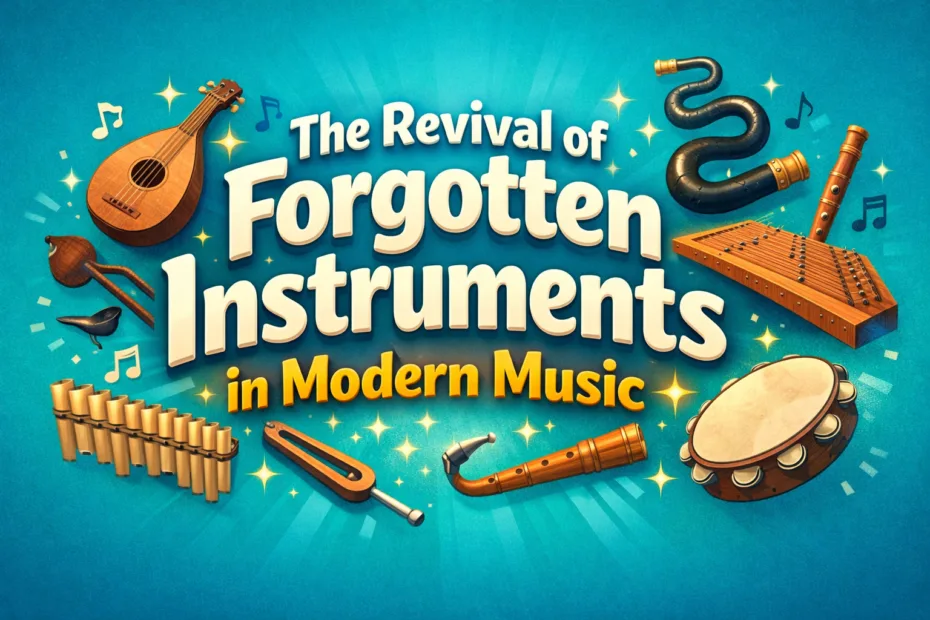
Forgotten instruments are popping back up in modern music like an old book that suddenly feels brand-new. You’ll hear instrument revival in film cues, indie records, game soundtracks, and even synth-heavy tracks—because these sounds have character, not just pitch.
🧭 What “forgotten” usually means
- Out of mainstream use (not taught everywhere) but still playable
- Hard to source (few builders) yet in demand for unique tone
- Niche technique (special touch) that rewards patient practice
- Misunderstood sound (old stereotypes) now reframed by modern production
🎛️ Why producers love them
- Instant texture: a little noise, a little air, a lot of identity
- Different envelopes: attack and decay that feel human
- Odd harmonics: overtones that sit beside synths without fighting
- Story in the sound: listeners hear a vibe even before they name the instrument
| Instrument type | What it adds | Where it shows up today | Practical notes |
|---|---|---|---|
| Wheel / drone strings (hurdy-gurdy, organistrum family) | Continuous tone buzz + shimmer | Folk-pop, cinematic layers | Tuning stability matters; capture both drone and melody cleanly |
| Historic winds/brass (serpent, cornett family) | Warm low-end vocal-like blend | Period ensembles, modern scoring | Intonation is part of the charm; plan supportive harmonies |
| Early electronic (ondes Martenot, trautonium family) | Glide + expressiveness singing vibrato | Film, ambient, art-pop | Performance control is the “secret sauce”; record gestures, not just notes |
| Plucked ancestors (citterns, lutes, early guitars) | Fast sparkle articulation | Acoustic indie, studio color | String choices change everything; keep pick noise intentional |
🧩 Why instruments fade out (and why they return)
- Volume wars: quieter instruments got squeezed by louder ensembles and venues, then later reclaimed via mics and PA
- Standardization: orchestras and schools leaned into a shared toolkit, while oddballs stayed specialized and rare
- Maintenance reality: if parts and makers are scarce, the instrument becomes a commitment, not a casual purchase
- Taste cycles: one era wants clean and shiny, the next wants grain and bite
The comeback pattern is usually simple: a sound gets labeled “old,” then someone uses it in a new context, and suddenly it feels fresh again—like wearing a vintage jacket with modern sneakers.
⚙️ The three engines behind today’s revivals
- Builders and restorers: replicas, hybrid designs, and better materials make old ideas reliable and tour-ready
- Communities: early music groups, folk scenes, and online teachers turn “mystery instruments” into learnable skills
- Modern production: close miking, re-amping, and smart EQ let unusual timbres sit beside big drums and wide synth pads
🎡 Spotlight: Hurdy-gurdy (drone + melody in one box)
What it is
- Bowed by a wheel turned with a crank; the wheel acts like an endless bow
- Drones + melody string give it a built-in “bandmate” feel
- Medieval roots include a larger two-person ancestor, then later smaller forms as it spread widelyReference✅
Why it feels “modern” again
- Rhythmic buzz (from the bridge mechanism on some setups) behaves like a natural percussion layer
- Sustained drones create instant harmony beds without needing a synth pad
- Micro-motion: tiny crank changes produce living tone
How it behaves in a mix
- Drone sits low-mid; it can fill space like a warm organ but with more hair
- Melody cuts when you keep its top end clean and avoid over-saturating
- Tuning tells the truth: stable tuning makes the whole track feel expensive
Playing controls that matter
- Crank speed shapes dynamics and brightness more than people expect
- Pressure changes timbre; think “bow pressure,” just via wheel contact
- Key action affects articulation; clean keys = clean melodies
🐍 Spotlight: Serpent (the bass voice that blends like velvet)
Serpent is a historic bass wind with a mouthpiece and finger holes. It’s famous for a tone that can feel vocal—like a choir bass line learned how to breathe.
- Historic job: supporting voices, especially in church settings; in France it was used to bolster plainsong from the late 16th century onwardReference✅
- Modern job: adding warm low-end lines that don’t sound like tuba, bassoon, or synth
- Best pairing: strings and voices—its tone tends to merge instead of dominating
- Performance reality: intonation can be expressive; tight arrangements should leave a bit of breathing room
Where it shines
- Unison doubles with cello or bass clarinet for a richer core
- Slow melodies where shape matters more than speed
- Choral pads in scores—an “ancient air” without sounding fake
Recording notes
- Capture the room: serpent likes a little space, so add distance mic if possible
- Watch low mids: it can build up; gentle cleanup keeps it clear
- Let it breathe: natural phrasing is part of the magic
⚡ Spotlight: Early electronic instruments (expressiveness before “synth presets”)
Early electronic instruments weren’t chasing “perfect” sound. They were chasing control and expression. A classic example is the Ondes Martenot, introduced in 1928 and notable for bringing an expressive electronic keyboard approach into real musical lifeReference✅.
What makes them “revival-ready”
- Gesture-first playing: vibrato, glide, and dynamics are built into the design
- One-note focus: monophonic lines cut through dense tracks like a lead singer
- Timbre controls: tone shaping happens at the fingers, not only in post
How modern artists use the vibe
- Melody hooks with expressive pitch motion (glide feels alive)
- Harmonic fog under vocals—soft, moving tone without heavy chords
- Sound design: record the performance, then layer with subtle processing
🎻 Other “lost-and-found” sounds showing up in modern music
- Viola da gamba: soft, detailed low strings; loves close mics
- Nyckelharpa: bowed keys, bright resonance; great for hooks
- Cittern family: metallic shimmer; sits above guitars as sparkle
- Frame drums: earthy transients; works with modern drums as texture
- Crwth / rebec: nasal strings that cut through; perfect for lines
- Cornett: bright, flexible wind; blends with voices in a weirdly modern way
- Hammered dulcimer relatives: clean attack; great for arpeggios
- Jew’s harp: tiny instrument, huge character; a rhythmic pulse
A revived instrument doesn’t “sound old.” It sounds different—and different is a shortcut to attention.
🎚️ Recording and production moves that respect the instrument
Capture
- Two perspectives: one close for detail, one a bit back for air
- Noise as texture: wheel, breath, key clicks—keep what feels musical
- Tuning check: track with a stable reference so the charm stays intentional
Shape
- Gentle EQ: remove only what masks the vocal or kick; keep the signature
- Dynamic touch: light compression keeps movement without flattening expression
- Space choice: room verbs for historic winds; plate or chamber for strings
A clean, modern signal chain that still feels “alive”
- Performance first: capture the best take before reaching for plugins
- High-pass only if needed: keep body when the instrument is the feature
- Light saturation: add glue, not fuzz; let detail stay
- Reverb with intention: pick one space that matches the song’s world
🧠 Choosing a revived instrument for a modern track
| If your track needs… | Reach for… | Why it works |
|---|---|---|
| A steady harmonic floor without pads | Hurdy-gurdy or drone strings | Continuous tone reads as “foundation,” plus movement |
| A human-like bass color not synthy | Serpent or historic bass winds | Vocal blend supports melodies without stealing them |
| Expressive lead motion glide + vibrato | Ondes-style lines or early electronic phrasing | Gesture-driven pitch feels like a voice with intent |
| Fast sparkle and attack for hooks | Cittern/lute relatives | Transient clarity sits above guitars and keys cleanly |
🧰 Care and setup basics that keep the vibe consistent
- Humidity awareness: many revived instruments use wood and glue that love stable air
- String and reed choices: small changes can shift the whole tone identity
- Mechanical maintenance: wheels, keys, and pads need gentle attention so the instrument stays predictable
- Case and transport: treat it like a camera lens—safe storage keeps the magic ready
❓ FAQ
Are revived instruments only for “old-style” music?
No. Their value is timbre and expression. Put them beside modern drums or synths and they become a signature layer, not a history lesson.
What makes an instrument “forgotten” if it still exists?
Availability and visibility. If it’s rarely taught, rarely stocked, and rarely heard in mainstream releases, it can feel forgotten even while dedicated players keep it alive.
Do modern recordings “change” these instruments too much?
They can, but tasteful production usually does the opposite: it reveals detail and keeps the identity intact. The goal is to amplify what’s already there, not replace it.
Which revived instrument is easiest to feature in a modern mix?
Drone-capable strings (like hurdy-gurdy style textures) are friendly because they create harmonic beds. Early electronic-style lines also work well because they behave like a lead voice.
How do I avoid the “novelty instrument” vibe?
Give it a role: bass support, hook melody, rhythmic texture, or sustained harmony. When the part is structural, the sound reads as intentional, not decorative.
