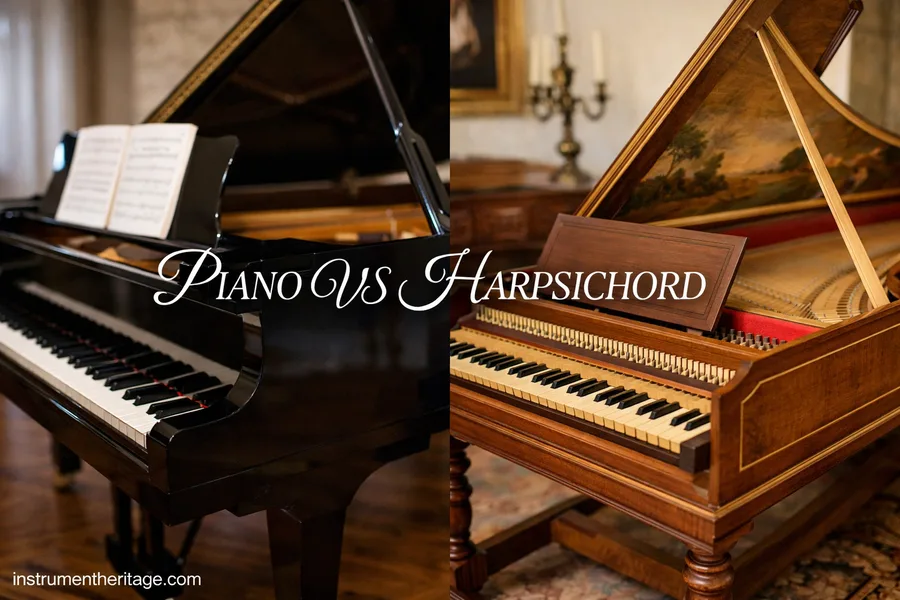
| Feature | Harpsichord | Piano (Pianoforte) |
|---|---|---|
| Sound Production | Plucked Strings (Plectrum mechanism) | Struck Strings (Hammer mechanism) |
| Dynamic Control | Limited (Terraced dynamics via stops/couplers) | Fully variable (Touch-sensitive) |
| Tone Sustain | Short decay, articulate, transparent | Long sustain, resonant, rich |
| Primary Era | Renaissance & Baroque (16th–18th Century) | Classical, Romantic, Modern (18th Century–Present) |
| Maintenance | High maintenance (Quills need frequent adjustment) | Moderate (Holds tune longer, complex action) |
| Touch Weight | Very light, “snap” feeling at the pluck point | Heavier, deeper key travel |
Explore the Differences
When you look at them from a distance, they might seem like siblings. Both have black and white keys, a wooden case, and a lid propped open to reveal a web of strings. But sit down to play, and you realize they are barely even distant cousins. The battle of Piano vs. Harpsichord isn’t just about which one is older or louder; it is a fundamental clash of physics, philosophy, and musical expression. One paints with broad, blending strokes of oil colors, while the other sketches with the precise, crisp lines of an ink pen.
For music lovers, historians, or aspiring musicians, understanding the distinction between these two giants goes beyond knowing that one sounds “twangy” and the other sounds “smooth.” It unlocks the secret to why Bach sounds mathematical and precise, while Chopin sounds sweeping and emotional. The architecture of these instruments literally dictated the music written for them.
The Mechanic Heart: Plucking vs. Striking
The single most critical difference lies under the hood. It defines everything else—from how the player touches the keys to how the sound reaches the listener’s ear. It is the difference between a plectrum and a hammer.
The Harpsichord: The Pluck
Imagine a guitar player plucking a string with a pick. That is exactly what happens inside a harpsichord. When you press a key, a vertical strip of wood called a jack rises. Attached to this jack is a tiny protrusion called a plectrum (historically made from bird quill, specifically crow or raven feathers, now often plastic).
This plectrum snaps across the string, causing it to vibrate. When you release the key, the jack falls back down, and a damper silences the string immediately. This action creates a very distinct distinct “click” or “snap” feeling in the finger.
The Piano: The Strike
The piano, formally known as the pianoforte, uses a system of leverage to propel a felt-covered hammer at the strings. When you press a key, the hammer swings up, contacts the string, and immediately bounces back, allowing the string to vibrate freely. Reference✅
Because it is a strike, the force you use matters. Hit the key gently, the hammer taps the string softly. Hit it hard, and the hammer strikes with force. This allows for graduated dynamics—the ability to play soft (piano) and loud (forte) just by changing your finger pressure.
This mechanical difference creates a massive divergence in how the musician connects with the instrument. On a piano, you are physically manipulating the intensity of the sound. On a harpsichord, the volume is essentially fixed; pressing the key harder doesn’t make it louder, it just adds a noisy “thump” to the mechanism.
The “Touch” Myth: Many pianists struggle when they first try a harpsichord because they try to “pour” emotion into the keys with weight. The harpsichord ignores arm weight. It demands articulation—the precise timing of when notes start and stop—rather than dynamic swelling.
Sound Profile and Timbre
If you were to close your eyes, the sonic signature of these instruments is unmistakable. The physics of the pluck versus the strike creates different overtone series and decay rates.
The Harpsichord’s Voice
The harpsichord is rich in high-frequency overtones. The sound is often described as:
Brittle Metallic Precise Transparent
Because the string is plucked, the energy dissipates very quickly. There is almost no sustain. Once the note is played, it begins to die away immediately. This lack of sustain means harpsichord music is often very “busy”—filled with trills, ornaments, and fast runs. Composers had to write many notes to keep the sound alive. You cannot play a long, singing melody on a harpsichord without decorating it.
The Piano’s Voice
The piano is designed for resonance. The soundboard is massive, and the strings are under tremendous tension (up to 20 tons in a modern concert grand). The sound is:
Warm Round Sustaining Dynamic
The hammer mechanism excites the fundamental frequency more strongly than the high overtones, giving it a “thicker” sound. Plus, the damper pedal (the right pedal) allows the strings to vibrate sympathetically even after the keys are released, creating a wash of sound that the harpsichord simply cannot replicate.
The Historical Shift: Why Did We Switch?
The transition from harpsichord to piano wasn’t an overnight revolution; it was a slow burn that mirrored the changing tastes of European society. To understand the instruments, you have to understand the timeline.
- The Golden Age of the Harpsichord (1500s – 1750s)
- During the Renaissance and Baroque eras, the harpsichord reigned supreme. It was the engine of the orchestra (basso continuo) and the favored solo instrument. The music of this time—Bach, Vivaldi, Handel—was built on counterpoint (multiple independent melodic lines weaving together). The harpsichord’s crisp, non-blending sound was perfect for this; you could hear every individual line clearly.
- The Invention of the Piano (c. 1700)
- An Italian keeper of instruments named Bartolomeo Cristofori was frustrated by the harpsichord’s lack of dynamics. Around 1700, he invented the gravicembalo col piano e forte (harpsichord with soft and loud). It was a technological marvel, but it took decades to catch on. Reference✅
- The Takeover (1770s – 1800s)
- As musical tastes shifted toward the Classical style (Mozart, Haydn), composers wanted emotional nuance. They wanted melodies that could “sing” and accompaniment that could fade into the background. The harpsichord couldn’t do this. By the time Beethoven arrived, the piano was becoming louder, sturdier, and more expressive, effectively rendering the harpsichord obsolete for the next 150 years.
For a long time, the harpsichord wasn’t just forgotten—it was considered an “old-fashioned” instrument, much like how we might view a typewriter today compared to a laptop. However, in the 20th century, there was a strong resurgence of the harpsichord as musicians realized that Bach sounds more distinct and true to its original form on the instrument he actually wrote for.
Expressiveness and Dynamics
This is where the debate often gets heated. Pianists often claim the harpsichord lacks expression because it lacks volume control. Harpsichordists argue that their expression is just more subtle.
Terraced Dynamics vs. Graduated Dynamics
Since a harpsichordist cannot make a note louder by hitting it harder, they use different tricks to create contrast:
- Registration: Harpsichords often have multiple sets of strings (choirs) and two keyboards (manuals). By pulling a lever (a stop), the player can engage an extra set of strings to double the sound volume. This creates “steps” or terraced dynamics—suddenly loud or suddenly soft, with no crescendo in between.
- Agogic Accent: This is a timing trick. To emphasize a note, the harpsichordist holds it slightly longer or delays its entry by a fraction of a second. It tricks the ear into thinking that note is “heavier” or more important, even though the volume hasn’t changed.
The piano, conversely, offers infinite gradation. You can play a crescendo (gradually getting louder) on a single chord progression. This capability gave birth to the Romantic era of music (Liszt, Rachmaninoff), where emotional swells and dramatic volume changes are central to the art.
Living with the Instrument
If you are considering acquiring one of these for your home, the ownership experience is vastly different. While a digital piano solves all these problems, comparing acoustic instruments reveals the fragile nature of the older technology.
| Tuning Stability | Harpsichord: Highly unstable. Changes in humidity or temperature can throw it out of tune in minutes. Most harpsichordists must learn to tune their own instrument and do so before every practice session. | Piano: Very stable. A well-maintained piano might need tuning only once or twice a year by a professional. |
| Mechanism Care | Harpsichord: The plectra (quills) wear out or break. You need to be comfortable replacing small parts and adjusting the action yourself. | Piano: The action is incredibly complex (thousands of parts), but durable. It rarely breaks under normal use, but if it does, you need an expert technician. |
| Portability | Harpsichord: Surprisingly light. Because the strings are under less tension, the frame is wood, not cast iron. Two people can often move a harpsichord. | Piano: Extremely heavy. The cast iron plate required to hold the high-tension strings makes even a small upright piano weigh hundreds of pounds. |
The Climate Factor: Harpsichords are essentially barometers made of wood. If you live in a climate with wild humidity swings, a harpsichord will be a demanding roommate. The soundboard swells and shrinks, dragging the strings out of tune constantly.
Repertoire: What Should You Listen To?
To truly hear the difference, you need to listen to the music native to each instrument. While you can play Bach on a piano (and it sounds beautiful), it is a translation, not the original language.
Essential Harpsichord Listening:
- Domenico Scarlatti: His 555 sonatas are full of rapid-fire repeated notes, hand-crossing, and percussive effects that sparkle on the harpsichord but can sound muddy on a piano.
- J.S. Bach: The Goldberg Variations. While Glenn Gould made the piano version famous, hearing it on a two-manual harpsichord reveals how the hands cross over each other without colliding, as they are on different keyboards.
- François Couperin: French Baroque music relies heavily on specific ornaments that are idiomatic to the harpsichord’s pluck.
Essential Piano Listening:
- Frédéric Chopin: His nocturnes rely entirely on the sustain pedal and the ability to make the melody “float” over a quiet accompaniment. This is physically impossible on a harpsichord.
- Ludwig van Beethoven: His later sonatas push the extremes of dynamic range, from a whisper to a roar, utilizing the full power of the hammer strike. Reference✅
- Claude Debussy: Impressionist music creates “colors” by blending sounds together using the piano’s resonance—an effect the crisp harpsichord cannot achieve.
Frequently Asked Questions
Is a harpsichord harder to play than a piano?
Technically, the harpsichord requires cleaner finger work. On a piano, the sustain pedal can hide sloppy playing. On a harpsichord, every mistake is clearly audible because the sound is so transparent. However, the piano requires more physical strength and coordination to manage the dynamic levels and the pedals.
Can I play piano music on a harpsichord?
You can play the notes, but the effect will be wrong. Romantic music (like Chopin or Rachmaninoff) relies on sustain and dynamics, which the harpsichord lacks. The music will sound dry and disjointed. Conversely, Baroque music written for harpsichord often transfers relatively well to the piano.
Why do harpsichord keys look reversed (black naturals, white sharps)?
In the past, keyboard colors weren’t standardized. Ebony (black wood) was often more durable or available than ivory for the main keys. Additionally, some say the darker keyboard made the player’s hands look paler and more elegant by contrast, which was a fashion preference in the Baroque era. The standard “white naturals, black sharps” became fixed largely with the rise of the piano.
How much does a harpsichord cost compared to a piano?
A high-quality concert grand piano (like a Steinway) is generally much more expensive than a top-tier harpsichord due to the sheer amount of materials and engineering involved. However, because harpsichords are rare and often custom-built by artisans by hand, a good replica instrument is still a considerable investment, often costing as much as a high-end upright piano or small grand.
