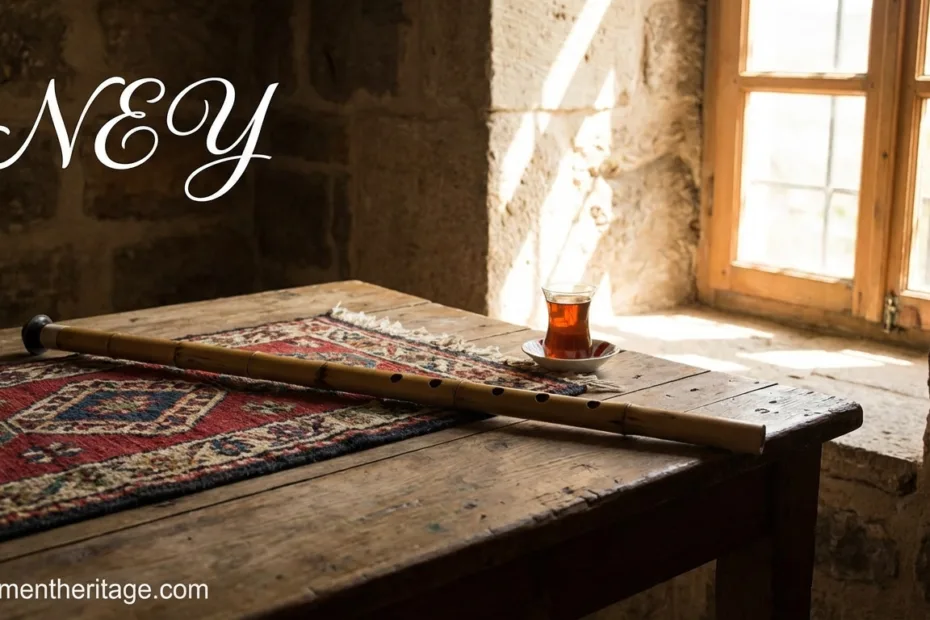
| Instrument Family | Woodwind (Aerophone) / End-blown Flute |
| Primary Material | Arundo Donax (Giant Reed) preferred; synthetic or wood alternatives exist. |
| Origin Region | Middle East, Central Asia, Egypt (Sumerian roots) |
| Key Components | Cane body (9 nodes/knots), Parazvane (metal rings), Bašpare (headpiece – Turkish style) |
| Standard Range | Approximately 2.5 to 3 octaves |
| Tuning System | Non-tempered (Microtonal/Maqam based). Pitch determined by length. |
| Playing Angle | Oblique (approx. 30 degrees to the side) |
| Classification | Open-ended flute (distinct from recorder or traverse flute) |
The sound of the Ney is often described not merely as music, but as a yearning human voice transformed into breath. Unlike the bright, metallic precision of modern orchestral flutes, the Ney carries a windy, textured, and deeply resonant tone that has captivated listeners from the banks of the ancient Nile to the dervish lodges of Istanbul. It is an instrument of deceptive simplicity: a hollow piece of river cane, pierced with holes, yet capable of navigating the complex microtonal geography of the Maqam system with unmatched fluidity. While it appears primitive, mastering the breath control required to produce its characteristic hushed, mystical timbre is a lifelong pursuit for any musician.
This is not just a flute; in many Eastern traditions, it is treated as a spiritual partner. The construction itself is a rigid discipline, requiring specific harvest times and curing processes that take years. Whether played in the classical Ottoman court style or the folk traditions of the Arab world, the Ney remains the quintessential voice of Middle Eastern reed instruments.
From Sumeria to the Ottomans: A Historical Timeline
The lineage of the Ney stretches back further than almost any other melodic instrument still in use today. Archeological evidence suggests that end-blown flutes made of cane were utilized in Ancient Egypt around 3000 BCE. Depictions on tomb walls show musicians holding long flutes in the characteristic oblique playing position still used today. The Sumerians called a similar instrument the gi-gid (long reed).
However, the instrument didn’t stay static. As it moved through the Persian Empire and into the Islamic Golden Age, it evolved from a folk instrument into a tool of high art. By the time of the Ottoman Empire, the Ney had been elevated to the center of classical music ensembles.
The Rumi Connection 🍃
You cannot discuss the history of the Ney without mentioning Mevlana Jalaluddin Rumi, the 13th-century Sufi mystic. The very opening lines of his magnum opus, the Masnavi, are dedicated to the Ney:
“Listen to the reed (Ney), how it tells a tale, complaining of separations…”
In this philosophy, the Ney represents the human soul. Just as the reed is cut from the riverbed (its home), dried, and pierced with holes (life’s trials) to produce beautiful music, the human soul is separated from the Divine and longs to return. This metaphor cemented the Ney’s status as the primary instrument of the Mevlevi Order (Whirling Dervishes). Reference✅
Anatomy: The Science of the Nine Knots
A true Ney is not simply a drilled piece of wood; it is a marvel of natural geometry. The standard Ney is crafted from a single piece of Arundo Donax, a species of giant reed that grows in Mediterranean and Middle Eastern wetlands. The selection process is rigorous. Makers look for cane with specific internode lengths and diameters.
- The Nine Nodes (Boğum): A classical Ney must have exactly nine nodes (knots) and essentially split into six distinct finger-hole sections. This natural segmentation affects the vibration of the air column, creating the instrument’s harmonic richness.
- The Parazvane: Because reed is organic and prone to splitting under temperature changes, metal rings called Parazvane are attached to the top and bottom ends. These are usually made of silver, copper, or brass. They protect the instrument without interfering with the sound.
- Finger Holes: There are typically six holes on the front and one thumb hole on the back. The placement is not mathematically equidistant but acoustically determined to facilitate the microtonal scales.
Distinction: Turkish, Arabic, and Persian Neys
While they share a name and a material, the regional variations create entirely different playing experiences and tonal qualities. Mixing them up is a common mistake for beginners.
Core Differences Overview
The Breath: Bilabial vs. Interdental
Playing the Ney is notoriously difficult. Unlike a recorder where you blow into a duct, or a flute where you blow across a hole, the Ney requires you to blow against the open rim of the tube. The air stream must be split by the sharp edge (the labium principle), with half the air going in and half going out.
The standard Turkish technique (Bilabial) involves forming a distinct embouchure. The player holds the Ney at an angle of roughly 30 degrees to the right or left. The lips form a small aperture, directing a pressurized stream of air onto the inner edge of the Bašpare. Reference✅
The Three Registers
A master Ney player doesn’t just play notes; they navigate “registers” or breath pressures. The same fingering produces different notes depending on how hard you blow:
- Dem Sesler (Deep Sounds): The lowest register, warm and fundamentally earthy.
- Dygah (Middle): The main playing range, clear and vocal.
- Tiz (High): Piercing, intense, used for climactic moments in improvisation (Taksim).
The “Ahenk” System: Why Are There So Many Sizes?
If you play the guitar, you tune the strings to change the key. With the Ney, you cannot retune the instrument significantly. To play in different keys (transpositions), the player must literally switch to a different sized instrument. This is why professional Neyzen (Ney players) carry a bundle of flutes in various lengths.
This system of lengths is called Bolahenk or simply Ahenk (Harmony). The pitch of the Ney is defined by the note it produces when all holes are closed (or specifically, the note ‘Rast’).
| Ney Name | Approx. Length | Fundamental Tone (Piano Pitch) | Usage Context |
|---|---|---|---|
| Kız Ney | ~68-72 cm | B (Si) | The absolute standard for beginners and solo performance. |
| Mansur Ney | ~78-82 cm | A (La) | Very common in classical ensembles. Deep, rich tone. |
| Şah Ney | ~86-90 cm | G (Sol) | Low, meditative, requires long arms/fingers. |
| Müstahsen | ~64-66 cm | C# (Do Diyez) | Higher pitch, brighter. |
| Bolahenk Nisfiye | ~50-52 cm | E (Mi) | Small, high-pitched, used for higher octaves. |
For a beginner, the Kız Ney is almost always the recommended starting point. It offers a balance between finger stretch capability and sound production. A Mansur Ney, while sounding deeper and often preferred by masters, requires a finger span that can be discouraging for a novice.
Maintenance: Feeding the Reed
Since the Ney is organic matter—essentially dead plant tissue—it is hydroscopic. It absorbs moisture from your breath and dries out in the air. This cycle can cause the reed to crack or warp, which destroys the tuning. To prevent this, the Ney must be oiled regularly.
- The Oiling Process (Yağlama)
- Traditionally, Sesame Oil or finely refined Hazelnut Oil is used. The instrument is submerged in a bath of oil or the oil is poured through the bore. This keeps the internal fibers flexible and creates a smooth inner surface for better airflow.
- Temperature Sensitivity
- Ney tuning changes with heat. A cold Ney plays flat; a warm Ney plays sharp. Before a performance, you will often see players blowing warm air through the instrument or holding it close to their body to bring it up to “operating temperature.”
Modern Adaptations and Global Influence
While deeply rooted in tradition, the Ney has found its way into modern synthesis. Artists like Mercan Dede and Kudsi Erguner have blended the Ney with electronic music and jazz, proving the instrument’s versatility. Synthetic Neys made from PVC or Delrin are now common for students. While purists argue they lack the complex overtones of natural cane, they are practically indestructible and consistent in tuning, making the instrument more accessible to a global audience.
Frequently Asked Questions
Is the Ney hard to learn?
Yes, it has a steep learning curve. Producing the first sound can take weeks for some beginners because it relies entirely on precise embouchure angle and breath control, unlike instruments with a fixed mouthpiece.
Why does my Ney sound airy or breathy?
A breathy tone is actually characteristic of the Ney, but excessive airiness usually means the blowing angle is slightly off, or the lips are not focused enough. It can also happen if the reed is dry and needs oiling.
Can I play Western songs on a Ney?
Yes, but with limitations. The Ney is diatonic and tuned for Maqam scales. While you can play chromatic notes by half-holing or changing head position, playing fast, complex Western chromatic progressions is extremely difficult.
How often should I oil my Ney?
For a new instrument, it is recommended to oil it once a week. Older, well-saturated instruments may only need oiling once every few months depending on humidity and usage.
Note: The acoustic properties mentioned refer to standard professional Neys. Decorative tourist souvenirs often lack accurate tuning capabilities.
