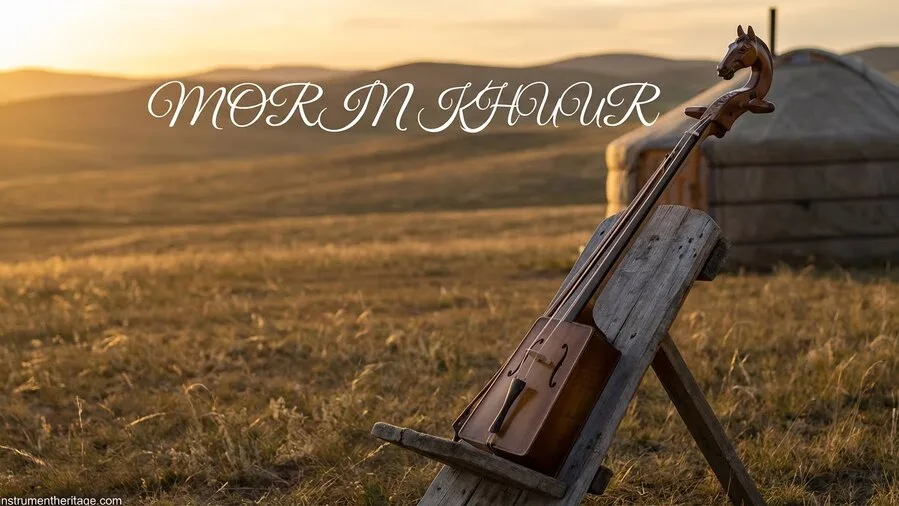
Imagine standing in the vast, open steppes of Mongolia. The wind whistles through the grass, and in the distance, you hear the thunder of hooves. Now, imagine capturing that entire sonic landscape inside a wooden box with two strings. That is the essence of the Morin Khuur. Known to the world as the Horsehead Fiddle, this isn’t just an instrument; it is the auditory soul of a nomadic nation, a vessel for history, and a masterpiece of acoustic engineering that has survived for centuries.
For anyone passionate about string instruments, the Morin Khuur represents a fascinating divergence from the European violin family. While a cello or violin projects a singing, focused tone, the Morin Khuur produces a sound that is wild, harmonic-rich, and incredibly expansive. It growls, it neighs, and it weeps. It is deeply connected to nature, specifically the horse, which has been the lifeline of the Mongol people for millennia. Recognizing its profound value to humanity, UNESCO proclaimed the traditional music of the Morin Khuur as a Masterpiece of the Oral and Intangible Heritage of Humanity. Reference✅
Whether you are a collector, a musician looking for new textures, or simply a lover of global heritage, understanding the Morin Khuur requires looking beyond its trapezoidal body. You have to understand the legends that birthed it and the unique playing techniques that make it sing.
The Heartbreak That Created a Masterpiece
You cannot separate the instrument from its mythology. In the oral traditions of Mongolia, the creation of the Morin Khuur is often tied to a tragedy of love and loss. The most famous tale concerns a shepherd named Khökhöö Namjil. This isn’t just a bedtime story; it is the emotional context that players channel when they draw the bow.
📜 The Legend of the Winged Horse
According to folklore, Namjil had a magical winged horse named Jonon Khar. This miraculous steed allowed him to fly across the vast distances of Mongolia every night to meet his beloved. However, a jealous woman, discovering the secret, cut the horse’s wings while it rested. Namjil’s horse died, leaving him grounded and heartbroken.
In his grief, Namjil refused to let the spirit of his companion fade. He used the horse’s skull to shape a body, its skin to cover the frame, and its hair to string a bow. When he played, the sound was not just music; it was the gallop, the neigh, and the spirit of Jonon Khar returning to him. Thus, the first Morin Khuur was born—an instrument of memory.
This origin story explains why the instrument’s scroll is always carved in the shape of a horse’s head. It is a tribute. When a master plays a sad melody, it is said they are re-telling this ancient grief, making the strings weep for the lost connection between man and beast.
Anatomy of the Steppe Cello
Visually, the Morin Khuur might remind you of a viola da gamba or a square cello, but its construction is distinctively Mongolian. Every part of the instrument is steeped in symbolism and practical acoustic design tailored for the dry, open environments of the Gobi and the steppes.
The Body and the Skin
The soundbox is traditionally trapezoidal. While modern concert instruments are entirely wooden (often spruce or maple) to project louder in concert halls, the traditional folk instruments often use camel, goat, or sheep skin stretched over the frame. This skin membrane functions similarly to a banjo head, giving the instrument a warmer, more percussive, and organic tone that reacts to humidity and temperature changes.
The Male and Female Strings
Here is where the Morin Khuur becomes truly unique. It has only two strings, but they are not simple wire or gut. They are bundles of nylon or traditional horsehair. The composition of these strings is governed by strict tradition and physics.
| Feature | The “Male” String (Zigan) | The “Female” String (Nariin) |
|---|---|---|
| Position | Thicker string, usually on the inside. | Thinner string, on the outside. |
| Traditional Material | ~130 hairs from a stallion’s tail. | ~105 hairs from a mare’s tail. |
| Tonal Quality | Deep, resonant, low frequencies. | Higher, sharper, melodic clarity. |
| Symbolism | Strength, stability, the earth. | Flexibility, melody, the sky. |
The strings are tuned a fourth apart (usually F and Bb). Because the strings are made of bundles of hair rather than a single solid core, the bow hair catches individual strands differently. This creates a rich spectrum of overtones. It’s almost like a natural chorus effect built into the instrument itself.
Not Just Plucking: The Art of the Knuckle
If you hand a violin to a classically trained Western musician, they will instinctively press the string down to the fingerboard to change the pitch. If they try that on a Morin Khuur, they will fail. The technique required to master this instrument is entirely different and physically demanding.
The Lateral Pressure Technique
You do not press the strings down to the wood. Instead, you slide your fingers underneath or push sideways against the string with the nail or the cuticle. This is known as the nail technique (for the higher strings) and the finger-pad push (for lower strings).
- Harmonics Control: Because the string is not stopped against a hard surface, it vibrates more freely. This allows players to manipulate the harmonics (the “flute-like” sounds) with incredible precision.
- The Glissando: The sliding movement is integral. Morin Khuur music rarely jumps abruptly from note to note; it slides, mimicking the wind or the contours of the rolling hills.
- Bowing: The bow is held loosely, often with the pinky finger controlling the tension of the hair (similar to a baroque bow hold). The right hand must be as fluid as water to execute the rapid tremolos that imitate galloping hooves.
- Tatlaga
- A specific genre of solo instrumental music designed to mimic the movements and sounds of animals—camels, horses, bulls, and birds. It is rhythmic and percussive.
- Urtyn Duu (Long Song)
- A lyrical, drawn-out vocal style often accompanied by the Morin Khuur. The instrument follows the singer’s voice, creating a polyphonic “shadow” or echo.
More Than Music: A Spiritual Tool
In the traditional Mongolian ger (yurt), the Morin Khuur is not kept in a case in the closet. It is hung in the place of honor, usually on the northern side of the dwelling. It is considered a symbol of household prosperity. A household without a fiddle is seen as incomplete, lacking a voice.
The Camel Coaxing Ritual
One of the most profound uses of the Morin Khuur is functional, not entertainment-based. In the Gobi Desert, when a mother camel rejects her newborn calf—a disaster for the herder—musicians are called in. They play a specific, soothing melody called Khuusloh.
The vibration of the Morin Khuur, combined with the herder’s chanting, has a documented psychological effect on the animal. It is said to make the camel weep and accept her offspring. This ritual is so culturally vital that it has been inscribed on the UNESCO List of Intangible Cultural Heritage in Need of Urgent Safeguarding. Reference✅
🛑 Taboo & Respect
It is traditionally considered disrespectful to place the Morin Khuur on the floor or to step over it. Before playing, a musician often touches the instrument to their forehead as a sign of reverence.
From the Steppe to the Stadium
While deeply rooted in the past, the Morin Khuur is not a fossil. It is alive and evolving. In the mid-20th century, during the socialist era, the instrument underwent “modernization.” Luthiers began making them with f-holes, soundposts, and wooden faces similar to violins to allow them to project in orchestras. This created a split between the Traditional/Folk Morin Khuur (skin-faced, warm, quiet) and the Stage Morin Khuur (wood-faced, loud, bright).
Today, the instrument has found a global audience through Folk Metal and World Fusion. Bands like The Hu have brought the growl of the Morin Khuur to rock festivals in Europe and America. They distort the signal, run it through amplifiers, and use it as a lead guitar substitute. This proves the versatility of the instrument; it can sound like a gentle breeze one moment and a roaring motorcycle the next.
Global Adoption
Interestingly, the instrument is gaining popularity in Japan and the West. Enthusiasts are drawn to its cello-like range but are captivated by the exotic overtones. Luthiers outside of Mongolia are now experimenting with carbon fiber bodies to make the instrument more travel-friendly and resistant to humidity changes, ensuring the horsehead fiddle survives the modern age.
Frequently Asked Questions
Is the Morin Khuur difficult to learn for guitar or violin players?
Yes, it presents a challenge. The main difficulty is the fingernail technique. Unlike guitar or violin where you press the string to the wood, on a Morin Khuur, you push the string sideways with the nail or knuckle. This requires developing new muscle memory and calluses in different places.
Why does the Morin Khuur have a horse head carved on top?
The horse head is a tribute to the legend of Khökhöö Namjil and his winged horse, Jonon Khar. It symbolizes the deep bond between the Mongolian nomad and their horse. Spiritually, the instrument is considered to hold the spirit of the horse.
What are the strings of a Morin Khuur made of?
Traditionally, they are made from real horsehair. The “male” (thick) string uses about 130 hairs from a stallion’s tail, and the “female” (thin) string uses about 105 hairs from a mare’s tail. Modern instruments often use specialized nylon strings for better durability and tuning stability.
How do I maintain a traditional skin-faced Morin Khuur?
Humidity control is key. The skin face can tighten in dry weather and sag in humid weather. You must keep it away from direct heat sources and radiators. It is often recommended to use a humidifier in the case during dry winters to prevent the wooden frame from warping or the skin from cracking.
Can the Morin Khuur be played in Western music styles?
Absolutely. Its range is similar to a cello, making it adaptable. It is increasingly used in movie soundtracks, rock, metal, and ambient music due to its ability to produce both melodic lines and atmospheric sound effects.
