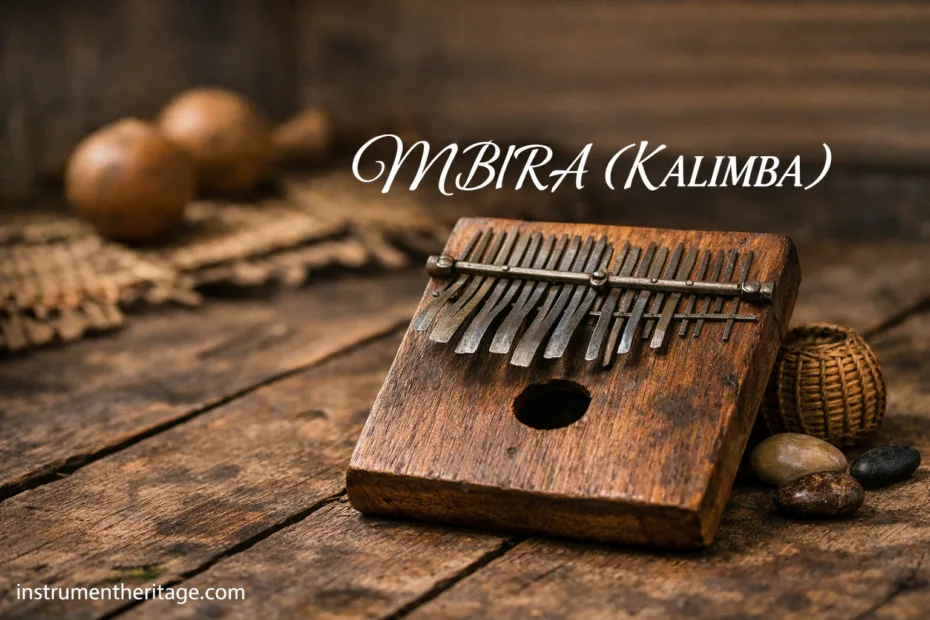
| Instrument Family | Lamellophone (Plucked Idiophone) |
| Origin & Roots | Zimbabwe (Shona People), Southern Africa |
| Traditional Name | Mbira dza Vadzimu (Voice of the Ancestors) |
| Modern Variation | Kalimba (Westernized version by Hugh Tracey) |
| Primary Materials | Hardwood soundboard (Gwariva), Metal tines, Calabash resonator (Deze), Bottle caps/Shells (Machachara) |
| Tuning Systems | Nyamaropa (Mixolydian/Major hybrid), Gandanga, Dambatsoko, Western Major Scale (Kalimba) |
| Sound Characteristics | Polyphonic, percussive, buzzing texture, bell-like sustain |
| Playing Technique | Thumbs (downward stroke), Right index finger (upward stroke) |
| Cultural Function | Bira ceremonies (spirit possession), storytelling, social gatherings, mental relaxation |
| UNESCO Status | Art of crafting and playing Mbira/Sansi (Inscribed on Representative List of Intangible Cultural Heritage) |
This seemingly small instrument holds the weight of centuries within its vibrating metal keys. Often simplified in the West as a “thumb piano,” the Mbira is a sophisticated, polyrhythmic masterpiece that serves as a telephone to the spirits in Shona culture. While many modern music enthusiasts recognize the Kalimba as a relaxation tool, the lineage of this instrument stretches back over a thousand years in Southern Africa. It is not merely a wooden box that makes pretty sounds; it is a technology of consciousness, designed to induce trance and bridge the gap between the physical and spiritual worlds. The complexity of its overlocking rhythms and the buzzing timber creates a sonic density that sounds like more than one instrument playing at once.
Explore the Mbira
The Shona Legacy: More Than an Instrument
To understand the Mbira, one must look deep into the history of the Shona people of Zimbabwe. Unlike many instruments that were developed purely for entertainment, the Mbira was forged with a sacred purpose. Archaeological evidence suggests that iron-tined lamellophones have existed in the Zambezi valley since at least the 16th century, though wooden-tined precursors likely existed for millennia before that. The instrument is inextricably linked to the Vadzimu (ancestral spirits). It acts as a sonic key, unlocking the gates between the living community and those who have passed on.
The specific variation known as Mbira dza Vadzimu (Mbira of the Ancestors) is the most notable and complex. It was not designed for solo virtuosity in the Western sense but for group participation. The music is cyclical, repetitive, and deeply mesmerizing, intended to help a medium enter a trance state during Bira ceremonies.
🏺 The Iron Age Connection
The development of the Mbira is directly tied to the mastery of iron smelting in Southern Africa. The transition from bamboo or raffia tines to metal keys allowed for a brighter, louder, and more durable sound. This technological leap turned the instrument into a powerhouse of resonance capable of cutting through the noise of singing and clapping during all-night ceremonies.
Distinguishing the Mbira from the Kalimba
There is often confusion where the terms are used interchangeably, but there is a distinct difference in history, construction, and tuning. The term “Kalimba” is actually a generic Bantu word for “little music,” but in the global market, it refers specifically to the version standardized by ethnomusicologist Hugh Tracey in the 1950s.
The Traditional Mbira
Features a double row of keys (usually 22 to 28 metal tines). The tuning is not fixed to a Western scale; it often uses the Nyamaropa tuning, which includes microtones that fall between Western notes. It almost always includes a buzzer mechanism to create a “dirty” or textured sound.
The Modern Kalimba
Typically features a single row of keys (often 17 tines). It is usually tuned to the Western Diatonic Major Scale (Do-Re-Mi), making it harmonious to Western ears and easier to play along with piano or guitar. It often lacks the buzzing mechanism, aiming for a pure, bell-like tone.
Hugh Tracey’s adaptation was brilliant for export, as it introduced African polyphony to the world in a package that Western music theory could digest. However, the Mbira dza Vadzimu remains the heavyweight champion of complexity, requiring a completely different fingering technique and mindset to master.
Anatomy: The Sum of Sacred Parts
The construction of a traditional Mbira is a marriage of biology and metallurgy. Every component serves an acoustic and symbolic function.
1. The Gwariva (Soundboard)
The foundation of the instrument is a slab of hardwood, typically from the Mubvamaropa (Bloodwood) tree. This wood is chosen for its density and ability to transmit vibrations. The wood is often hand-carved to fit ergonomically into the player’s hands. It is not just a holder for the keys; it is the grounding element of the sound.
2. The Lamellae (Keys)
The keys are made from flattened metal, often repurposed from springs, umbrella spokes, or bicycle spokes in modern times. Historically, they were smelted iron. The length of the tine determines the pitch—longer is lower, shorter is higher. They are held in place by a metal bridge and a heavy crossbar.
3. The Machachara (Buzzers)
This is the feature most often misunderstood by outsiders. A traditional Mbira has bottle caps, snail shells, or beads loosely attached to the metal plate or the soundboard. When the keys are played, these objects vibrate against the wood/metal, creating a constant buzzing drone.
Why the buzz? In Shona cosmology, the buzz is essential. It clears the mind, similar to “white noise,” allowing the listener to focus on the inner melodies. It is said that the buzz is what attracts the spirits, as it mimics the sound of breathing or whispering voices.
4. The Deze (Resonator)
To amplify the sound for a large gathering, the Mbira is placed inside a large, hollowed-out gourd called a Deze. The gourd acts like a natural amplifier, projecting the sound outward and adding warmth to the tone. Without the Deze, the Mbira is a quiet, intimate instrument; with it, it becomes a commanding voice.
The Physics of Polyrhythm and Acoustics
The musical output of the Mbira is a fascinating study in psychoacoustics. The instrument is played with the two thumbs stroking downwards and the right index finger stroking upwards. This allows for a density of notes that creates an auditory illusion.
The music is structured around two interlocking parts:
- Kushaura: The leading part. This is the main melodic theme that calls out. It establishes the rhythmic cycle and the identity of the song.
- Kutsinhira: The following part. This is a second rhythmic line that interlocks with the first. It is often played a beat behind or in between the notes of the Kushaura.
When these two parts are played together—either by one master player or two players interacting—the result is a kaleidoscope of sound. The listener’s ear begins to hear “resultant melodies” that no single finger is actually playing. These ghost melodies are where the Shona believe the voices of the ancestors reside. It is a phenomenon where the sum is greater than the parts.
- Overtones and Sympathy
- Because the metal tines are mounted on a single board, striking one key sends vibrations through the wood that can sympathetically excite other keys. This creates a natural reverb effect, giving the Mbira its characteristic dreamy, watery texture.
The Bira Ceremony: Music as a Conduit
The cultural context of the Mbira cannot be overstated. It is the centerpiece of the Bira, an all-night ritual used to call upon ancestors for guidance on issues like illness, drought, or social conflict. The music is not a performance for applause; it is a utilitarian tool.
Musicians play specific songs that were favorites of the ancestor they are trying to summon. The music must be played continuously, often for hours, without breaking the rhythm. The repetitive nature creates a trance state in the spirit medium (Svikiro). Once the medium is possessed, the music stops or changes to support the dialogue between the living and the dead.
Interestingly, the Mbira players are highly respected but also viewed with a mix of awe and caution. They are seen as people who live on the boundary between worlds. The instrument itself is treated with reverence; in traditional contexts, it is not uncommon for players to refer to their instruments as having their own personalities or “moods.” Reference✅
From Zimbabwe to Earth, Wind & Fire
The journey of the Mbira from the savannahs of Zimbabwe to global pop stages is a story of resilience and adaptation. During the colonial era in Rhodesia (now Zimbabwe), missionaries often discouraged the playing of the Mbira, associating it with “pagan” worship. The instrument went underground but never vanished.
In the struggle for independence in the 1970s, the Mbira experienced a massive resurgence. It became a symbol of national identity and resistance. Musicians like Thomas Mapfumo began transposing Mbira rhythms onto electric guitars, creating the genre known as Chimurenga music. This electrified the sound of the ancestors and broadcast it to the youth.
Globally, the Kalimba version found its way into Western pop music. Maurice White of the legendary band Earth, Wind & Fire was a prominent Kalimba player, using it to add an mystical, African texture to hits like “Kalimba Story” and “Evil.” This exposure introduced the unique timber of the lamellophone to millions of listeners who had never set foot in Africa.
🌐 The Mbira in Education
Today, the Kalimba and Mbira are used extensively in music education and music therapy. The logic of the layout—where notes alternate left and right—engages both hemispheres of the brain. It is considered one of the most accessible instruments for beginners because it is impossible to play a “wrong” note on a diatonic Kalimba, providing instant gratification and lowering the barrier to musical expression.
Preservation and Future
While the mass-produced Kalimba is thriving on e-commerce platforms, the traditional art of crafting the Mbira dza Vadzimu faces challenges. It requires deep botanical knowledge to find the right wood and metallurgical skill to forge the keys. However, organizations and master players are working tirelessly to archive the traditional repertoires. Reference✅
The digital age has created a new “global village” for the instrument. Tablatures are shared online, and 3D printing is even being experimented with for resonator bodies. Yet, the heart of the instrument remains in its organic roots—the wood, the metal, and the intent of the player to connect with something larger than themselves.
Frequently Asked Questions
“`
Is it difficult to learn the Mbira or Kalimba?
The Kalimba (Western version) is considered very easy for beginners because it is tuned to a major scale, meaning no “bad” notes. The traditional Mbira is more challenging due to its complex polyrhythmic playing style and different note layout, requiring more dedication to master.
Why do some Mbiras have bottle caps on them?
The bottle caps or shells are there to create a buzzing sound. In traditional Shona culture, this buzz is important as it clears the mind, adds volume, and mimics the sounds of the spirit world. It turns the clear tone into a textured, complex sound.
What is the difference between Mbira and Kalimba?
The Mbira is the traditional Zimbabwean instrument with a double row of keys, specific cultural tunings, and a buzzing mechanism. The Kalimba is a modernized, Westernized adaptation (usually by Hugh Tracey) with a single row of keys and typically tuned to the standard Do-Re-Mi major scale.
Can I retune a Kalimba or Mbira?
Yes, absolutely. Both instruments rely on the length of the metal tine to determine pitch. By tapping the tine downward (lengthening it), the pitch lowers. Tapping it upward (shortening it) raises the pitch. A small tuning hammer is usually used for this process.
“`
{
“@context”: “[https://schema.org](https://schema.org)”,
“@type”: “FAQPage”,
“mainEntity”: [{
“@type”: “Question”,
“name”: “Is it difficult to learn the Mbira or Kalimba?”,
“acceptedAnswer”: {
“@type”: “Answer”,
“text”: “The Kalimba (Western version) is considered very easy for beginners because it is tuned to a major scale, meaning no ‘bad’ notes. The traditional Mbira is more challenging due to its complex polyrhythmic playing style and different note layout, requiring more dedication to master.”
}
},{
“@type”: “Question”,
“name”: “Why do some Mbiras have bottle caps on them?”,
“acceptedAnswer”: {
“@type”: “Answer”,
“text”: “The bottle caps or shells are there to create a buzzing effect. In traditional Shona culture, this buzz is crucial as it clears the mind, adds volume, and mimics the sounds of the spirit world. It turns the clear tone into a textured, complex sound.”
}
},{
“@type”: “Question”,
“name”: “What is the difference between Mbira and Kalimba?”,
“acceptedAnswer”: {
“@type”: “Answer”,
“text”: “The Mbira is the traditional Zimbabwean instrument with a double row of keys, specific cultural tunings, and a buzzing mechanism. The Kalimba is a modernized, Westernized adaptation (usually by Hugh Tracey) with a single row of keys and typically tuned to the standard Do-Re-Mi major scale.”
}
},{
“@type”: “Question”,
“name”: “Can I retune a Kalimba or Mbira?”,
“acceptedAnswer”: {
“@type”: “Answer”,
“text”: “Yes, absolutely. Both instruments rely on the length of the metal tine to determine pitch. By tapping the tine downward (lengthening it), the pitch lowers. Tapping it upward (shortening it) raises the pitch. A small tuning hammer is usually used for this process.”
}
}]
}
