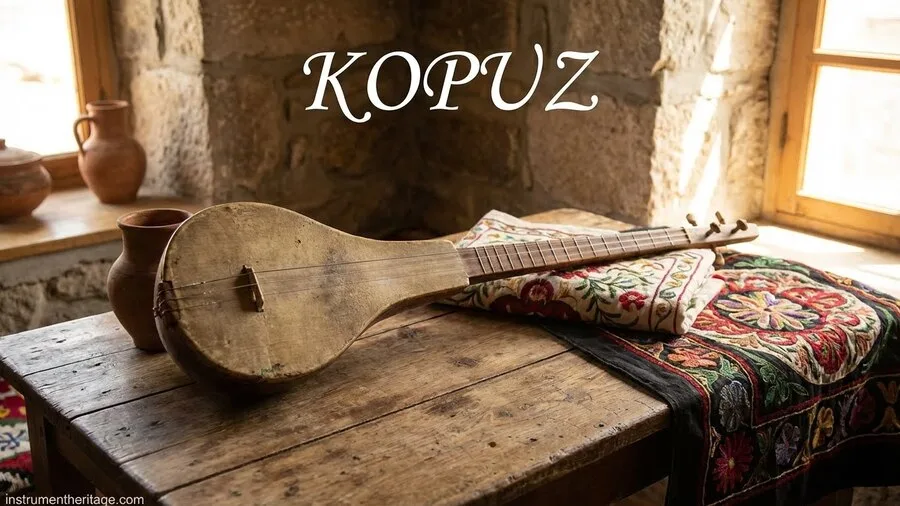
Imagine a sound that traveled across the windy steppes of Central Asia thousands of years ago, carried by horseback riders and storytellers. This is the story of the Kopuz, an instrument that is considered the grandfather of almost all Turkish string instruments. It is not merely a musical device; it is a sacred object that was believed to possess magical powers, used by shamans to communicate with the spirit world before it became the companion of the wandering bards known as Ozans. While modern instruments focus on perfect pitch, the Kopuz was designed to mimic the sounds of nature, from the galloping of a horse to the whisper of the wind.
The Sacred Instrument of the Steppes
The history of the Kopuz is as old as the Turkic peoples themselves. Before it was an instrument of entertainment, it was a tool of spirituality and healing. In the ancient belief systems of the steppes, particularly Shamanism (Tengrism), the religious leaders known as Kam or Baksı used the Kopuz to enter trances. They believed the vibrations of the strings could drive away bad spirits and heal illnesses.
Unlike modern music theory which relies on strict notes, the music of the Kopuz was based on imitation and narrative. The instrument was strictly associated with the nomadic lifestyle. You can think of it as a portable storyteller; lightweight, durable, and capable of producing a surprising amount of volume for its size.
The Holy Wood
In ancient traditions, the Kopuz was never placed on the ground. It was hung on the wall when not in use, often wrapped in fabric, treated with the same respect one might give to a holy book today. Stepping over a Kopuz was considered a grave insult and bad luck.
Anatomy of the Ancient Kopuz
The construction of the Kopuz differs significantly from the modern guitar or lute. It represents a transition from nature to art. The materials used were directly sourced from the nomad’s environment—the herd and the forest.
- The Bowl (Body)
- Traditionally carved from a single block of wood, usually mulberry, juniper, or apricot. This carving technique, called “oyma,” ensures better resonance and durability compared to glued ribs.
- The Soundboard
- This is a key difference. While modern lutes use wood, the ancient Kopuz often used stretched skin (leather) over the bowl. This gave it a banjo-like, percussive tonal quality.
- The Strings
- Before metal and nylon, there was horsehair. The original Kopuz featured strings made of twisted horsehair, which produced a raspy, warm, and primitive sound.
- The Frets
- Originally, the Kopuz was a fretless instrument. This allowed the musician to slide between notes (glissando), mimicking the human voice or animal sounds. Later versions adopted movable tie-on frets.
The Voice of Dede Korkut
You cannot talk about the Kopuz without mentioning Dede Korkut. He is the semi-legendary wise man and bard of the Oghuz Turks. In the epic stories known as the Book of Dede Korkut, he appears with his Kopuz to solve problems, name heroes, and teach moral lessons.
The instrument was his badge of office. When Dede Korkut played, arguments ceased, and warriors listened. This connection solidified the Kopuz as a symbol of wisdom and cultural identity. It transformed the instrument from a shamanic tool into a vehicle for oral history, carrying the legends of the tribe from one generation to the next
Reference✅
.
Ruzba, Komuz, and Qopuz: A Family Tree
The term “Kopuz” is actually a broad category. Depending on the region in Central Asia or Anatolia, the instrument changes shape and playing style.
1. The Plucked Kopuz (Komuz)
Most common in Kyrgyzstan. It has three strings and is played with a frantic, incredible strumming technique involving the entire hand. It is fretless and carved from apricot wood.
2. The Bowed Kopuz (Qyl-kobyz)
Found in Kazakhstan. This version is played with a bow (like a cello) and looks like an open wooden spoon with mirrors inside the bowl to deflect evil spirits. It is still heavily associated with shamanic rituals.
3. The Anatolian Kopuz (Ruzba)
This is the direct ancestor of the Turkish Bağlama. It eventually gained frets, the body became deeper, and metal strings replaced horsehair, evolving into the instruments used by the Alevi-Bektashi minstrels.
Comparison: Kopuz vs. Modern Bağlama
To understand how music evolved in the region, it helps to see the shift from the nomadic Kopuz to the settled Bağlama (Saz).
| Feature | Traditional Kopuz | Modern Bağlama (Saz) |
|---|---|---|
| Soundboard Material | Often Skin (Leather) | Thin Wood (Spruce) |
| String Material | Horsehair or Gut | Steel / Metal |
| Playing Method | Finger plucking / Bowing | Plectrum (Tezene) or Fingertip (Şelpe) |
| Fret System | Fretless or Movable | Fixed Microtonal Frets |
| Primary Use | Epic Storytelling / Ritual | Folk Songs / Social Gatherings |
The “Şelpe” Technique
One thing that hasn’t changed is the Şelpe technique. This is the art of playing without a pick, beating the strings with the fingers. While modern Saz players use a plastic pick, masters who want to reconnect with the roots of the instrument return to the Şelpe style, which mimics the percussive attack of the ancient Kopuz.
From the Steppe to the Court
As Turkic tribes migrated westward into Anatolia, the Kopuz came with them. However, as they settled and built cities (like the Seljuk and Ottoman empires), the music became more refined. The rough, buzzy sound of horsehair was replaced by the bright, projecting sound of metal strings. The Ozan (bard) became the Aşık (minstrel).
Despite these changes, the Kopuz never truly vanished. It lives on in the soul of the Bağlama. In recent years, there has been a massive revival. Luthiers are now reconstructing ancient three-stringed Kopuz models, and musicians are relearning the old scales to capture that mystical “sound of the steppe” that modern instruments often lack
Reference✅
.
Frequently Asked Questions
Is the Kopuz the same thing as the Saz?
Not exactly. The Kopuz is the ancestor of the Saz (Bağlama). While they look similar, the Kopuz is generally smaller, historically fretless or having fewer frets, and originally used gut or horsehair strings, whereas the Saz uses metal strings and has a specific fret arrangement.
What does the word “Kopuz” mean?
Etymologically, it is believed to come from the Turkic root “kop-” which means to break off, rise, or begin. It is also linked to the word “gop” meaning high or loud. It signifies a magical musical instrument that “raises” the spirit.
How many strings does a Kopuz have?
The ancient Kopuz typically had two or three strings. The three-stringed version is most common in Kyrgyzstan (Komuz), while the two-stringed version (often bowed) is common in Kazakhstan.
Is the Kopuz still played today?
Yes, absolutely. It is the national instrument of Kyrgyzstan and is widely played in Kazakhstan. In Turkey, there is a strong revival movement where folk musicians are returning to the “Üç Telli” (Three-stringed) Kopuz to perform traditional vernacular music.
