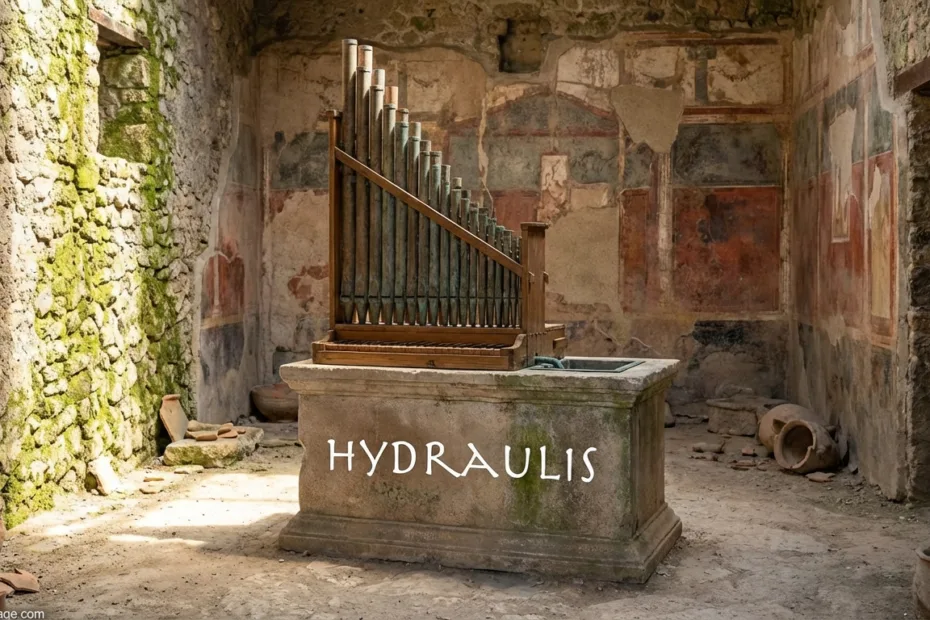
| Instrument Name | Hydraulis (Water Organ) |
| Inventor | Ctesibius of Alexandria |
| Date of Origin | 3rd Century BC |
| Classification | Aerophone (Keyboard Instrument) |
| Primary Mechanism | Water-regulated air pressure |
| Key Materials | Bronze, Copper, Wood, Leather |
| Primary Usage | Arenas, Theaters, Aristocratic Homes |
Imagine a musical instrument so advanced for its time that it seemed like sorcery to the ancient world. Before the grand pipe organs of medieval cathedrals, there was the Hydraulis. It wasn’t powered by electricity or massive bellows, but by the sheer physics of water and air working in harmony. This wasn’t just a noise-maker; it was the world’s first keyboard instrument, a technological marvel that combined engineering genius with musical artistry.
Walking through the bustling streets of ancient Alexandria or the massive stone arches of a Roman amphitheater, you wouldn’t hear a piano or a guitar. You would hear the piercing, powerful sound of bronze pipes singing out, driven by the steady pressure of water. It is an engineering beast that set the stage for Western music history.
Explore the Hydraulis
The Birth of the “Water Flute”
The story starts in Alexandria, Egypt, during the Ptolemaic period. This city was the Silicon Valley of the ancient world. It is here that a brilliant engineer named Ctesibius (sometimes spelled Ktesibios) had a lightbulb moment. He wasn’t trying to make music initially; he was obsessed with pneumatics and hydraulics.
Legend has it that Ctesibius grew up in his father’s barber shop. He noticed that when a movable mirror—suspended by a lead counterweight running inside a tube—was pulled down, the trapped air underneath the weight was forced out, making a sharp hissing sound. That simple “hiss” sparked an idea: Could compressed air be used to blow a whistle?
💡 The Name Game
The word Hydraulis is a mash-up of two Greek words: Hydor (meaning water) and Aulos (meaning pipe or flute). So, literally, it translates to “Water Pipe.” It is a fitting name for a machine that uses water to give the pipes their voice.
Ctesibius didn’t just stop at a whistle. He scaled it up. He realized that to play a melody, you needed a steady stream of air. If you just blew into a bag, the pressure would drop as the air ran out, making the pitch wobble. He needed a regulator. That is where the water came in. He created a system where water pressure kept the air pressure constant, allowing the instrument to be played smoothly without the pitch dropping flat.
The Engineering: How Water Creates Sound
This is where things get really interesting. A common misconception is that water flows through the pipes like a garden hose. That is completely incorrect. Water never touches the pipes. Instead, water acts as a regulator or a “pressure clamp.”
The mechanism relies on three main components working together in a delicate dance of physics:
- The Cistern: A large bronze or wood container filled halfway with water.
- The Pnigeus (Air Chamber): An inverted funnel or bell-shaped vessel submerged in the cistern. It has an opening at the bottom allowing water to enter, and pipes coming out of the top.
- The Pumps: Cylindrical pumps on the side, operated by strong assistants (often slaves in Roman times), forcing air into the Pnigeus.
The Step-by-Step Process
When the assistants pump the levers, they force air into the Pnigeus (the submerged chamber). As air rushes in, it pushes the water level down inside the chamber and up into the surrounding cistern. The water, wanting to return to its natural level, pushes back against the air. This hydraulic pressure compresses the air inside the chamber.
This compressed air now has nowhere to go but up into the wind chest (a box sitting on top). When the musician presses a key, a valve opens, and this highly pressurized air shoots through the bronze pipe, creating a crisp, loud note. The genius of Ctesibius was that even if the pumpers were a bit uneven in their rhythm, the water pressure smoothed it out, keeping the tone steady.
Built to Last: Materials of the Ancient Organ
An instrument this complex wasn’t built from scraps. It required the finest craftsmanship of the Hellenistic and Roman eras. Based on archaeological finds, we know the Hydraulis was a visual masterpiece as well as a sonic one.
| Component | Material Used | Reasoning |
| Pipes (Auloi) | Bronze or Copper | Durability and brilliant, piercing resonance. |
| Cistern (Tank) | Bronze, Wood lined with Lead | To prevent leaks and withstand water weight. |
| Keys & Sliders | Wood, Bone, or Metal | Tactile response for the musician’s fingers. |
| Seals | Leather & Cork | To make the air pumps airtight. |
The pipes weren’t just simple tubes. They were often arranged in rows, similar to modern organ “stops.” Some were designed to sound like flutes, others like trumpets. The visual aesthetic was vital because these instruments were often center stage. The outer casing was frequently decorated with intricate engravings, silver inlays, or even colored glass.
The Miracle at Dion: A Time Capsule
For centuries, the Hydraulis was just a myth, a drawing in old manuscripts or a description in the writings of Vitruvius and Hero of Alexandria. Historians knew it existed, but they had never touched one. That changed in the summer of 1992.
In the ancient city of Dion, located at the foot of Mount Olympus in Greece, Professor Dimitris Pantermalis and his team struck gold—not jewelry, but something far more valuable to music history. Buried in the mud of an old workshop, they found a flattened, corroded lump of metal.
Careful conservation revealed it to be the oldest musical instrument of its kind ever found: a Hydraulis from the 1st Century BC Reference✅. The mud had preserved the bronze pipes and the internal mechanism amazingly well. This discovery proved that the intricate descriptions by ancient engineers weren’t just theory; they were blueprints of reality.
- The Dion Specs
- The instrument found at Dion had two rows of pipes. The first row had 24 pipes, and the second had 16 pipes. The sheer precision of the welding and the copper sheets showed that the Greeks had mastered metallurgy to an art form.
Because of this find, the European Cultural Centre of Delphi was able to reconstruct a working replica. When they played it, the sound wasn’t soft or breathy. It was sharp, metallic, and resonant, confirming that this was an instrument designed to be heard over the roar of a crowd.
Gladiators, Emperors, and Rock Stars
While the Greeks invented it, the Romans made it famous. In Rome, the Hydraulis wasn’t a church instrument; it was the soundtrack of the arena. It was the electric guitar of the Gladiator games. When swords clashed and chariots raced, the Hydraulis provided the adrenaline-pumping background music.
The sound needed to be loud enough to cut through the noise of thousands of screaming spectators at the Colosseum. The high pressure provided by the water mechanism allowed for this volume. It was the ancient equivalent of a PA system.
👑 Nero: The Emperor Organist
You have heard the saying “Nero fiddled while Rome burned.” Well, historians believe that is wrong. Fiddles (violins) didn’t exist yet. If he played anything, he likely played the Hydraulis or a lyre. Emperor Nero was obsessed with the water organ. Roman historian Suetonius tells us that even towards the end of his life, amidst political chaos, Nero spent time examining a new type of water organ, obsessing over its mechanical details rather than the crumbling empire.
The instrument was also a symbol of wealth and status. Owning a Hydraulis in your villa was like owning a grand piano today. It showed you were cultured, wealthy, and appreciated the cutting edge of technology. Competitions were held for organ players, and champions were celebrated much like modern sports stars.
From Water to Wind: The Evolution
So, where did the water go? If the Hydraulis was so effective, why don’t we use water organs today? The key factor is how easy it is to transport and care for the instrument. Water is heavy. It spills. It evaporates. It rusts the metal parts. Carrying a cistern full of water to a new venue was a real hassle.
By the 2nd and 3rd centuries AD, engineers began replacing the water pump system with leather bellows. Bellows were lighter, easier to repair, and didn’t require a water source. This marked the transition from the Hydraulis to the Pneumatic Organ. However, the keyboard mechanism and the wind chest concepts remained largely the same.
The Hydraulis didn’t just disappear; it evolved. It is the direct ancestor of the massive pipe organs you see in churches and concert halls today. Every time you hear Bach played on a pipe organ, you are hearing the great-great-grandchild of Ctesibius’s water machine.
Frequently Asked Questions
Did the water go inside the pipes to make the sound?
No, this is a common myth. Water never entered the pipes. The water was kept in a lower tank and used solely to regulate the air pressure. The sound was produced by air (wind) moving through the bronze pipes, just like a modern organ.
Who invented the Hydraulis and when?
The Hydraulis was invented by a Greek engineer named Ctesibius of Alexandria in the 3rd Century BC (around 246 BC). He is considered the father of pneumatics.
Was the Hydraulis used in churches?
Originally, no. In Roman times, it was associated with gladiator games, pagan festivals, and theater. The early church actually banned it for centuries because of this bloody association. It wasn’t until much later (around the 8th century AD) that the organ (now pneumatic) was accepted into Christian worship.
Are there any surviving Hydraulis instruments today?
Yes! The most famous is the Dion Hydraulis found in Greece in 1992. Another notable find is the Aquincum Organ (though largely pneumatic/transitional) found in Budapest. Both are displayed in museums and have led to the creation of functional replicas.
How loud was the Hydraulis?
It was very loud. Since it was designed for open-air amphitheaters and arenas, the water pressure allowed for a strong, sharp, and penetrating sound that could carry over long distances and crowd noise.
