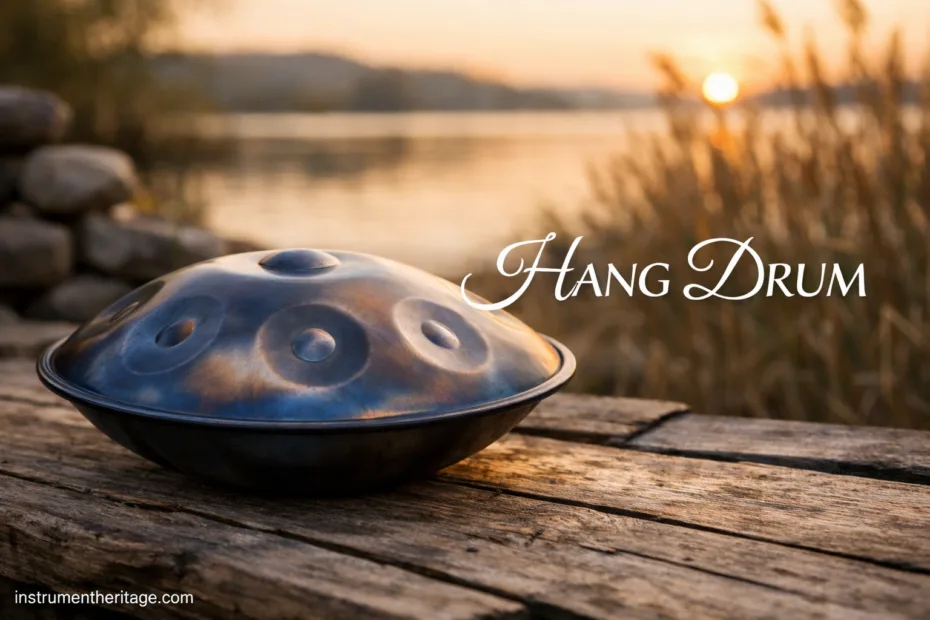
| Instrument Name | Hang (often called Handpan or Pantam) |
| Classification | Idiophone (Struck directly) / Sound Sculpture |
| Place of Origin | Bern, Switzerland |
| Inventors | Felix Rohner and Sabina Schärer (PANArt) |
| Invention Year | 2000 (Presented at Frankfurt Musikmesse in 2001) |
| Primary Material | Nitrided Steel (Gas-nitriding process) or Stainless Steel |
| Tuning System | Just Intonation (often) or Equal Temperament |
| Key Components | The Ding (Top center note), The Gu (Bottom port), Tone Fields |
| Playing Method | Hand, thumb, and finger strikes (No mallets) |
| Acoustic Principle | Helmholtz Resonance (Air cavity resonance) |
Imagine stumbling upon a flying saucer left behind in a forest, but instead of alien technology, it is crafted from raw, heat-treated metal. When you touch it, the sound isn’t metallic or harsh; it is warm, sustaining, and profoundly hypnotic. This is the first encounter most people have with the Hang (or widely known as the handpan). Unlike the violin or the flute, which have had centuries to evolve, this instrument is a mere infant in the timeline of music history. Yet, in just over two decades, it has reshaped how we define percussion, blending rhythm with melody in a way that feels almost magical and intuitive.
This is not just a drum. It is a sound sculpture designed to bridge the gap between physical touch and acoustic vibration. The instrument demands a connection; you cannot simply hit it. You must coax the sound out, treating the steel like a living membrane. Whether you are a seasoned percussionist or someone who has never held an instrument, the allure of this convex steel vessel is undeniable. It speaks a language of vibration and resonance that bypasses the brain and goes straight to the chest.
Explore the Section
The Bern Origin Story: Where Steel Met Clay
The story begins not in a factory, but in a small workshop in Bern, Switzerland. The year was 2000. Felix Rohner and Sabina Schärer, the founders of PANArt Hangbau AG, had spent years researching the tuning of steel pans—the vibrant instruments from Trinidad and Tobago. They were obsessed with the properties of sheet metal and how it could hold a tune. Their breakthrough came when a percussionist brought them a Ghatam (an Indian clay pot drum) and asked for something that played like it but sounded like a steel drum.
The result was the Hang. In the Bernese German dialect, the word “Hang” simply means “Hand”. It was a literal description: a steel instrument made for the hand, not the mallet. This distinction is important. Striking a Hang with a stick can actually alter its tuning or damage the delicate structure of the tone fields. The inventors created a convex shape, welding two half-shells of deep-drawn, nitrided steel sheet together. It was a combination of the Caribbean steel pan and the Indian Ghatam.
Note on Terminology: While the world often calls these “Hang Drums,” the creators firmly avoid the word “Drum.” To them, it is a Sound Sculpture. The term “Handpan” emerged later as a general name when other makers began creating similar instruments, avoiding the trademarked name “Hang.”
For years, obtaining a PANArt Hang was nearly impossible. You could not just buy one online. You had to write a handwritten letter, travel to Switzerland, and be “chosen” to purchase one. This scarcity and mystique fueled a global obsession, birthing a new industry of handpan makers (often called makers) spanning from Russia to the United States.
Anatomy of a Sound Sculpture
Visually, the instrument looks like a UFO. Technically, it is a marvel of acoustic engineering. The top shell is known as the Ding side, and the bottom shell is the Gu side. Understanding these parts changes how you listen to the music.
The Ding and the Tone Fields
The center note, or the Ding, acts as the bass and the anchor. It bubbles outward (convex) in the original models, though some modern variations invert it. Surrounding the Ding are the tone fields—typically seven or eight notes arranged in a circle. Each tone field is not just one note; it is tuned to a fundamental tone plus an octave and a fifth above it. When you strike a note, you aren’t hearing a single frequency; you are hearing a chord structure shimmering within the metal.
The Gu and Helmholtz Resonance
Flip the instrument over, and you find a large hole called the Gu. This is not just for holding the instrument. It functions similarly to the opening of a wine bottle. When you blow across a bottle, it hums. This is Helmholtz resonance Reference✅. In the Hang, the air inside the hollow body resonates at a specific low frequency (usually tuned to match the Ding or a sub-bass interval). Advanced players use their legs or hands to modulate the opening of the Gu, creating wah-wah effects or deep bass pulses.
Nitrided Steel vs. Stainless Steel
Not all metal sounds the same. As the instrument evolved, makers began experimenting with different alloys and heat treatments. Today, the market is generally split between two main material types, each offering a distinct flavor of sound.
Nitrided Steel
This is the classic material used by PANArt. The steel undergoes a gas-nitriding process that hardens the surface and makes it rust-resistant.
Sound Character: Ceramic, dry, and percussive. It has a shorter sustain, which is excellent for fast, rhythmic playing because the notes don’t “muddy” together. It feels earthy and grounded.
Stainless Steel
Stainless steel handpans have exploded in popularity recently. The metal is naturally resistant to rust and softer to the touch.
Sound Character: Long, cathedral-like sustain. The sound is incredibly bright, ethereal, and dreamy. It is perfect for meditation and slow, melodic playing, but can get messy if played too fast.
Choosing between them is a matter of taste. If you want to play fast, percussive beats, nitrided steel is your friend. If you want to play sound baths or yoga sessions, stainless steel will fill the room with lingering vibrations.
The Art of Touch: Hands, Not Hammers
The most common mistake beginners make is hitting the instrument too hard. The metal is under immense tension (compressive stress). Hitting it like a conga or a djembe will “choke” the sound. The technique requires a “hot stone” approach—imagine the surface is burning hot.
- The Tap: You use the bony tip of the finger or the pad of the thumb. You strike and retreat instantly, allowing the metal to vibrate freely.
- The Ghost Note: These are very soft, percussive taps between the tone fields (on the “shoulder” of the instrument). They add a rhythmic texture without producing a melodic tone.
- The Tak: A sharp, high-pitched slap on the side of the instrument, mimicking a snare drum crack.
Because the notes are arranged in a circle (often a zig-zag pattern ascending in pitch), playing scales requires alternating hands. This left-right-left movement creates a dance-like flow that feels very different from the linear layout of a piano or the grid of a guitar.
Scales: Choosing Your Atmosphere
Unlike a piano, a handpan is diatonic or fixed to a specific scale. You cannot change keys (unless you have multiple instruments). This limitation is actually its greatest strength. It prevents you from playing a “wrong” note, making it accessible to non-musicians. The scale you choose dictates the emotional landscape you can explore.
| Scale Name | Emotional Quality | Typical Vibe |
|---|---|---|
| Kurd (Minor) | Mysterious, complete, emotional | The most popular scale. It feels like a journey home. Very versatile. |
| Hijaz | Exotic, tension, Middle Eastern | Sounds like the desert sands. Full of drama and passion. |
| Celtic (Amara) | Hopeful, earthy, ancient | Reminiscent of green fields and folklore. Deeply grounding. |
| Pygmy | Dreamy, floating, dark | Great for trance and meditation. It feels like floating in space. |
When selecting an instrument, listening to the scale is more important than the look. Does the sound make you feel uplifted? Or does it make you feel introspective? Since you will be locked into these notes, the emotional connection must be instant.
Buying and Maintenance: A Reality Check
Owning a handpan is a responsibility. These instruments are sensitive to their environment. Direct sunlight is the enemy; if the metal gets too hot, the tuning can shift temporarily or, in extreme cases, permanently. Never leave a handpan in a hot car.
Rust is another concern, especially for nitrided pans. Owners must develop a ritual of cleaning and oiling. Products like Phoenix Oil, coconut oil, or dedicated handpan waxes are used to create a protective barrier. It becomes a meditative practice in itself—wiping down the instrument after playing, thanking it for the music.
Buying Advice: Be wary of mass-produced instruments sold on generic marketplaces for under $500. A high-quality handpan takes weeks of manual hammering by a skilled tuner. Good instruments typically start around $1,200 to $3,000. Cheap versions often lack sustain, are out of tune, or sound like “buckets.”
The global community of players is tight-knit. Festivals dedicated solely to this instrument, such as Hangout UK or Griasdi in Austria, gather thousands of people. It is a culture of sharing, where jamming is less about showing off technical skill and more about listening and weaving sounds together.
The Future of the Circle
We are seeing rapid evolution. “Mutant” pans now exist with 20+ notes, including bottom notes on the Gu side, allowing for complex harmonies and basslines. Electronics are being integrated to pickup the sound for live electronic music. Yet, despite these advancements, the core appeal remains the primal simplicity of steel and hand.
The Hang and its descendants remind us that in a digital world, we crave physical vibration. It is a vessel that transforms kinetic energy into peace. Whether you play for yourself in a quiet room or for a crowd in a subway station, the result is the same: a moment of suspended time, where the only thing that matters is the fading pulse of the last note struck.
Frequently Asked Questions
Is a Hang Drum the same as a Steel Pan?
No, although they are related. A Steel Pan (from Trinidad) is concave (bowl-shaped), played with mallets, and usually played in a loud band setting. A Hang/Handpan is convex (dome-shaped), played with the hands, and is much quieter and suitable for solo playing.
How often does a handpan need retuning?
With proper care and gentle playing technique, a high-quality handpan can stay in tune for 2 to 5 years. However, playing too hard (heavy-handed hitting) can detune it within months. Retuning must be done by a professional hammer tuner.
Can I learn to play without musical theory knowledge?
Absolutely. Because the instrument is tuned to a fixed scale, there are no “wrong notes.” It is one of the most intuitive instruments in the world, making it perfect for beginners who rely on feeling and rhythm rather than sheet music.
Why are handpans so expensive?
The cost reflects the labor. Shaping the steel and tuning the harmonics is a manual art form that takes years to master. A maker might spend weeks hammering a single shell to get the frequencies perfectly aligned. It cannot be fully automated by machines.
{
“@context”: “https://schema.org”,
“@type”: “FAQPage”,
“mainEntity”: [{
“@type”: “Question”,
“name”: “Is a Hang Drum the same as a Steel Pan?”,
“acceptedAnswer”: {
“@type”: “Answer”,
“text”: “No, although they are related. A Steel Pan is concave, played with mallets. A Hang/Handpan is convex, played with the hands.”
}
},{
“@type”: “Question”,
“name”: “How often does a handpan need retuning?”,
“acceptedAnswer”: {
“@type”: “Answer”,
“text”: “With proper care, every 2 to 5 years. Heavy playing can detune it faster.”
}
},{
“@type”: “Question”,
“name”: “Can I learn to play without musical theory knowledge?”,
“acceptedAnswer”: {
“@type”: “Answer”,
“text”: “Yes. The fixed scale means there are no wrong notes, making it highly intuitive.”
}
},{
“@type”: “Question”,
“name”: “Why are handpans so expensive?”,
“acceptedAnswer”: {
“@type”: “Answer”,
“text”: “It requires skilled manual labor. Tuning harmonics with a hammer is an art form that cannot be automated.”
}
}]
}
