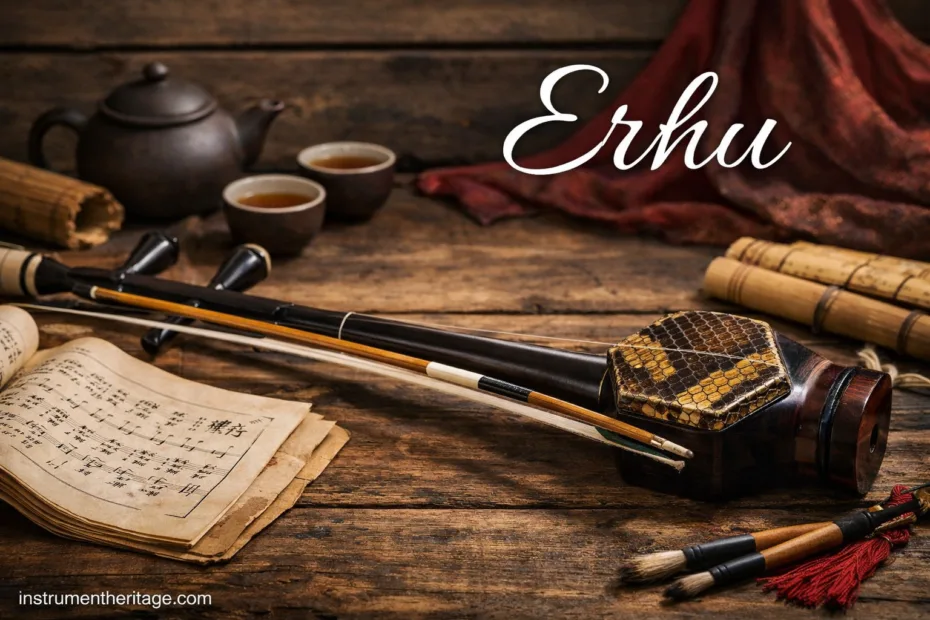
| Aspect | Details | Why it matters in sound and use |
|---|---|---|
| Instrument family | Member of the huqin family; a vertical two-string bowed fiddle with a spike-style neck and a small resonator. | It sits close to other East and Central Asian spike fiddles, yet its voice and setup are very much its own. |
| Usual tuning | Most often tuned in fifths, usually D–A for standard concert use, with alternative tunings used for some repertories and ranges. | The fifth gives the erhu a clear, open frame for melody, shifting, and singing upper lines. |
| Body and front | Small round, hexagonal, or octagonal resonator; the front is traditionally covered with python skin or, in newer reform models, a synthetic membrane. | The membrane gives the attack a focused edge and helps create that tight, vocal, slightly reedy color people remember. |
| Neck and fingerboard | There is no fingerboard. The left hand stops the strings in the air rather than pressing them down to a wooden board. | This changes everything: intonation, vibrato, slides, pressure, and the feeling of touch all become more fluid. |
| Bow relationship | The bow hair passes between the two strings and stays there; it is not normally separated from the instrument during playing. | String crossing feels different from violin-family playing and gives the erhu its own bow logic and phrasing style. |
| Common materials | Hardwoods such as red sandalwood, padauk-style woods, ebony, or other dense timbers; metal strings are now standard on many instruments. | Wood density, membrane quality, and bridge fit shape response, warmth, projection, and upper-register stability. |
| Typical range | About three octaves in standard practice, with a strong middle and upper singing register. | The erhu can sit close to a human vocal line, then climb into a bright, tense, almost crying register without losing focus. |
| Main musical settings | Solo recital, regional opera, silk-and-bamboo ensemble, Chinese orchestra, chamber crossover, film music, and contemporary concert writing. | It is not only a “traditional” instrument. It moves easily between intimate melody and modern stage writing. |
| Closest comparisons | Often compared with the violin, but also better understood beside gaohu, zhonghu, banhu, and older Silk Road bowed instruments. | The violin comparison is useful for orientation, though it misses the erhu’s membrane acoustics, touch, and phrasing habits. |
Erhu can look almost too simple: two strings, a narrow neck, a body small enough to fit in one hand. Then the bow touches the string and that small frame opens up into a voice that feels closer to breath than to carpentry. That is the first surprise. The second is that the erhu is not built like a reduced violin at all. It is a different idea of what a bowed instrument can be—leaner, more direct, less cushioned, and astonishingly flexible when a player shapes pitch, pressure, and vibrato with care.
- Chinese bowed fiddle
- Huqin family
- Two strings
- Membrane resonator
- No fingerboard
- Solo and ensemble use
People often call it the “Chinese violin.” That helps for about five seconds. After that, the shortcut starts to blur the real story. The erhu’s tone production, left-hand feel, body design, and musical habits all point somewhere else. It can sigh, glow, bite, whisper, and bloom, but it does so through a much smaller acoustic engine and with a playing surface that gives the fingers less support and more freedom. That mix is exactly why the instrument feels so alive.
🎼 What makes the erhu sound so human
The first thing many listeners notice is not sadness. It is directness. The note arrives quickly, without the broad cushion a violin body can give, and that quick arrival makes every detail count: the bow’s entry, the grain of the vibrato, the tiny lift at the end of a phrase. A good erhu tone has a center, but it also has a soft halo of friction around it. That halo is part of the charm.
A lot of that color comes from the small resonator and its front membrane. Instead of driving a wooden top in the violin-family way, the bridge feeds energy into a tightly stretched skin. The result is a sound that can feel focused, slightly nasal, and wonderfully speech-like. Not narrow. Focused. It is like the difference between a voice in a small room and a voice in a stone hall. The erhu usually chooses the room.
The instrument also rewards nuance in a very exposed way. A little more bow pressure can bring a rough edge. A touch more speed can brighten the line. Relax the right hand and the note settles into something almost conversational. Push harder and the same pitch can sound urgent, metallic, or openly dramatic. That is why the erhu carries melody so well: it is built for inflection.
- Listen to the start of each note. On erhu, the attack tells you a great deal about the player’s control.
- Listen to the slide into pitch. The instrument loves arriving by motion rather than by a fixed landing.
- Listen to how the upper register changes color. It does not simply get higher; it often gets tighter, more urgent, and more luminous.
- Listen to the spaces between notes. Skilled players shape silence almost like a singer taking breath.
What many descriptions miss
The erhu’s sound is not “expressive” only because of repertory or cultural association. Its acoustics push it that way. The membrane front, slim neck, exposed left-hand contact, and narrow two-string layout all make the instrument highly sensitive to small physical changes. In plain terms, the instrument tells on the player. That honesty is a big part of its emotional force.
🪵 How the instrument is built
The erhu is compact, but it is not crude. Its design is spare in the best sense. The resonator body, often called the qin tong, is usually hexagonal today, though round and octagonal forms are also seen. The neck or shaft rises through the body, and two tuning pegs sit near the top. A small bridge stands on the front membrane. A loop called the qianjin acts like a movable nut and sets the speaking length of the strings. Those few parts do a surprising amount of work.
University documentation on the instrument lays out this modern structure clearly, including the standard parts, the common hardwood body, and the 20th-century regularization of the form.Reference-1✅
The front is the part most people remember. Traditional erhus use python skin stretched across the resonator face. That membrane is not decoration. It is the heart of the response. Thickness, tension, age, and even local climate can change how the instrument speaks. Two erhus built to the same outline can feel quite different if the membrane behaves differently. Players know this well. One instrument opens easily. Another resists, then suddenly blooms. A third stays brilliant but a little dry.
The back of the resonator is usually left open with a decorative lattice or sound window rather than sealed like a violin box. Dense hardwoods are favored for the body and neck because they help keep the structure stable and provide a firm base for a membrane-driven sound. Older instruments and higher-grade workshop instruments often place great value on seasoned wood, clean joinery, and a bridge that meets the skin with the right pressure. Small errors here are audible.
The bow is another quiet marvel. It lives between the strings, not outside them. That means the player does not “cross strings” the way a violinist does. Instead, the right hand changes which side of the bow hair is engaging which string. It feels intimate, almost woven into the instrument. Once you understand that, a lot of erhu phrasing starts to make sense.
Parts worth knowing: qin tong (resonator), qin gan (neck/shaft), qianjin (string loop that sets speaking length), bridge, pegs, and bow. Learn those parts and the instrument stops feeling mysterious very quickly.
🧭 How the erhu took shape
The erhu did not appear all at once as a finished concert instrument. It grew out of the wider huqin family of bowed spike fiddles and absorbed ideas over a long period. Museum records connect the spread of two-string huqin into China with northern and northwestern routes and note their presence during the Yuan period, when Mongol rule helped carry musical tools, habits, and performance ideas across a very large zone.Reference-2✅
That older history matters because the erhu still carries traces of mobility. It is light, portable, and structurally economical. It belongs to a long family line of fiddles that traveled well and adapted easily. Over time, local types multiplied. Opera traditions, regional ensembles, and urban folk music each pulled the family in different directions. Some relatives went higher and sharper. Some went lower and darker. The erhu settled into a middle register that made it unusually flexible.
For much of its earlier life, the erhu was closer to everyday music-making than to elite stage prestige. It accompanied voices, shadowed opera lines, colored ensemble texture, and served working musicians. That grounding stayed with it even after the concert hall embraced it. In the early 20th century, players and composers—most famously Liu Tianhua—helped regularize technique, repertory, and instrument form so the erhu could stand as a solo voice rather than only an accompanying one. That shift was not cosmetic. It changed teaching, notation, composition, and public expectation.
Then came repertory that listeners still use as a doorway into the instrument. Liu Tianhua’s solos opened new technical and lyrical ground. A Bing’s “Erquan Yingyue” gave the erhu one of its best-known emotional signatures, though the piece is far more than a “sad erhu tune.” It shows how the instrument can carry memory, contour, restraint, and pressure all in the same line. From there, the erhu moved into conservatories, orchestras, chamber music, radio, film, and later crossover work without losing its older accent.
✋ Why it feels so different under the fingers
The left hand is where many outsiders misread the erhu. On violin, a finger drops the string onto a fingerboard. On erhu, the finger meets the string without pinning it to a wooden surface. That changes the whole tactile map. Pitch is still exacting—often brutally so—but the route to pitch is more elastic. The finger can lean, roll, slide, and warm the note from within rather than stamp it into place.
University of Iowa program notes describe this setup in a very practical way: the player shapes pitch and color without pressing the string to the neck, and the two strings are normally tuned a fifth apart with the bow placed between them.Reference-3✅
This is why erhu ornament feels less like surface decoration and more like grammar. Slides are not extras. Vibrato is not just shimmer. Portamento, lingering approach notes, gentle pitch bends, and different widths of finger vibrato are part of how the instrument speaks. The line can bend like a reed in wind, then stand upright for a clean, plain tone a moment later. That contrast is one of the erhu’s great gifts.
The right hand has its own special logic. Because the bow hair sits between the strings, the player works with inward and outward bow relationships rather than the more familiar over-the-top crossing pattern of the violin family. Good players make this look effortless. It is not. Smooth bow changes, balanced pressure, and clean string access take serious training, especially when the music asks for rapid ornaments, high positions, or long singing phrases that cannot sag in the middle.
What advanced listeners notice
A mature erhu player can change character without changing note. Bow speed, contact point, finger pressure, and the width of vibrato may alter the line from dry and speech-like to glowing and almost vocalized. That is one reason the instrument works so well in slow melodies and narrative pieces: it can hold a single pitch and keep it alive.
🎭 Where the erhu lives in music
The erhu belongs in several musical homes at once. In regional opera, it may double, answer, or support the voice. In jiangnan sizhu and related chamber traditions, it helps weave a line-based ensemble texture that feels light but never empty. In the modern Chinese orchestra, it often sits in a role that is closer to a leading melodic section, with higher and lower huqin relatives expanding the color around it.
- Solo literature: lyrical pieces, character pieces, rhapsodic concert works, and newer contemporary writing.
- Opera and theatre: vocal support, melodic doubling, and expressive interludes.
- Ensemble music: chamber-like silk-and-bamboo settings and larger Chinese orchestral writing.
- Cross-genre work: film score, jazz-leaning projects, chamber crossover, and collaborations with Western strings or piano.
Its range of use is one reason the erhu never sits still historically. The same instrument that can whisper through an intimate line can also cut through a larger ensemble when needed. Not with violin-style brilliance, but with penetration and contour. It finds the center of a phrase quickly and holds it there.
🔎 Why “Chinese violin” only tells half the story
The comparison with violin is not useless. Both are bowed string instruments capable of singing melody, fine vibrato, and virtuosic passagework. But the similarities stop early. The erhu has two strings, a membrane front, no fingerboard, a vertical playing position, and a permanently threaded bow. Its phrasing logic is different, its tone engine is different, and even its sense of resistance under the hand is different. The violin is a close cousin only from a distance.
| Instrument | Build | Typical voice | Where it often shines |
|---|---|---|---|
| Erhu | Two strings, membrane resonator, no fingerboard, vertical hold, bow hair between strings. | Warm, focused, vocal, often reedy in the best sense; strong lyrical middle register. | Solo melody, opera support, chamber ensemble, Chinese orchestra. |
| Violin | Four strings, wooden top and back, fingerboard, horizontal hold, detached bow. | Broader projection, wider harmonic spread, fast articulation across four strings. | Western art music, chamber music, orchestra, solo repertory. |
| Gaohu | Close huqin relative with a smaller body and higher tessitura. | Brighter, leaner, more incisive than erhu. | Cantonese music and higher leading lines in Chinese ensembles. |
| Zhonghu | Larger, lower-pitched huqin relative built to support inner and lower ranges. | Darker, thicker, more mellow than erhu. | Chinese orchestra inner lines and lower melodic support. |
| Banhu | Two strings, but with a hard front face rather than the typical erhu membrane setup. | Brilliant, bright, sharp-edged, highly projective. | Northern opera styles and lively regional repertories. |
The better comparison is often not erhu versus violin, but erhu within the huqin family. Once you hear gaohu above it, zhonghu below it, and banhu beside it, the erhu’s identity becomes clearer. It sits in a wonderfully balanced zone: neither too piercing nor too heavy, neither too ornamental nor too plain. That middle place is why it became the family’s most widely recognized solo voice.
🛠️ What modern makers are changing
Modern erhu making is not only about copying old workshop habits. It is also about climate stability, consistency, and ensemble use. Natural skin still matters deeply in traditional building, and many players remain attached to its touch and color. At the same time, some orchestral and research-driven builders have experimented with synthetic membranes, altered cavity design, and new methods for balancing volume across registers.
The Hong Kong Chinese Orchestra’s documented Eco-Huqin work is one of the clearest public examples: it describes the use of renewable PET membranes in place of python skin while keeping the traditional playing method and aiming for better stability and orchestral blend.Reference-4✅
That does not mean the old instrument has been replaced. Far from it. What it does mean is that the erhu is still alive as a crafted object. Makers are still asking old questions with new tools: how much brightness is too much, how much stability costs too much personality, and how to preserve the instrument’s grain without making it fragile or unpredictable. Those are good questions. Living instruments should have them.
A practical truth: when players talk about one erhu being “open,” “tight,” “sweet,” or “dry,” they are usually hearing a mix of membrane behavior, wood response, bridge fit, setup, and the player’s own hand. On erhu, build and technique are always in conversation.
❓ FAQ
Common questions about the erhu
Is the erhu really similar to the violin?
Only in a broad sense. Both are bowed string instruments and both can carry a singing melodic line. The erhu, though, has two strings, a membrane front, no fingerboard, a vertical hold, and a bow that sits between the strings. Its touch, tone, and phrasing work on a different physical logic.
Why does the erhu sound so close to a human voice?
Part of it is cultural listening, but much of it is physical. The small resonator, membrane front, exposed left-hand control, and flexible pitch shaping let the player bend and color notes in a very speech-like way. The instrument does not hide those small changes. It magnifies them.
What is the erhu usually made from?
Traditional instruments often use dense hardwood for the neck and body, metal strings in modern setups, and a snakeskin front membrane on the resonator. Some newer reform instruments use synthetic membranes instead, especially in research or orchestral-development settings.
Does the erhu have frets or a fingerboard?
No. That is one of its most important features. The fingers stop the strings without pressing them down to a fingerboard, which makes vibrato, slides, and micro-adjustments of pressure much more fluid.
Is the erhu only used for old or traditional music?
No. It remains rooted in older repertories and opera traditions, but it also appears in Chinese orchestral writing, chamber music, film scoring, crossover work, and new concert music. Its identity is traditional, but its use is not locked in the past.
What makes one erhu better than another?
Not a single factor. Good wood, a responsive membrane, clean workmanship, stable tuning, a well-fitted bridge, and balanced response across registers all matter. Then the player enters the picture. On erhu, a fine setup and a thoughtful hand reveal each other very quickly.
