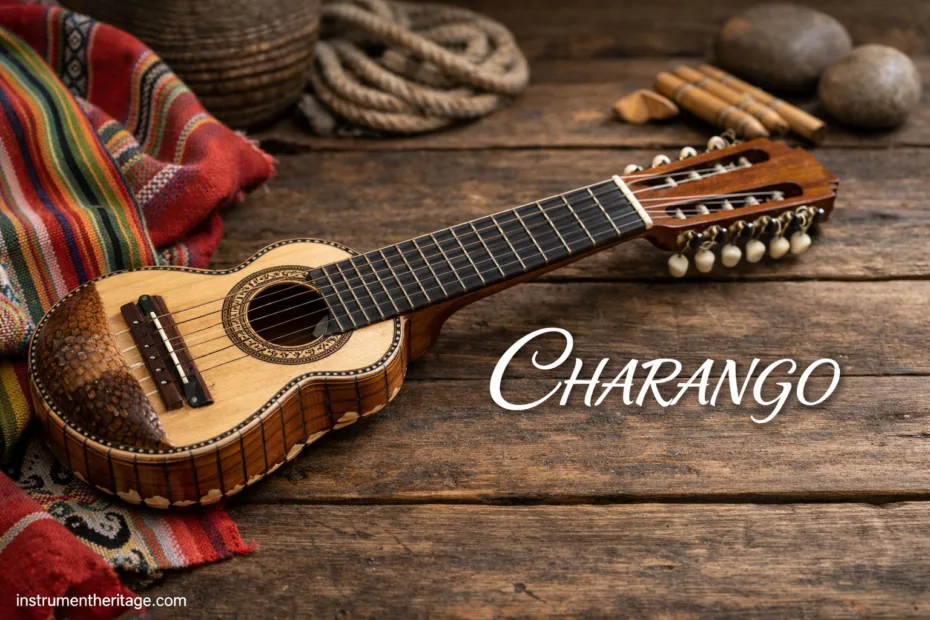
| Aspect | What to notice |
|---|---|
| Instrument family | A small Andean lute with a short scale, frets, and five courses of strings in its standard form. |
| Usual string layout | Most common setup is ten strings in five paired courses. The middle course often carries the lowest pitch, which gives the instrument its famous upside-down feel. |
| Common tuning | G4-G4, C5-C5, E4-E5, A4-A4, E5-E5 in one widespread mestizo setup; it is re-entrant, not a straight low-to-high ladder. |
| Body construction | Older examples may use an armadillo shell back; many modern instruments are fully wooden, often carved with a rounded bowl back or built with a flat guitar-like back. |
| Materials | Common woods include cedar, walnut, jacaranda, naranjillo, and other local hardwoods. String choices change the voice a lot: nylon softens it, metal sharpens it. |
| Scale and feel | Compact in the hands, often around a 35–37 cm scale, with chord shapes that feel close and quick rather than stretched. |
| Sound character | Bright, ringing, fast to speak, and full of sparkle. It can sound almost bell-like in arpeggios and surprisingly percussive in strumming. |
| Main playing styles | Rapid strumming, rhythmic brushing, broken-chord accompaniment, melodic picking, and double-stop lines that let melody and harmony travel together. |
| Musical setting | Heard in huayno, carnaval music, yaraví, courtship songs, village dance music, and many urban folk settings across the Andes. |
| Close relatives | Walaycho, chillador, ronroco, and other regional members of the wider charango family. |
Charango is often introduced as a tiny guitar from the Andes, or as the instrument with the armadillo shell back. Both descriptions are a little too small for what it really is. The charango is a compact, high-voiced lute with its own logic, its own touch, and a sound that seems to throw light rather than weight. It sits close to the chest, answers quickly, and fills a room with a bright metallic shimmer even when the body is small enough to look almost playful.
That first impression can fool you. This is not just a miniature guitar. Its tuning behaves differently. Its body is often carved or arched in ways that change the attack. Its repertory ties it to dance, song, courtship, ritual, and ensemble playing across Andean life. Even the way it is strummed has a pulse of its own. Short instrument. Long story.
- Plucked bowl lute
- Five paired courses
- Re-entrant tuning
- Bright upper register
- Andean folk repertories
- Wood and shell traditions
🎵 What the charango really is
The charango belongs to the family of fretted, plucked lutes. In plain terms, that means a neck, frets, strings, and a resonating body designed for fingers rather than a bow. The standard instrument usually carries ten strings in five courses, and those courses matter more than the raw string count. You do not hear ten separate lines. You hear pairs working together: sometimes in unison, sometimes with an octave split, sometimes like a single shining thread with extra grain in it.
Its proportions are part of the charm. The scale is short, so the left hand can move quickly and compact chord shapes feel natural. The sound box is small, yet the voice cuts through ensemble texture with ease. That contrast is one of the charango’s signatures: small frame, wide presence. It behaves less like a reduced guitar and more like a purpose-built high register engine.
Why it sounds bigger than it looks: the short scale gives a fast response, the paired courses thicken the attack, and the re-entrant tuning stacks bright pitches in a tight range. The result is a voice that seems to glow outward rather than spread downward.
🗺️ History in the Andes
The charango took shape in the Andes after European string instruments entered the region during the colonial period. It is usually linked to local adaptation, not simple copying. Makers and players absorbed ideas from guitar- and vihuela-related instruments, then reshaped them according to local craft habits, available materials, musical needs, and regional taste. In that sense, the charango is not a side note to European history. It is an Andean answer.
Scholars and collections often connect its early development to the northern Andean highlands, with Potosí appearing again and again in origin stories and visual references. What matters most for a listener is this: the charango grew where Indigenous and colonial sound worlds met, and it stayed because it fit the music so well. Smithsonian Folkways describes the charango as one of the popular Andean instruments of colonial origins, while Duke’s collection notes the strong association with the northern Andes and early Potosí traditions. Reference-1✅
A lot of short articles stop there. They give you the birth certificate and move on. Yet the richer part of the story is how the instrument settled into daily musical life. It became useful for sung repertories, dance repertories, personal song, and group music. That practical fit is why it lasted. Instruments survive because hands keep reaching for them.
Not one frozen tradition
The charango never stayed fixed. Body shape, stringing, tuning details, fret counts, woods, and playing style all shift from place to place. Some versions lean toward rustic village use, some toward urban concert craft, some toward accompaniment, some toward melodic picking. That living variation is normal. It is part of the instrument’s identity, not a problem to be corrected.
🪵 Build, wood, shell, and maker’s choices
If you want to understand the charango, start with the back. The rounded back is not only a visual signature. It shapes the way the sound reflects inside the body and how the player feels the instrument against the chest. Traditional examples with an armadillo shell back became famous far beyond the Andes, but wooden charangos are not second-best substitutes. In many cases, they are the more refined lutherie path.
A museum example at The Met lists armadillo shell, wood, and pearloid and measures 62.2 cm in overall length, which gives a useful sense of the instrument’s compact but not toy-like scale. The museum classifies it clearly as a plucked fretted lute. Reference-2✅
One-piece carving and bowl-back thinking
Many fine wooden charangos are carved from a single block for the back and body, then topped with a separate soundboard. That monoblock approach changes the feel of the instrument. The body can be stiff, direct, and quick to answer. Other charangos use bent sides and a flat back, closer in spirit to a small guitar. Those often feel a bit more familiar to players coming from guitar, and they can offer a different balance of warmth and projection.
What materials do to the sound
- Cedar or similar softer tops often give a quicker bloom and a sweeter edge.
- Denser backs and sides can tighten the note and add a glassier ring.
- Nylon strings soften the bite and make the tone rounder.
- Metal strings raise the sting, the sparkle, and the raw village brightness many listeners recognize right away.
Decoration matters too. Rosettes, purfling, fingerboard choices, peghead size, and bridge shape all leave fingerprints on the instrument. Still, the charango’s deepest identity is structural: short scale, paired courses, a compact resonator, and a body built to throw quick light into the air.
🔔 Tuning, touch, and the charango voice
The charango’s sound starts with a trick of architecture. On many string instruments, pitch rises in a straight path across the courses. On the charango, the middle course can hold the lowest pitch. That re-entrant layout changes everything. Chords come out with a chiming top-heavy lift. Arpeggios skip and flash. Even simple strums can feel rhythmically alive because the ear is not hearing a neat bass-to-treble staircase.
Grinnell’s musical instrument collection gives one common tuning as G4-G4, C5-C5, E4-E5, A4-A4, E5-E5, and also notes the contrast between the sharper, high-pitched bite of wire-strung instruments and the more subdued response of nylon-strung ones. That single detail explains a lot of what players mean when they talk about the charango’s spark. Reference-3✅
Strumming is not just accompaniment
With charango, rhythm and tone arrive together. A brushing strum is not merely harmony under a melody. It is part drum, part shimmer, part harmonic field. In village styles, repeated strumming can create a drone-like bed where melody lives on top of a moving surface. In more urban and arranged playing, thumb-and-finger work can pull melody and harmony into parallel motion, almost like weaving two bright threads at once.
That is why the instrument often feels alive even when the musical material is plain. The motion of the right hand matters. The way the paired strings answer matters. The attack is half the sentence.
A useful listening clue: if the charango sounds like a tiny bell choir sitting inside a strummed groove, you are probably hearing the re-entrant layout doing its work.
🌄 Where the charango lives in music
The charango belongs to repertory, not just to organology. It is woven into huayno, carnaval music, yaraví, wedding and courting songs, local dance forms, and mixed ensembles across the Andes. In some settings it supports the voice with a nervous bright pulse. In others it takes the lead, especially when a melody needs to stay agile and airborne.
Smithsonian Folkways notes the charango in courtship and funeral repertories from the Peruvian Andes, which tells you a lot about its expressive range. It can accompany flirtation, procession, memory, movement, and communal marking of time. This is not a one-mood instrument. It can sound festive, tender, restless, intimate, and raw within the same musical culture.
In ensemble settings, it often sits beside quena, siku or zampoña, harp, violin, guitar, and bombo. A Library of Congress record for a Peruvian huayno photograph names the charango among the instruments used to accompany the dance, alongside quena, harp, and violin. Reference-4✅
Why it works so well in ensemble texture
The charango rarely fights for the low end, so it leaves room for drum, harp, guitar, or larger strings. Its job is different. It adds shine, rhythmic bite, and upper-register density. Think of it as the part of the ensemble that catches light on the edge of every phrase. When flute, voice, and charango line up, the blend can feel almost woven rather than layered.
🧭 Charango and its close neighbors
People often compare the charango to a ukulele because of size, or to a mandolin because of paired strings. Both comparisons help a little. Neither gets all the way there. The charango’s tuning logic, Andean repertory, bowl-backed tradition, and strummed rhythmic role make it a different animal.
| Instrument | String setup | Tuning feel | Typical voice | Main difference from charango |
|---|---|---|---|---|
| Charango | 10 strings in 5 courses | Usually re-entrant | Bright, ringing, percussive, high | The reference point: paired courses and Andean rhythmic shimmer. |
| Ukulele | 4 single strings | Often re-entrant, but simpler layout | Rounder, softer, less dense | No paired courses, less choral thickness in the attack. |
| Mandolin | 8 strings in 4 courses | Straight violin-style tuning | Tighter, more pointed, more pick-driven | Built around a different tuning map and a different melodic grammar. |
| Ronroco | Usually larger multi-course relative | Lower and broader | Warmer, deeper, more shadow in the tone | Same family feeling, but a wider chest voice where charango gives the head voice. |
| Chillador | Regional charango-type form | Often charango-related | Brilliant and cutting | Flat-back or steel-strung tendencies can shift the color and response. |
The wider charango family
The standard charango is only one branch. Walaycho runs smaller and brighter. Ronroco steps downward into a fuller register. Regional instruments may change the number of strings, the kind of back, the scale length, or the balance between accompaniment and melody. So when someone says “charango,” they may mean the standard instrument, or they may be speaking more broadly about a family of related Andean lutes.
Three details that matter more than many articles admit
- The bowl back is not just decoration. It changes feel, projection, and identity.
- The tuning is the sound. Re-entrant string order is not a footnote; it is the reason chords flash the way they do.
- The charango is a family, not a single frozen object. Variants are normal, regional, and musically useful.
That is also why the charango keeps pulling builders, players, and listeners back in. It gives a lot with very little wood in your hands. A small body. A fast response. A voice that can laugh, sting, hover, or dance.
FAQ
Is a charango basically a small guitar?
Not really. It shares some ancestry with guitar-related instruments, but its paired courses, short scale, re-entrant tuning, and Andean repertory make it behave very differently. In the hands, it feels compact; in the ear, it feels bright and layered.
Why does the charango sound so bright?
The short scale, high register, paired courses, and re-entrant tuning all push the sound toward shimmer and fast attack. String material matters too. Metal strings make that edge even sharper.
Are all charangos made with an armadillo shell?
No. Many modern charangos are fully wooden, and many makers prefer wood for durability, consistency, and tonal control. The rounded back remains part of the visual language even when no shell is used.
What music is the charango most associated with?
It is strongly linked with Andean repertories such as huayno, carnaval music, yaraví, local dance music, and sung traditions tied to social and ceremonial life.
What is the difference between a charango and a ronroco?
The ronroco is a larger, lower-pitched relative within the same family. If the standard charango feels like the bright upper voice, the ronroco feels like the darker, broader companion under it.
