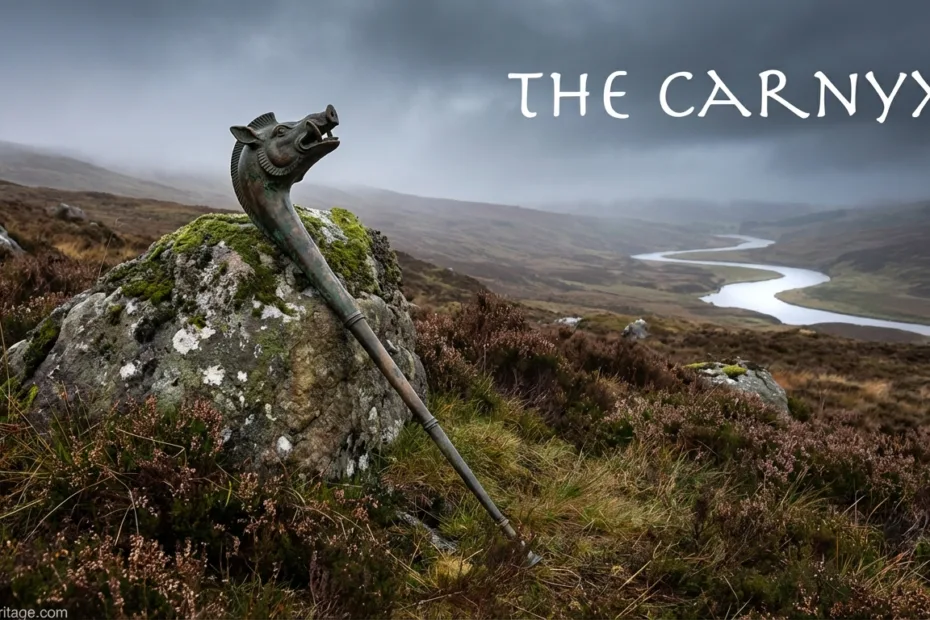
Imagine a misty morning in 200 BC. You are standing on a damp field in Gaul, waiting for a battle that will likely decide your fate. Suddenly, a sound tears through the fog—a shrieking, metallic scream that sounds like an angry beast rising from the earth. You look up and see a row of tall, bronze tubes held vertically, topped with the gaping jaws of wild boars. This isn’t a nightmare; it’s the Carnyx. This ancient Celtic instrument wasn’t just about making music; it was a psychological weapon designed to freeze the blood of enemies and rally the spirits of warriors.
The Carnyx is one of the most visually and sonically unique instruments of the European Iron Age. Unlike the compact horns of other cultures, this was a giant, towering typically over two meters high (about six feet), constructed from forged bronze sheets. It is a masterpiece of ancient metallurgy and acoustics, bridging the gap between art, warfare, and ritual.
| Classification | Wind / Aerophone (Labrosones) |
| Primary Era | c. 300 BC – AD 200 (Iron Age) |
| Material | Beaten Bronze, Brass, occasionally wood |
| Origin Region | Western & Central Europe (Celtic territories) |
| Distinctive Feature | Stylized animal head bell (Boar, Serpent, Wolf) |
Anatomy of the Beast: More Than Just a Horn
When you look at a Carnyx, you aren’t looking at a simple trumpet. You are looking at a complex assembly of metal engineering. The instrument is essentially a long tube, but unlike the Roman cornu or tuba which curved around the player’s body or stayed straight, the Carnyx was designed to be held vertically. This verticality was strategic; it allowed the sound to project over the heads of the gathered army, carrying commands—or terror—across vast distances.
The most iconic feature is the bell. Instead of a flared cone like modern trumpets, the Carnyx ends in an elaborate animal head. The Wild Boar is the most common motif, a sacred animal to the Celts representing courage and ferocity. However, variations exist.
🎨 Visual Characteristics
- The Head: Often featured a movable jaw or tongue, mounted on a spring, which would clatter when the instrument was played, adding a percussive rattle to the tone.
- The Eyes: Some discoveries suggest the eyes were inlaid with glass or semi-precious stones, making the beast look alive in the sunlight.
- The Tube: Constructed from multiple sections of bronze sheet, hammered incredibly thin and riveted together with microscopic precision.
The craftsmanship required to make a Carnyx was elite. We are talking about bronze sheets hammered to a thickness of less than 1 millimeter in some places. The joinery involved telescopic sections that fit together perfectly. This implies that the Celtic smiths possessed a level of specialized knowledge in acoustic physics that we often underestimate.
Acoustics: The Voice of the Carnyx
So, what does it actually sound like? Thanks to modern reconstructions, we don’t have to guess. The sound is not purely musical in the melodic sense; it is timbral and textural. It produces a rich, brassy drone that can shift into a high-pitched scream.
The Greek historian Polybius described the noise of the Celtic host, mentioning specifically the “innumerable horns and trumpets” making such a din that “not only the trumpets and the soldiers but all the country round… seemed to be raising its voice.”
The “trick” of the Carnyx is the movable tongue found in some examples (like the Deskford Carnyx). When the player blows hard, the air pressure causes the bronze tongue inside the boar’s mouth to vibrate or flap. This doesn’t just look cool; it modifies the sound wave, creating a warbling, distortion effect. Imagine a trombone mixed with the growl of a large animal.
Digging Up the Past: Key Archaeological Finds
For centuries, the Carnyx was known mostly through images on Roman coins (like those of Caesar’s campaigns) or the famous Gundestrup Cauldron. Physical evidence was fragmented until relatively recently. These discoveries changed everything we knew about Celtic music.
1. The Deskford Carnyx (Scotland)
Found in a peat bog in Banffshire around 1816, this is perhaps the most famous example. It is a brass-like alloy head of a wild boar. The craftsmanship is stunning, but for a long time, we didn’t know what the rest of it looked like. It survived because the bog preserved the metal, preventing total oxidation. It is currently housed in the National Museums Scotland.Reference✅
2. The Tintignac Hoard (France)
In 2004, archaeologists in the Corrèze region of France hit the jackpot. They discovered a ritual pit containing seven carnyces. This was a monumental find. Before Tintignac, we had to guess the tube’s shape. These instruments were found intentionally broken (ritual decommissioning) but were complete enough to show exactly how the straight and curved parts connected. One featured a boar’s head, while another looked more like a serpent.
- 📍 Why Tintignac Matters
- The Tintignac discovery confirmed that the Carnyx had a straight vertical tube section leading into the curved bell, standing much taller than previous estimates.
War, Ritual, and Liminal Spaces
It is easy to categorize the Carnyx solely as an instrument of war, but that simplifies Celtic society too much. While it certainly had a martial function—signaling troop movements and intimidating Romans—it was deeply spiritual.
The Celts did not view war and religion as separate spheres. The battlefield was a sacred space where the boundary between life and death thinned. The Carnyx, with its animal imagery, likely served as a conduit to the Otherworld. The sound was meant to summon spirits or amplify the warrior’s “fervor” (a state of battle rage).
Furthermore, the context of the finds (in bogs and ritual pits) suggests these instruments were ritually placed. You don’t just throw away a high-value bronze masterpiece. You offer it to the gods. The destruction of the Tintignac carnyces suggests a ritual “sacrifice” of the object, perhaps to release its spirit or ensure it couldn’t be used by enemies.
The Revival: Bringing the Boar Back to Life
Today, the Carnyx is no longer silent. Thanks to the work of musicologists and craftsmen, accurate replicas exist. The musician John Kenny became the first person in modern history to play a reconstructed Carnyx. Working with the National Museums Scotland, he developed playing techniques based on the physics of the instrument.
Kenny’s performances revealed that the instrument is capable of subtle musicality, not just noise. It can produce ghost tones, multiphonics (singing while playing), and rhythmic pulses that sound incredibly modern, almost akin to avant-garde jazz or ambient drone music.
Frequently Asked Questions
Common Questions About the Carnyx
Is the Carnyx hard to play?
Yes, it requires great lung power and lip control. Unlike modern brass instruments with valves, the player must rely entirely on their embouchure (lip tension) and air pressure to change notes within the harmonic series.
Why does the Carnyx have a boar’s head?
The wild boar was a potent symbol in Celtic culture, representing strength, fearlessness, and combat prowess. Using the boar’s image likely aimed to channel these attributes and intimidate enemies visually and spiritually.
Did the Romans use the Carnyx?
The Romans did not use the Carnyx themselves; they used the Cornu, Tuba, and Lituus. However, the Romans were fascinated by the Carnyx and frequently depicted it on coins and monuments (like Trajan’s Column) as a symbol of their Gallic victories.
How was the Carnyx made?
It was primarily made from beaten bronze sheets. Craftsmen would hammer the metal into thin sheets, roll them into tubes, and rivet them together. The head was often made from multiple hammered pieces joined with incredible skill.
