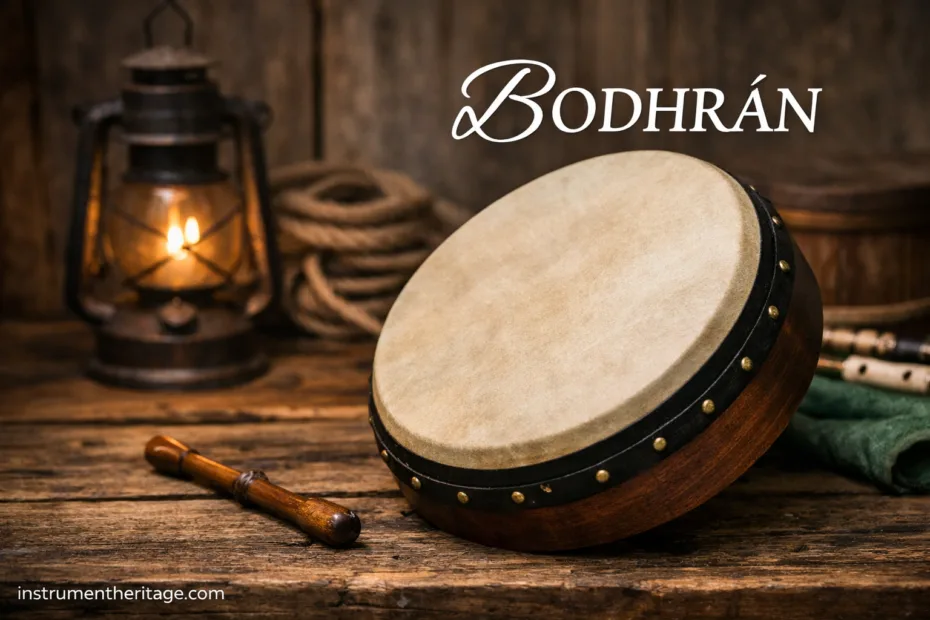
| Instrument Name | Bodhrán (pronounced Bow-rawn) |
|---|---|
| Classification | Membranophone, Frame Drum |
| Place of Origin | Ireland 🇮🇪 |
| Traditional Materials | Cured Goat Skin (head), Ash or Birch Wood (rim) |
| Standard Diameter | 35cm to 45cm (14 to 18 inches) |
| Standard Depth | 9cm to 15cm (3.5 to 6 inches) |
| Beater Name | Tipper, Beater, or Cipín |
| Playing Technique | Kerry Style (Two-ended), Top-End Style, Hand Style |
| Iconic Players | Peadar Mercier, Johnny “Ringo” McDonagh, John Joe Kelly, Eamon Murray |
When you step into a dimly lit pub in Galway or Clare, before you even see the musicians, you feel it. That low, resonant thud that seems to align with your own pulse. This isn’t just a drum; it is the heartbeat of Irish tradition. The Bodhrán might look simple—a circle of wood and a stretch of goat skin—but it holds a rhythmic complexity that rivals instruments twice its size. For decades, this frame drum was misunderstood, often relegated to the background or treated as a noisemaker. Today, however, it stands as a sophisticated percussion instrument capable of incredible tonal variation, from thunderous bass lines to whispering, melodic taps.
It acts as the engine room of a traditional session. While the fiddle and flute weave intricate melodies, the bodhrán provides the rhythm and depth. It’s a shapeshifter. In the hands of a master, it sounds like a jazz drum kit, a tabla, or even a bass guitar. Understanding this instrument requires us to look beyond the surface and explore the physics, the history, and the pure magic that happens when wood, skin, and bone collide.
Explore the Bodhrán
The Mysterious Origins: Ancient or Accidental?
There is a massive debate in the musicology world regarding exactly how old the bodhrán actually is. If you ask a romantic, they will tell you it was the war drum of the ancient Celts, thundering across the hills to scare off invaders. It’s a great story. But the reality is likely much more agricultural and humble. Most evidence suggests that the bodhrán, in its current musical form, is a relatively young instrument.
Until the mid-19th century, what we now call a drum was likely a winnowing tray used on farms. Farmers would stretch a skin over a wooden frame to separate chaff from grain or to carry peat turf. On festive occasions like St. Stephen’s Day, the “Wren Boys” (musicians and performers) would take these farm tools and beat on them for rhythm. It was a poor man’s tambourine, lacking the jingles (zils) found on frame drums in Spain or the Middle East.
The Seán Ó Riada Revolution
The turning point arrived in the 1960s. A composer named Seán Ó Riada, playing with his group Ceoltóirí Chualann (which later evolved into The Chieftains), decided to bring the bodhrán onto the formal stage. He took it out of the kitchen and into the concert hall. Before this, the piano was often the rhythmic accompaniment in ceilidh bands. Ó Riada stripped that back, favoring the native primal sound of the goat skin drum.
This was the Big Bang for the instrument. Suddenly, makers began refining the construction specifically for sound, not for carrying grain. The rims got deeper, the skins were treated with more care, and the playing styles began to evolve from a simple steady beat to complex syncopation Reference✅.
Anatomy: More Than Just Wood and Skin
To the untrained eye, it’s a circle. To a musician, it is a complex combination of acoustics. The construction of a high-quality bodhrán is an art form that balances tension, resonance, and ergonomics. Let’s break down the key components that make the sound possible.
🪵 The Shell (Rim)
The frame is usually made from Ash, Birch, or Oak.
- Depth Matters: Modern drums are deeper (4-6 inches) than the old shallow trays. A deeper rim allows for a bassier, rounder tone because more air is trapped and compressed inside the shell.
- Lamination: High-end drums often use laminated wood (layers glued together). This is incredibly strong and stiff, which ensures the drum stays perfectly round. If a drum goes “out of round” (becomes oval), you can never tune it properly.
- The Cutaway: You might see a dip or a “cutout” in the rim. This is purely ergonomic, allowing the player to hold the drum closer to their chest without the wood digging into their ribs.
The Crossbar Debate
Traditionally, bodhráns had a cross-shaped brace inside the back. This served two purposes: structural integrity (to stop the rim from collapsing under skin tension) and a handle for the player. However, in the modern era, the crossbar is controversial.
Why remove it? Modern players use their left hand (the hand inside the drum) to press against the skin to change the pitch. A static wooden crossbar blocks the hand from moving freely across the entire surface. Therefore, most professional drums now have a simple “T-bar” or a single bar, or are completely open-backed to allow full freedom of movement for tonal bending.
The Skin: The Soul of the Sound
This is where the magic happens. The membrane is traditionally Goat Skin. Why goat? Because goat skin has a unique fiber structure that is tight yet flexible, allowing for a haunting sustain and a sharp attack. Cow skin is too thick; sheep skin is too greasy and weak. Goat is the Goldilocks material.
- The “Spine” Line
- If you look at a traditional skin, you might see a darker line running down the center. This is the goat’s spine. Historically, this was prized, but modern makers often avoid it because the skin thickness varies too much there. They prefer the flank areas for consistent tone.
- Taping the Edge
- You will see black electrical tape around the edge of the skin on 99% of professional drums. This isn’t a repair job! It is an acoustic dampener. It stops the high-pitched “overtones” or “ringing” at the edge of the drum, focusing the sound into a warm, punchy bass note.
The Weather Problem: Goat skin is hygroscopic. It breathes. If you play in a damp Irish pub, the skin absorbs moisture, gets loose, and sounds like a wet cardboard box. If you go into a dry, heated room, it tightens up and sounds like a high-pitched bongo. This unpredictability led to the invention of tunable mechanics.
Modern bodhráns have tuning screws (cams or Allen keys) hidden inside the rim. This allows the player to push a metal ring against the skin, tightening or loosening it to match the room’s humidity Reference✅.
The Tipper: Not Just a Stick
You don’t play this with your hand (usually) or a standard drumstick. You use a Tipper, also known as a cipín or beater. The evolution of the beater has changed the sound of Irish music entirely.
- The Knobbeater: A heavy stick with weighted ends. It creates a thumping, heavy bass sound. Great for old-school traditional styles.
- The Hot Rod: Made of many thin dowels of wood bound together. It produces a softer, “clicky” sound, similar to jazz brushes. It’s perfect for not drowning out quieter instruments like the harp.
- The Brush: Literally a nylon or wire brush. Used for soft, atmospheric playing or simulating the “shhh” sound of a snare drum.
- Hardwood vs. Snakewood: The density of the wood changes the attack. Snakewood or Ebony tippers are heavy and fast, allowing for rapid-fire triplets.
Playing Techniques: From Kerry to Top-End
The playing style is what separates the novices from the pros. The wrist action is often compared to turning a doorknob or shaking water off your hand. It’s a double-ended oscillation.
1. The Kerry Style (Traditional)
This is the older style. The player uses both ends of the stick. The bottom of the stick hits the downbeat, and the top end hits the upbeat in a rolling motion. It is rhythmic and driving, often focusing on the lower third of the drum. It’s heavy, trance-like, and perfect for supporting a Polka or Slide.
2. Top-End Style (Modern)
Popularized by legends like John Joe Kelly and Eamon Murray. The playing happens mostly at the top of the drum skin. The stick is held differently, allowing for incredible speed and melody.
Why Top-End? It allows the left hand (behind the skin) to access the full range of tones. By pressing the heel of the hand or fingers against the skin, the player can change the pitch in real-time, effectively playing bass lines and melodies that mimic the tune being played by the fiddler.
The Synthetic Revolution
While purists love goat skin, a new challenger has appeared: Synthetic Heads. Brands like REMO or specialized makers offer synthetic skins that look and feel like animal skin but are immune to weather.
Imagine flying from a humid Dublin to a dry Las Vegas for a gig. A goat skin drum would need serious retuning and care. A synthetic drum will sound exactly the same in both places. While some argue they lack the “complex grain” sound of a real goat, the technology is getting frighteningly close. They are clearer, punchier, and maintenance-free.
The Etiquette of the Session
We cannot talk about the bodhrán without mentioning the “Session Etiquette.” Because the drum occupies the same sonic frequency as the human voice and the lower guitar strings, it is very easy to be overpowering.
Caring for the Heartbeat
If you own a natural skin drum, you are essentially looking after a living thing. It needs moisture. If the skin dries out too much, it can become brittle and even tear under tension.
- Hydration: Some players rub a tiny amount of water on the back of the skin before playing to drop the pitch.
- Dubbin/Lanolin: Occasionally, the skin needs conditioning with a leather treatment like Dubbin to keep it flexible.
- Relaxing: Always tune the drum down (loosen the screws) when you are finished playing. Leaving it under high tension when not in use kills the elasticity of the skin over time.
The bodhrán has traveled a long way from the farmyard chaff tray to the global stage. It is a symbol of the Irish spirit—taking something simple and practical and transforming it into art through rhythm, passion, and community Reference✅.
Frequently Asked Questions
Is the Bodhrán difficult to learn for beginners?
It has a “low barrier to entry but a high ceiling.” You can learn the basic “Kerry Polka” beat in an hour. However, mastering the tonal variations, the left-hand pitch bending, and the rapid-fire triplets of the modern style takes years of dedicated practice.
Why do players put tape on the drum skin?
The black tape around the rim is used to dampen unwanted overtones. Without it, the drum can ring too much and sound harsh. The tape focuses the sound, making it deeper, warmer, and more defined, which is preferred in modern Irish music.
What is the difference between a single-bar and cross-bar Bodhrán?
A traditional cross-bar (X shape) restricts your hand from touching the back of the skin. A single-bar or T-bar allows the player to move their hand freely against the skin to change pitch and tone, which is essential for modern playing styles.
Can vegans play the Bodhrán?
Absolutely. While traditional drums use goat skin, high-quality synthetic skins (like those made by Remo) are widely available. These synthetic drums are not only vegan-friendly but also hold their tuning better in changing weather conditions.
