| Aspect | Detail |
|---|---|
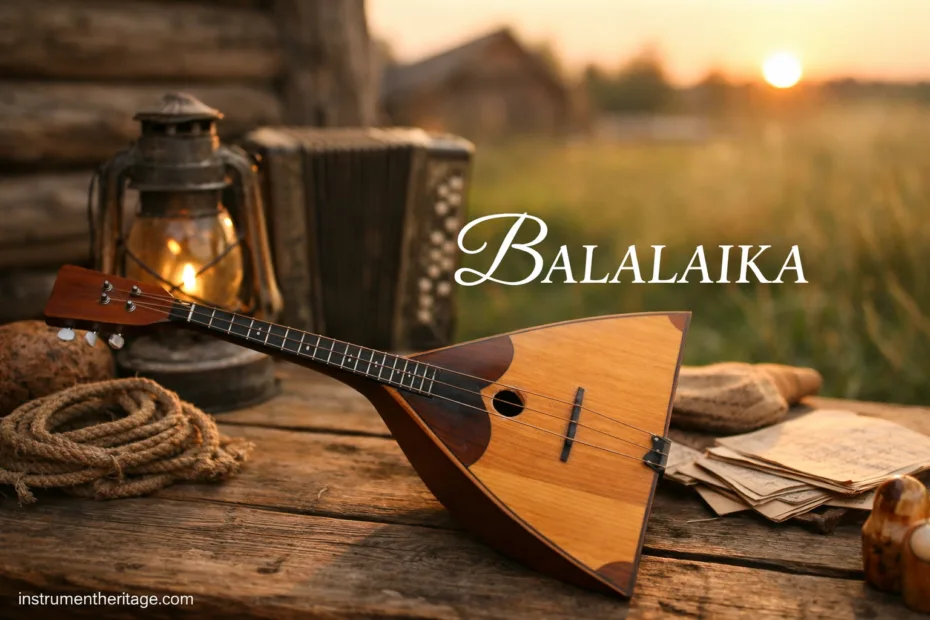
| Instrument family | Plucked, fretted lute-family instrument with a triangular wooden body. |
| Usual string plan | Three strings; on the prima, the familiar concert setup is usually E–E–A. |
| Recognizable build | Flat back, fretted neck, small round sound hole, light top, and a voice that speaks with fast attack. |
| Main sizes | Piccolo, prima, secunda, alto, bass, contrabass. |
| Material logic | Light, responsive top wood paired with harder body and neck woods to balance clarity, strength, and projection. |
| Historic turning point | Late 19th-century standardization turned a village instrument into a concert and orchestral family. |
| Sound character | Bright, dry, woody, rhythmically alert; less lingering bloom than a guitar, more bite at the front of the note. |
| Usual musical jobs | Dance pulse, chordal sparkle, tremolo melody, inner harmony, and deep bass foundation in ensemble playing. |
- Three-string design
- Triangular body
- Village roots
- Concert instrument
- Orchestral family
- Handcrafted voice
The balalaika looks almost too simple at first: three strings, a flat triangular body, a narrow neck, not much ornament unless a maker chooses to add it. Then you hear a good one. The voice is bright, dry, woody, and quick off the line. It does not hang in the air like a classical guitar. It flashes, speaks, and moves on. That fast response is part of its identity. It is also why the instrument works so well in dance music, song accompaniment, solo tremolo lines, and the layered texture of a balalaika ensemble.
Plenty of short introductions stop at the triangle and the folklore. That misses the real story. The balalaika is a clever piece of instrument design, a family rather than a single model, and a meeting point between everyday music-making and highly disciplined craft. To understand it, you have to look at shape, materials, tuning, right-hand attack, and the late 19th-century push that gave it a stable concert form.
🪕 Why the shape matters
The triangle is not just visual flair. It changes how the instrument is built and how it answers the hand. A flat back is easier to make than a carved bowl, the body can be assembled from straight or gently angled pieces, and the instrument stays light enough to react quickly. That lightness is a big part of the sound. Strike the string and the note starts fast. You get a clean edge, not a slow swell.
The balalaika’s face is also doing more work than people sometimes notice. The bridge pushes energy into a relatively light top, and the small round sound hole does not turn the voice soft and airy; it helps keep the response focused. The result is a tone with definition. Even when a player uses tremolo to stretch a phrase, you still hear the grain of each attack underneath.
A well-made balalaika often feels a little like a hand tool that has been refined for generations. Nothing looks excessive. Every angle has a job.
This is one reason the instrument sits so naturally in rhythm-heavy music. Notes do not smear into one another. They line up. A fast strum on a good prima can sound almost like carved wood clicking into place, while a bigger bass or contrabass gives a broad pulse that is short enough to stay tidy inside an ensemble.
📜 How the balalaika took its modern form
Most standard reference works place the balalaika in recognizable form in the 18th century and connect it to the wider long-necked lute family associated with the domra or dombra. They also treat it not as one fixed object but as a family that later expanded from small treble instruments to large bass models. Reference-1✅
Its earlier life was close to ordinary social music: songs, dances, gatherings, accompaniment, a practical instrument rather than a salon luxury. The turning point came in the late 19th century, when Vasily Andreyev and the craftsman Franz Paserbsky pushed the balalaika toward a concert identity. The Saint Petersburg Encyclopaedia records a 12-fret chromatic balalaika in 1886, an amateur balalaika circle in 1887, and public success in St. Petersburg by March 1888. That sequence matters. It marks the moment when a local folk instrument began to act like an organized instrumental system. Reference-2✅
After that, the balalaika stopped being only a single village voice. It became a set of matched voices. Small instruments handled melody and chords. Middle sizes filled harmony. Large ones supplied bass weight. That orchestral way of thinking is one of the reasons the balalaika still feels distinct today. It was not merely preserved. It was recomposed as a family.
Museum collections help keep this history grounded. A 19th-century Russian balalaika in The Metropolitan Museum of Art is cataloged as a wooden, fretted, plucked chordophone of the lute family, which is a useful reminder that the instrument belongs to material history as much as performance history. Reference-3✅
🎵 What the balalaika actually sounds like
If a guitar can spread tone like a brush across paper, the balalaika is closer to a firm pencil line. The note begins with a clear edge. The body gives it wood and color. Then it lets go. That does not make the instrument thin. It makes it articulate. The balalaika is built for shape in time as much as shape in pitch.
- Short sustain: the note does not linger for long, which keeps rhythm crisp and dance patterns readable.
- Fast attack: the instrument responds quickly to the hand, so strums and repeated notes feel lively instead of heavy.
- Open-string flavor: the tuning encourages ringing shapes that mix melody with drone-like resonance.
- Tremolo as a color: players can lengthen a phrase by rapidly repeating a note, creating the feeling of sustain without changing the instrument’s basic character.
Duke University’s musical instrument collection gives the standard modern summary clearly: six sizes, three strings, and a usual pattern in which two strings share a pitch while the third sits a fourth higher. It also notes the familiar prima tuning of E–E–A and the use of a leather plectrum on metal-strung or large instruments. Reference-4✅
That tuning does more than place notes. It shapes the feel of the repertoire. Two strings sharing a pitch make repeated patterns and ringing figures feel natural under the fingers. The sound can be sparkling on top, but it also has a raw, almost spoken quality. On a fine instrument, especially one with a responsive top and clean fretwork, the tone is not harsh at all. It is pointed, warm at the center, and very honest about the player’s touch.
🎻 The balalaika family
One of the easiest ways to misunderstand the balalaika is to imagine only the small solo model. The family layout is a big part of the instrument’s identity. Once you hear several sizes together, the design logic becomes obvious.
| Size | Usual job | Playing feel |
|---|---|---|
| Piccolo | Rare, very high voice for special color | Bright and agile, more coloristic than central |
| Prima | Melody, chords, tremolo passages, solo work | Most familiar feel; quick, nimble, direct |
| Secunda | Inner harmony, rhythmic drive, chord support | Less flashy than the prima, but essential for texture |
| Alto | Middle register glue between treble and bass | Rounder body to the sound, still clearly percussive |
| Bass | Low line, pulse, harmonic grounding | Played with more weight; note starts broad and firm |
| Contrabass | Deep foundation in large ensembles | Floor-supported instrument with a commanding, dry thump |
That spread of sizes helps explain why balalaika orchestras never sound like a novelty act when they are done well. The small instruments do not have to fake bass, and the large instruments do not have to fake brilliance. Each model stays in a range where its wooden attack makes musical sense.
The prima may be the public face of the balalaika, but the family sound is the fuller story. Once middle and low instruments enter, the triangle stops looking like a curiosity and starts sounding like architecture.
🪵 Materials, joinery, and setup
Like many plucked instruments, the balalaika lives in a careful balance between lightness and control. Too heavy, and it loses snap. Too lightly built, and the tone can turn papery or unstable. Makers solve that balance through wood choice, top thickness, neck angle, fretwork, and bridge setup.
Body and top
On many concert instruments, makers choose a light softwood top and pair it with harder woods for the neck and body. That is a familiar luthier’s recipe for a reason: the top needs to move, while the rest of the instrument needs to stay stable. A good balalaika top should feel responsive, not floppy. The back and sides should support the note, not choke it.
Strings, frets, and bridge
String choice changes the personality quickly. Synthetic or gut-style setups can sound softer and rounder. Metal strings bring more edge and projection. Frets need to be cleanly dressed because the balalaika’s clear attack makes rough fret ends and poor leveling easy to hear. The bridge matters just as much. A small setup change can turn a lively instrument into a stubborn one.
A handmade balalaika also rewards close inspection. Look at the seam work. Look at how the fingerboard meets the neck. Check whether notes die suddenly in one area, whether open strings ring evenly, whether the action invites speed without buzzing all over the board. These are not fussy collector details. They are the difference between an instrument that feels alive and one that only looks the part.
- Clean fret edges make a bigger difference than many beginners expect.
- Even response across the strings matters more than sheer loudness.
- Neck angle and bridge height shape both comfort and tonal bite.
- Body weight should support projection without making the instrument sluggish.
🎼 Playing style and musical use
The balalaika rewards a right hand that understands timing. On the smaller instruments, players often use finger strokes, fast repeated tremolo, crisp chord patterns, and short melodic cells that lean on open strings. On the large bass models, the touch becomes broader and more physical. You are not trying to imitate a bowed bass. You are building a rhythmic floor with a distinctly plucked, wooden edge.
That is why the balalaika can shift between roles so naturally. In one setting it is the sparkle on top. In another it is a pulse instrument. In another it carries melody with a slightly grainy singing line. That flexibility is easy to miss if you only know the stereotype of a fast, bright strummer. A mature balalaika tradition includes lyric playing, ensemble discipline, arranged repertoire, and a great deal of craft in how notes are released, not just how they begin.
- Tremolo gives lines length without asking the instrument to become something it is not.
- Rhythmic strumming keeps dance patterns clear and springy.
- Broken chords and arpeggios let the tuning speak in a natural way.
- Ensemble doubling gives the family sound its layered, almost woven texture.
It also sits well beside related folk and art-music instruments. In ensemble settings, the balalaika does not need to dominate to be heard. Its attack helps it find space. That may be the most practical thing to understand about its sound: it is built to place notes cleanly in shared musical space.
🔍 Balalaika beside related instruments
The balalaika is often introduced through comparison, and that is useful as long as the comparison stays honest. It is not just a triangular guitar. It is not just a rustic mandolin. Its closest conversation is with nearby fretted lutes, especially the domra, but its musical behavior is its own.
| Instrument | Body idea | String layout | Usual feel in the ear | Typical musical strength |
|---|---|---|---|---|
| Balalaika | Triangular, flat-backed | Usually 3 strings | Bright, dry, woody, quick release | Rhythm, tremolo melody, ensemble layering |
| Domra | Round body | Usually 3 or 4 strings | Rounder, more sustained, more directly melodic | Single-line melody and agile passagework |
| Mandolin | Bowl or flat body depending type | Courses of doubled strings | Metallic shimmer, sharper ring | Tremolo, pick articulation, folk and classical crossover |
| Guitar | Waisted flat body | Usually 6 strings | Longer sustain, fuller chord bloom | Harmony, accompaniment, broad solo repertoire |
If you come from guitar, the first surprise is usually the shorter afterglow of the note. If you come from mandolin, the surprise is often the less metallic, more woody center of the tone. If you come from domra, you may notice that the balalaika invites more chordal and rhythmic thinking. It asks the hand to speak in angles, not curves. Short phrase. Big difference.
❓ FAQ
Is a balalaika always a three-string instrument?
The modern balalaika is usually understood as a three-string instrument, especially in its standard concert form. Older folk practice was not always uniform, but the three-string design is the form most listeners and players recognize today.
Why is the balalaika triangular?
The triangular body is part of both its look and its function. It helps keep the instrument light, practical to build, and quick in response. That light response is one reason the balalaika has such a crisp, articulate attack.
Which balalaika is the most common?
The prima is the best-known model. It handles melody, chords, tremolo, and most solo playing, so it is the version many people picture when they hear the word balalaika.
What makes the balalaika sound different from a guitar?
The balalaika usually has fewer strings, a lighter and smaller body, and a much faster release after the note begins. A guitar tends to bloom and linger. A balalaika tends to speak, sparkle, and step aside.
What woods are often used on balalaikas?
Makers often combine a light top with harder woods for the body and neck. The exact recipe varies, but the goal stays the same: enough flexibility for response, enough stiffness for stable pitch and a focused tone.
How is the balalaika different from the domra?
The domra usually has a round body and is often more directly melody-centered in feel. The balalaika, with its triangular body and usual three-string setup, leans more naturally into a mix of rhythm, chordal color, and tremolo-based melody.
